Hempcrete Market Size, Share Demand Report By Product Type (Hempcrete Blocks, Hempcrete Panels, Cast-in-place Hempcrete, Precast Hempcrete Materials), By Application (Residential Construction, Commercial Construction, Renovation and Retrofitting, Insulation and Wall Systems), By End-Use (New Construction Projects, Green Building Projects, Infrastructure Development, Eco-friendly Housing) By Region & Segment Forecasts, 2025–2034
USD 3950
Market Overview
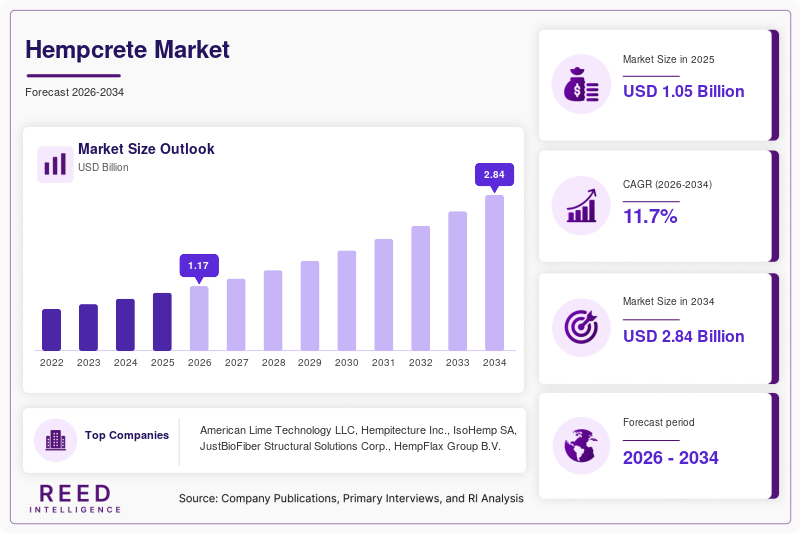
The global Hempcrete Market size was valued at USD 1.05 billion in 2025 and is projected to reach USD 2.85 billion by 2034, expanding at a CAGR of 11.7% during the forecast period (2025–2034). The market is witnessing steady growth due to the rising adoption of sustainable construction materials and increasing awareness regarding carbon-neutral building solutions. Hempcrete, a bio-composite material made from hemp hurds and lime, is gaining attention as an eco-friendly alternative to conventional construction materials.
A key global factor supporting the growth of the Hempcrete Market is the increasing focus on reducing carbon emissions in the construction sector. Governments and regulatory bodies are promoting green building standards and sustainable materials, encouraging builders and developers to adopt hemp-based construction solutions. Hempcrete offers advantages such as thermal insulation, fire resistance, moisture regulation, and low environmental impact, making it suitable for residential and commercial construction.
Key Highlights:
- Europe dominated the market with a 46% share in 2025, while Asia Pacific is expected to register the fastest CAGR of 13.2% during the forecast period.
- Blocks and panels segment led with a 52% share, while precast hempcrete is projected to grow at a CAGR of 12.5%.
- Residential construction accounted for 49% share, while commercial construction is expected to grow at 12.1% CAGR.
- France remained the dominant country with market values of USD 310 million in 2025 and USD 345 million in 2026.
Market Trends
Rising Adoption of Carbon-negative Building Materials
The Hempcrete Market is witnessing increasing demand for carbon-negative construction materials. Hempcrete absorbs carbon dioxide during its lifecycle, making it an attractive option for sustainable construction projects. Builders and developers are integrating hempcrete into green building designs to meet environmental targets and certifications. This trend is influencing material selection in residential and commercial construction projects globally.
Technological Advancements in Precast Hempcrete Solutions
Manufacturers are focusing on developing precast hempcrete blocks and panels to improve construction efficiency and reduce labor costs. These prefabricated solutions enable faster installation and consistent quality, making hempcrete more accessible to large-scale construction projects. The growing adoption of modular construction techniques is further supporting the demand for precast hempcrete products, thereby driving innovation in the Hempcrete Market.
Market Drivers
Increasing Demand for Sustainable Construction Materials
The construction industry is shifting toward eco-friendly and sustainable materials to reduce environmental impact. Hempcrete offers benefits such as biodegradability, low carbon footprint, and excellent insulation properties. These advantages are driving its adoption in green building projects, supporting the growth of the Hempcrete Market.
Government Support and Green Building Regulations
Governments worldwide are promoting sustainable construction practices through incentives, subsidies, and regulations. Policies encouraging the use of renewable materials and energy-efficient building solutions are driving the demand for hempcrete. The implementation of green building certifications is further accelerating market growth.
Market Restraint
Limited Awareness and Supply Chain Constraints
Despite its benefits, the Hempcrete Market faces challenges due to limited awareness among builders and contractors. Many construction professionals are unfamiliar with hempcrete’s properties and applications, which restricts its adoption.
Additionally, the supply chain for hemp-based raw materials is still developing in several regions. The availability of hemp hurds and processing facilities remains limited, leading to higher costs and inconsistent supply. Regulatory restrictions on hemp cultivation in some countries also impact raw material availability.
These factors collectively hinder market growth and limit the widespread adoption of hempcrete in mainstream construction. Addressing these challenges through education, infrastructure development, and policy support will be essential for market expansion.
Market Opportunities
Expansion of Green Building Projects
The increasing number of green building projects worldwide presents significant opportunities for the Hempcrete Market. Developers are seeking sustainable materials to meet environmental standards and reduce carbon footprints. Hempcrete’s eco-friendly properties make it a suitable choice for these projects, creating growth opportunities for market players.
Growth in Affordable and Sustainable Housing
The demand for affordable housing combined with sustainability goals is driving the adoption of hempcrete in residential construction. Hempcrete provides cost-effective insulation and energy efficiency, reducing long-term operational costs. As governments and organizations invest in sustainable housing initiatives, the demand for hempcrete is expected to increase.
Segmental Analysis
By Product Type
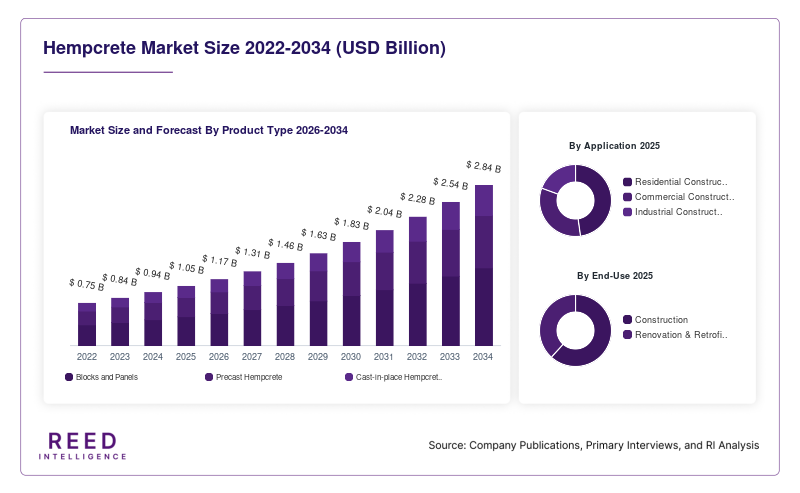
Blocks and panels dominated the Hempcrete Market with a 52% share in 2025. These products are widely used in construction due to their ease of installation, durability, and insulation properties. They are suitable for walls, insulation, and structural applications, making them a preferred choice among builders.
Precast hempcrete is expected to be the fastest-growing segment, registering a CAGR of 12.5% during the forecast period. The increasing adoption of modular construction techniques and demand for efficient building solutions are driving this segment’s growth.
By Application
Residential construction accounted for 49% of the market share in 2025, driven by the growing demand for sustainable housing. Hempcrete is widely used in residential buildings for insulation and wall construction, supporting energy efficiency and comfort.
Commercial construction is projected to grow at a CAGR of 12.1%, supported by increasing investments in green office buildings, retail spaces, and public infrastructure projects.
By End-Use
The construction sector dominated the market with a 68% share in 2025, as hempcrete is primarily used in building applications. Its thermal insulation and fire-resistant properties make it suitable for construction projects.
Renovation and retrofitting are expected to grow at a CAGR of 11.8%, driven by the increasing focus on upgrading existing buildings with sustainable materials.
By Distribution Channel
Direct sales accounted for 55% of the market share in 2025, as manufacturers directly supply hempcrete products to construction companies and developers.
Online distribution channels are expected to grow at a CAGR of 12.9%, supported by the increasing digitalization of procurement processes and the availability of construction materials on online platforms.
Regional Analysis
North America
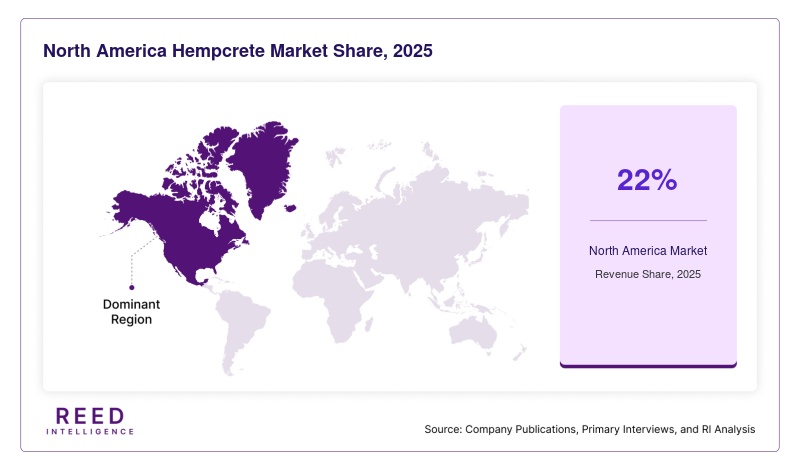
North America accounted for 22% of the Hempcrete Market share in 2025 and is expected to grow at a CAGR of 10.8% during the forecast period. The region’s growth is supported by increasing awareness of sustainable construction materials and rising adoption of green building practices.
The United States dominated the regional market due to growing investments in eco-friendly housing and infrastructure projects. The expansion of the construction sector and increasing demand for energy-efficient buildings are contributing to the adoption of hempcrete in the country.
Europe
Europe held the largest share of 46% in 2025 and is projected to grow at a CAGR of 11.2% through 2034. The region’s market growth is driven by strong environmental regulations and widespread adoption of sustainable building materials.
France emerged as the dominant country, supported by its well-established hemp industry and early adoption of hempcrete in construction. The country’s focus on reducing carbon emissions and promoting green building practices is driving market growth.
Asia Pacific
Asia Pacific accounted for 18% of the market in 2025 and is expected to grow at a CAGR of 13.2%, making it the fastest-growing region. Rapid urbanization, infrastructure development, and increasing awareness of sustainable construction are driving market growth in the region.
China dominated the regional market due to its large construction industry and growing focus on sustainable materials. Government initiatives promoting eco-friendly construction practices are supporting the adoption of hempcrete.
Middle East & Africa
The Middle East & Africa held 8% of the market share in 2025 and is projected to grow at a CAGR of 12.5% during the forecast period. The region’s growth is supported by increasing investments in sustainable infrastructure and construction projects.
The United Arab Emirates is the dominant country, driven by its focus on green building initiatives and sustainable urban development. The adoption of innovative construction materials is contributing to market growth.
Latin America
Latin America accounted for 6% of the market in 2025 and is expected to grow at a CAGR of 11.0% during the forecast period. The region’s growth is driven by increasing awareness of sustainable construction and expanding infrastructure projects.
Brazil emerged as the leading country, supported by its growing construction industry and rising interest in eco-friendly materials. The adoption of hempcrete is gradually increasing as builders seek sustainable alternatives.
Competitive Landscape
The Hempcrete Market is characterized by the presence of several regional and global players focusing on sustainable construction solutions. Companies are investing in research and development to improve product performance and expand their product portfolios.
A key market leader is Lime Technology Ltd (Hemcrete), known for its innovative hemp-based construction materials. The company has recently expanded its product range to include advanced precast hempcrete solutions, enhancing construction efficiency and sustainability.
Other major players include American Lime Technology, Hempitecture Inc., and IsoHemp SA, which are focusing on expanding their production capacities and strengthening their market presence. Strategic partnerships and collaborations with construction companies are common strategies adopted by market participants.
Key Players List
- Lime Technology Ltd (Hemcrete)
- American Lime Technology
- Hempitecture Inc.
- IsoHemp SA
- JustBioFiber Structural Solutions Corp.
- HempFlax Group B.V.
- NatureFibres
- Hemp Block USA
- Canobioteh
- Ecofibre Limited
- Dun Agro Hemp Group
- Hempire Building Materials
- UK Hempcrete Ltd
- Hemplime Ltd
- Hemp Building Company
Recent Developments
- In 2024, Lime Technology Ltd introduced new precast hempcrete panels for modular construction.
- In 2023, Hempitecture Inc. expanded its production facility in North America.
- In 2024, IsoHemp SA launched high-performance hempcrete blocks for commercial buildings.
- In 2023, American Lime Technology developed improved hemp-lime formulations for better durability.
- In 2024, JustBioFiber Structural Solutions Corp. introduced advanced bio-composite building materials.
Hempcrete Market Segments
By Product Type
- Blocks and Panels
- Precast Hempcrete
- Cast-in-place Hempcrete
By Application
- Residential Construction
- Commercial Construction
- Industrial Construction
By End-Use
- Construction
- Renovation & Retrofitting
By Distribution Channel
- Direct Sales
- Distributors
- Online Channels
By Region
- North America
- Europe
- APAC
- Middle East and Africa
- LATAM