Hereditary Hemorrhagic Telangiect Disease Market Size, Share & Demand Report By Treatment Type (Pharmacological Therapy, Biologics, Surgical Interventions), By Diagnosis Method (Genetic Testing, Imaging Techniques, Clinical Evaluation), By End-Use (Hospitals, Specialty Clinics, Ambulatory Surgical Centers), By Distribution Channel (Hospital Pharmacies, Retail Pharmacies, Online Pharmacies), By Region & Segment Forecasts, 2025–2034
USD 3950
Market Overview
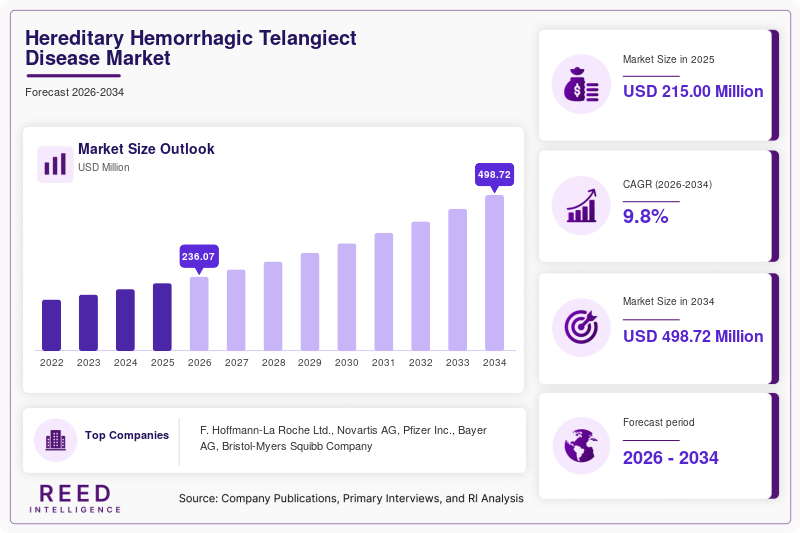
The Hereditary Hemorrhagic Telangiect Disease Market size was valued at approximately USD 215 million in 2025 and is projected to reach USD 498 million by 2034, expanding at a CAGR of 9.8% during the forecast period (2025–2034). This growth trajectory reflects increasing clinical awareness, improved diagnostic protocols, and a gradual rise in targeted therapeutic development for rare vascular disorders.
A key global factor supporting the expansion of the Hereditary Hemorrhagic Telangiect Disease Market is the growing emphasis on rare Disease management frameworks. Governments and healthcare institutions are investing in early diagnosis programs, patient registries, and orphan drug incentives. These initiatives have improved patient identification rates and encouraged pharmaceutical companies to develop novel treatment approaches, thereby strengthening market growth.
Key Highlights
- North America dominated the market with a 42% share in 2025, while Asia Pacific is expected to register the fastest CAGR of 11.4% through 2034.
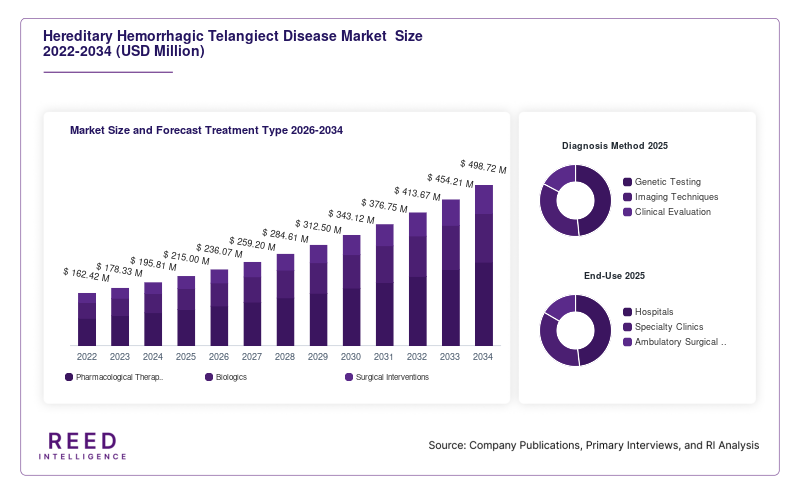
- By treatment type, pharmacological therapies led with a 58% share, whereas biologics are projected to grow at a CAGR of 12.1%.
- By end-use, hospitals accounted for 61% of the market, while specialty clinics are anticipated to grow at a CAGR of 10.7%.
- The U.S. market was valued at USD 92 million in 2025 and is expected to reach USD 100 million in 2026.
Market Trends
Increasing Adoption of Targeted Therapies
The Hereditary Hemorrhagic Telangiect Disease Market is witnessing a shift toward targeted and personalized therapies. Traditional symptomatic treatments are gradually being supplemented with biologics that target abnormal blood vessel formation. Anti-angiogenic agents and monoclonal antibodies are gaining attention due to their ability to address underlying Disease mechanisms rather than just symptoms. This trend is encouraging pharmaceutical companies to invest in clinical trials focused on precision medicine, improving treatment efficacy and patient adherence.
Expansion of Rare Disease Registries
Another notable trend shaping the Hereditary Hemorrhagic Telangiect Disease Market is the expansion of global patient registries. These databases help clinicians and researchers better understand Disease prevalence, genetic mutations, and treatment outcomes. Improved data collection is enabling earlier diagnosis and facilitating clinical research. Additionally, registry-driven insights are supporting regulatory approvals and reimbursement decisions, thereby enhancing access to advanced therapies across multiple regions.
Market Drivers
Rising Awareness and Early Diagnosis Programs
The increasing awareness of hereditary hemorrhagic telangiectasia among healthcare professionals and patients is a significant driver of the Hereditary Hemorrhagic Telangiect Disease Market. Educational campaigns and screening initiatives are improving early detection rates, which is critical for effective Disease management. Early diagnosis allows timely intervention, reducing complications and driving demand for treatment solutions.
Growth in Orphan Drug Development
The expansion of orphan drug designation programs is accelerating innovation within the Hereditary Hemorrhagic Telangiect Disease Market. Regulatory incentives such as tax credits, extended exclusivity, and expedited approvals are encouraging pharmaceutical companies to invest in rare Disease therapies. This has led to an increase in clinical trials and pipeline drugs, particularly in biologics and targeted treatments, which are expected to drive sustained market growth.
Market Restraint
Limited Treatment Availability and High Costs
A major restraint in the Hereditary Hemorrhagic Telangiect Disease Market is the limited availability of approved therapies combined with high treatment costs. Most current treatment approaches focus on symptom management rather than Disease modification. Advanced therapies, including biologics, often come with significant price points, limiting accessibility in low- and middle-income regions.
Additionally, the rarity of the Disease leads to lower patient volumes, which can reduce commercial incentives for large-scale drug development. This results in fewer treatment options and slower innovation cycles. Healthcare systems with constrained budgets may also face challenges in reimbursing high-cost therapies, further restricting patient access. These factors collectively hinder the broader adoption of advanced treatments and may limit market expansion in certain regions.
Market Opportunities
Development of Gene-Based Therapies
Gene therapy presents a promising opportunity in the Hereditary Hemorrhagic Telangiect Disease Market. As the Disease has a genetic origin, advancements in gene editing and gene replacement technologies offer potential long-term solutions. Ongoing research in CRISPR-based and viral vector therapies could lead to transformative treatments, creating new revenue streams and reshaping the competitive landscape.
Expansion in Emerging Markets
Emerging economies offer significant growth opportunities for the Hereditary Hemorrhagic Telangiect Disease Market. Improvements in healthcare infrastructure, increasing healthcare expenditure, and growing awareness of rare Diseases are driving demand for diagnostic and treatment services. Pharmaceutical companies are expanding their presence in these regions through partnerships and distribution networks, enabling better patient access and supporting market growth.
Segmental Analysis
By Treatment Type
Pharmacological therapies dominated the Hereditary Hemorrhagic Telangiect Disease Market in 2025, accounting for 58% of the total share. These treatments include antifibrinolytics, iron supplements, and hormonal therapies aimed at managing symptoms such as bleeding and anemia. Their widespread use and accessibility contributed to their leading position.
Biologics are expected to be the fastest-growing subsegment, with a projected CAGR of 12.1% through 2034. The growth is driven by their targeted mechanism of action, particularly in inhibiting abnormal blood vessel formation. Increasing clinical trials and regulatory approvals are expected to accelerate adoption.
By Diagnosis Method
Genetic testing held the largest share of 46% in 2025 within the Hereditary Hemorrhagic Telangiect Disease Market. Its ability to confirm diagnosis and identify specific mutations has made it a preferred approach among clinicians.
Imaging techniques are anticipated to grow at the fastest CAGR of 10.8%. Advancements in imaging technologies are enabling better detection of internal vascular malformations, improving diagnostic accuracy and supporting treatment planning.
By End-Use
Hospitals accounted for 61% of the Hereditary Hemorrhagic Telangiect Disease Market share in 2025. Their access to advanced diagnostic tools and multidisciplinary teams has made them the primary treatment centers for patients.
Specialty clinics are projected to grow at a CAGR of 10.7%, driven by increasing demand for focused care and personalized treatment approaches. These clinics offer specialized expertise, improving patient outcomes and satisfaction.
By Distribution Channel
Hospital pharmacies dominated the market with a 54% share in 2025. Their integration with healthcare facilities ensures easy access to prescribed treatments, supporting their leading position.
Online pharmacies are expected to grow at a CAGR of 11.2%. The increasing adoption of digital healthcare platforms and home delivery services is driving this growth, particularly in urban areas.
Regional Analysis
North America
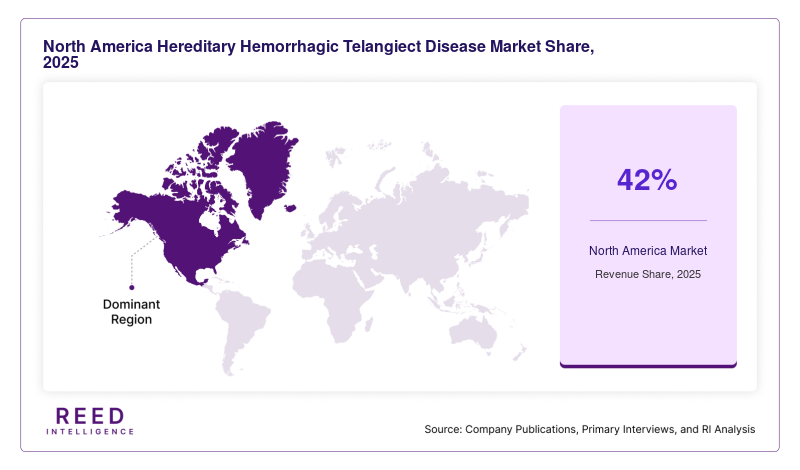
North America accounted for 42% of the Hereditary Hemorrhagic Telangiect Disease Market share in 2025 and is expected to grow at a CAGR of 9.2% during the forecast period. The region’s growth is supported by advanced healthcare infrastructure and strong research capabilities.
The United States dominated the regional market due to its robust rare Disease research ecosystem. The presence of specialized treatment centers and active patient advocacy groups has enhanced early diagnosis and treatment adoption.
Europe
Europe held a 28% share of the Hereditary Hemorrhagic Telangiect Disease Market in 2025 and is projected to grow at a CAGR of 9.5% through 2034. Favorable regulatory frameworks and increasing investment in orphan drugs are supporting regional growth.
Germany emerged as the dominant country, driven by its well-established healthcare system and focus on rare Disease management. Government-backed initiatives are promoting research collaborations and improving patient access to therapies.
Asia Pacific
Asia Pacific captured 17% of the Hereditary Hemorrhagic Telangiect Disease Market in 2025 and is expected to register the fastest CAGR of 11.4% over the forecast period. The region is witnessing rapid improvements in healthcare infrastructure and diagnostic capabilities.
China led the regional market due to its expanding healthcare system and growing focus on rare Diseases. Increased funding for medical research and rising awareness among healthcare professionals are contributing to market growth.
Middle East & Africa
The Middle East & Africa region accounted for 7% of the Hereditary Hemorrhagic Telangiect Disease Market in 2025 and is anticipated to grow at a CAGR of 8.7% through 2034. Limited awareness and healthcare access have historically constrained market growth.
Saudi Arabia dominated the region due to its increasing investment in healthcare infrastructure. Government initiatives aimed at improving rare Disease diagnosis are supporting market development.
Latin America
Latin America held a 6% share of the Hereditary Hemorrhagic Telangiect Disease Market in 2025 and is projected to grow at a CAGR of 8.9% during the forecast period. The region is gradually improving access to specialized healthcare services.
Brazil led the regional market due to its expanding healthcare network and increasing awareness of rare Diseases. Public health initiatives are playing a role in enhancing diagnosis and treatment availability.
Competitive Landscape
The Hereditary Hemorrhagic Telangiectdisease Market is characterized by the presence of niche pharmaceutical companies and research-driven organizations. Key players are focusing on developing targeted therapies and expanding their clinical pipelines.
The market leader, F. Hoffmann-La Roche Ltd., has strengthened its position through ongoing research in anti-angiogenic therapies. The company recently advanced a biologic candidate into late-stage clinical trials, reflecting its commitment to innovation in rare disease treatment.
Other prominent players are actively engaged in collaborations, partnerships, and acquisitions to enhance their market presence. Companies are also investing in patient support programs and awareness campaigns to improve diagnosis rates and treatment adoption.
Key Players List
- F. Hoffmann-La Roche Ltd.
- Novartis AG
- Pfizer Inc.
- Bayer AG
- Bristol-Myers Squibb Company
- Sanofi S.A.
- Takeda Pharmaceutical Company Limited
- Amgen Inc.
- AstraZeneca plc
- Regeneron Pharmaceuticals, Inc.
- CSL Limited
- Ipsen Pharma
- Teva Pharmaceutical Industries Ltd.
- BioCryst Pharmaceuticals
- Acceleron Pharma
Recent Developments
- Roche initiated a Phase III clinical trial for a biologic therapy targeting vascular abnormalities.
- Novartis expanded its rare disease portfolio through strategic collaborations.
- Pfizer increased investment in gene therapy research for vascular disorders.
- Takeda launched a patient support initiative to improve treatment accessibility.
- AstraZeneca partnered with research institutions to accelerate drug discovery in rare diseases.
Hereditary Hemorrhagic Telangiect Disease Market Segments
Treatment Type
- Pharmacological Therapy
- Biologics
- Surgical Interventions
Diagnosis Method
- Genetic Testing
- Imaging Techniques
- Clinical Evaluation
End-Use
- Hospitals
- Specialty Clinics
- Ambulatory Surgical Centers
Distribution Channel
- Hospital Pharmacies
- Retail Pharmacies
- Online Pharmacies
By Region
- North America
- Europe
- APAC
- Middle East and Africa
- LATAM