Hereditary Multiple Exostoses Treatment Market Size, Share & Demand Report By Treatment Type (Surgical Treatment, Pain Management, Gene Therapy), By Diagnosis Method (Imaging Techniques, Genetic Testing, Physical Examination), By End-Use (Hospitals, Specialty Clinics, Ambulatory Surgical Centers), By Distribution Channel (Direct Sales, Retail Pharmacies, Online Channels) & Segment Forecasts, 2026–2034
USD 3950
Market Overview
The Hereditary Multiple Exostoses Treatment Market size was valued at approximately USD 1.05 billion in 2026 and is projected to reach USD 1.85 billion by 2034, expanding at a CAGR of 7.4% during the forecast period (2026–2034). The market growth is primarily influenced by increasing awareness of rare genetic disorders and the rising focus on early diagnosis and intervention strategies. Additionally, advancements in orthopedic surgical techniques and genetic research have significantly contributed to improved treatment outcomes, thereby supporting market expansion.
A key global factor driving the Hereditary Multiple Exostoses Treatment Market is the growing investment in rare disease research programs. Governments and private institutions are allocating funds to enhance diagnostic accuracy and develop targeted therapies, which is accelerating innovation in treatment options. Furthermore, the integration of advanced imaging technologies and minimally invasive procedures is improving patient care standards.
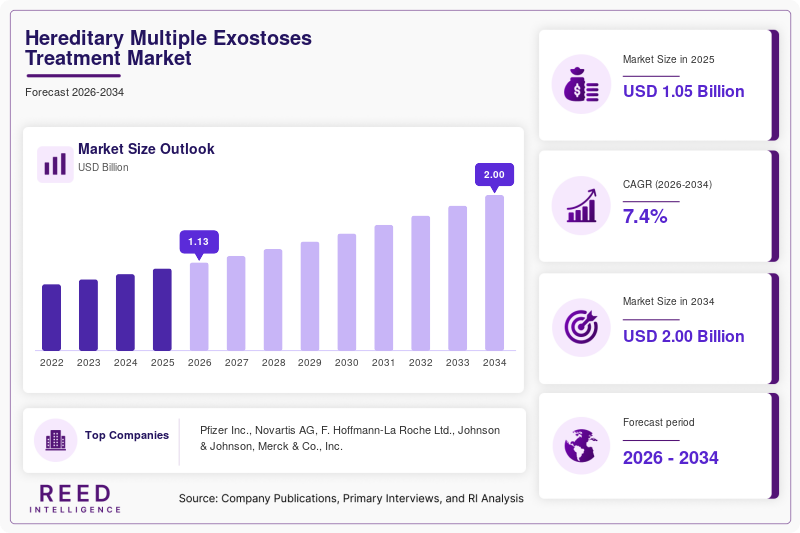
Key Highlights:
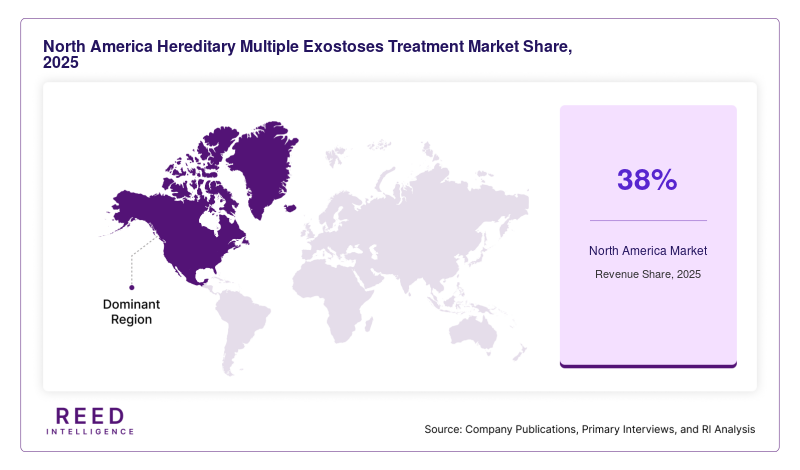
- North America dominated the market with a 38% share in 2025, while Asia Pacific is expected to grow at the fastest CAGR of 8.6% during the forecast period.
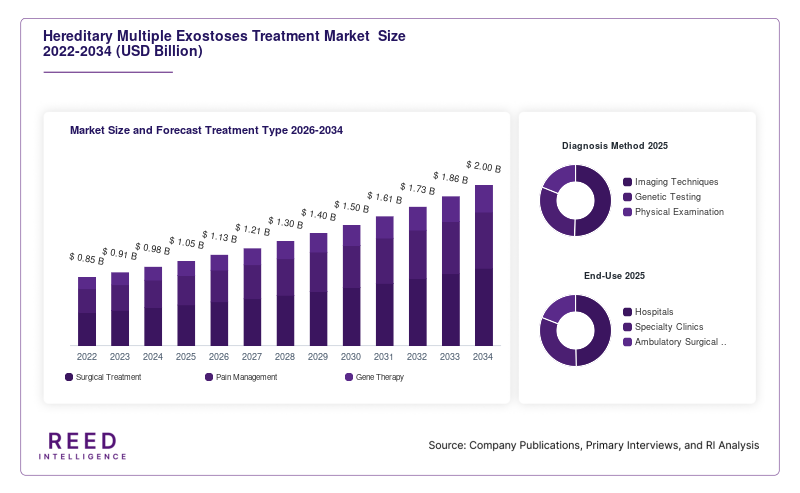
- Surgical treatment emerged as the leading segment with a 54% share in 2025, whereas gene therapy is projected to be the fastest-growing segment with a CAGR of 9.2%.
- Hospitals accounted for the largest end-use segment, while specialty clinics are anticipated to witness rapid growth.
- The United States remained the dominant country, with market values of USD 380 million in 2024 and USD 410 million in 2025.
Market Trends
Increasing Adoption of Minimally Invasive Surgical Procedures
The Hereditary Multiple Exostoses Treatment Market is witnessing a shift toward minimally invasive surgical techniques. These procedures reduce recovery time, minimize complications, and improve patient outcomes compared to traditional open surgeries. The adoption of arthroscopic and image-guided surgical methods is growing due to their precision and efficiency. Healthcare providers are increasingly prioritizing patient-centric approaches, which is encouraging the use of advanced surgical technologies. This trend is further supported by the availability of improved surgical instruments and training programs for orthopedic surgeons.
Expansion of Genetic Research and Targeted Therapies
Another notable trend shaping the Hereditary Multiple Exostoses Treatment Market is the expansion of genetic research aimed at identifying the underlying mutations responsible for the condition. This has led to the development of targeted therapies that address the root cause rather than just managing symptoms. Biopharmaceutical companies are investing in gene-editing technologies and molecular treatments, which are expected to transform the treatment landscape. The growing collaboration between research institutions and pharmaceutical firms is accelerating clinical trials and innovation in this space. As a result, personalized medicine is becoming a key focus area, offering new possibilities for long-term disease management.
Market Drivers
Rising Prevalence of Genetic Disorders and Early Diagnosis Initiatives
The increasing prevalence of genetic disorders, including hereditary skeletal conditions, is a major driver of the Hereditary Multiple Exostoses Treatment Market. Improved screening programs and diagnostic technologies have enabled early detection, which is critical for effective treatment planning. Governments and healthcare organizations are promoting awareness campaigns to educate patients and clinicians about rare diseases. Early diagnosis not only enhances treatment outcomes but also reduces long-term complications, thereby increasing demand for medical interventions.
Advancements in Orthopedic and Imaging Technologies
Technological advancements in orthopedic procedures and diagnostic imaging are significantly contributing to market growth. Modern imaging tools such as high-resolution MRI and CT scans allow precise identification of exostoses, enabling better surgical planning. Additionally, innovations in orthopedic implants and surgical techniques are improving treatment success rates. The availability of advanced healthcare infrastructure in developed regions further supports the adoption of these technologies. These developments are encouraging healthcare providers to adopt more efficient and accurate treatment methods, thereby driving the overall growth of the Hereditary Multiple Exostoses Treatment Market.
Market Restraint
High Cost of Treatment and Limited Accessibility
One of the primary challenges in the Hereditary Multiple Exostoses Treatment Market is the high cost associated with diagnosis, surgical procedures, and ongoing care. Advanced imaging technologies, specialized surgical interventions, and post-operative rehabilitation can be expensive, limiting access for patients in low- and middle-income regions. Additionally, the rarity of the condition often results in limited insurance coverage and reimbursement policies, further increasing the financial burden on patients and their families.
The lack of specialized healthcare facilities in certain regions also restricts access to appropriate treatment. Many patients require multidisciplinary care involving orthopedic surgeons, geneticists, and rehabilitation specialists, which may not be readily available in underserved areas. Furthermore, delays in diagnosis due to limited awareness can lead to more complex and costly interventions at later stages. These factors collectively hinder the growth potential of the Hereditary Multiple Exostoses Treatment Market, particularly in emerging economies.
Market Opportunities
Development of Gene Therapy and Personalized Medicine
The emergence of gene therapy presents a significant opportunity in the Hereditary Multiple Exostoses Treatment Market. Advances in genetic engineering and molecular biology are enabling the development of therapies that target specific gene mutations responsible for the condition. Personalized medicine approaches are gaining traction, allowing treatments to be tailored to individual patient profiles. This not only improves efficacy but also reduces the risk of complications. As research progresses, gene-based therapies are expected to become a transformative solution in the long term.
Expansion in Emerging Markets and Healthcare Infrastructure
Emerging economies offer substantial growth opportunities for the Hereditary Multiple Exostoses Treatment Market. Increasing healthcare investments, improving infrastructure, and rising awareness of rare diseases are driving demand for advanced treatment options. Governments in these regions are focusing on expanding access to healthcare services and supporting research initiatives. Additionally, the growing presence of international healthcare providers and medical tourism is facilitating access to specialized treatments. These factors are expected to create new avenues for market expansion during the forecast period.
Segmental Analysis
By Treatment Type
Surgical treatment dominated the Hereditary Multiple Exostoses Treatment Market in 2025, accounting for approximately 54% of the total share. This dominance was attributed to the effectiveness of surgical procedures in removing symptomatic exostoses and preventing complications.
Gene therapy is expected to be the fastest-growing segment, with a projected CAGR of 9.2% during the forecast period. The growth is driven by advancements in genetic research and the potential to address the root cause of the condition, offering long-term therapeutic benefits.
By Diagnosis Method
Imaging techniques held the largest share of the market in 2025, contributing around 48%. The widespread use of MRI and CT scans enabled accurate detection and monitoring of exostoses.
Genetic testing is anticipated to witness the fastest growth, with a CAGR of 8.8%. The increasing focus on early diagnosis and personalized treatment is driving the adoption of advanced genetic screening methods.
By End-Use
Hospitals accounted for the largest share of the Hereditary Multiple Exostoses Treatment Market in 2025, with approximately 52%. The availability of advanced medical facilities and multidisciplinary care supported this dominance.
Specialty clinics are projected to grow at the fastest CAGR of 8.3%, driven by their focus on specialized care and improved patient experience.
By Distribution Channel
Direct sales dominated the market in 2025, holding a share of 46%. Hospitals and healthcare providers preferred direct procurement to ensure quality and reliability.
Online distribution channels are expected to grow at a CAGR of 8.5%, supported by increasing digitalization and convenience in accessing medical products.
Regional Analysis
North America
North America accounted for approximately 38% of the Hereditary Multiple Exostoses Treatment Market share in 2025 and is projected to grow at a CAGR of 6.8% during the forecast period. The region benefited from advanced healthcare infrastructure, widespread availability of specialized treatment facilities, and strong research capabilities.
The United States dominated the regional market due to its well-established healthcare system and high adoption of advanced diagnostic technologies. The presence of leading research institutions and continuous funding for rare disease studies contributed to market growth. Additionally, favorable reimbursement policies supported patient access to treatment.
Europe
Europe held a 27% share of the Hereditary Multiple Exostoses Treatment Market in 2025 and is expected to expand at a CAGR of 6.9% through 2034. The region’s growth was supported by government initiatives promoting rare disease research and improved access to healthcare services.
Germany emerged as the dominant country in Europe, driven by its strong medical research infrastructure and availability of specialized orthopedic care. Collaborative efforts between public and private sectors further enhanced treatment accessibility and innovation.
Asia Pacific
Asia Pacific captured around 18% of the market share in 2025 and is anticipated to grow at the fastest CAGR of 8.6% during the forecast period. The region’s growth is attributed to increasing healthcare investments and rising awareness of genetic disorders.
China led the regional market due to its expanding healthcare infrastructure and growing focus on rare disease management. Government initiatives to improve diagnostic capabilities and support research activities contributed significantly to market expansion.
Middle East & Africa
The Middle East & Africa region accounted for approximately 9% of the Hereditary Multiple Exostoses Treatment Market share in 2025 and is expected to grow at a CAGR of 6.5% during the forecast period. The region showed gradual improvement in healthcare access and infrastructure development.
Saudi Arabia dominated the regional market, supported by increasing healthcare expenditure and the establishment of specialized medical centers. Efforts to enhance awareness and early diagnosis also contributed to market growth.
Latin America
Latin America held about 8% of the market share in 2025 and is projected to grow at a CAGR of 6.7% through 2034. The region experienced steady growth due to improving healthcare systems and rising awareness of rare diseases.
Brazil emerged as the leading country in the region, driven by government initiatives to expand healthcare access and support research programs. Increasing collaboration with international healthcare providers further strengthened the market outlook.
Competitive Landscape
The Hereditary Multiple Exostoses Treatment Market is moderately competitive, with several global and regional players focusing on innovation and strategic collaborations. Leading companies are investing in research and development to introduce advanced treatment options and improve patient outcomes.
The market leader, Pfizer Inc., has maintained a strong position through continuous investment in rare disease research and the development of targeted therapies. The company recently announced progress in clinical trials for a novel gene-based treatment, highlighting its commitment to innovation.
Other key players are focusing on partnerships, acquisitions, and expansion strategies to strengthen their market presence. The competitive landscape is characterized by increasing emphasis on personalized medicine and technological advancements.
Key Players List
- Pfizer Inc.
- Novartis AG
- F. Hoffmann-La Roche Ltd.
- Johnson & Johnson
- Merck & Co., Inc.
- Sanofi S.A.
- GlaxoSmithKline plc
- Amgen Inc.
- Biogen Inc.
- Regeneron Pharmaceuticals, Inc.
- Takeda Pharmaceutical Company Limited
- Eli Lilly and Company
- AstraZeneca plc
- Bayer AG
- AbbVie Inc.
Recent Developments
- 2025: A leading pharmaceutical company initiated a Phase II clinical trial for a gene therapy targeting hereditary bone disorders.
- 2024: Increased collaboration between research institutes and biotech firms accelerated innovation in genetic diagnostics.
- 2025: Expansion of specialty orthopedic clinics in Asia Pacific improved access to advanced treatments.
- 2026: Adoption of AI-based imaging tools enhanced diagnostic accuracy in rare skeletal conditions.
Hereditary Multiple Exostoses Treatment Market Segments
Treatment Type
- Surgical Treatment
- Pain Management
- Gene Therapy
Diagnosis Method
- Imaging Techniques
- Genetic Testing
- Physical Examination
End-Use
- Hospitals
- Specialty Clinics
- Ambulatory Surgical Centers
Distribution Channel
- Direct Sales
- Retail Pharmacies
- Online Channels
By Region
- North America
- Europe
- APAC
- Middle East and Africa
- LATAM