Hereditary Spherocytosis Market Size, Share, Demand Report by Diagnosis Type (Blood Smear Analysis, Osmotic Fragility Test, Genetic Testing), By Treatment Type (Splenectomy, Folic Acid Supplementation, Blood Transfusion, Supportive Care), By End User (Hospitals, Specialty Clinics, Diagnostic Laboratories), and By Region Forecasts, 2026–2034
USD 3950
Market Overview
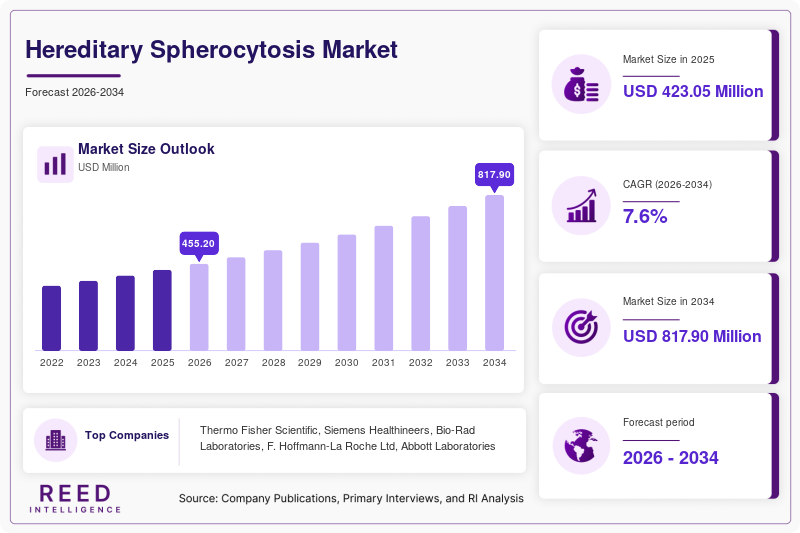
The Hereditary Spherocytosis Market size is projected to reach USD 455.2 million in 2026 and is anticipated to attain USD 812.6 million by 2034, registering a compound annual growth rate (CAGR) of 7.6% during the forecast period (2026–2034). The expansion of the Hereditary Spherocytosis Market is primarily driven by increasing awareness of rare hematologic disorders and advancements in diagnostic technologies enabling early disease identification at the global level.
Improved genetic screening programs and the integration of next-generation sequencing in clinical diagnostics have significantly enhanced detection rates, thereby supporting the steady growth of the Hereditary Spherocytosis Market. Additionally, rising healthcare expenditure in both developed and emerging economies has strengthened access to specialized care for hemolytic disorders.
Key Highlights
- Dominant region share (2025): North America accounted for 38% of the Hereditary Spherocytosis Market
- Fastest-growing region CAGR (2026–2034): Asia Pacific at 8.4%
- Dominant subsegment: Splenectomy under treatment type with 41% share (2025)
- Fastest-growing subsegment: Genetic testing diagnostics with 9.1% CAGR (2026–2034)
- Dominant country: United States market size valued at USD 145.3 million in 2025 and USD 152.8 million in 2024
Market Trends
Expansion of Genetic and Molecular Diagnostics
The Hereditary Spherocytosis Market is experiencing a strong shift toward molecular diagnostics, including gene sequencing and membrane protein analysis. These tools allow clinicians to identify mutations in genes such as ANK1, SPTB, and SLC4A1, improving early diagnosis and disease classification. As precision medicine continues to evolve, diagnostic accuracy is becoming a key growth enabler in the Hereditary Spherocytosis Market.
Shift Toward Non-Surgical Management Approaches
Another emerging trend in the Hereditary Spherocytosis Market is the gradual shift from splenectomy toward conservative management approaches. Increased awareness regarding post-splenectomy infection risks has encouraged healthcare providers to adopt folic acid supplementation, transfusion therapies, and supportive care strategies. This transition is reshaping treatment protocols and influencing long-term care pathways in the Hereditary Spherocytosis Market.
Market Drivers
Rising Prevalence and Improved Diagnosis of Rare Hemolytic Disorders
The increasing identification of hereditary hemolytic disorders has significantly contributed to the expansion of the Hereditary Spherocytosis Market. Enhanced newborn screening programs and broader adoption of hematology panels have improved early detection rates. As a result, more patients are entering long-term care pathways, supporting sustained demand within the Hereditary Spherocytosis Market.
Advancements in Personalized Medicine and Genetic Research
Progress in personalized medicine is a major driver of the Hereditary Spherocytosis Market. Gene-based research has enabled deeper understanding of red blood cell membrane defects, supporting targeted therapeutic development. Pharmaceutical and biotechnology companies are increasingly investing in rare disease pipelines, further accelerating innovation in the Hereditary Spherocytosis Market.
Market Restraint
Limited Awareness and High Diagnostic Complexity
Despite advancements, limited awareness among primary healthcare providers remains a major restraint for the Hereditary Spherocytosis Market. Misdiagnosis or delayed diagnosis is common due to symptom overlap with other hemolytic anemia conditions. Additionally, high dependency on specialized laboratory infrastructure restricts accessibility in low-income regions, constraining overall growth of the Hereditary Spherocytosis Market.
Market Opportunities
Development of Gene Therapy-Based Treatment Approaches
One of the most promising opportunities in the Hereditary Spherocytosis Market lies in gene therapy development. Research into correcting membrane protein defects at the genetic level is gaining traction. Although still in experimental stages, such innovations could redefine long-term treatment strategies and significantly expand the Hereditary Spherocytosis Market in the coming decade.
Expansion of Rare Disease Healthcare Infrastructure in Emerging Economies
Emerging economies are investing in rare disease centers and specialized hematology units, creating substantial opportunities for the Hereditary Spherocytosis Market. Increased government support for orphan diseases and improved insurance coverage are expected to enhance patient access to diagnostics and treatment, supporting long-term expansion of the Hereditary Spherocytosis Market.
Segmental Analysis
By Diagnosis Type
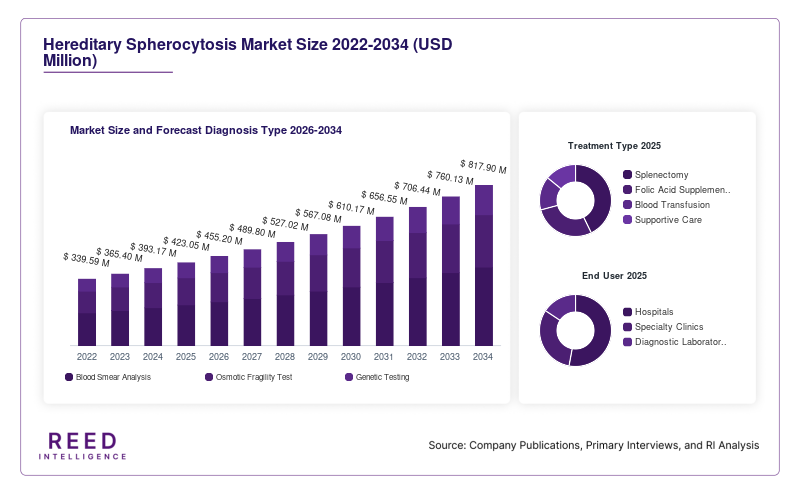
The diagnostic segment of the Hereditary Spherocytosis Market includes blood smear analysis, osmotic fragility tests, and genetic testing. Blood smear analysis dominated with 44% share in 2025 due to its cost-effectiveness and widespread availability in hospital laboratories. However, genetic testing is expected to grow at a 9.1% CAGR (2026–2034) as precision medicine expands, improving mutation-level identification and disease classification in the Hereditary Spherocytosis Market.
By Treatment Type
The treatment segment includes splenectomy, folic acid supplementation, blood transfusion, and supportive care. Splenectomy remained the dominant subsegment with 41% share in 2025, primarily due to its long-standing effectiveness in reducing hemolysis. However, folic acid supplementation is projected to register the fastest growth at a 7.9% CAGR (2026–2034) as non-invasive management approaches gain preference in the Hereditary Spherocytosis Market.
By End User
Hospitals dominated the end-user segment with 52% share in 2025 due to the availability of advanced diagnostic facilities and surgical infrastructure. However, specialty clinics are expected to grow at a 8.2% CAGR (2026–2034) as outpatient-based hematology care expands and decentralized healthcare models strengthen across the Hereditary Spherocytosis Market.
Regional Analysis
North America
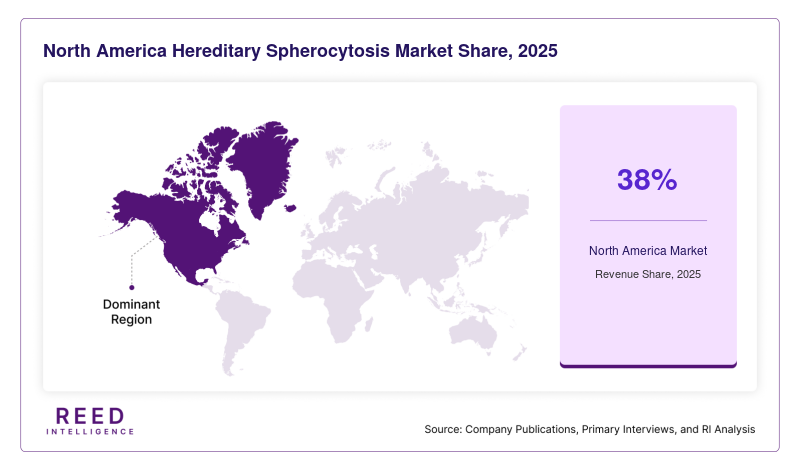
North America held 38% share of the Hereditary Spherocytosis Market in 2025 and is projected to grow at a 7.2% CAGR (2026–2034). The region benefits from advanced healthcare infrastructure, strong genetic research capabilities, and widespread availability of diagnostic tools. The United States dominates due to high awareness levels and established rare disease registries supporting the Hereditary Spherocytosis Market.
Europe
Europe accounted for 28% share in 2025 and is expected to register a 6.9% CAGR (2026–2034) in the Hereditary Spherocytosis Market. Growth is supported by government-funded rare disease programs and strong hematology research networks. Germany leads regional growth due to its structured diagnostic pathways and increasing adoption of molecular testing.
Asia Pacific
Asia Pacific captured 22% share in 2025 and is forecasted to grow at the highest 8.4% CAGR (2026–2034) in the Hereditary Spherocytosis Market. Rising healthcare investments, expanding genetic testing infrastructure, and increasing awareness in countries such as China, India, and Japan are key growth factors driving the Hereditary Spherocytosis Market in this region.
Middle East & Africa
The Middle East & Africa region held 6% share in 2025 and is projected to grow at a 6.5% CAGR (2026–2034) in the Hereditary Spherocytosis Market. Growth is driven by improving healthcare infrastructure and increasing government initiatives for rare disease diagnosis, particularly in Gulf Cooperation Council (GCC) countries.
Latin America
Latin America accounted for 6% share in 2025 and is expected to expand at a 6.7% CAGR (2026–2034) in the Hereditary Spherocytosis Market. Brazil leads the region due to expanding access to hematology care and gradual improvements in diagnostic availability across public healthcare systems.
Competitive Landscape
The Hereditary Spherocytosis Market is moderately consolidated with the presence of global diagnostic companies, pharmaceutical firms, and biotechnology organizations focusing on rare hematologic disorders. Key players include Thermo Fisher Scientific, Siemens Healthineers, Bio-Rad Laboratories, F. Hoffmann-La Roche, and Abbott Laboratories. These companies focus on expanding diagnostic capabilities, improving genetic testing platforms, and enhancing automation in hematology analyzers.
Thermo Fisher Scientific holds a strong position in the Hereditary Spherocytosis Market due to its advanced sequencing technologies and molecular diagnostic tools. Recently, the company expanded its rare disease genomic testing portfolio, improving accessibility for hematology diagnostics across clinical laboratories. Siemens Healthineers continues to invest in AI-integrated hematology analyzers, enhancing accuracy in red blood cell morphology detection. Strategic collaborations, product innovation, and expansion into emerging markets remain key competitive strategies shaping the Hereditary Spherocytosis Market landscape.
Key Players List
- Thermo Fisher Scientific
- Siemens Healthineers
- Bio-Rad Laboratories
- F. Hoffmann-La Roche Ltd
- Abbott Laboratories
- Danaher Corporation
- Sysmex Corporation
- Beckman Coulter
- Quest Diagnostics
- Illumina Inc.
- Agilent Technologies
- PerkinElmer
- Becton Dickinson and Company
- Charles River Laboratories
- Ortho Clinical Diagnostics
Recent Developments
- In 2025, several diagnostic companies expanded next-generation sequencing panels tailored for rare hemolytic disorders, enhancing early detection capabilities in the Hereditary Spherocytosis Market.
- In 2026, AI-based hematology analyzers were increasingly integrated into clinical workflows, improving diagnostic precision for red blood cell membrane disorders.
- Research institutions initiated collaborative programs focusing on gene correction techniques targeting membrane protein mutations, potentially transforming long-term treatment strategies in the Hereditary Spherocytosis Market.
- Expansion of rare disease funding programs in Asia Pacific improved accessibility to advanced hematology diagnostics, strengthening regional market penetration.
Hereditary Spherocytosis Market Segments
Diagnosis Type
- Blood Smear Analysis
- Osmotic Fragility Test
- Genetic Testing
Treatment Type
- Splenectomy
- Folic Acid Supplementation
- Blood Transfusion
- Supportive Care
End User
- Hospitals
- Specialty Clinics
- Diagnostic Laboratories
By Region
- North America
- Europe
- APAC
- Middle East and Africa
- LATAM