Herpes Markers Testing Market Size, Share & Demand Report By Test Type (Serological Testing, Molecular Diagnostic Testing, Viral Culture Testing), By Infection Type (HSV-1 Testing, HSV-2 Testing, Combined HSV-1 and HSV-2 Panel Testing), By Technology (Immunoassay Technology, PCR Technology, Enzyme-Linked Immunosorbent Assay (ELISA)), By End User (Hospitals, Diagnostic Laboratories, Specialty Clinics), By Region & Segment Forecasts, 2026–2034
USD 3950
Market Overview
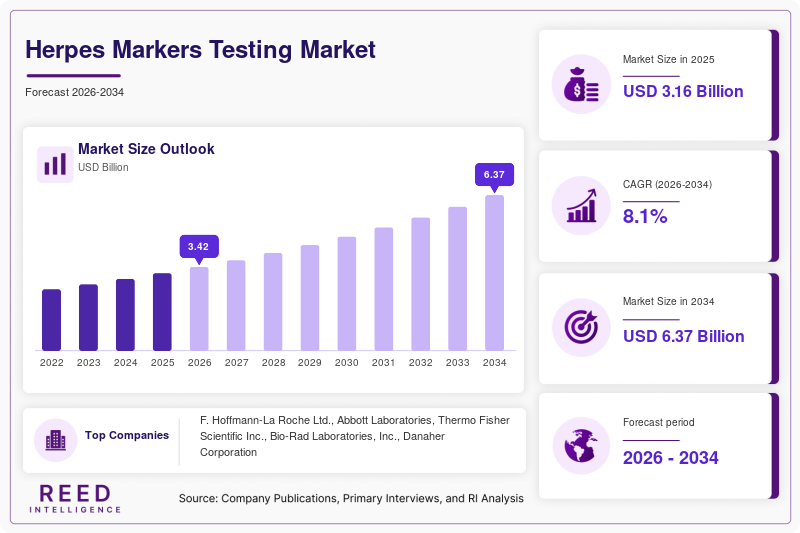
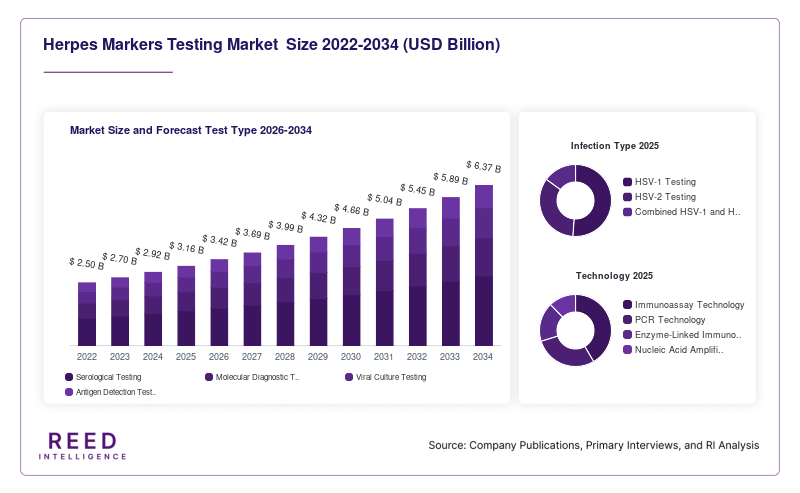
The Herpes Markers Testing Market Size was valued at approximately USD 3.16 billion in 2026 and is projected to reach USD 5.89 billion by 2034, expanding at a CAGR of 8.1% during the forecast period from 2026 to 2034. The global Herpes Markers Testing Market growth has been supported by increasing awareness regarding sexually transmitted infections and the rising adoption of early diagnostic screening programs worldwide. Growing public health initiatives focused on infectious disease monitoring and expanding access to diagnostic services have accelerated demand for herpes markers testing solutions across hospitals, diagnostic laboratories, and specialized clinics.
The Herpes Markers Testing Market has witnessed considerable expansion due to increasing prevalence of herpes simplex virus infections globally. Healthcare providers are increasingly emphasizing early detection and accurate diagnosis to reduce transmission risks and improve patient management outcomes. Serological assays, molecular diagnostics, and immunoassay-based testing solutions are gaining traction because of their ability to deliver faster and more reliable results.
Key Highlights
- North America accounted for 38.4% of the global Herpes Markers Testing Market share in 2025, while Asia Pacific is projected to register the fastest CAGR of 9.2% during 2026–2034.
- By test type, serological testing dominated the market with a 44.7% share in 2025, while molecular diagnostic testing is projected to grow at a CAGR of 9.8%.
- By infection type, HSV-2 testing represented the leading segment with 58.3% market share in 2025, whereas combined HSV-1 and HSV-2 panel testing is forecast to expand at a CAGR of 10.1%.
- By end user, diagnostic laboratories held 41.5% of the market share in 2025, while homecare testing services are expected to grow at a CAGR of 10.4%.
- The United States remained the dominant country market, valued at USD 612 million in 2024 and USD 648 million in 2025.
Market Trends
Increasing Adoption of Molecular Diagnostic Technologies
Molecular diagnostics have emerged as a major trend influencing the Herpes Markers Testing Market. Healthcare providers are increasingly adopting PCR-based and nucleic acid amplification testing methods because of their high sensitivity and specificity.
These technologies provide faster and more accurate detection of herpes simplex virus infections compared to traditional testing methods. Diagnostic laboratories are integrating automated molecular platforms to improve workflow efficiency and support high-volume testing requirements.
Rising Demand for Home-Based STI Testing Kits
The growing popularity of home-based diagnostic testing has significantly influenced the Herpes Markers Testing Market. Consumers are increasingly seeking confidential and convenient testing options that reduce the need for clinical visits.
Manufacturers are introducing self-collection testing kits with digital reporting systems and telehealth consultation support. This trend is particularly strong among younger populations seeking accessible sexual health screening solutions.
Market Drivers
Growing Prevalence of Sexually Transmitted Infections
The rising incidence of sexually transmitted infections worldwide has significantly supported the growth of the Herpes Markers Testing Market. Public health agencies and healthcare providers are increasing screening efforts to improve early diagnosis and reduce disease transmission.
Growing awareness campaigns and educational initiatives regarding sexual health have encouraged more individuals to undergo regular diagnostic testing.
Expansion of Diagnostic Healthcare Infrastructure
The expansion of healthcare diagnostic infrastructure across developed and emerging economies has accelerated demand for herpes markers testing solutions. Hospitals and diagnostic laboratories are investing in advanced laboratory technologies to improve infectious disease detection capabilities.
The Herpes Markers Testing Market has therefore benefited from increased healthcare spending and modernization of clinical laboratory systems.
Market Restraint
Social Stigma Associated with STI Testing
The Herpes Markers Testing Market faces challenges related to social stigma and limited patient willingness to undergo sexually transmitted infection screening. Concerns regarding privacy and social perception may reduce testing adoption rates in certain regions.
Market Opportunities
Expansion of Digital Health and Telemedicine Services
The increasing adoption of telemedicine platforms presents strong opportunities for the Herpes Markers Testing Market. Telehealth services enable remote consultation, digital result interpretation, and confidential diagnostic support for patients seeking STI testing services.
Healthcare providers are expected to integrate digital health tools with diagnostic testing platforms to improve patient accessibility and engagement.
Growing Demand for Multiplex Infectious Disease Panels
The development of multiplex diagnostic assays creates emerging opportunities for the Herpes Markers Testing Market. Healthcare facilities are increasingly adopting testing panels capable of simultaneously detecting multiple sexually transmitted infections.
These platforms improve diagnostic efficiency and reduce overall laboratory processing time, supporting broader clinical adoption.
Segmental Analysis
By Test Type
Serological Testing Dominated the Market
Serological testing accounted for 44.7% of the Herpes Markers Testing Market share in 2025. Its dominance was attributed to broad clinical adoption, cost efficiency, and widespread use in routine screening programs.
These tests remained highly preferred because they enable detection of herpes simplex virus antibodies in large patient populations.
Molecular Diagnostic Testing to Witness Fastest Growth
Molecular diagnostic testing is projected to grow at a CAGR of 9.8% through 2034. Growth will be driven by increasing adoption of PCR technologies offering enhanced diagnostic accuracy and rapid result delivery.
Healthcare providers are expected to expand utilization of molecular testing platforms in specialized infectious disease diagnostics.
By Infection Type
HSV-2 Testing Held the Largest Share
HSV-2 testing represented 58.3% of the Herpes Markers Testing Market share in 2025 because of the high prevalence of genital herpes infections globally.
Healthcare providers increasingly prioritized HSV-2 screening within sexual health management programs and routine STI testing protocols.
Combined HSV-1 and HSV-2 Panel Testing to Grow Rapidly
Combined HSV-1 and HSV-2 panel testing is projected to expand at a CAGR of 10.1% during the forecast period. Growth will be supported by rising demand for comprehensive diagnostic screening and multiplex testing efficiency.
By End User
Diagnostic Laboratories Dominated the Market
Diagnostic laboratories captured 41.5% of the Herpes Markers Testing Market share in 2025 because of increasing patient testing volumes and growing laboratory automation adoption.
Large laboratories continued investing in advanced molecular diagnostic infrastructure to improve testing throughput and operational efficiency.
Homecare Testing Services to Register Strong Expansion
Homecare testing services are anticipated to grow at a CAGR of 10.4% through 2034. Growth will be driven by rising consumer preference for confidential and convenient diagnostic testing options.
By Technology
Immunoassay Technology Led the Market
Immunoassay technology accounted for 39.8% of the market share in 2025 due to its extensive use in routine herpes antibody detection and laboratory screening procedures.
PCR Technology to Expand Significantly
PCR technology is expected to grow at a CAGR of 9.9% during the forecast period. Growth will be supported by increasing need for high-sensitivity viral detection and rapid infectious disease diagnosis.
Regional Analysis
North America
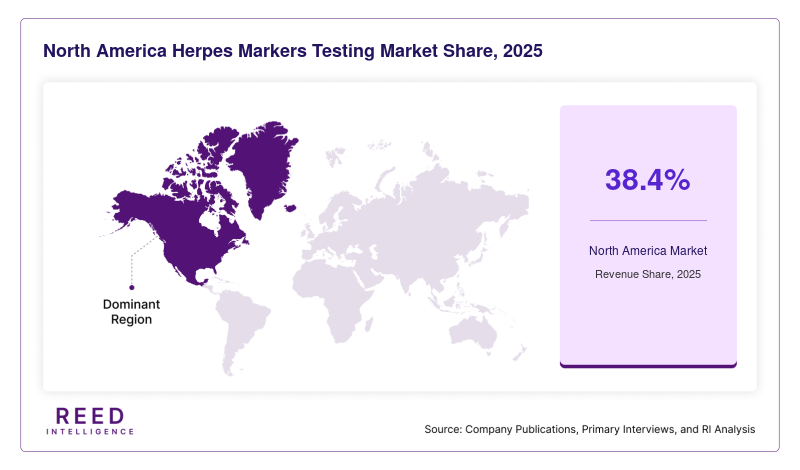
North America held 38.4% of the global Herpes Markers Testing Market share in 2025 and will grow at a CAGR of 7.8% through 2034. The regional market expanded steadily because of strong healthcare infrastructure and high awareness regarding sexually transmitted infection screening.
The United States dominated the region due to increasing adoption of molecular diagnostics and growing demand for confidential home-based testing services.
Europe
Europe accounted for 27.9% of the Herpes Markers Testing Market share in 2025 and will expand at a CAGR of 7.7% during the forecast period. The market experienced stable growth because of rising investments in public health screening programs and advanced laboratory diagnostics.
Germany emerged as the dominant country due to increasing healthcare digitization and growing implementation of automated diagnostic systems.
Asia Pacific
Asia Pacific represented 22.8% of the global Herpes Markers Testing Market share in 2025 and will witness the fastest CAGR of 9.2% during 2026–2034. Rapid healthcare infrastructure development and increasing awareness regarding infectious diseases accelerated regional market growth.
China led the regional market because of expanding diagnostic laboratory networks and rising government support for infectious disease management programs.
Middle East & Africa
Middle East & Africa captured 5.8% of the Herpes Markers Testing Market share in 2025 and will grow at a CAGR of 7.1% through 2034. Regional market growth was supported by increasing healthcare investments and improving access to clinical diagnostic services.
Saudi Arabia dominated the regional market due to expansion of healthcare modernization initiatives and increasing laboratory testing capabilities.
Latin America
Latin America accounted for 5.1% of the global Herpes Markers Testing Market share in 2025 and will register a CAGR of 6.9% during the forecast period. The market expanded because of rising awareness regarding sexual health and increasing diagnostic accessibility.
Brazil remained the dominant country due to growing healthcare expenditure and expansion of infectious disease screening programs.
Competitive Landscape
The Herpes Markers Testing Market remains competitive, with companies focusing on molecular diagnostics innovation, automated laboratory systems, and digital health integration. Manufacturers are investing in advanced assay development and multiplex testing technologies to improve diagnostic efficiency and clinical accuracy.
F. Hoffmann-La Roche Ltd. remained one of the leading participants in the Herpes Markers Testing Market due to its strong molecular diagnostics portfolio and extensive global healthcare distribution network. The company recently expanded infectious disease testing capabilities through advanced automated PCR platforms designed for high-throughput laboratory operations.
Other market participants are emphasizing rapid testing technologies, home-based diagnostic kits, and telemedicine-compatible solutions to strengthen competitiveness within the evolving infectious disease diagnostics industry.
Key Players List
- F. Hoffmann-La Roche Ltd.
- Abbott Laboratories
- Thermo Fisher Scientific Inc.
- Bio-Rad Laboratories, Inc.
- Danaher Corporation
- Siemens Healthineers AG
- QIAGEN N.V.
- Becton, Dickinson and Company
- BioMérieux SA
- PerkinElmer Inc.
- Hologic, Inc.
- DiaSorin S.p.A.
- Trinity Biotech plc
- OraSure Technologies, Inc.
- Quest Diagnostics Incorporated
Recent Developments
- F. Hoffmann-La Roche Ltd. expanded automated PCR testing capabilities for infectious disease diagnostics.
- Abbott Laboratories introduced enhanced multiplex STI testing solutions for clinical laboratories.
- Thermo Fisher Scientific Inc. expanded molecular diagnostic assay development for viral infection screening.
- Siemens Healthineers AG strengthened digital laboratory integration systems for infectious disease management.
- QIAGEN N.V. launched advanced nucleic acid extraction technologies for rapid viral testing applications.
- BioMérieux SA increased investment in automated infectious disease diagnostic platforms.
- Hologic, Inc. expanded molecular testing portfolio targeting women’s health and STI diagnostics.
- OraSure Technologies, Inc. developed confidential home-based STI testing services integrated with telehealth consultation platforms.
Herpes Markers Testing Market Segments
Test Type
- Serological Testing
- Molecular Diagnostic Testing
- Viral Culture Testing
- Antigen Detection Testing
Infection Type
- HSV-1 Testing
- HSV-2 Testing
- Combined HSV-1 and HSV-2 Panel Testing
Technology
- Immunoassay Technology
- PCR Technology
- Enzyme-Linked Immunosorbent Assay (ELISA)
- Nucleic Acid Amplification Testing
End User
- Hospitals
- Diagnostic Laboratories
- Specialty Clinics
- Homecare Testing Services
By Region
- North America
- Europe
- APAC
- Middle East and Africa
- LATAM