Herpes Simplex Virus (HSV) Vaccines Market Size, Share & Trends Analysis Report By Vaccine Type (Prophylactic Vaccines, Therapeutic Vaccines), By Vaccine Platform (mRNA Vaccines, Recombinant Protein/Subunit Vaccines, Live-Attenuated & Replication-Defective Vaccines, DNA Vaccines, Other Platforms), By Virus Type (HSV-1, HSV-2, HSV-1/HSV-2 Combination), By End User (Hospitals & Clinics, Vaccination Centers, Research & Academic Institutions) Forecasts, 2026–2034
USD 3950
Herpes Simplex Virus (HSV) Vaccines Market Size
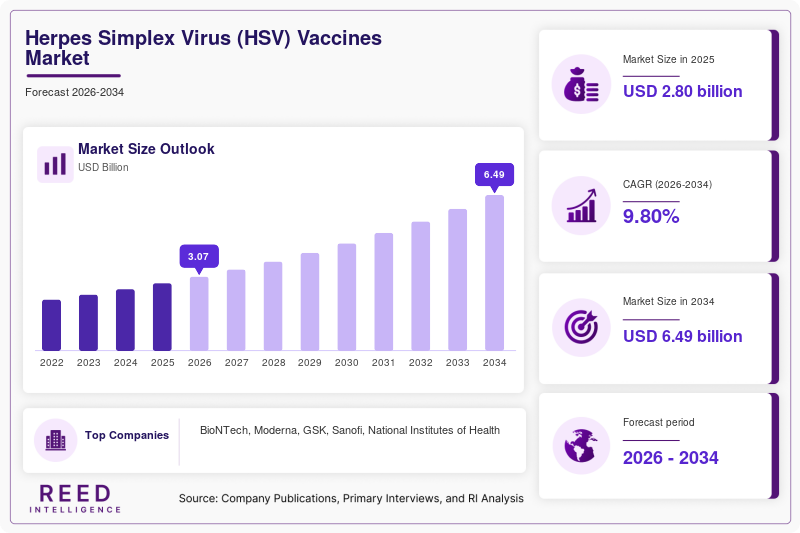
The global herpes simplex virus (HSV) vaccines market size was valued at USD 2.80 billion in 2025 and is projected to grow from USD 3.07 billion in 2026 to USD 6.40 billion by 2034, registering a CAGR of 9.80% during the forecast period from 2026 to 2034.
The commercial opportunity is tied to a large untreated prevention gap. WHO estimates that 3.8 billion people under age 50 had HSV-1 infection and 520 million people aged 15–49 had HSV-2 infection in 2020. WHO also estimates that 205 million people in the 15–49 age group experienced at least one symptomatic episode of genital herpes.
At present, there is no licensed vaccine against HSV-1 or HSV-2, so the market is fundamentally driven by vaccine development and the potential future commercialization of prophylactic and therapeutic products. WHO has established separate preferred product characteristics for prophylactic and therapeutic HSV vaccines, reflecting the two principal commercial and public-health pathways.
HSV vaccine development addresses a disease burden that remains large despite the availability of antiviral treatment. HSV infections are lifelong, and current medicines can reduce symptoms and recurrences but do not eliminate latent infection. WHO identifies HSV-2 as a major cause of genital herpes and notes its association with approximately a three-fold higher risk of acquiring HIV.
The vaccine-development landscape is divided into two distinct approaches. Prophylactic vaccines seek to prevent infection before exposure, while therapeutic vaccines target people who are already infected and aim to reduce recurrent genital disease, viral shedding or transmission. WHO's preferred product characteristics explicitly recognize both approaches.
Herpes Simplex Virus (HSV) Vaccines Market Drivers
Large global HSV infection burden creates substantial unmet prevention demand
The fundamental market signal is the scale and persistence of HSV infection. WHO estimates that 64% of people younger than 50 globally were infected with HSV-1 in 2020, while 13% of people aged 15–49 were infected with HSV-2. Most infections are asymptomatic or unrecognized, which means transmission can occur without individuals knowing they are infected.
The market mechanism is different from that of many acute infections. HSV establishes lifelong infection, meaning that preventing initial infection can potentially avoid years of recurrent disease, transmission and treatment. WHO's vaccine-development framework therefore emphasizes prevention of HSV-2 infection, reduction of genital ulcer disease and prevention of neonatal herpes.
A successful vaccine could also have an indirect public-health effect because HSV-2 increases HIV acquisition and transmission risk. WHO identifies this as one reason HSV vaccination could have value beyond direct herpes prevention.
The counterbalance is that a very large infection population does not automatically translate into vaccine demand. Most HSV infections are asymptomatic, so future vaccination programs will need strong evidence of meaningful clinical and transmission benefits.
New vaccine platforms are reopening development pathways
HSV vaccine development has historically faced difficulty because the virus establishes latency and evades immune responses. NIH's current strategic plan therefore emphasizes several approaches rather than a single vaccine technology, including live attenuated and replication-defective viruses, DNA/RNA vaccines and protein-subunit platforms.
The renewed focus on mRNA is commercially relevant because mRNA vaccine technology has demonstrated that complex viral antigens can be delivered rapidly through lipid nanoparticles. Moderna's mRNA-1608 entered a Phase I/II trial for adults with recurrent HSV-2 genital herpes, enrolling 303 participants. The trial evaluated safety, immunogenicity and proof-of-concept clinical benefit.
BioNTech is pursuing another mRNA approach with BNT163, a trivalent candidate targeting HSV antigens. Its Phase I program includes healthy volunteers and participants with recurrent genital herpes.
The commercial implication is increased technological diversity and a greater number of potential routes toward a licensed vaccine. However, the development mechanism remains clinical efficacy: strong immune responses alone will not create a commercial product without demonstrated protection or clinically meaningful reduction in disease.
Public-health agencies are establishing clearer vaccine-development requirements
WHO has developed preferred product characteristics specifically for HSV vaccines. Its prophylactic framework identifies prevention of HSV-2 infection as the primary target and notes that protection against HSV-1 would provide additional benefit. It also identifies adolescents as an important potential routine-immunization population if a suitable vaccine is developed.
WHO's therapeutic framework addresses people who already have HSV-2 infection, with the objective of reducing symptomatic genital disease.
This creates a clearer development pathway for pharmaceutical companies. Developers can design clinical programs around measurable outcomes such as infection prevention, genital lesions, viral shedding, recurrence rates and durability of protection.
The commercial effect is that regulatory and public-health frameworks are increasingly available to guide product design, trial endpoints and eventual vaccination strategies.
Herpes Simplex Virus (HSV) Vaccines Market Restraints
Clinical efficacy remains the central development barrier
The largest constraint is that HSV has repeatedly challenged vaccine developers. GSK announced in September 2024 that its therapeutic vaccine candidate GSK3943104 did not meet the primary efficacy objective of its Phase II trial and would not progress to Phase III. No safety concern was observed, but the efficacy result prevented further advancement of that candidate.
Earlier vaccine programs have also produced mixed clinical results. NIH's strategic plan notes that previous DNA vaccine approaches showed promising preclinical results but failed to reduce recurrent outbreaks sufficiently in clinical trials.
This creates a direct market constraint: companies may invest heavily in discovery, manufacturing and clinical development without reaching commercialization. Investors and developers therefore need evidence that a candidate can generate durable protection or clinically meaningful reduction in disease.
HSV biology complicates broad population vaccination
HSV establishes lifelong latent infection, and vaccine development must address both viral immune evasion and differences between people who have never been infected and those who already carry HSV-1 or HSV-2.
BioNTech's BNT163 trial specifically evaluates the effect of pre-existing HSV-1 and HSV-2 immunity on vaccine safety and immune responses.
This creates a segmentation challenge for future vaccination programs. A prophylactic product may need to perform differently in HSV-seronegative and previously exposed populations. Vaccine developers must therefore determine appropriate target populations, dosing schedules and efficacy endpoints.
The implication is longer and more complex clinical development compared with vaccines targeting pathogens where prior exposure does not materially alter vaccine response.
Herpes Simplex Virus (HSV) Vaccines Market Opportunities
Prophylactic vaccination for adolescents and high-risk populations
WHO's preferred product characteristics identify early adolescence as a potential routine-immunization population for prophylactic HSV vaccination, particularly if a candidate can prevent HSV-2 infection and potentially HSV-1.
A successful prophylactic vaccine could therefore be integrated into existing adolescent vaccination infrastructure rather than relying exclusively on adult treatment markets. This would create opportunities for combination vaccination strategies, public-health procurement and large-scale immunization programs.
The commercial opportunity would be particularly significant in countries with high HSV-2 prevalence or substantial HIV burden because preventing HSV-2 could provide benefits beyond reducing herpes symptoms.
Therapeutic vaccines for people with recurrent genital herpes
Therapeutic vaccines represent a second commercial pathway because a large population is already infected. WHO estimates 520 million people aged 15–49 had HSV-2 infection in 2020, while 205 million experienced symptomatic genital herpes.
A therapeutic vaccine does not need to eliminate latent HSV to create commercial value. A clinically meaningful reduction in recurrence frequency, lesion duration or viral shedding could provide an alternative or complement to long-term antiviral therapy.
Moderna's mRNA-1608 program illustrates this approach: its Phase I/II study enrolled adults with recurrent HSV-2 genital herpes and was designed to establish proof of concept for clinical benefit.
Segmental Analysis
By Vaccine Type
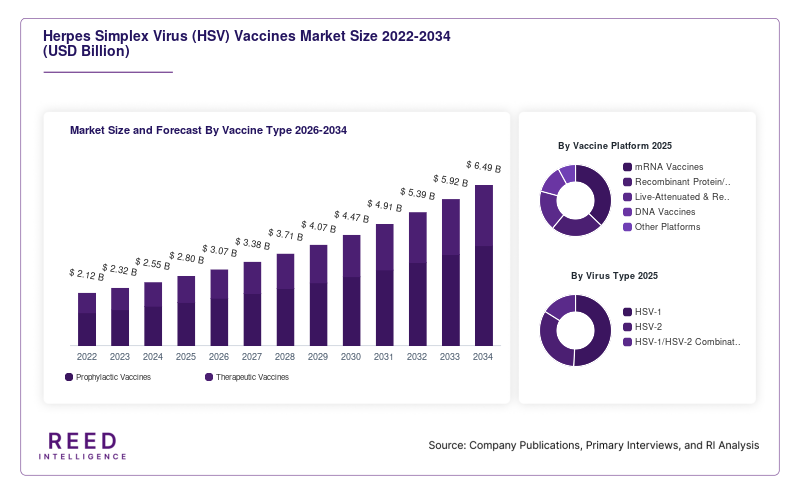
Prophylactic Vaccines represent approximately 58% of the global market in 2025, making them the dominant vaccine type. Their commercial proposition is to prevent HSV infection before exposure, potentially reducing genital herpes, transmission and neonatal infection.
WHO's preferred product characteristics identify prevention of HSV-2 infection as the primary target for prophylactic vaccines and note that additional HSV-1 protection would be beneficial.
The segment has the potential to access larger population-based vaccination programs because a successful prophylactic vaccine could be administered before infection rather than only to people who already experience recurrent disease.
Therapeutic Vaccines account for approximately 42% and are the fastest-growing vaccine type, with approximately 11.2% CAGR. The target population is already infected individuals, particularly those with recurrent genital herpes.
WHO specifically identifies reduction of symptomatic HSV-2 genital ulcer disease as a therapeutic-vaccine objective.
Moderna's mRNA-1608 program illustrates the therapeutic approach, while GSK's 2024 Phase II experience demonstrates both the opportunity and the efficacy challenge.
By Vaccine Platform
mRNA Vaccines represent approximately 32% of the market and are the fastest-growing platform at approximately 13.8% CAGR. Their position is supported by renewed interest in mRNA-based approaches to HSV antigen delivery.
Moderna developed mRNA-1608 as an HSV-2 therapeutic candidate, while BioNTech's BNT163 uses an mRNA approach for prophylactic prevention of genital lesions.
The advantage is platform flexibility and the ability to encode multiple antigens. The limitation remains clinical validation because mRNA technology does not itself guarantee durable protection against latent HSV.
Recombinant Protein/Subunit Vaccines account for approximately 28%. This platform has a long history in HSV research, including candidates targeting multiple HSV glycoproteins.
NIH continues to identify protein-subunit approaches as part of the HSV vaccine-development strategy.
Live-Attenuated & Replication-Defective Vaccines represent approximately 22%. These approaches attempt to generate broad immune responses while limiting the ability of the vaccine virus to cause disease.
HSV529, a replication-defective HSV-2 candidate developed through NIH-supported research, has been evaluated in humans, although the study is completed rather than an active commercial product.
By Virus Type
HSV-2 represents approximately 52% of the market, reflecting its central role in genital herpes prevention and therapeutic development. WHO estimates 520 million people aged 15–49 were infected with HSV-2 in 2020.
HSV-2 also has a direct relationship with HIV transmission and acquisition, increasing its public-health significance.
HSV-1 accounts for approximately 29%. WHO estimates that 3.8 billion people under age 50 had HSV-1 infection in 2020. Although HSV-1 is primarily associated with oral herpes, it can also cause genital infection.
Combined HSV-1/HSV-2 vaccines represent approximately 19% and are the fastest-growing virus-type segment at approximately 12.1% CAGR. A broader-spectrum vaccine could potentially simplify vaccination programs and provide protection against both major HSV types.
BioNTech's BNT163 program is designed around HSV-2 and potentially HSV-1, illustrating the industry's interest in broader coverage.
Regional Analysis
North America Herpes Simplex Virus (HSV) Vaccines Market
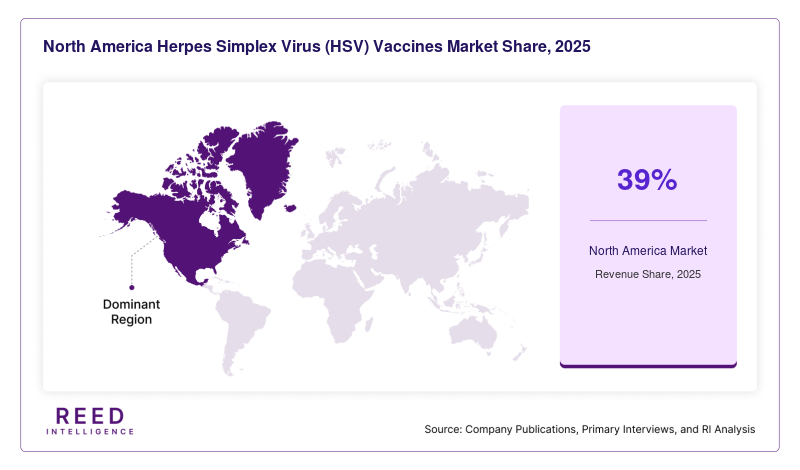
North America represents approximately 39% of the global HSV Vaccines Market in 2025, making it the largest region, with approximately 8.8% CAGR.
The region has a strong HSV clinical-development ecosystem, supported by major academic research centers, biotechnology companies and pharmaceutical developers. The United States is also a major location for clinical testing. Moderna's mRNA-1608 Phase I/II study enrolled 303 adults in the U.S., while BioNTech's BNT163 program includes U.S. clinical sites.
The U.S. also has extensive public-health infrastructure for vaccine procurement and delivery. If a prophylactic HSV vaccine demonstrates sufficient efficacy, the existing immunization system could provide a pathway toward large-scale administration.
Research funding is another regional advantage. NIH's 2025 HSV strategic plan specifically identifies vaccine development as a strategic research objective and supports work across attenuated-virus, DNA/RNA and protein-subunit approaches.
The main constraint is clinical uncertainty. The absence of an approved HSV vaccine means the commercial market remains dependent on successful late-stage development. Previous failures, including GSK's therapeutic candidate, demonstrate that promising immunogenicity must translate into meaningful clinical outcomes.
Europe Herpes Simplex Virus (HSV) Vaccines Market
Europe accounts for approximately 27% of the global market in 2025, with approximately 9.1% CAGR.
European demand is supported by strong vaccine research infrastructure, pharmaceutical manufacturing capabilities and public-health systems. The region is also important to clinical development because BioNTech's BNT163 program includes international clinical evaluation and has been designed to assess immune responses in both healthy and previously infected participants.
The European research environment supports multiple vaccine technologies, including mRNA and protein-based approaches. The scientific focus is increasingly shifting toward understanding mucosal immunity, antigen selection and the impact of pre-existing HSV immunity.
A future prophylactic vaccine could benefit from Europe's established national immunization systems, but adoption would depend on demonstrated efficacy, cost-effectiveness and recommendations from national and regional health authorities.
The primary constraint is the absence of an established HSV vaccination schedule. Unlike HPV or herpes zoster vaccination, there is no existing HSV vaccine program into which a new product could simply be inserted. Developers will therefore need evidence strong enough to establish new vaccination policies.
APAC Herpes Simplex Virus (HSV) Vaccines Market
APAC represents approximately 18% of the global market in 2025 and is the fastest-growing region, registering approximately 11.8% CAGR.
The region's growth is supported by large populations, significant infectious-disease research capacity and expanding biotechnology capabilities in countries including Japan, China, South Korea, Australia and India.
The commercial opportunity is particularly relevant to prophylactic vaccines because large adolescent and young-adult populations provide potential target cohorts if a vaccine eventually demonstrates suitable efficacy and durability.
APAC also has growing mRNA manufacturing and vaccine-development capabilities following the expansion of regional vaccine infrastructure during the COVID-19 period. This creates a potential manufacturing advantage if an HSV vaccine reaches commercialization.
The principal constraint is variation in healthcare expenditure, vaccine procurement systems and regulatory requirements between countries. A successful product may therefore require differentiated pricing and public-health strategies across the region.
Middle East and Africa Herpes Simplex Virus (HSV) Vaccines Market
Middle East and Africa represents approximately 8% of the global market in 2025, with approximately 10.4% CAGR.
The region has a substantial public-health rationale for HSV vaccination because HSV-2 is associated with increased HIV acquisition and transmission risk. WHO specifically identifies potential indirect HIV-prevention benefits as part of the rationale for developing HSV vaccines.
A successful vaccine could therefore have greater public-health value in countries with substantial HIV prevalence, particularly if vaccination reduces HSV-2 acquisition or transmission.
However, vaccine access, healthcare infrastructure, cold-chain requirements and financing remain important constraints. A future product may require international procurement mechanisms and differentiated access strategies to reach populations with the highest public-health need.
LATAM Herpes Simplex Virus (HSV) Vaccines Market
LATAM represents approximately 8% of the global market in 2025, with approximately 10.0% CAGR.
The region provides an opportunity for HSV vaccination through established national immunization programs and growing healthcare infrastructure. The potential public-health benefit is particularly relevant because HSV-2 is widespread globally and contributes to genital herpes and HIV-related risk.
Brazil, Mexico and other larger healthcare markets can provide important commercial entry points for a future licensed vaccine, while regional public-health procurement could support broader adoption.
The major constraints are differences in healthcare budgets, vaccine reimbursement, regulatory processes and access between countries. Pricing and health-economic evidence will therefore be important to future market penetration.
Competitive Landscape
The HSV Vaccines Market remains fundamentally a pipeline-driven competitive environment, because WHO confirms that no HSV-1 or HSV-2 vaccine is currently licensed.
Competition is centered on achieving clinically meaningful protection against a virus that establishes lifelong latency. Developers are pursuing different technological strategies rather than competing solely through manufacturing scale. NIH's strategic plan identifies live attenuated and replication-defective vaccines, DNA/RNA approaches and protein-subunit candidates as active development areas.
BioNTech is one of the key active developers through BNT163, an mRNA candidate designed for prophylactic prevention of genital lesions. Its Phase I program evaluates safety, tolerability and immune responses in healthy adults and people with recurrent genital herpes.
Moderna advanced mRNA-1608 through a Phase I/II therapeutic study in recurrent HSV-2 genital herpes. The trial was completed in April 2025, with results subsequently posted to ClinicalTrials.gov in May 2026.
Key Market Players
Recent Market Developments
-
September 2024 – GSK's therapeutic HSV candidate fails primary efficacy endpoint. GSK reported that GSK3943104 did not meet the primary efficacy objective of the Phase II TH HSV REC-003 study. The company stated that the candidate would not progress to Phase III, although no safety concern was observed. The result reinforces the high clinical-efficacy hurdle facing HSV therapeutic vaccines and increases the importance of improved antigen selection and immune-response strategies.
- 2026 – BioNTech continues BNT163 clinical development: BioNTech's BNT163-01 trial is a Phase I study designed to evaluate safety, tolerability and immune responses to an investigational vaccine intended to prevent genital herpes lesions. The study includes healthy volunteers and people with recurrent HSV-2 genital herpes. BNT163 keeps an mRNA prophylactic approach in the clinical pipeline and provides a development pathway toward broader HSV-1/HSV-2 protection.
Herpes Simplex Virus (HSV) Vaccines Market Segments
By Vaccine Type
- Prophylactic Vaccines
- Therapeutic Vaccines
By Vaccine Platform
- mRNA Vaccines
- Recombinant Protein/Subunit Vaccines
- Live-Attenuated & Replication-Defective Vaccines
- DNA Vaccines
- Other Platforms
By Virus Type
- HSV-1
- HSV-2
- HSV-1/HSV-2 Combination
By End User
- Hospitals & Clinics
- Vaccination Centers
- Research & Academic Institutions
- Other Healthcare Settings
By Region
- North America
- Europe
- APAC
- Middle East and Africa
- LATAM