Heterogeneous Networks Market Size, Share & Demand Report By Component (Hardware, Software, Services), By Deployment Type (Small Cells, Distributed Antenna Systems, Wi-Fi Access Points, Macro Cells), By End-Use (Telecom Operators, Enterprise Networks, Government & Public Sector, Industrial Facilities, Healthcare Organizations), By Region & Segment Forecasts, 2026–2034
USD 3950
Market Overview
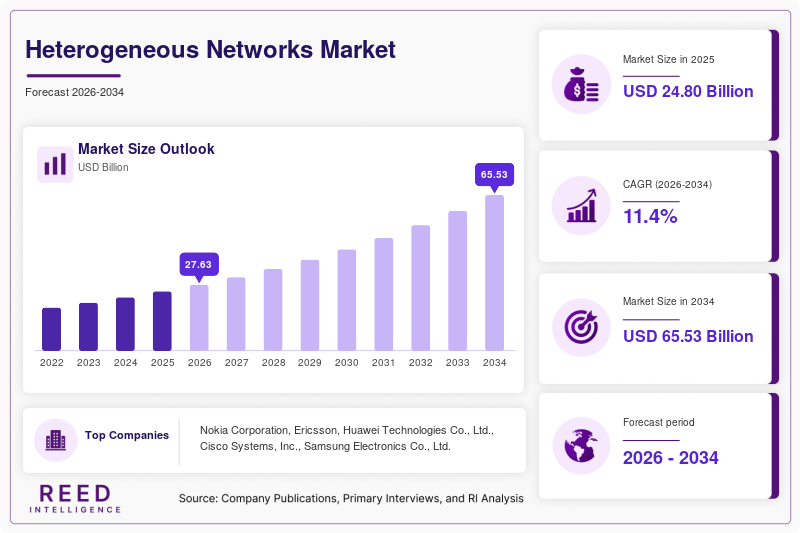
The global Heterogeneous Networks Market size was valued at USD 24.8 billion in 2026 and is projected to reach USD 58.9 billion by 2034, expanding at a CAGR of 11.4% during 2026–2034. The market is experiencing sustained growth as mobile operators, enterprises, and public infrastructure providers continue to enhance wireless coverage, network capacity, and user experience across increasingly connected environments. Heterogeneous networks, commonly known as HetNets, combine macro cells, small cells, Wi-Fi access points, distributed antenna systems, and other wireless technologies into a unified architecture capable of delivering improved connectivity and network efficiency.
One of the primary factors supporting market expansion globally is the rapid growth in mobile data consumption. The increasing adoption of cloud applications, video streaming, remote work platforms, smart devices, and industrial IoT solutions has placed significant pressure on traditional cellular infrastructure. As a result, telecom operators are investing heavily in heterogeneous network deployments to improve spectrum utilization, reduce network congestion, and ensure seamless connectivity in urban and high-density environments.
Key Highlights
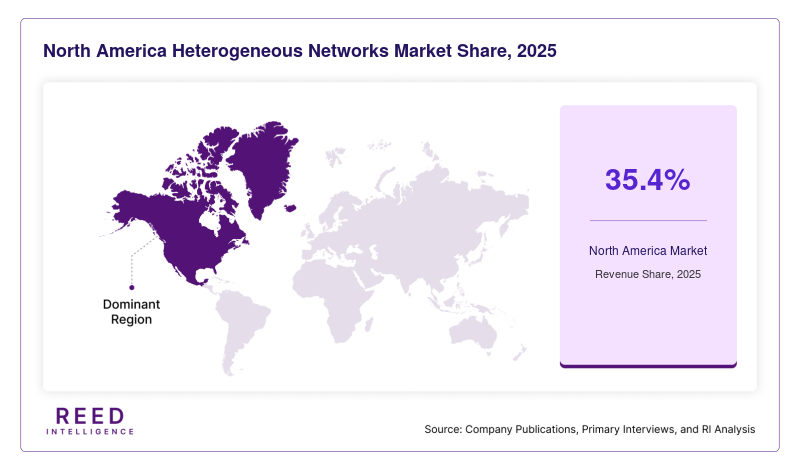
- North America dominated the market with a 35.4% share in 2025, while Asia Pacific is expected to grow at the fastest CAGR of 13.2% during 2026–2034.
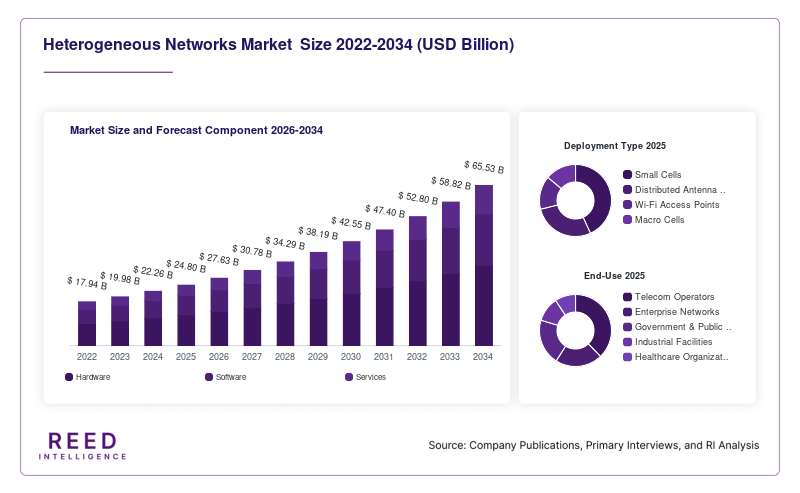
- By component, hardware solutions accounted for the largest share of 44.6%, while services are projected to grow at a CAGR of 12.8%.
- By deployment type, small cells led the market with a 39.8% share, whereas distributed antenna systems are expected to expand at a CAGR of 13.1%.
- By end-use, telecom operators held the largest share of 48.2%, while enterprise networks are anticipated to grow at a CAGR of 13.6%.
- The United States remained the dominant country, with market values of USD 6.8 billion in 2024 and USD 7.5 billion in 2025.
Market Trends
Growing Integration of Private Wireless Networks
Private wireless networks are becoming a significant trend within the heterogeneous networks market. Enterprises increasingly require secure, high-performance connectivity to support automation, robotics, connected machinery, and real-time analytics. Traditional Wi-Fi networks often face limitations in large industrial environments, creating opportunities for heterogeneous architectures that combine cellular technologies with localized wireless infrastructure. Manufacturing plants, logistics hubs, airports, and smart campuses are deploying integrated network solutions that deliver higher reliability and broader coverage. As organizations continue digital transformation initiatives, demand for private wireless environments supported by heterogeneous network frameworks is expected to increase steadily throughout the forecast period.
Expansion of Smart City Connectivity Infrastructure
The development of smart cities is accelerating investments in heterogeneous networking solutions across urban areas. Municipal authorities are deploying connected traffic systems, surveillance networks, public Wi-Fi, environmental sensors, and intelligent transportation platforms that require seamless communication between multiple wireless technologies. Heterogeneous networks enable efficient traffic management, enhanced public safety, and optimized resource utilization by integrating different access technologies into a unified ecosystem. Increasing urbanization, combined with government funding for digital infrastructure projects, is encouraging broader deployment of small cells and distributed antenna systems. This trend is expected to create sustained market demand across both developed and emerging economies.
Market Drivers
Rising Mobile Data Traffic and Network Congestion
The continued surge in mobile data consumption is a major growth driver for the heterogeneous networks market. Consumers increasingly rely on high-definition video streaming, cloud gaming, social media platforms, and real-time communication applications. These services require substantial bandwidth and place pressure on existing macro-cellular infrastructure. Telecom operators are addressing capacity challenges through the deployment of heterogeneous network architectures that distribute traffic across multiple access points and wireless technologies. By improving spectrum efficiency and reducing congestion in densely populated areas, heterogeneous networks help maintain service quality while supporting growing subscriber bases. The need to manage escalating data traffic is expected to remain a fundamental market growth catalyst.
Increasing Investments in Advanced Wireless Infrastructure
Significant investments in wireless infrastructure modernization are driving heterogeneous network adoption globally. Telecom providers are expanding network coverage while improving indoor and outdoor connectivity through the deployment of small cells, distributed antenna systems, and integrated Wi-Fi solutions. Enterprises are also investing in advanced communication networks to support digital operations and connected devices. Public infrastructure projects focused on transportation systems, healthcare facilities, educational campuses, and industrial complexes further contribute to market expansion. These investments enable organizations to achieve greater operational efficiency, improve user experiences, and support emerging applications that require reliable high-capacity wireless communication environments.
Market Restraint
Complex Network Integration and High Deployment Costs
Despite favorable growth prospects, the heterogeneous networks market faces challenges related to network integration complexity and deployment expenses. Building a heterogeneous network requires the coordination of multiple technologies, equipment vendors, and infrastructure components operating within a unified framework. This complexity often increases planning requirements, implementation timelines, and operational management costs. Telecom operators must address interoperability concerns while maintaining network security and service quality across diverse environments.
The financial burden associated with deploying small cells, distributed antenna systems, fiber backhaul infrastructure, and network management platforms can be significant, particularly for smaller operators and organizations with limited budgets. Urban deployments may involve site acquisition expenses, regulatory approvals, and installation challenges that further increase project costs. In addition, maintaining and upgrading heterogeneous network environments requires skilled technical personnel and continuous investment in optimization tools. These factors can slow adoption rates in cost-sensitive markets and create barriers for organizations evaluating large-scale network modernization initiatives.
Market Opportunities
Expanding Industrial IoT Deployments Across Industries
The growing adoption of Industrial Internet of Things technologies presents substantial opportunities for heterogeneous network providers. Manufacturing facilities, energy plants, mining operations, and logistics centers increasingly rely on connected devices for monitoring, automation, predictive maintenance, and operational analytics. These environments require reliable wireless connectivity capable of supporting large numbers of devices and real-time data transmission. Heterogeneous networks provide the scalability and flexibility necessary to meet these requirements by integrating multiple wireless technologies within a single infrastructure. As industries continue implementing smart factory initiatives and connected operational systems, demand for advanced heterogeneous networking solutions is expected to increase considerably.
Rising Demand for Rural and Remote Connectivity Solutions
Many countries continue to face connectivity gaps in rural and remote areas where traditional cellular infrastructure remains economically challenging to deploy. Heterogeneous networks offer an opportunity to improve coverage by combining different wireless access technologies that optimize network performance and cost efficiency. Governments and telecom operators are increasingly prioritizing digital inclusion initiatives aimed at expanding broadband access to underserved populations. Educational services, telemedicine platforms, agricultural technologies, and digital government programs all benefit from improved connectivity. Consequently, heterogeneous network deployments designed for rural environments are expected to emerge as an important growth opportunity during the forecast period.
Segmental Analysis
By Component
Hardware solutions represented the dominant subsegment and accounted for approximately 44.6% market share in 2024. This category includes small cells, radio access equipment, distributed antenna systems, network controllers, and supporting communication infrastructure. Organizations continue investing heavily in physical network assets to improve wireless coverage and support growing connectivity requirements. Telecom operators remain major purchasers of hardware components as they pursue network densification strategies. Increasing demand for enhanced indoor coverage within commercial buildings, airports, stadiums, and transportation hubs further supports hardware deployment across diverse environments. Continuous infrastructure upgrades and network expansion projects contribute significantly to revenue generation within this segment.
Services constitute the fastest-growing subsegment and are projected to expand at a CAGR of 12.8% through 2034. Demand is increasing for consulting, deployment, integration, optimization, maintenance, and managed service offerings associated with heterogeneous network environments. Organizations often require specialized expertise to design and operate complex wireless infrastructures involving multiple technologies and vendors. As heterogeneous network deployments become more sophisticated, service providers play a critical role in ensuring performance, reliability, and security. The growing emphasis on operational efficiency and lifecycle management is expected to accelerate demand for professional and managed services throughout the forecast period.
By Deployment Type
Small cells emerged as the dominant deployment type, accounting for nearly 39.8% of market share in 2024. These solutions are widely adopted because they provide localized coverage improvements while increasing network capacity in densely populated environments. Telecom operators use small cells extensively in urban centers, commercial districts, transportation hubs, and large public venues. Their ability to offload traffic from macro networks helps improve user experiences and network efficiency. Rising mobile data consumption and increasing subscriber expectations for uninterrupted connectivity continue to support strong demand for small-cell deployments across developed and emerging markets alike.
Distributed antenna systems are expected to register the fastest growth, with a projected CAGR of 13.1% during 2026–2034. These systems are increasingly deployed in large indoor environments where reliable wireless coverage is essential. Airports, hospitals, educational institutions, shopping centers, and industrial facilities are adopting distributed antenna systems to improve signal quality and support high user densities. Growing demand for seamless indoor connectivity, combined with the increasing use of connected devices and digital applications, is encouraging organizations to invest in advanced distributed coverage solutions that complement broader heterogeneous network architectures.
By End-Use
Telecom operators held the largest share of the market, representing approximately 48.2% of total revenue in 2024. These organizations remain the primary adopters of heterogeneous network technologies due to their responsibility for delivering reliable connectivity to millions of subscribers. Investments focus on expanding coverage, increasing capacity, improving service quality, and optimizing spectrum utilization. As mobile data traffic continues to rise, operators are deploying integrated wireless architectures that combine macro cells, small cells, Wi-Fi networks, and other technologies. Ongoing infrastructure modernization initiatives ensure that telecom operators maintain their leading position within the market throughout the forecast period.
Enterprise networks are anticipated to record the fastest growth, advancing at a CAGR of 13.6% through 2034. Businesses increasingly require high-performance wireless connectivity to support digital transformation, industrial automation, hybrid work models, and IoT deployments. Enterprises across manufacturing, healthcare, retail, logistics, and education sectors are implementing heterogeneous networking solutions to achieve greater reliability, scalability, and operational efficiency. The growing importance of secure and uninterrupted communication environments is encouraging organizations to invest in advanced network infrastructures tailored to their specific operational requirements, thereby accelerating segment growth.
Regional Analysis
North America
North America accounted for approximately 35.4% of the global heterogeneous networks market in 2025 and continues to maintain a leading position within the industry. The region is projected to expand at a CAGR of 10.8% through 2034, supported by strong investments in wireless infrastructure and advanced communication technologies. High mobile data consumption, widespread enterprise digitization, and increasing demand for seamless connectivity across urban environments continue to stimulate deployment activities among telecom operators and infrastructure providers.
The United States remains the dominant market within North America. One of the primary growth factors supporting expansion is the extensive deployment of advanced small-cell infrastructure across densely populated metropolitan areas. Telecom operators are investing in network densification strategies to improve capacity, coverage, and user experiences. Enterprise adoption of private wireless solutions across manufacturing facilities, logistics hubs, and healthcare institutions is also contributing to sustained market growth throughout the country.
Europe
Europe represented nearly 27.6% of global market revenue in 2025 and is expected to grow at a CAGR of 10.5% during the forecast period. The region benefits from increasing digital transformation initiatives, modernization of communication infrastructure, and rising demand for connected services across industrial and commercial sectors. Governments and private organizations continue to invest in wireless technologies that improve network performance while supporting expanding digital ecosystems.
Germany remains the leading country within the European heterogeneous networks market. A key growth factor is the country's strong industrial base and continued adoption of smart manufacturing technologies. Industrial facilities increasingly require reliable wireless communication systems to support automation, predictive maintenance, and connected production environments. This demand is encouraging enterprises to implement heterogeneous networking architectures that provide scalable and resilient connectivity solutions.
Asia Pacific
Asia Pacific held approximately 23.8% market share in 2025 and is forecast to register the fastest CAGR of 13.2% between 2026 and 2034. Rapid urbanization, growing smartphone penetration, and expanding digital economies are creating favorable conditions for market growth. Telecom operators across the region are investing aggressively in network expansion initiatives to accommodate rising data traffic and improve service quality in densely populated areas.
China dominates the Asia Pacific market due to its large telecommunications sector and extensive infrastructure development activities. A unique growth factor supporting market expansion is the country's large-scale smart city development programs. Municipal governments continue deploying intelligent transportation systems, surveillance networks, environmental monitoring platforms, and connected public services that rely heavily on heterogeneous networking architectures for efficient communication and operational management.
Middle East & Africa
The Middle East & Africa region accounted for around 7.2% of global market revenue in 2025 and is expected to grow at a CAGR of 11.3% through 2034. Investments in digital infrastructure, increasing internet penetration, and modernization of public services are supporting demand for advanced wireless communication networks. Several countries are prioritizing connectivity enhancement projects as part of broader economic diversification and digital transformation strategies.
Saudi Arabia represents the largest market within the region. One notable growth factor is the implementation of national digital transformation programs that require extensive communication infrastructure development. Smart city initiatives, industrial modernization projects, and expanding enterprise connectivity requirements are driving investments in heterogeneous network deployments. These projects are expected to create long-term opportunities for infrastructure providers and technology vendors operating in the region.
Latin America
Latin America captured approximately 6.0% of the global heterogeneous networks market in 2025 and is anticipated to expand at a CAGR of 10.9% during the forecast period. Growing demand for broadband connectivity, increasing mobile internet usage, and ongoing telecommunications modernization efforts are contributing to market growth. Governments and operators are investing in wireless infrastructure to improve service coverage and support digital inclusion objectives.
Brazil remains the dominant country across Latin America. A significant growth factor is the increasing deployment of connectivity solutions across transportation, logistics, and public infrastructure projects. The country's expanding urban population and rising demand for digital services are encouraging telecom operators to deploy heterogeneous networking architectures that enhance network capacity and improve connectivity experiences for both businesses and consumers.
Competitive Landscape
The heterogeneous networks market remains moderately consolidated, with major telecommunications equipment manufacturers and networking technology providers competing through product innovation, strategic partnerships, and infrastructure expansion initiatives. Market participants focus on enhancing network efficiency, improving interoperability, and supporting evolving connectivity requirements across enterprise and carrier environments.
Nokia Corporation continues to maintain a leading position due to its broad wireless infrastructure portfolio and strong presence across global telecommunications markets. The company recently expanded its heterogeneous networking capabilities through advanced network management solutions designed to improve traffic optimization and infrastructure efficiency.
Other prominent participants include Ericsson, Huawei Technologies, Cisco Systems, and Samsung Electronics. These companies continue investing in small-cell technologies, distributed antenna systems, cloud-native network management platforms, and enterprise wireless solutions. Strategic collaborations with telecom operators and enterprise customers remain common as vendors seek to strengthen market presence and address growing demand for advanced connectivity infrastructure. Competitive differentiation increasingly depends on scalability, operational simplicity, network intelligence, and support for diverse deployment environments.
Key Players
- Nokia Corporation
- Ericsson
- Huawei Technologies Co., Ltd.
- Cisco Systems, Inc.
- Samsung Electronics Co., Ltd.
- ZTE Corporation
- Fujitsu Limited
- CommScope Holding Company, Inc.
- NEC Corporation
- Airspan Networks
- Corning Incorporated
- Juniper Networks, Inc.
- Mavenir Systems, Inc.
- Parallel Wireless, Inc.
- Qualcomm Incorporated
Recent Developments
- In 2025, a leading telecommunications infrastructure provider expanded its small cell deployment capacity to support rising demand for ultra-dense heterogeneous network architectures in urban environments.
- In 2025, several network equipment vendors launched integrated heterogeneous networking solutions combining macro cells, small cells, and Wi-Fi access points to improve seamless connectivity and network efficiency.
- In 2024, a major telecom technology company introduced an advanced distributed antenna system (DAS) platform designed to enhance indoor coverage for airports, hospitals, and large commercial complexes.
- In 2024, global network operators increased investments in AI-driven network optimization tools aimed at improving traffic management and performance in heterogeneous network environments.
- In 2025, strategic collaborations between telecom operators and cloud service providers accelerated the rollout of private 5G-enabled heterogeneous network solutions for industrial and enterprise applications.
Heterogeneous Networks Market Segments
Component
- Hardware
- Software
- Services
Deployment Type
- Small Cells
- Distributed Antenna Systems
- Wi-Fi Access Points
- Macro Cells
End-Use
- Telecom Operators
- Enterprise Networks
- Government & Public Sector
- Industrial Facilities
- Healthcare Organizations
By Region
- North America
- Europe
- APAC
- Middle East and Africa
- LATAM