Hexahydrobenzoyl Chloride Market Size, Share & Demand Report By Type (Industrial Grade, Pharmaceutical Grade), By Application (Pharmaceuticals, Agrochemicals, Chemical Synthesis), By End-Use Industry (Pharmaceutical Industry, Chemical Manufacturing, Research Laboratories), By Distribution Channel (Offline Distribution, Online Distribution) & Region Forecasts, 2025–2034
USD 3950
Market Overview
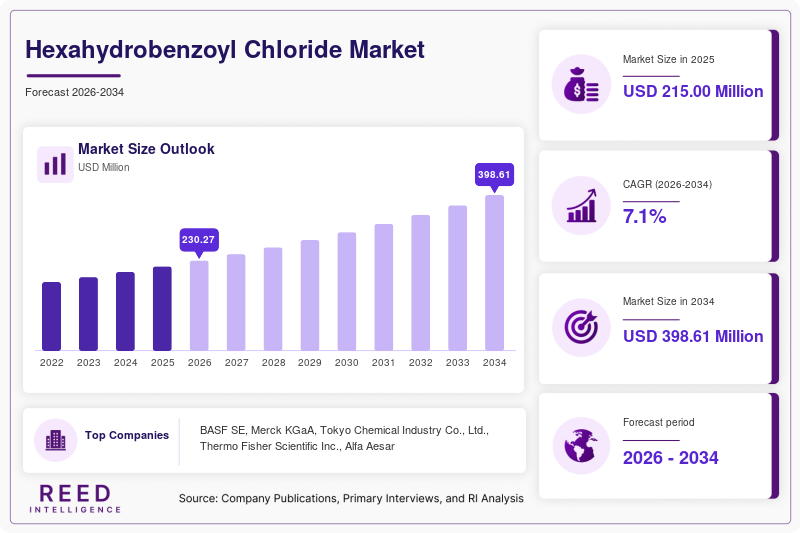
The Hexahydrobenzoyl Chloride Market size was valued at USD 215 million in 2025 and is projected to reach USD 398 million by 2034, expanding at a CAGR of 7.1% during the forecast period (2025–2034). The market growth is supported by increasing demand for specialty chemical intermediates in pharmaceutical synthesis and agrochemical production. Hexahydrobenzoyl chloride is widely used as an acylating agent, enabling efficient chemical reactions in drug formulation and crop protection product development. Its stability and reactivity make it suitable for controlled synthesis processes across multiple industrial applications.
A key global factor supporting the growth of the Hexahydrobenzoyl Chloride Market is the expansion of the pharmaceutical and fine chemicals industry. Rising investments in drug discovery, particularly in emerging economies, have increased the consumption of high-purity intermediates. Additionally, growing demand for crop protection chemicals to enhance agricultural productivity has reinforced the need for specialized reagents such as hexahydrobenzoyl chloride. This dual demand from pharmaceutical and agrochemical sectors continues to sustain market expansion.
Key Highlights:
- Asia Pacific dominated the market with a share of 36% in 2025, while it is expected to register the fastest CAGR of 8.2% during the forecast period.
- By type, industrial grade accounted for the largest share, while pharmaceutical grade is anticipated to witness the fastest growth at a CAGR of 8.6%.
- By application, pharmaceuticals led the segment, whereas agrochemicals are projected to grow rapidly at a CAGR of 8.1%.
- China remained the dominant country, with market values of USD 62 million in 2025 and USD 66 million in 2026.
Market Trends
Increasing Demand for High-Purity Chemical Intermediates
The Hexahydrobenzoyl Chloride Market is witnessing a growing shift toward high-purity chemical intermediates, particularly in pharmaceutical applications. Manufacturers are focusing on improving product quality to meet stringent regulatory standards. This trend is driven by the need for precision in drug formulation and synthesis processes. As pharmaceutical companies emphasize quality assurance and compliance, the demand for pharmaceutical-grade hexahydrobenzoyl chloride continues to increase steadily.
Expansion of Agrochemical Production
Another significant trend shaping the Hexahydrobenzoyl Chloride Market is the expansion of agrochemical manufacturing. Rising global food demand has encouraged the use of advanced crop protection chemicals, which rely on specialized intermediates. Hexahydrobenzoyl chloride plays a role in synthesizing active ingredients for pesticides and herbicides. This trend is particularly evident in developing economies where agricultural productivity is a priority, leading to sustained consumption of chemical intermediates.
Market Drivers
Rising Demand from Pharmaceutical Manufacturing
The increasing demand for pharmaceutical products is a major driver for the Hexahydrobenzoyl Chloride Market. The compound is widely used in synthesizing active pharmaceutical ingredients (APIs), making it essential in drug development. As global healthcare needs expand and new therapies are developed, the demand for reliable chemical intermediates continues to rise. This growth is further supported by increasing investments in pharmaceutical research and manufacturing facilities.
Growth of Agrochemical Industry
The expanding agrochemical sector is another key driver of the Hexahydrobenzoyl Chloride Market. Farmers and agricultural companies are adopting advanced crop protection solutions to improve yields and manage pests effectively. Hexahydrobenzoyl chloride is used in the synthesis of various agrochemical compounds, supporting its demand. As global agricultural output requirements increase, the need for efficient chemical intermediates is expected to grow consistently.
Market Restraint
Stringent Environmental and Safety Regulations
A major restraint affecting the Hexahydrobenzoyl Chloride Market is the implementation of strict environmental and safety regulations governing chemical production and handling. Regulatory authorities across regions have established guidelines to minimize environmental impact and ensure safe usage of hazardous substances. Compliance with these regulations often requires additional investments in safety infrastructure, waste management, and emission control systems.
Furthermore, the handling and storage of hexahydrobenzoyl chloride require specialized equipment and trained personnel, increasing operational costs for manufacturers. Smaller companies may face challenges in meeting these requirements, limiting their participation in the market. The regulatory burden can also slow down product approvals and expansion plans, affecting overall market growth. While these regulations aim to ensure safety and sustainability, they present challenges for industry players seeking to scale operations.
Market Opportunities
Expansion in Emerging Markets
Emerging economies present significant opportunities for the Hexahydrobenzoyl Chloride Market. Countries in Asia Pacific and Latin America are experiencing rapid industrialization and growth in pharmaceutical and agrochemical sectors. Increasing investments in manufacturing infrastructure and favorable government policies are encouraging the establishment of chemical production facilities. This expansion creates new demand for intermediates such as hexahydrobenzoyl chloride, supporting market growth.
Advancements in Specialty Chemical Applications
The development of advanced specialty chemicals offers another promising opportunity for the Hexahydrobenzoyl Chloride Market. Researchers are exploring new applications for chemical intermediates in areas such as advanced materials and fine chemical synthesis. These innovations require high-performance reagents, increasing the relevance of hexahydrobenzoyl chloride. As industries continue to evolve and adopt new technologies, the demand for specialized intermediates is expected to expand.
Segmental Analysis
By Type
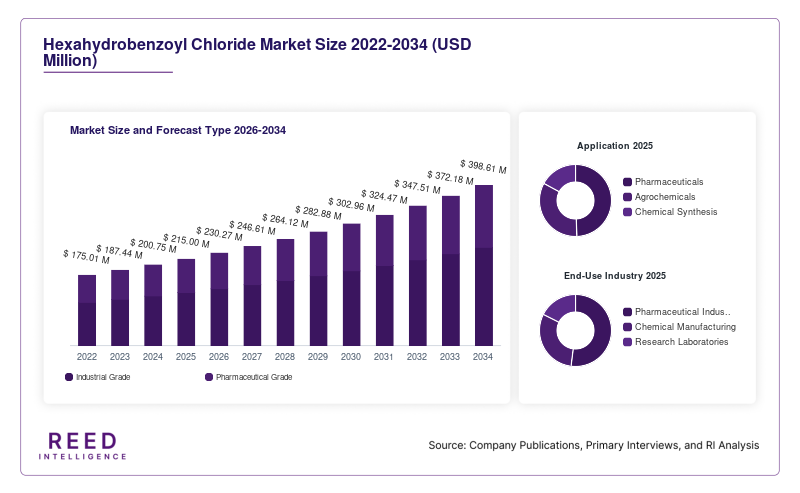
Industrial grade hexahydrobenzoyl chloride dominated the Hexahydrobenzoyl Chloride Market in 2025, accounting for 61% of the total share. Its widespread use in large-scale chemical synthesis and cost-effectiveness made it the preferred choice across various industries.
Pharmaceutical grade is projected to grow at the fastest CAGR of 8.6% during the forecast period. The increasing focus on high-purity chemicals for drug manufacturing will drive demand, supported by stringent quality standards in the pharmaceutical sector.
By Application
The pharmaceuticals segment held the largest share of 48% in 2025, driven by the compound’s role in API synthesis and drug development processes. The demand for effective intermediates in pharmaceutical production continues to support segment dominance.
The agrochemicals segment is expected to grow at a CAGR of 8.1%. Rising demand for crop protection chemicals and improved agricultural productivity will drive the adoption of hexahydrobenzoyl chloride in agrochemical synthesis.
By End-Use Industry
The pharmaceutical industry dominated the Hexahydrobenzoyl Chloride Market with a 45% share in 2025. The need for reliable intermediates in drug formulation and manufacturing processes contributed to this dominance.
The chemical manufacturing segment is anticipated to grow at a CAGR of 7.9%. Increasing production of specialty chemicals and industrial intermediates will support growth in this segment.
By Distribution Channel
Offline distribution channels accounted for 64% of the market share in 2025, as bulk buyers prefer direct procurement from manufacturers and authorized distributors.
Online distribution channels are expected to grow at a CAGR of 8.3%. The convenience of digital platforms and expanding e-commerce infrastructure for industrial chemicals will drive segment growth.
Regional Analysis
North America
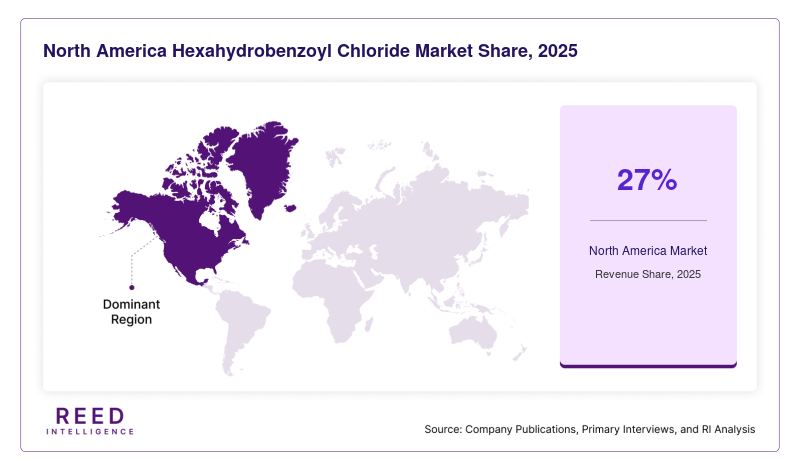
North America accounted for 27% of the Hexahydrobenzoyl Chloride Market share in 2025 and will grow at a CAGR of 6.7% during the forecast period. The region benefits from a well-established pharmaceutical industry and strong research infrastructure, supporting consistent demand for chemical intermediates.
The United States leads the regional market due to its advanced pharmaceutical manufacturing capabilities. The country’s focus on drug innovation and high-quality production standards drives the demand for hexahydrobenzoyl chloride in synthesis processes.
Europe
Europe held a 24% share of the Hexahydrobenzoyl Chloride Market in 2025 and is expected to grow at a CAGR of 6.5% through 2034. The region is characterized by a strong presence of chemical and pharmaceutical industries.
Germany dominates the European market due to its robust chemical manufacturing sector. The country’s emphasis on precision engineering and high-quality production supports the demand for specialized intermediates in industrial and pharmaceutical applications.
Asia Pacific
Asia Pacific represented 36% of the market in 2025 and is projected to grow at the fastest CAGR of 8.2% during the forecast period. Rapid industrialization and expanding pharmaceutical production are key growth factors in the region.
China leads the market due to its large-scale chemical manufacturing capabilities. The country’s focus on increasing domestic production and exports of pharmaceuticals and agrochemicals drives demand for hexahydrobenzoyl chloride.
Middle East & Africa
The Middle East & Africa accounted for 7% of the Hexahydrobenzoyl Chloride Market in 2025 and will grow at a CAGR of 6.3%. Increasing investments in industrial diversification support market expansion.
Saudi Arabia is a key contributor, driven by its focus on developing the chemical and manufacturing sectors. Government initiatives aimed at reducing dependence on oil revenues are encouraging the growth of specialty chemical production.
Latin America
Latin America held a 6% share of the market in 2025 and is expected to grow at a CAGR of 6.6% through 2034. Growth is supported by rising demand for agrochemicals and pharmaceuticals.
Brazil dominates the regional market due to its expanding agricultural sector. The country’s need for advanced crop protection solutions drives demand for chemical intermediates used in agrochemical production.
Competitive Landscape
The Hexahydrobenzoyl Chloride Market is moderately competitive, with key players focusing on product quality, supply chain efficiency, and strategic partnerships. Companies are investing in research and development to enhance product performance and meet industry standards.
BASF SE is a leading player in the market, recognized for its extensive portfolio of specialty chemicals. The company recently expanded its production capacity for high-purity intermediates to meet growing pharmaceutical demand. Other notable players include Merck KGaA, Tokyo Chemical Industry Co., Ltd., and Thermo Fisher Scientific Inc., which emphasize innovation and global distribution networks. These companies adopt strategies such as mergers, collaborations, and product launches to strengthen their market positions and expand their presence in emerging markets.
Key Players List
- BASF SE
- Merck KGaA
- Tokyo Chemical Industry Co., Ltd.
- Thermo Fisher Scientific Inc.
- Alfa Aesar
- Sigma-Aldrich (Merck Group)
- Santa Cruz Biotechnology, Inc.
- TCI America
- Oakwood Chemical
- Acros Organics
- Central Drug House (P) Ltd.
- Loba Chemie Pvt. Ltd.
- Chem-Impex International
- Haihang Industry Co., Ltd.
- Wuhan ChemNorm Biotech Co., Ltd.
Recent Developments
- BASF SE expanded production capacity for specialty intermediates to meet pharmaceutical demand.
- Merck KGaA introduced high-purity variants for research and pharmaceutical applications.
- Tokyo Chemical Industry enhanced its global distribution network for specialty chemicals.
- Thermo Fisher Scientific launched advanced chemical intermediates for laboratory use.
- Sigma-Aldrich expanded its product portfolio to include specialty reagents for industrial applications.
Hexahydrobenzoyl Chloride Market Segments
Type
- Industrial Grade
- Pharmaceutical Grade
Application
- Pharmaceuticals
- Agrochemicals
- Chemical Synthesis
End-Use Industry
- Pharmaceutical Industry
- Chemical Manufacturing
- Research Laboratories
Distribution Channel
- Offline
- Online
By Region
- North America
- Europe
- APAC
- Middle East and Africa
- LATAM