Hexamine Market Size, Share & Demand Report By Product Type (Industrial Grade, Pharmaceutical Grade, Food Grade), By Application (Resins, Pharmaceuticals, Explosives, Rubber Processing Chemicals, Fuel Tablets, Others), By End-Use Industry (Construction, Automotive, Healthcare, Mining, Defense, Electronics, Others) By Region & Segment Forecasts, 2026–2034
USD 3950
Market Overview
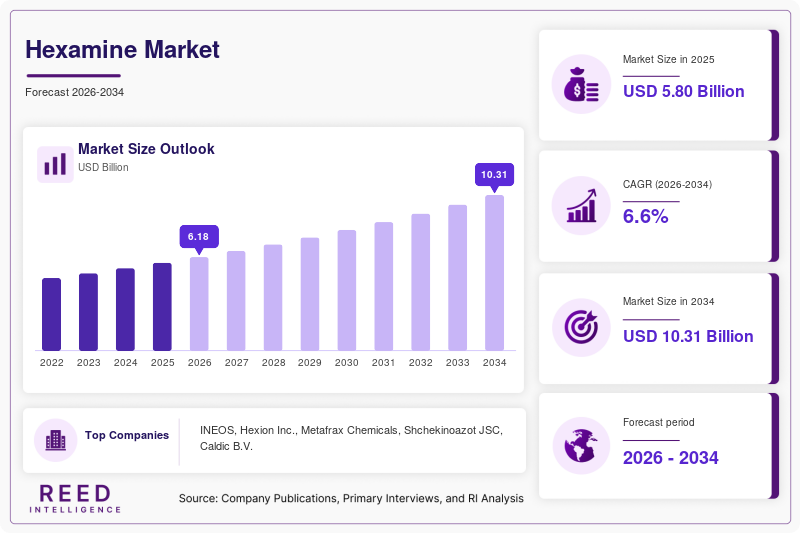
The global Hexamine Market size was valued at USD 5.8 billion in 2026 and is projected to reach USD 9.7 billion by 2034, expanding at a CAGR of 6.6% during the forecast period from 2026 to 2034. Hexamine, also known as hexamethylenetetramine, remains an important industrial chemical widely used in resins, explosives, pharmaceuticals, rubber processing chemicals, and fuel tablets. The market continues to witness steady demand growth due to the expansion of construction, automotive, defense, and industrial manufacturing activities across both developed and emerging economies. Increasing consumption of phenolic and amino resins in laminates, insulation materials, brake linings, and molded products has strengthened the commercial outlook for manufacturers operating in the global industry.
A major global factor supporting market expansion is the rising investment in industrial infrastructure and engineered wood products. Governments and private companies are increasing spending on transportation, residential construction, and industrial facilities, creating higher demand for phenolic resins and adhesive formulations where hexamine serves as a curing and crosslinking agent. In addition, the growing use of lightweight and durable composite materials in automotive and aerospace applications has further improved long-term market prospects. Demand from the pharmaceutical sector for urinary tract infection treatments and specialty formulations also contributes to stable revenue generation across regions.
Key Highlights
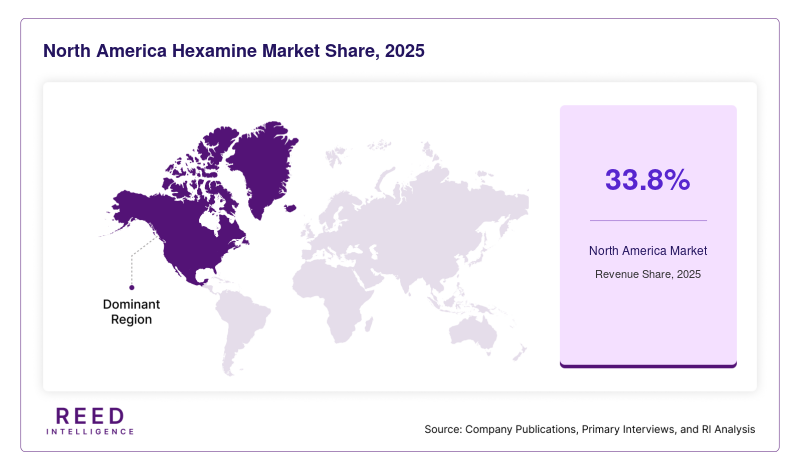
- North America dominated the market with a 33.8% share in 2025.
- Asia Pacific is expected to grow at the fastest CAGR of 7.9% during 2026–2034.
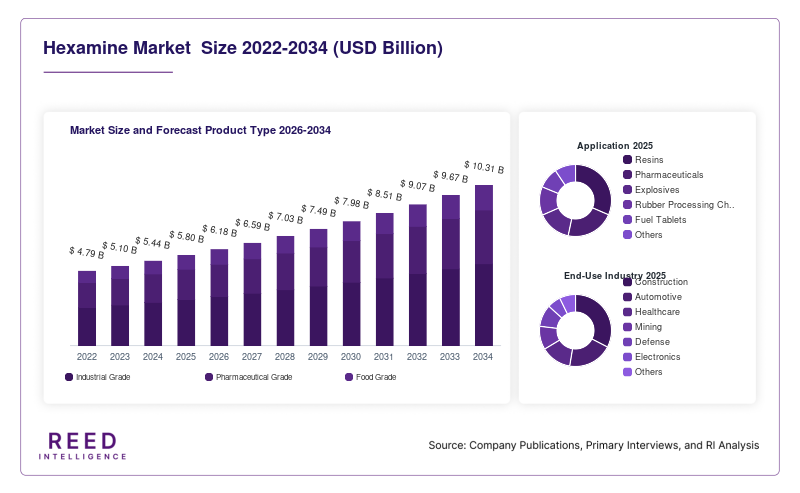
- By application, resins accounted for the largest share of 44.1%.
- while pharmaceuticals are projected to grow at a CAGR of 8.3%.
- By end-use industry, construction led with a 36.5% share, whereas automotive is expected to expand at a CAGR of 7.8%.
- The United States remained the dominant country, with market values of USD 1.42 billion in 2024 and USD 1.51 billion in 2025.
Market Trends
Growing utilization of hexamine in high-performance resin manufacturing
The increasing adoption of high-performance resin systems across construction, automotive, electronics, and furniture manufacturing industries is shaping new growth trends in the Hexamine Market. Manufacturers are using hexamine as a hardening and crosslinking agent in phenolic and amino resins to improve mechanical strength, heat resistance, and chemical durability. Demand for engineered wood panels, insulation laminates, industrial coatings, and molded components has increased significantly due to rising infrastructure investments and urban development projects. Industrial producers are also focusing on lightweight composite materials that improve energy efficiency in transportation systems. As industrial design requirements become more complex, resin manufacturers are seeking stable and efficient curing agents, supporting sustained demand growth for hexamine products in both mature and developing economies.
Expansion of pharmaceutical and specialty chemical applications
The pharmaceutical industry is emerging as an important area of application for hexamine manufacturers due to growing healthcare expenditure and increasing treatment demand for urinary tract infections. Hexamine compounds are used in specific medicinal formulations because of their antibacterial properties and formulation stability. In addition, specialty chemical manufacturers are expanding the use of hexamine in rubber accelerators, explosives, corrosion inhibitors, and fuel tablets for military and camping applications. The diversification of application areas has reduced dependence on a single industrial sector and improved long-term market resilience. Companies are also investing in customized grades and high-purity formulations to address strict quality standards required in pharmaceutical and specialty industrial applications, creating broader opportunities for revenue expansion.
Market Drivers
Rising demand from the construction and infrastructure sector
Strong growth in residential, commercial, and industrial construction activities continues to drive demand in the Hexamine Market. Hexamine is widely utilized in phenolic resin production for laminates, insulation materials, adhesives, and molding compounds used in construction applications. Governments in Asia Pacific, North America, and the Middle East are investing heavily in transport infrastructure, smart cities, and industrial corridors, creating sustained consumption of engineered materials and resin-based products. The growing preference for durable, heat-resistant, and chemically stable construction materials has further strengthened the use of phenolic compounds where hexamine acts as a curing agent. In addition, increasing renovation activities in developed countries are contributing to higher consumption of industrial adhesives and composite products.
Expanding automotive production and lightweight material adoption
The automotive industry remains a significant driver for the global Hexamine Market due to increasing production of lightweight and high-strength vehicle components. Hexamine-based resin systems are used in brake linings, clutch facings, molded parts, and composite structures that improve thermal stability and wear resistance. Automakers are under pressure to improve fuel efficiency and reduce emissions, encouraging the use of lightweight materials across passenger and commercial vehicles. Electric vehicle production is also creating additional opportunities for advanced composite materials and insulation systems. Growing investments in automotive manufacturing facilities across India, China, Mexico, and Eastern Europe are supporting industrial chemical demand and creating favorable long-term growth conditions for hexamine suppliers.
Market Restraint
Stringent environmental regulations and raw material price volatility
The Hexamine Market faces challenges related to fluctuating raw material prices and increasingly strict environmental regulations governing chemical manufacturing operations. Hexamine production depends on formaldehyde and ammonia feedstocks, both of which experience price volatility due to supply chain disruptions, energy cost fluctuations, and geopolitical uncertainties. Rising raw material costs can reduce manufacturer profit margins and create pricing pressure across downstream industries. In addition, environmental agencies in North America and Europe have implemented stricter emission and workplace safety standards for formaldehyde-based chemicals because of concerns regarding worker exposure and environmental impact. Compliance with these regulations requires significant investment in emission control systems, waste treatment facilities, and production process optimization. Smaller manufacturers often face operational challenges in maintaining compliance while remaining cost competitive. These factors can limit capacity expansion and delay investment decisions in certain regional markets.
Market Opportunities
Increasing defense spending and demand for industrial explosives
Growing defense modernization programs and mining activities are creating new opportunities for the Hexamine Market. Hexamine is used in the production of explosives and propellant formulations due to its chemical stability and efficient combustion properties. Several countries are increasing defense budgets to strengthen military preparedness and modernize ammunition systems, supporting demand for specialty explosive chemicals. The mining industry is also expanding exploration and extraction activities for critical minerals, metals, and rare earth resources needed for renewable energy and electronics manufacturing. This trend has increased the need for industrial blasting materials and chemical intermediates. Manufacturers that develop high-purity and application-specific hexamine grades are expected to benefit from stable demand across defense and mining sectors.
Development of sustainable and high-purity chemical production technologies
The transition toward sustainable industrial manufacturing presents long-term opportunities for companies operating in the Hexamine Market. Chemical producers are investing in energy-efficient processing systems, emission reduction technologies, and advanced catalyst methods to reduce environmental impact while improving production yields. Demand for high-purity hexamine grades is increasing in pharmaceutical, electronics, and specialty chemical applications where product consistency and regulatory compliance are critical. Companies that adopt cleaner production technologies and improve supply chain transparency are expected to strengthen relationships with global customers and regulatory authorities. In addition, strategic collaborations between chemical manufacturers and research institutions are supporting innovation in resin chemistry, specialty additives, and industrial processing applications, creating opportunities for differentiated product development.
Segmental Analysis
By Application
Resins accounted for the largest share of the global Hexamine Market in 2024, representing 44.1% of total revenue. Hexamine is extensively used as a curing and crosslinking agent in phenolic and amino resin production because it improves thermal resistance, mechanical durability, and chemical stability. Demand for resin-based products has increased across construction, automotive, electronics, and furniture manufacturing industries. Laminates, insulation materials, brake linings, molded parts, and industrial adhesives continue to drive large-scale resin consumption globally. The expansion of infrastructure development projects and growing use of engineered wood products have further strengthened demand for phenolic resin systems. Manufacturers are increasingly focusing on high-performance resin formulations to meet changing industrial requirements related to durability, lightweight design, and sustainability.
Pharmaceuticals are projected to register the fastest CAGR of 8.3% during the forecast period due to increasing healthcare expenditure and rising demand for antibacterial treatment formulations. Hexamine compounds are used in pharmaceutical applications because of their antimicrobial characteristics and formulation stability. Growth in aging populations and increasing incidence of urinary tract infections are supporting demand for specialty medicinal products containing hexamine derivatives. Pharmaceutical companies are also investing in advanced drug delivery systems and improved production standards, encouraging the use of high-purity chemical intermediates. Expanding healthcare infrastructure in emerging economies and rising access to medical treatment are expected to create additional opportunities for pharmaceutical-grade hexamine suppliers during the coming years.
By End-Use Industry
Construction emerged as the dominant end-use industry in the Hexamine Market in 2024, accounting for 36.5% of total market share. The industry uses hexamine-based resins and adhesives in insulation materials, laminates, wood panels, coatings, and molded construction products. Rapid urbanization, commercial infrastructure expansion, and residential housing projects continue to increase the use of engineered materials requiring durable resin systems. Governments in Asia Pacific and the Middle East are investing heavily in transport infrastructure, industrial corridors, and smart city developments, contributing to higher consumption of construction chemicals. The need for heat-resistant and chemically stable building materials has also encouraged the adoption of phenolic resin systems where hexamine serves as a key curing agent.
Automotive is expected to witness the fastest CAGR of 7.8% from 2026 to 2034 due to rising global vehicle production and increasing adoption of lightweight composite materials. Hexamine-based resins are widely utilized in brake pads, clutch facings, molded components, and insulation materials because of their strength and thermal stability. Electric vehicle manufacturing is creating additional opportunities for advanced materials and engineered components designed to improve energy efficiency and performance. Automotive manufacturers are also focusing on emission reduction and fuel economy standards, increasing demand for lightweight materials that support vehicle weight reduction. Expanding production facilities across China, India, Mexico, and Eastern Europe are expected to accelerate industrial chemical demand during the forecast period.
By Product Type
Industrial-grade hexamine held the largest share of the global Hexamine Market in 2024, contributing 61.2% of total revenue. Industrial-grade products are extensively utilized in resin manufacturing, explosives, rubber chemicals, and fuel tablets because of their broad applicability and cost efficiency. The increasing use of industrial adhesives, laminates, molded plastics, and specialty coatings has supported large-scale demand for industrial-grade materials. Chemical manufacturers are focusing on improving production efficiency and supply chain integration to meet growing industrial requirements. In addition, the expansion of mining, construction, and automotive manufacturing sectors has strengthened consumption of industrial-grade hexamine across both developed and emerging markets.
Pharmaceutical-grade hexamine is anticipated to record the fastest CAGR of 8.1% during the forecast period due to rising quality standards and increasing pharmaceutical production worldwide. Healthcare manufacturers require highly purified chemical intermediates to comply with strict regulatory guidelines and ensure formulation consistency. Growing demand for urinary tract infection treatments and specialty medicinal products is creating favorable opportunities for pharmaceutical-grade suppliers. Several producers are investing in advanced purification technologies and quality control systems to strengthen competitiveness in high-value healthcare applications. Expanding pharmaceutical manufacturing capacity in Asia Pacific and North America is expected to support sustained growth for premium-grade hexamine products.
Regional Analysis
North America
North America accounted for 33.8% of the global Hexamine Market share in 2025 and is expected to maintain stable growth at a CAGR of 5.8% during the forecast period. The region benefits from advanced industrial infrastructure, strong automotive production capabilities, and consistent demand for engineered resin systems. Construction renovation activities across the United States and Canada continue to support consumption of laminates, adhesives, and insulation materials. In addition, the presence of major chemical manufacturers and strong research capabilities contribute to product innovation and supply chain efficiency.
The United States remained the dominant country in North America due to its large-scale industrial manufacturing sector and strong defense expenditure. The country also benefits from growing demand for specialty chemicals and pharmaceutical formulations. Expansion of electric vehicle production facilities and infrastructure modernization projects has created additional demand for composite materials and resin applications. Increasing investments in industrial automation and advanced manufacturing technologies are also supporting higher consumption of high-performance chemical intermediates, including hexamine-based products.
Europe
Europe represented 26.4% of the global Hexamine Market in 2025 and is projected to expand at a CAGR of 5.4% between 2026 and 2034. The regional market is supported by strong demand from automotive, construction, and industrial manufacturing industries. Germany, France, and Italy remain major consumers of phenolic resins and molded industrial components. European manufacturers are increasingly focusing on environmentally responsible chemical production processes, leading to investment in low-emission manufacturing systems and sustainable industrial practices.
Germany dominated the European market due to its extensive automotive and industrial engineering industries. The country has a strong base of chemical manufacturing companies that utilize hexamine in resin systems, rubber processing, and specialty applications. Rising adoption of lightweight vehicle components and high-performance industrial materials continues to support product demand. In addition, European Union sustainability policies are encouraging companies to improve process efficiency and invest in cleaner production technologies, which has accelerated modernization across the regional chemical sector.
Asia Pacific
Asia Pacific held 24.7% of the global Hexamine Market in 2025 and is anticipated to register the fastest CAGR of 7.9% during the forecast period. Rapid industrialization, urban infrastructure development, and rising automotive production are major contributors to regional market growth. Countries such as China, India, Japan, and South Korea are witnessing strong demand for adhesives, laminates, molding compounds, and specialty chemicals. The availability of low-cost manufacturing infrastructure and expanding industrial investment have also attracted global chemical companies to establish regional production facilities.
China emerged as the dominant country in Asia Pacific because of its large-scale chemical manufacturing base and extensive construction activities. The country continues to invest heavily in industrial infrastructure, transportation networks, and residential housing projects, increasing demand for resin-based products and industrial chemicals. In addition, rising production of electric vehicles and consumer electronics has created higher consumption of engineered materials and composite components. India is also becoming an important growth market due to expanding industrial production and favorable manufacturing policies.
Middle East & Africa
The Middle East & Africa accounted for 8.1% of the global Hexamine Market in 2025 and is expected to grow at a CAGR of 5.9% through 2034. Industrial diversification programs and infrastructure development projects are supporting chemical demand across the region. Gulf countries are investing in downstream petrochemical industries and industrial manufacturing facilities to reduce economic dependence on crude oil exports. Demand for industrial adhesives, coatings, insulation materials, and specialty chemicals has increased steadily due to ongoing urban development and energy sector expansion.
Saudi Arabia dominated the regional market because of its strong petrochemical sector and increasing industrial investment. The country has expanded manufacturing activities related to construction materials, automotive components, and industrial chemicals. Government-led industrial diversification programs and economic development initiatives continue to attract foreign investment into the chemical sector. In addition, mining and defense-related projects across the region are contributing to higher demand for industrial explosives and specialty chemical compounds where hexamine is used as an important intermediate.
Latin America
Latin America captured 7.0% of the global Hexamine Market in 2025 and is forecast to expand at a CAGR of 5.3% during the assessment period. The regional market is supported by growth in construction, mining, and automotive manufacturing activities. Brazil and Mexico remain important production and consumption hubs for industrial chemicals and engineered materials. Rising investments in transportation infrastructure and industrial facilities have contributed to increasing demand for adhesives, resins, and composite products across regional economies.
Brazil remained the dominant country in Latin America due to its diversified industrial sector and large construction industry. The country has experienced rising demand for engineered wood products, insulation materials, and industrial coatings used in residential and commercial development projects. Growth in mining activities and agricultural equipment manufacturing has also strengthened demand for specialty chemicals and industrial resins. Mexico is emerging as another important market because of its expanding automotive manufacturing industry and integration with North American supply chains.
Competitive Landscape
The global Hexamine Market is moderately consolidated, with leading companies focusing on production expansion, product quality improvement, and long-term supply agreements with industrial customers. Major manufacturers are investing in advanced process technologies, sustainability initiatives, and regional distribution networks to strengthen their market position. Companies are also emphasizing research and development activities to improve production efficiency and develop high-purity grades for pharmaceutical and specialty chemical applications.
INEOS remains one of the leading participants in the global market due to its strong production capabilities, integrated chemical supply chain, and broad industrial customer base. The company has focused on improving operational efficiency and expanding specialty chemical offerings to support rising industrial demand. Hexion, Metafrax Chemicals, Shchekinoazot, and Caldic are also important players operating across resin, industrial chemical, and specialty applications.
Key Players
- INEOS
- Hexion Inc.
- Metafrax Chemicals
- Shchekinoazot JSC
- Caldic B.V.
- Simalin Chemical Industries Pvt. Ltd.
- KCIL Chemicals
- Muby Chemicals
- Methanol Chemicals Company
- Alfa Aesar
- Merck KGaA
- Dongying Rich Chemical Co., Ltd.
- Triveni Chemicals
- Kanto Chemical Co., Inc.
- Borden Chemical Inc.
Recent Developments
- INEOS announced capacity optimization initiatives in 2025 to improve production efficiency and reduce emissions across its specialty chemical operations.
- Hexion expanded its resin manufacturing partnership network in Asia Pacific during 2024 to strengthen regional supply capabilities for industrial adhesive applications.
- Metafrax Chemicals invested in advanced process automation systems in 2025 to improve operational productivity and product consistency for industrial-grade hexamine.
- Shchekinoazot introduced upgraded environmental monitoring systems at its manufacturing facilities to align with evolving industrial sustainability requirements.
Hexamine Market Segments
Product Type
- Industrial Grade
- Pharmaceutical Grade
- Food Grade
Application
- Resins
- Pharmaceuticals
- Explosives
- Rubber Processing Chemicals
- Fuel Tablets
- Others
End-Use Industry
- Construction
- Automotive
- Healthcare
- Mining
- Defense
- Electronics
- Others
By Region
- North America
- Europe
- APAC
- Middle East and Africa
- LATAM