Hi-Fi Stereo Systems Market Size, Share & Trends Analysis Report By Type (Integrated Stereo Systems, Component Stereo Systems, Network Stereo Systems, Micro Hi-Fi Systems and Others), By Application (Residential, Commercial and Professional Audio) and By Region (North America, Europe, Asia Pacific, Latin America, Middle East & Africa) Forecasts, 2026–2034
USD 3950
Hi-Fi Stereo Systems Market Size
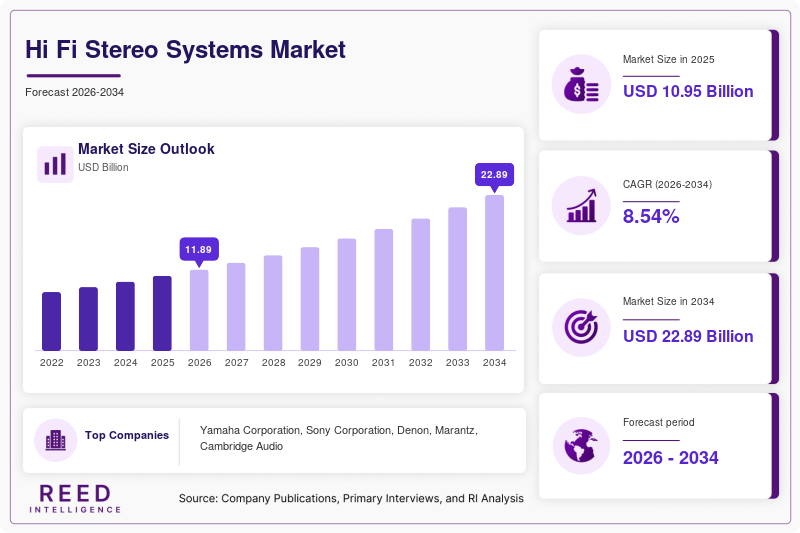
The global Hi-Fi stereo systems market size was valued at USD 10.95 billion in 2025 and is projected to grow from USD 11.88 billion in 2026 to USD 22.89 billion by 2034, registering a CAGR of 8.54% during the forecast period from 2026 to 2034.
Hi-Fi stereo systems are designed to reproduce music through dedicated left- and right-channel audio configurations, generally emphasizing amplifier quality, loudspeaker performance, source fidelity, soundstage, and signal integrity. The category ranges from traditional component-based systems to compact integrated units with network streaming and wireless connectivity.
The market is experiencing a transition from standalone hardware toward connected audio systems. Consumers increasingly expect a stereo system to accommodate streaming platforms, smartphones, televisions, turntables, CDs, and high-resolution digital files through a single integrated architecture. Yamaha's current network Hi-Fi products, for example, support streaming services alongside vinyl and other conventional sources.
Hi-Fi Stereo Systems Market Drivers
Expansion of High-Resolution and Streaming Audio
Streaming has become a fundamental source category for modern music consumption. The 2026 IFPI Global Music Report shows that streaming generated 69.6% of global recorded-music revenue in 2025, with subscription streaming revenue increasing 8.8%. This changes the role of the stereo system from a physical-media playback device into a networked endpoint for cloud-based music libraries.
Manufacturers are responding by integrating streaming directly into amplifiers, receivers and network players. Yamaha's MusicCast platform supports high-resolution formats and services alongside Bluetooth and AirPlay, while Denon's HEOS ecosystem enables wireless streaming and multi-room playback.
Revival of Physical Music and Vinyl
The growth of digital streaming has not eliminated physical music demand. Global physical recorded-music revenues increased 8.0% in 2025, while vinyl revenues grew 13.7%, marking the format's 19th consecutive year of growth.
This supports demand for stereo systems that accommodate turntables, CD players and digital sources within the same setup. Modern network amplifiers increasingly include analog inputs and phono connectivity, allowing consumers to combine physical collections with streaming services rather than choosing one source category.
Integration With Modern Living Spaces
Stereo equipment is increasingly being designed around smaller living spaces and simplified system architecture. Compact streaming amplifiers, network receivers and integrated stereo systems reduce the number of separate components required while retaining dedicated amplification and speaker connectivity.
Yamaha's WXA-70A and WXC-70A illustrate this shift by combining streaming, HDMI eARC, multi-room functionality, room calibration and smart-home integration in compact components.
Hi-Fi Stereo Systems Market Restraints
Premium Hardware Costs
Dedicated Hi-Fi equipment can involve substantially higher acquisition costs than mass-market wireless speakers and soundbars. Separate amplifiers, network players, DACs, turntables and passive speakers also increase the total system cost.
The resulting price structure can restrict adoption among consumers who prioritize convenience or compactness over component-level audio performance. Manufacturers are consequently introducing integrated and compact products to reduce system complexity and broaden the addressable customer base.
Technology and Platform Obsolescence
Network-connected audio equipment depends on software platforms, streaming-service compatibility and network standards. Sony, for example, announced that network services including Spotify, Google Cast and other services would terminate on certain older audio and video products from November 17, 2026.
This creates a distinction between conventional amplifier longevity and connected-device longevity. Consumers purchasing network-enabled Hi-Fi equipment increasingly need continued software and service compatibility in addition to hardware durability.
Hi-Fi Stereo Systems Market Opportunities
Compact Networked Hi-Fi Systems
Compact streaming amplifiers and network stereo components provide manufacturers with an opportunity to bridge the gap between traditional component Hi-Fi and simplified wireless audio. Such products can retain high-resolution playback while reducing physical space and setup complexity.
Yamaha's 2026 WXA-70A and WXC-70A combine streaming, HDMI eARC, multi-room functionality, room calibration and smart-home integration, demonstrating how traditional Hi-Fi architecture can be adapted to contemporary living spaces.
Integration of Physical and Digital Sources
The simultaneous expansion of streaming and physical music creates an opportunity for systems capable of handling both formats. Consumers can use network streaming for everyday listening while maintaining CD and vinyl playback within the same system.
This creates demand for integrated amplifiers and network receivers with combinations of HDMI, optical, analog, phono, USB, Bluetooth, Wi-Fi and network-streaming connectivity. The resulting product architecture can extend system relevance across multiple generations of music formats.
Hi-Fi Stereo Systems Market Segmental Analysis
By Type
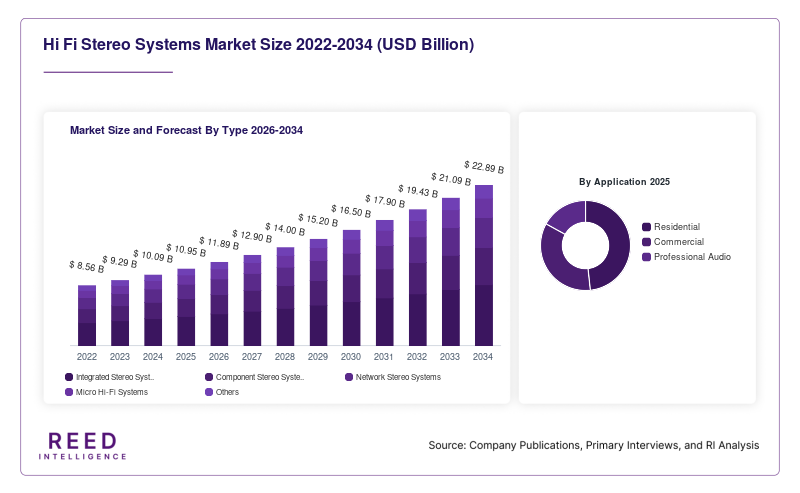
Integrated Stereo Systems represent the dominant type, accounting for approximately 38% share. Integrated products combine amplification and source connectivity into fewer components, reducing setup complexity while providing access to streaming, television audio, Bluetooth and conventional physical sources.
Network Stereo Systems are the fastest-growing type, registering an estimated 10.2% CAGR. Their growth is linked to the migration from local music libraries toward streaming services and multi-room playback. Yamaha, Denon and Marantz increasingly combine network functionality with dedicated stereo amplification.
Component Stereo Systems account for approximately 27% share and expand at 7.4% CAGR, supported by enthusiasts seeking separate amplifiers, source components and speakers. Micro Hi-Fi Systems represent approximately 17% and grow at 6.8% CAGR, while Others account for approximately 18% with a 7.1% CAGR.
By Application
Residential applications dominate the market with approximately 72% share. Home listening remains the primary environment for dedicated stereo equipment, with consumers increasingly using systems for streaming music, vinyl, CD playback and television audio.
Commercial applications account for approximately 18% share and grow at 9.1% CAGR, supported by restaurants, hospitality venues, retail environments, lounges and other spaces requiring higher-quality distributed music.
Professional Audio represents approximately 10% share and records the fastest growth at 9.8% CAGR. Demand includes monitoring, content production, specialized listening environments and professional installations where accurate stereo reproduction remains important.
Hi-Fi Stereo Systems Market Regional Analysis
North America Hi-Fi Stereo Systems Market
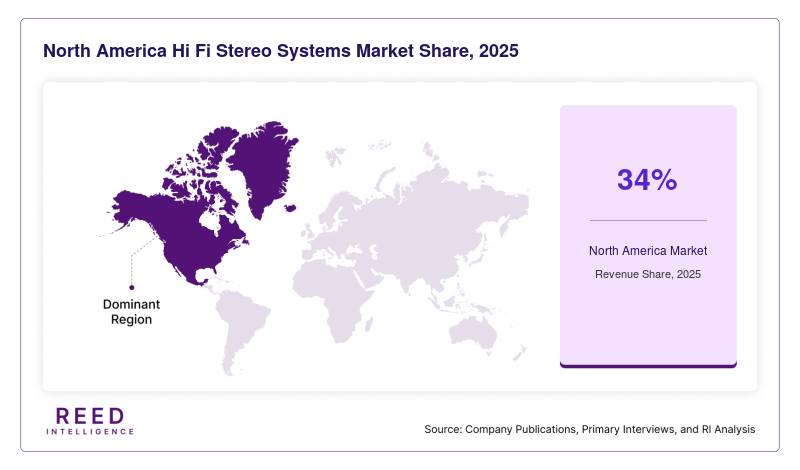
North America is the dominant region, accounting for approximately 34% share. The region has a mature consumer-audio ecosystem supported by established Hi-Fi brands, specialist retailers, custom-installation channels and a large base of music and home-entertainment consumers.
Demand combines network-connected stereo systems with premium integrated amplifiers, passive speakers, turntables and physical-media equipment. The region also benefits from strong availability of streaming services and high-resolution digital content.
Europe Hi-Fi Stereo Systems Market
Europe is projected to register approximately 7.9% CAGR during 2026–2034. The region has a long-established Hi-Fi culture and a strong presence of specialist audio manufacturers and retailers.
Demand spans both traditional component systems and newer network-connected products. The continuing relevance of vinyl and other physical formats also supports systems equipped with analog and digital source inputs.
Asia Pacific Hi-Fi Stereo Systems Market
Asia Pacific is the fastest-growing region, with an estimated 10.1% CAGR. Rising consumer electronics adoption, expanding disposable incomes, established electronics manufacturing capabilities and growing use of digital music services support demand.
Japan represents an established high-fidelity audio market, while China, India, South Korea and Southeast Asian markets provide additional opportunities for compact networked systems and integrated stereo equipment.
Latin America Hi-Fi Stereo Systems Market
Latin America is projected to expand at approximately 8.2% CAGR. Increasing access to streaming services and consumer electronics is broadening the market for connected stereo equipment.
Integrated systems with wireless streaming capabilities can reduce the need for multiple source components, making them suitable for consumers transitioning from conventional audio systems toward connected home entertainment.
Middle East & Africa Hi-Fi Stereo Systems Market
The Middle East & Africa region is projected to register approximately 8.8% CAGR. Premium residential developments, hospitality installations, retail environments and higher-end home entertainment support demand for dedicated audio systems.
Commercial installations provide an additional channel because hotels, restaurants and premium retail spaces can require higher-performance stereo or distributed-audio equipment.
Hi-Fi Stereo Systems Market Competitive Landscape
The Hi-Fi stereo systems market includes diversified consumer-electronics manufacturers, specialist Hi-Fi companies, premium audio brands and component manufacturers. Competition is increasingly based on sound engineering, connectivity, streaming compatibility, industrial design, ecosystem integration and product longevity.
Yamaha competes across integrated amplifiers, stereo receivers, network audio products, speakers and multi-room systems. Its MusicCast platform links conventional Hi-Fi components with streaming services, wireless technologies and whole-home playback.
Key Market Players
- Yamaha Corporation
- Sony Corporation
- Denon
- Marantz
- Cambridge Audio
- Bose Corporation
- Harman International
- Sonos, Inc.
- Pioneer Corporation
- Onkyo Corporation
- Naim Audio
- KEF
- Bowers & Wilkins
- Technics
- McIntosh Laboratory, Inc.
Recent Market Developments
- August 2026 - Yamaha Corporation: Yamaha announced the WXA-70A Compact Streaming Amplifier and WXC-70A Compact Streamer, combining Hi-Fi performance with AirPlay 2, Google Cast, Spotify Connect, TIDAL Connect, Qobuz Connect, Roon Ready, HDMI eARC, MusicCast multi-room functionality and YPAO room calibration. The products are scheduled for November 2026 availability.
- April 2026 - Cambridge Audio: Cambridge Audio introduced the CX Black limited-edition range comprising the CXA81 Mk II integrated stereo amplifier, CXC CD transport and CXN100 SE music streamer. The CXN100 SE adds HDMI eARC while retaining the company's StreamMagic Gen 4 platform.
Hi Fi Stereo Systems Market Segments
By Type
- Integrated Stereo Systems
- Component Stereo Systems
- Network Stereo Systems
- Micro Hi-Fi Systems
- Others
By Application
- Residential
- Commercial
- Professional Audio
By Region
- North America
- Europe
- APAC
- Middle East and Africa
- LATAM