High Heat Melamine Foam Market Size, Share & Demand Report By Type (Rigid Melamine Foam, Flexible Melamine Foam), By Application (Thermal Insulation, Acoustic Insulation, Fire Protection, Filtration), By End-Use Industry (Building & Construction, Automotive, Industrial, Aerospace, Electronics), By Density (Low Density, Medium Density, High Density), By Region & Segment Forecasts, 2026–2034
USD 3950
Market Overview
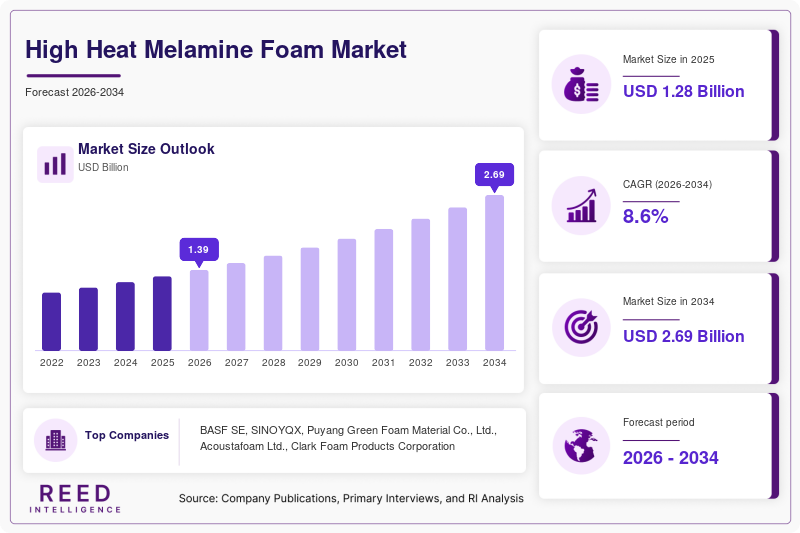
The global High Heat Melamine Foam Market size was valued at USD 1.28 billion in 2026 and is projected to reach USD 2.47 billion by 2034, expanding at a CAGR of 8.6% from 2026 to 2034. The market growth is primarily supported by the increasing global emphasis on energy-efficient insulation materials across industrial and commercial sectors. High heat melamine foam, known for its superior thermal resistance, flame retardancy, and acoustic insulation properties, has gained strong traction in applications requiring performance under extreme temperature conditions.
A major global factor driving market expansion is the rising adoption of lightweight, fire-resistant materials in construction and transportation industries. Governments and regulatory bodies worldwide are enforcing stricter fire safety and energy efficiency standards, encouraging the use of advanced materials such as melamine-based foams.
Key Highlights
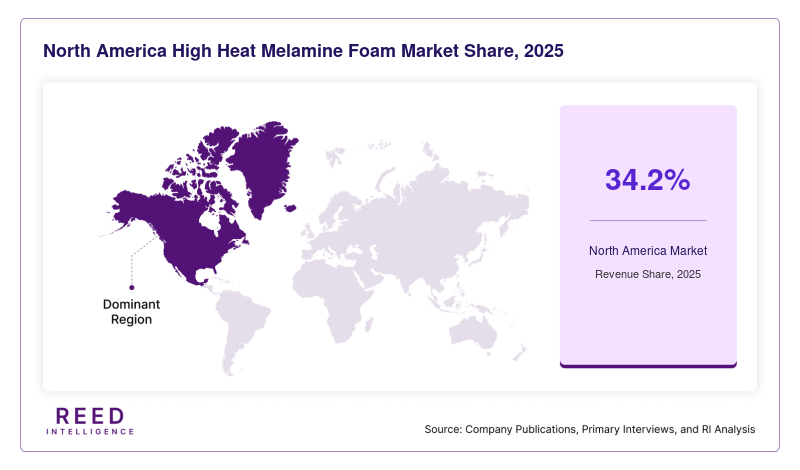
- Dominant region: North America held 34.2% share in 2025, while Asia Pacific is expected to grow at a CAGR of 9.8%
- Leading segment: Industrial insulation accounted for 41.5% share in 2025, while transportation applications are projected to grow at a CAGR of 10.2%
- Dominant country: The U.S. market was valued at USD 342 million in 2024 and USD 371 million in 2025
Market Trends
Growing Adoption in Electric Vehicles (EVs)
The shift toward electric mobility has significantly influenced the High Heat Melamine Foam Market. These foams are increasingly used in EV battery insulation systems due to their flame resistance and heat management capabilities. Manufacturers are integrating high heat melamine foam to enhance passenger safety and improve thermal stability in battery compartments.
Rising Demand for Acoustic and Thermal Insulation Solutions
The demand for dual-function materials that provide both sound absorption and thermal insulation has been increasing across commercial buildings and industrial facilities. High heat melamine foam is being widely adopted in HVAC systems, recording studios, and heavy machinery enclosures, driving consistent market expansion.
Market Drivers
Stringent Fire Safety Regulations
Governments across developed and developing economies are implementing strict fire safety standards in construction and industrial environments. High heat melamine foam, with its inherent flame-retardant properties, is increasingly preferred as a compliant material, boosting its adoption across multiple sectors.
Expansion of Industrial Manufacturing Activities
The growth of manufacturing industries, particularly in emerging economies, has increased the need for high-performance insulation materials. High heat melamine foam is widely used in equipment insulation, piping systems, and machinery, supporting sustained market growth.
Market Restraint
High Production Costs
The production of high heat melamine foam involves advanced chemical processing and specialized raw materials, leading to relatively higher costs compared to conventional insulation materials. This factor limits its adoption in price-sensitive markets.
Market Opportunities
Increasing Use in Aerospace Applications
The aerospace sector presents a strong opportunity for the High Heat Melamine Foam Market due to the material’s lightweight nature and resistance to high temperatures. It is being increasingly used in aircraft interiors and insulation systems, where weight reduction and safety are critical.
Growth in Green Building Initiatives
The global shift toward sustainable construction practices is opening new avenues for high heat melamine foam. Its energy-efficient properties align with green building standards, making it a preferred material in eco-friendly construction projects.
Segmental Analysis
By Type
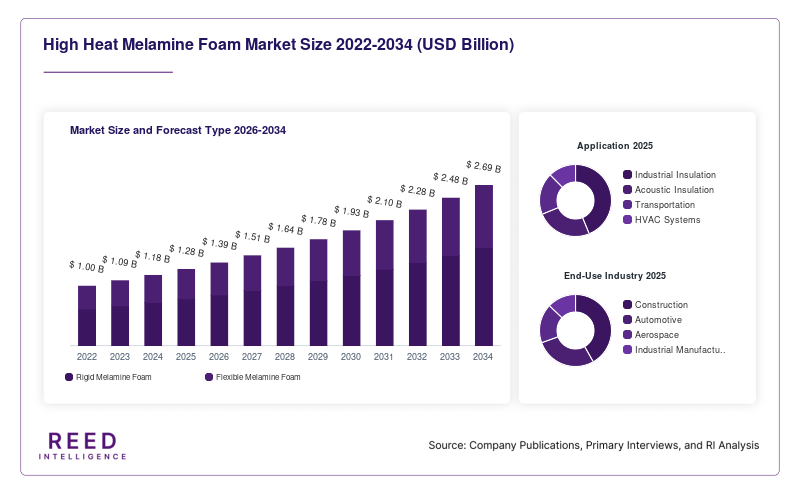
The rigid melamine foam segment dominated the High Heat Melamine Foam Market with a 58.7% share in 2025, owing to its superior structural stability and high-temperature resistance. It is widely used in industrial insulation and construction applications where durability is essential.
The flexible melamine foam segment is projected to grow at a CAGR of 9.4% during the forecast period. Its lightweight nature and adaptability make it suitable for automotive and acoustic insulation applications. The increasing demand for customized insulation solutions will drive its growth.
By Application
Industrial insulation emerged as the dominant application segment, accounting for 41.5% share in 2025. The segment’s growth is attributed to the extensive use of high heat melamine foam in machinery, pipelines, and high-temperature equipment.
The transportation segment is expected to grow at the fastest CAGR of 10.2%. The rising adoption of electric vehicles and the need for advanced thermal management systems are key factors driving growth in this segment.
By End-Use Industry
The construction industry held the largest share of 38.9% in 2025, driven by increasing demand for fire-resistant and energy-efficient building materials. High heat melamine foam is extensively used in commercial and residential buildings for insulation purposes.
The aerospace industry is projected to witness the fastest growth at a CAGR of 9.7%. The increasing demand for lightweight materials with high thermal resistance is a major factor contributing to the segment’s expansion.
By Distribution Channel
The direct sales segment dominated the market with a 63.2% share in 2025, as manufacturers prefer direct engagement with industrial clients and large-scale buyers.
The online distribution channel is anticipated to grow at a CAGR of 10.5%, supported by the increasing digitalization of procurement processes and the expansion of e-commerce platforms for industrial materials.
Regional Analysis
North America
North America accounted for 34.2% of the market share in 2025 and is expected to grow at a CAGR of 7.9% during the forecast period. The United States dominated the regional market due to the widespread adoption of advanced insulation materials in commercial construction. A key growth factor is the strong presence of stringent building codes that emphasize fire resistance and energy efficiency.
Europe
Europe held 27.5% share in 2025 and is projected to expand at a CAGR of 8.1% from 2026 to 2034. Germany emerged as the leading country, driven by its well-established automotive and industrial manufacturing sectors. The demand for high-performance materials in automotive interiors has significantly contributed to regional growth.
Asia Pacific
Asia Pacific captured 23.8% of the market share in 2025 and is anticipated to grow at the fastest CAGR of 9.8%. China led the region, supported by rapid industrialization and infrastructure development. The increasing number of large-scale manufacturing facilities has accelerated demand for high heat-resistant insulation materials.
Middle East & Africa
The Middle East & Africa held 8.1% share in 2025 and is expected to grow at a CAGR of 7.4%. The UAE dominated the regional market due to rising investments in commercial construction and infrastructure projects. The adoption of advanced insulation solutions in high-temperature environments is a major growth factor.
Latin America
Latin America accounted for 6.4% share in 2025 and is forecasted to grow at a CAGR of 7.6%. Brazil led the region, driven by increasing industrialization and demand for energy-efficient materials. Growth in construction and manufacturing sectors has supported market expansion.
Competitive Landscape
The High Heat Melamine Foam Market is moderately competitive, with several global and regional players focusing on product innovation and strategic partnerships. Leading companies are investing in research and development to enhance product performance and expand application areas.
BASF SE is recognized as the market leader, leveraging its strong product portfolio and global distribution network. The company recently introduced advanced melamine foam solutions designed for high-temperature industrial applications, strengthening its market position.
Other key players such as SINOYQX, Puyang Green Foam Material Co., Ltd., and Acoustafoam Ltd. are focusing on expanding their production capacities and entering emerging markets. Additionally, companies like Clark Foam Products Corporation are emphasizing customized solutions to cater to specific industry requirements.
Strategic collaborations, mergers, and product launches remain key strategies adopted by market participants to maintain competitiveness and capture market share.
Key Players List
- BASF SE
- SINOYQX
- Puyang Green Foam Material Co., Ltd.
- Acoustafoam Ltd.
- Clark Foam Products Corporation
- CMS Danskin Acoustics Ltd.
- Beijing Guojian Anke Technology Co., Ltd.
- Linyi Yingke Chemistry Co., Ltd.
- Reilly Foam Corporation
- Wilhams Insulation Materials Ltd.
- Junhua Group
- Soundcoat Company Inc.
- Zotefoams Plc
- Rogers Corporation
- Recticel NV
Recent Developments
- In 2025, BASF SE expanded its production capacity for melamine foam materials to meet rising global demand.
- In 2024, SINOYQX launched a new range of high heat-resistant foam products targeting industrial insulation applications.
- In 2025, Acoustafoam Ltd. introduced advanced acoustic foam solutions with enhanced thermal resistance.
- In 2024, Recticel NV invested in R&D to develop eco-friendly melamine foam alternatives.
- In 2025, Rogers Corporation collaborated with automotive manufacturers to develop customized insulation solutions for EVs.
High Heat Melamine Foam Market Segments
Type
- Rigid Melamine Foam
- Flexible Melamine Foam
Application
- Industrial Insulation
- Acoustic Insulation
- Transportation
- HVAC Systems
End-Use Industry
- Construction
- Automotive
- Aerospace
- Industrial Manufacturing
Distribution Channel
- Direct Sales
- Distributors
- Online Channels
By Region
- North America
- Europe
- APAC
- Middle East and Africa
- LATAM