High Pressure Die Casting (HPDC) Market Size, Share & Trends Analysis Report By Machine Type (Cold Chamber, Hot Chamber), By Material (Aluminum, Magnesium, Zinc), By Component (Powertrain Components, Structural & Chassis Components, Battery & E-Mobility Components), By Application (Automotive, Industrial Machinery, Consumer Electronics, Aerospace & Defense) and By Region (North America, Europe, APAC, Middle East and Africa, LATAM) Forecasts, 2026–2034
USD 3950
High Pressure Die Casting (HPDC) Market Size
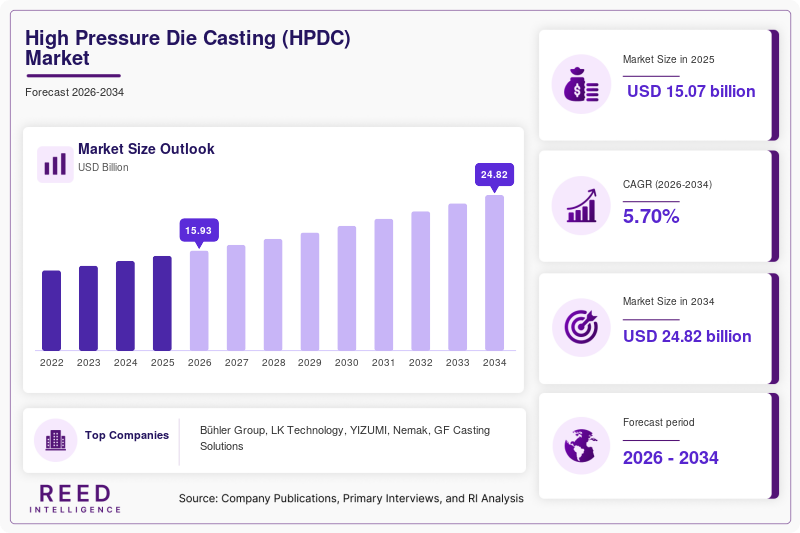
The global High Pressure Die Casting (HPDC) Market size was valued at USD 15.07 billion in 2025 and is projected to grow from USD 15.93 billion in 2026 to USD 24.82 billion by 2034, registering a CAGR of 5.70% during the forecast period from 2026 to 2034.
High-pressure die casting is moving from conventional production of relatively small aluminum components toward larger, integrated structural parts. In HPDC, molten aluminum, magnesium or zinc is injected into hardened steel dies at high speed and pressure, enabling thin-wall, high-volume components with tight dimensional control.
The automotive industry remains the primary demand center because OEMs use HPDC to reduce vehicle weight, consolidate multiple stamped and welded components, and shorten manufacturing steps. Nemak describes HPDC as a process for blocks, transmissions, structural components and battery trays, while its casting portfolio increasingly targets body-in-white, chassis and e-mobility applications.
Electric-vehicle production is reinforcing this transition. Global electric-car sales exceeded 20 million units in 2025, representing 25% of new-car sales, while the IEA expects global electric-car sales to reach about 23 million in 2026.
The technology is also moving toward megacasting and gigacasting. Bühler offers die-casting systems with 50,000–92,000 kN clamping force for large body structures, while YIZUMI has expanded ultra-large machines into the 6,000–9,000-ton range.
High Pressure Die Casting (HPDC) Market Drivers
Vehicle Lightweighting Is Increasing the Use of Aluminum HPDC
Vehicle manufacturers are under pressure to reduce mass while maintaining crash performance, range and structural integrity. Aluminum provides a lower-density alternative to steel, while HPDC allows manufacturers to combine lightweight material with high-volume production and complex geometries.
Nemak's current technology portfolio specifically combines HPDC with structural and chassis components, battery housings and e-mobility applications. The company identifies weight reduction, safety, sustainable materials and manufacturing cost as key engineering priorities.
The commercial mechanism becomes stronger when an OEM can replace multiple stamped, welded or machined pieces with one integrated casting. YIZUMI states that integrated aluminum castings can replace assemblies containing 30–90 stamped and welded components, while its ultra-large systems target rear floor structures and other EV body applications.
This changes HPDC from a component-production method into a vehicle-architecture technology. The counterbalance is that large castings require new tooling, joining strategies, thermal management and repair processes, so OEMs do not automatically replace every stamped assembly with a casting.
EV Production Is Expanding Demand for Structural and Battery Castings
EV architecture is creating new applications for large aluminum castings, including battery trays, housings, front and rear underbody structures, motor housings and other integrated chassis components.
The IEA reports that electric-car sales increased 20% in 2025 to more than 20 million units, with electric vehicles representing one in four new cars globally. In China, EVs accounted for nearly 55% of new-car sales in 2025.
This is commercially relevant because battery-electric vehicles require different component architectures from conventional powertrains. Nemak's HPDC portfolio already includes battery trays and other e-mobility structures.
The demand mechanism is therefore twofold: existing powertrain castings continue to require production, while new structural and battery-related castings add applications. Nemak's 2026 acquisition of GF Casting Solutions' automotive business strengthened its structural, chassis and EV capabilities and added HPDC capacity across nine facilities.
Megacasting Is Increasing the Required Scale and Value of HPDC Equipment
The emergence of megacasting is changing the economics of HPDC. Instead of producing numerous smaller body components and joining them later, manufacturers can produce large sections of the vehicle body in one casting.
Bühler says its Carat megacasting systems use 50,000–92,000 kN clamping forces and are designed for large body-in-white components. The company reports that six of the ten largest automotive manufacturers globally already use megacasting technology, with four having ordered Bühler equipment.
YIZUMI's 2026 industry update also shows the movement toward ultra-large machines. Its die-casting-machine business generated CNY 1.189 billion of revenue in 2025, up 33.06%, while its portfolio expanded to 7,000T, 9,000T and 10,000T machines.
The commercial effect is higher equipment value per installation and greater demand for advanced molds, thermal management, automation, quality control and material-handling systems.
High Pressure Die Casting (HPDC) Market Restraints
High Tooling and Equipment Costs Increase the Investment Threshold
Large HPDC programs require expensive machines, molds, automated handling, melting and holding systems, cooling equipment, inspection systems and downstream machining. The investment becomes particularly substantial for megacasting because the machine, die, material-handling and factory-layout requirements increase together.
Bühler notes that large megacasting cells require dedicated planning for part flow, material handling, thermal management, spraying and return-material handling.
YIZUMI similarly emphasizes complete project planning, process simulation, equipment selection, mold support and operational assistance for ultra-large die-casting projects.
This creates a barrier for smaller foundries and makes utilization rates important. If a large machine does not achieve sufficient production volume, its capital cost can weaken the economics compared with smaller casting cells or alternative forming technologies.
Tool Life, Porosity and Quality-Control Requirements Limit Process Flexibility
HPDC combines high injection speeds, high pressures and rapid solidification. The process can produce thin-wall components at high productivity, but dies experience thermal cycling, erosion and soldering risks.
Voestalpine identifies high-pressure die-casting inserts as critical tooling components exposed to high thermal loads and has developed specialized tool steels, heat treatments and additive-manufactured inserts to extend performance.
Large structural castings also require consistent mechanical properties and dimensional accuracy. Defects such as porosity can become more commercially significant when a single casting replaces multiple structural components.
The response is greater investment in process simulation, real-time shot monitoring, die-temperature control, vacuum systems, non-destructive testing and downstream machining. YIZUMI's HII-S platform, for example, incorporates process-parameter recording and monitoring and has been developed to improve injection precision and repeatability.
High Pressure Die Casting (HPDC) Market Opportunities
Large Structural and Megacastings
Large structural castings represent one of the clearest opportunities for HPDC suppliers. Bühler's megacasting portfolio demonstrates that machines above 50,000 kN are already being deployed for large body structures, while YIZUMI has commercialized 6,000–9,000-ton systems for EV structural applications.
The opportunity extends beyond equipment sales. Larger castings require new die designs, advanced steels, conformal cooling, automated material handling, inspection systems, machining and process-control software.
Battery Housings and EV Chassis Components
Battery trays and housings provide a new application pool for aluminum HPDC. Nemak identifies battery housings, structural components and e-mobility among its casting and assembly technologies.
The opportunity is supported by the continued expansion of EV production. The IEA expects electric-car sales to reach about 23 million units in 2026, with particularly strong growth in Europe and Asia-Pacific markets outside China.
Suppliers that combine casting, machining and assembly can capture more value per vehicle than suppliers selling a basic casting alone.
Recycled Aluminum and Closed-Loop Manufacturing
Aluminum recycling can reduce material and energy requirements while fitting the circularity goals of automotive manufacturers. Novelis notes that recycled aluminum requires approximately 5% of the energy needed to produce primary aluminum.
HPDC suppliers can therefore develop closed-loop scrap recovery systems that return runners and production scrap into appropriate alloy streams. Li Auto has demonstrated integrated-die-casting aluminum components containing 30% recycled material while maintaining required mechanical properties.
This creates opportunities for low-carbon casting programs, although alloy segregation and quality control remain important technical requirements.
Segmental Analysis
By Machine Type
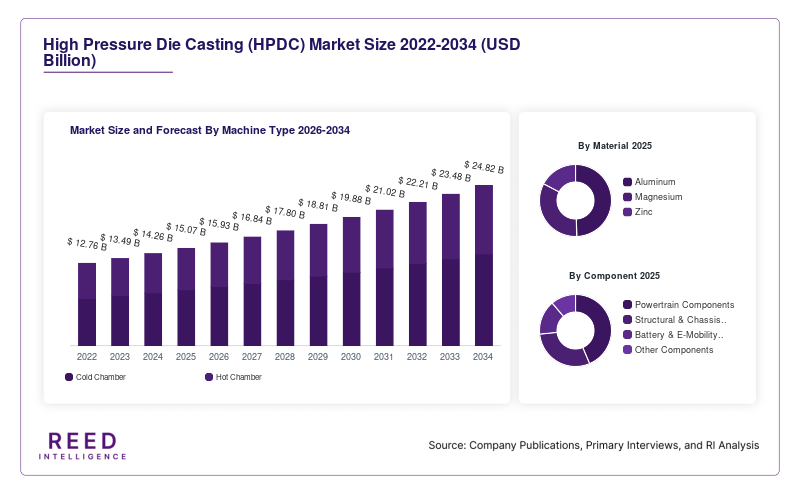
Cold Chamber represents approximately 82% of the global HPDC market in 2025, making it the dominant machine configuration. Cold-chamber systems are particularly suited to aluminum alloys, which are widely used in automotive powertrain, structural, chassis and battery-related castings. YIZUMI's current cold-chamber portfolio extends from conventional machines into 9,000-ton systems for large automotive components.
Hot Chamber accounts for approximately 18% of the market and is primarily associated with lower-melting-point alloys such as zinc and selected magnesium applications.
Cold Chamber is also the faster-growing machine type, with an estimated 6.0% CAGR, supported by aluminum-intensive vehicle architectures and large structural castings.
By Material
Aluminum represents approximately 78% of the market in 2025, supported by its strength-to-weight characteristics, recyclability and broad use in vehicle components. Voestalpine identifies aluminum, magnesium and zinc as the main HPDC alloy families, while automotive lightweighting remains a central application driver.
Zinc accounts for approximately 15%, supported by automotive hardware, electronics and precision components.
Magnesium represents approximately 7%.
Magnesium is the fastest-growing material segment, with approximately 7.4% CAGR, supported by lightweighting requirements in mobility, electronics and selected structural applications. YIZUMI also identifies semi-solid processing as an expanding technology area for magnesium and aluminum applications.
By Component
Powertrain Components account for approximately 34% of the market in 2025. Engine, transmission, motor and related housings remain important because HPDC provides high-volume production and dimensional consistency.
Structural & Chassis Components represent approximately 31%, supported by body structures, subframes, shock towers and other integrated components.
Battery & E-Mobility Components represent approximately 24%, including battery housings, trays and electric-drive components.
Other Components account for approximately 11%.
Battery & E-Mobility Components are the fastest-growing component segment, with approximately 10.2% CAGR. The mechanism is the combination of EV volume growth and the increasing use of integrated aluminum structures. Nemak's portfolio and its acquisition of GF Casting Solutions both demonstrate the movement toward EV, structural and chassis applications.
By Application
Automotive represents approximately 71% of the global HPDC market in 2025, making it the dominant application. The automotive sector uses HPDC for powertrain, transmission, motor, structural, chassis and battery components.
The demand base remains large even as propulsion technologies change. IEA data show that global electric-car sales exceeded 20 million in 2025 and are expected to reach approximately 23 million in 2026.
Industrial Machinery represents approximately 13%, Consumer Electronics 8%, Aerospace & Defense 3%, and other applications 5%.
Consumer Electronics is the fastest-growing application segment at approximately 8.1% CAGR, supported by demand for thin-wall, lightweight and dimensionally precise aluminum and magnesium housings. HPDC is also used in 3C/electronics applications alongside automotive production.
Regional Analysis
North America High Pressure Die Casting (HPDC) Market
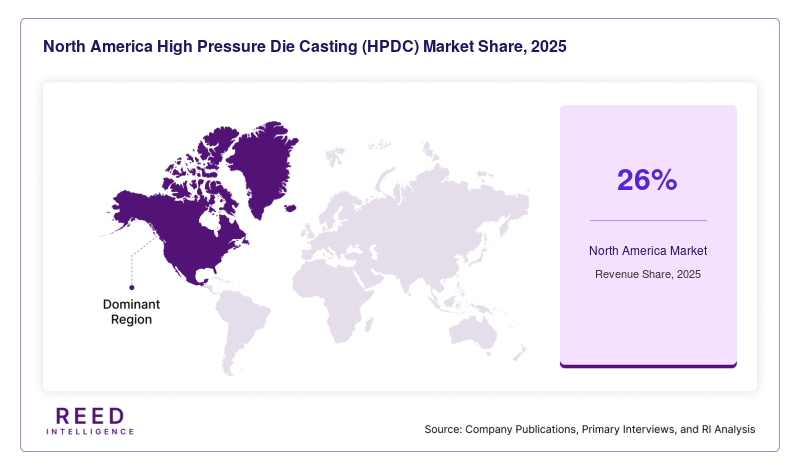
North America represents approximately 26% of the global HPDC market in 2025. The region has a large automotive manufacturing base, established aluminum supply chains, major Tier-1 suppliers and growing investment in EV and battery manufacturing.
The U.S. automotive market continues to provide a substantial production base. NADA reported a 16.8 million-unit seasonally adjusted annualized light-vehicle sales rate in August 2026 and expected full-year industry sales of at least 16 million units.
HPDC demand is shifting from conventional engine and transmission components toward structural and electrification applications. Nemak's acquisition of GF Casting Solutions' automotive business added nine production facilities across Austria, China, Germany, Romania and the U.S., as well as structural and EV-focused HPDC capabilities.
Toyota's Tennessee facility provides another indication of continued aluminum casting demand. The plant produces approximately 2 million engine blocks and more than 1 million transmission cases and housings annually, using high-pressure casting and die-making operations.
North America is projected to grow at approximately 5.1% CAGR through 2034. The region's main competitive advantages are proximity to vehicle OEMs, engineering capabilities and established foundry infrastructure. Higher labor and energy costs remain constraints compared with some Asian manufacturing locations.
Europe High Pressure Die Casting (HPDC) Market
Europe accounts for approximately 25% of the global HPDC market in 2025. The region has a strong concentration of automotive OEMs, Tier-1 suppliers, die manufacturers and advanced materials companies.
European demand is being influenced by vehicle electrification and manufacturing efficiency. Nemak's acquisition of GF Casting Solutions added customers including Audi, BMW, Jaguar Land Rover, Mercedes-Benz, Porsche, Stellantis, Volkswagen and Volvo, while approximately 80% of the acquired business's portfolio was related to e-mobility and structure/chassis applications.
Tooling technology is also becoming a competitive factor. Voestalpine's 2026 EUROGUSS participation emphasized productivity, overall equipment effectiveness and total cost of ownership rather than die life alone, reflecting the industry's move toward complete process economics.
Europe is projected to grow at approximately 5.3% CAGR. The region's strengths include automotive engineering, premium vehicle manufacturing and advanced die/tooling capabilities. Energy costs, industrial investment requirements and slower vehicle production growth can moderate expansion.
APAC High Pressure Die Casting (HPDC) Market
APAC represents approximately 36% of the global HPDC market in 2025 and is the fastest-growing region, with an estimated CAGR of 7.2%.
China is the main regional production center, supported by a large automotive industry, extensive EV manufacturing and a strong domestic die-casting equipment sector. The IEA reports that electric vehicles represented nearly 55% of new-car sales in China in 2025.
The region is also leading the move toward ultra-large integrated die casting. YIZUMI expanded its portfolio to 7,000T, 9,000T and 10,000T machines, while its 2026 business update reported 33.06% year-on-year growth in die-casting-machine revenue for 2025.
Nemak's acquisition of GF Casting Solutions added production capacity in China and expanded its relationships with Chinese OEMs including BYD, Denza, Geely, Hongqi, Li Auto, Nio, Xpeng and Zeekr.
APAC is therefore developing both the demand side and the equipment supply side of the HPDC ecosystem. Its main constraints include intense price competition, excess-capacity risk in some equipment categories and differences in quality and certification requirements between markets.
Middle East and Africa High Pressure Die Casting (HPDC) Market
Middle East and Africa represents approximately 6% of the global HPDC market in 2025 and is expected to grow at approximately 5.8% CAGR.
Automotive production is smaller than in APAC, Europe or North America, but industrial diversification and manufacturing localization create opportunities for aluminum casting. The region's industrial-development strategies also support automotive, machinery and metal-processing investments.
HPDC demand can emerge through vehicle assembly, commercial vehicles, industrial equipment and components supplied into international automotive value chains. The region can also benefit from its access to aluminum feedstocks and energy-intensive manufacturing.
The main constraint is the smaller installed base of high-volume automotive foundries and specialized die-casting suppliers. Large HPDC cells require substantial investment in machinery, dies, melting systems and downstream machining, making utilization a central consideration.
LATAM High Pressure Die Casting (HPDC) Market
LATAM represents approximately 7% of the global market in 2025 and is projected to grow at approximately 6.1% CAGR.
Brazil and Mexico provide the region's principal automotive manufacturing bases. Mexico's proximity to the U.S. automotive industry supports demand for cast components within North American supply chains, while Brazil maintains a substantial domestic vehicle and industrial manufacturing base.
The regional opportunity is increasingly connected to lightweight automotive components and electrification. HPDC suppliers can serve engine and transmission applications while progressively adding structural and battery-related components as vehicle architectures evolve.
The main constraint is the comparatively smaller regional market for ultra-large integrated die casting compared with China and other Asian markets. Currency volatility, capital costs and the need for specialized tooling and process-control capabilities can also affect investment decisions.
Competitive Landscape
The HPDC market is becoming more concentrated around companies that can combine casting technology, large-tonnage machinery, tooling, automation, process simulation and downstream machining.
Nemak is strengthening its position in structural and electrification applications. Its February 2026 completion of the GF Casting Solutions automotive acquisition added approximately USD 707 million of 2024 revenue, nine manufacturing facilities and approximately 2,500 employees. The acquired portfolio was heavily concentrated in e-mobility and structural/chassis components and added HPDC capacity.
Bühler is positioned strongly in large structural casting equipment. Its Carat portfolio covers megacasting systems from 50,000 to 92,000 kN, with the company stating that its equipment produces approximately half of the structural components made using the relevant technology.
YIZUMI has expanded aggressively into ultra-large integrated die casting. Its 2026 disclosures show 7,000T, 9,000T and 10,000T platforms, while the LEAP series supports large EV structural components.
LK Technology has developed 16,000-ton die-casting technology and has reported applications covering integrated EV chassis structures. Its technology development reflects the industry's movement toward larger machines and fewer structural parts.
Key Market Players
- Bühler Group
- LK Technology
- YIZUMI
- Nemak
- GF Casting Solutions
- Ryobi Limited
- Linamar Corporation
- Rheinmetall
- Endurance Technologies
- Dynacast
- Form Technologies
- Pace Industries
- Shiloh Industries
- Ryobi Die Casting
- Gibbs Die Casting
- Teksid
- Georg Fischer
- Sandhar Technologies
- Ningbo Tuopu Group
- Wencan Group
Recent Market Developments
- May 2026 – YIZUMI delivered a LEAP9000 ultra-large die-casting machine to a major new-energy vehicle manufacturer. The company said LEAP9000 and LEAP10000 machines had already entered mass production lines, showing that ultra-large casting is moving beyond pilot projects toward repeat production.
- February 2026 – Nemak completed its acquisition of GF Casting Solutions' automotive business. The transaction added nine production sites, approximately 2,500 employees and substantial aluminum/magnesium structural and HPDC capabilities, strengthening Nemak's position in EV and chassis applications.
High Pressure Die Casting (HPDC) Market Segments
By Machine Type
- Cold Chamber
- Hot Chamber
By Material
- Aluminum
- Magnesium
- Zinc
By Component
- Powertrain Components
- Structural & Chassis Components
- Battery & E-Mobility Components
- Other Components
By Application
- Automotive
- Industrial Machinery
- Consumer Electronics
- Aerospace & Defense
- Other Applications
By Region
- North America
- Europe
- APAC
- Middle East and Africa
- LATAM