High Pressure Laminate Market Size, Share & Trends Analysis Report By Type (General Purpose HPL, Postforming HPL, Compact HPL, Fire-Retardant HPL, Chemical-Resistant HPL), By Application (Furniture & Cabinets, Countertops, Wall Panels, Doors, Flooring, Others), By End Use (Residential, Commercial, Healthcare, Hospitality, Education, Retail, Others) and By Region (North America, Europe, APAC, Middle East and Africa, LATAM) Forecasts, 2026–2034
USD 3950
High Pressure Laminate Market Size
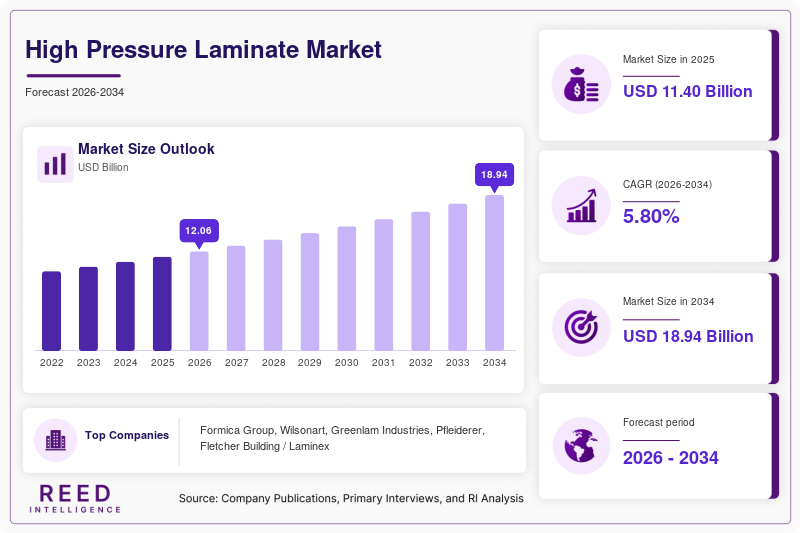
The global High Pressure Laminate Market size was valued at USD 11.40 Billion in 2025 and is projected to grow from USD 12.06 Billion in 2026 to USD 18.94 Billion by 2034, registering a CAGR of 5.80% during the forecast period from 2026 to 2034.
High-pressure laminate (HPL) is positioned as a durable decorative surface material for furniture, countertops, doors, wall panels, worktops, healthcare interiors, offices, hospitality spaces, and other high-use applications. Its commercial value comes from combining design flexibility with resistance to wear, scratches, stains, moisture, impact, and chemicals. Formica offers HPL across woodgrain, stone, solid-color, and textured designs, while Wilsonart provides HPL for countertops, furniture, doors, wall panels, millwork, and other high-traffic applications.
The market is also shifting toward higher-performance and specification-driven products. Manufacturers are introducing fire-rated, antimicrobial, chemical-resistant, scratch-resistant, high-wear, and customized HPL products for applications where standard decorative surfaces may not meet performance requirements. Wilsonart, for example, offers HPL with fire-rated, chemical-resistant, antimicrobial, and enhanced wear options.
Sustainability is becoming another purchasing consideration. Wilsonart states that its HPL contains an average of 26% post-consumer recycled content, while Pfleiderer offers HPL products with Blue Angel and FSC or PEFC certifications.
High Pressure Laminate Market Drivers
Demand for Durable Interior Surfaces
HPL is increasingly specified where interior surfaces face frequent contact, cleaning, abrasion, impact, and moisture. This makes the material suitable for countertops, furniture, worktops, doors, wall panels, healthcare interiors, schools, restaurants, offices, and retail environments. Pfleiderer specifically identifies HPL applications across restaurants, hospitals, schools, administration buildings, leisure facilities, and other non-residential buildings.
The commercial mechanism is based on lifecycle performance. Buyers can select HPL when durability and cleanability are more important than using lower-performance decorative surfaces. Wilsonart also positions HPL for high-traffic areas such as countertops and reception desks where wear resistance and longevity are important.
Expansion of Furniture and Interior Design Applications
Furniture manufacturers, architects, designers, and contractors increasingly require surfaces that provide both visual customization and functional performance. HPL can reproduce wood, stone, textile, metal, and other visual effects while maintaining a consistent manufactured surface.
Formica's current collection includes extensive ranges of plain colors, woodgrains, patterns, and textures, while Pfleiderer provides wood, stone, solid-color, metallic, and customized designs.
This design flexibility expands HPL beyond traditional kitchen applications into offices, hotels, healthcare facilities, retail environments, educational buildings, and commercial furniture.
Development of High-Performance and Sustainable Laminates
Product development is moving beyond basic decorative surfaces toward HPL with specific technical characteristics. Manufacturers now offer antimicrobial, fire-retardant, chemical-resistant, high-wear, scratch-resistant, and specialty HPL products. Pfleiderer, for example, offers microPLUS antimicrobial and antiviral products, fire-retardant products, real-metal HPL, magnetic HPL, and customized digital-printing options.
At the same time, recycled content and environmental certifications are becoming more relevant in commercial specifications. This allows manufacturers to compete on both technical performance and sustainability credentials rather than price and appearance alone.
High Pressure Laminate Market Restraints
Competition from Alternative Surface Materials
HPL competes with thermally fused laminate, veneer, solid surface, quartz, acrylic, painted surfaces, and other engineered materials. Wilsonart notes that TFL can be approximately 30% lower in cost than HPL for certain applications, although HPL provides advantages in wear resistance, impact resistance, postforming, and high-use applications.
This creates application-specific competition rather than a single market-wide substitution pattern. Cost-sensitive projects may select lower-cost surfaces, while high-traffic environments can justify the premium associated with HPL.
Raw Material and Manufacturing Costs
HPL production requires kraft paper, decorative paper, phenolic resins, melamine resins, energy, pressing equipment, finishing, and distribution. Changes in paper, resin, energy, transportation, and manufacturing costs can affect producer margins and finished-product pricing.
The impact is particularly relevant for standardized HPL products where customers have multiple suppliers and can compare prices. Manufacturers therefore need to balance input-cost management with investments in new designs, specialty finishes, sustainability features, and performance technologies.
High Pressure Laminate Market Opportunities
Growth in Healthcare, Education and Commercial Interiors
Healthcare, education, hospitality, retail, and office environments require surfaces that can withstand repeated cleaning and heavy daily use. HPL is already used across these applications because of its resistance characteristics and design flexibility. Pfleiderer lists hospitals, care facilities, kindergartens, schools, administration buildings, restaurants, and leisure facilities among HPL applications.
Healthcare is particularly relevant because antimicrobial, chemical-resistant, moisture-resistant, and easy-clean surfaces can address specific facility requirements. Wilsonart also markets healthcare HPL for high-touch areas and emphasizes durability, stain resistance, and impact resistance.
Customization and Digital HPL
Customization provides manufacturers with a way to move HPL away from standardized commodity products. Digital printing allows customers to use customized motifs and project-specific graphics. Pfleiderer states that its HPL can be digitally printed from a run of one, while its Individual Motiv products support bespoke designs.
This creates opportunities in hospitality, retail, branded interiors, corporate offices, healthcare environments, and architectural projects where surface design is part of the overall customer experience.
Segmental Analysis
By Type
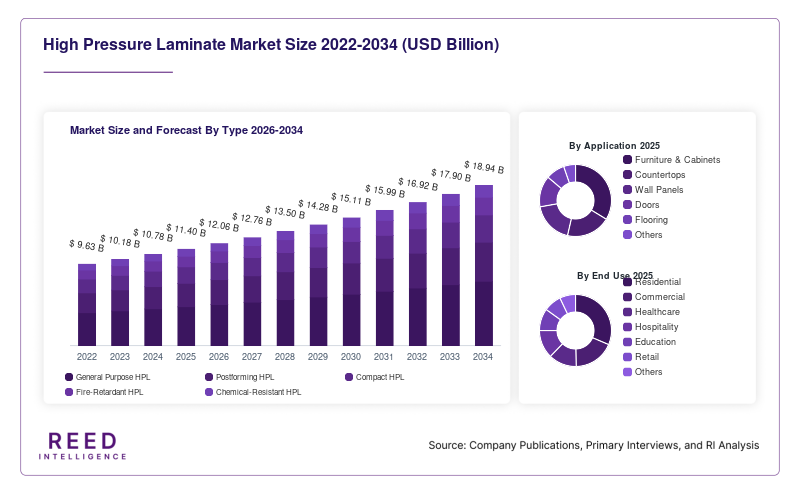
General Purpose HPL accounted for approximately 42% of the global High Pressure Laminate Market in 2025, equivalent to USD 4.79 Billion. Its broad application base includes furniture, cabinetry, wall surfaces, doors, counters, and other interior components. The segment benefits from established manufacturing processes and wide availability across standard colors, woodgrains, stone patterns, and textures.
Postforming HPL represented approximately 22% of the market in 2025, equivalent to USD 2.51 Billion. Its ability to be shaped around curved edges supports countertops, worktops, tabletops, and other applications where seamless edge treatment is required. Formica and Wilsonart both provide postformable laminate products for applications requiring shaped surfaces.
Compact HPL accounted for approximately 16% of the market, equivalent to USD 1.82 Billion in 2025. The segment is used where a thicker, self-supporting laminate structure is required, including partitions, doors, furniture components, and high-use interior applications.
Fire-retardant HPL represented approximately 11% of the market, equivalent to USD 1.25 Billion in 2025. Demand is supported by commercial, transportation, hospitality, healthcare, and institutional projects where fire-performance specifications affect material selection. Pfleiderer offers flame-retarding HPL products for building and ship-fitting applications.
Chemical-resistant HPL accounted for approximately 9% of the market, equivalent to USD 1.03 Billion in 2025. The segment is particularly relevant to healthcare, laboratories, commercial kitchens, industrial interiors, and other environments where surfaces may contact cleaning chemicals or aggressive substances.
By Application
Furniture and cabinets represented approximately 34% of the global market in 2025, equivalent to USD 3.88 Billion. HPL provides furniture manufacturers with a combination of decorative choice, durability, cleanability, and consistent surface quality.
Countertops accounted for approximately 24% of the market, equivalent to USD 2.74 Billion. High resistance to wear, stains, moisture, and impact makes HPL suitable for kitchens, bathrooms, offices, hospitality spaces, and commercial worktops. Wilsonart specifically positions HPL as a solution for countertops and other high-traffic surfaces.
Wall panels represented approximately 16% of the market, equivalent to USD 1.82 Billion. Commercial, healthcare, education, hospitality, and retail projects use HPL where designers require durable decorative surfaces that can withstand regular cleaning and physical contact.
Doors accounted for approximately 12% of the market, equivalent to USD 1.37 Billion. HPL is used on interior doors because of its resistance to everyday wear and its wide design selection.
Flooring represented approximately 7% of the market, equivalent to USD 798 Million. HPL-based flooring applications benefit from surface durability and decorative flexibility, although they face competition from specialized flooring materials.
Other applications accounted for approximately 7% of the market, equivalent to USD 798 Million, covering partitions, architectural elements, fixtures, laboratory surfaces, and specialty interior applications.
By End Use
Commercial applications represented approximately 32% of the market in 2025, equivalent to USD 3.65 Billion. Offices, retail stores, restaurants, and commercial buildings require durable surfaces capable of handling frequent daily use.
Residential applications accounted for approximately 29% of the market, equivalent to USD 3.31 Billion. Kitchens, cabinetry, furniture, countertops, doors, and home workspaces remain important consumption areas.
Healthcare represented approximately 12% of the market, equivalent to USD 1.37 Billion. Demand is supported by requirements for cleanable, durable, stain-resistant, chemical-resistant, and specialized antimicrobial surfaces.
Hospitality accounted for approximately 10% of the market, equivalent to USD 1.14 Billion. Hotels, restaurants, resorts, and other facilities require surfaces that combine appearance with resistance to repeated use.
Education represented approximately 7% of the market, equivalent to USD 798 Million, supported by schools, universities, libraries, laboratories, and student facilities.
Retail accounted for approximately 6% of the market, equivalent to USD 684 Million, with applications across counters, fixtures, wall panels, displays, and furniture.
Regional Analysis
North America
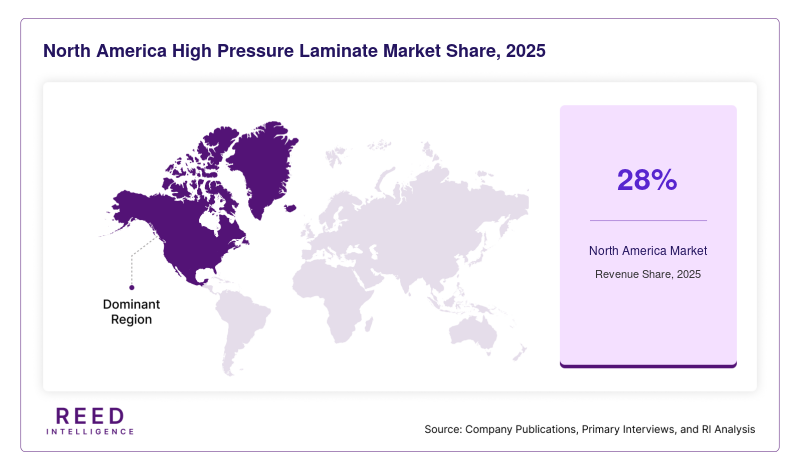
North America accounted for approximately 28% of the global High Pressure Laminate Market in 2025, equivalent to USD 3.19 Billion. The region benefits from established HPL manufacturers, mature commercial construction, furniture manufacturing, healthcare infrastructure, and strong architectural specification activity.
Wilsonart maintains a large HPL portfolio in the region, including high-wear, fire-rated, chemical-resistant, antimicrobial, and specialty products. Its distribution network covers more than 100 locations across North America.
The U.S. remains the principal consumption market, supported by office interiors, residential remodeling, healthcare facilities, hospitality projects, retail spaces, and institutional construction. Product differentiation through sustainability certifications, design libraries, performance enhancements, and customized surfaces is becoming increasingly important.
North America is projected to reach approximately USD 4.90 Billion by 2034, supported by renovation activity, commercial interiors, healthcare construction, and replacement demand.
Europe
Europe represented approximately 25% of the market in 2025, equivalent to USD 2.85 Billion. The region has a mature furniture and interior-design industry, strong architectural standards, and high demand for certified and performance-oriented materials.
Pfleiderer's HPL portfolio includes standard, compact, antimicrobial, fire-retardant, real-metal, magnetic, and customized HPL products. The company also provides HPL with Blue Angel certification and FSC or PEFC options.
European purchasing decisions increasingly incorporate environmental declarations, responsible sourcing, indoor-air-quality requirements, durability, and product certification. This favors manufacturers that can provide documented environmental and technical performance.
Europe is projected to reach approximately USD 4.10 Billion by 2034, supported by renovation, furniture production, commercial interiors, healthcare, hospitality, and sustainability-focused procurement.
APAC
APAC accounted for approximately 31% of the global market in 2025, equivalent to USD 3.53 Billion, making it the largest regional market. China, India, Japan, South Korea, and Southeast Asian countries provide significant demand through furniture production, residential construction, commercial interiors, hospitality, and infrastructure development.
The region also has a strong manufacturing base for decorative surfaces and furniture components. Greenlam's product matrix, for example, covers general-purpose, postforming, compact, interior cladding, exterior cladding, ESD, fire-retardant, digital, and other HPL categories.
India and China remain important markets because of large domestic furniture and construction ecosystems. Southeast Asia adds demand through furniture manufacturing and export-oriented production.
APAC is projected to reach approximately USD 5.93 Billion by 2034, supported by urbanization, residential construction, furniture manufacturing, commercial development, and rising demand for durable decorative interiors.
Middle East and Africa
The Middle East and Africa represented approximately 8% of the market in 2025, equivalent to USD 912 Million. Hospitality, commercial buildings, retail developments, healthcare facilities, and premium residential construction support demand for decorative surfaces.
The Middle East is particularly relevant for hospitality and commercial interiors, where architects often require surfaces that combine design flexibility with durability. HPL can reproduce stone, wood, metal, and other visual materials without requiring the weight and maintenance associated with some natural materials.
Africa offers longer-term potential through urban development, housing, commercial construction, and furniture manufacturing. However, market development differs considerably across countries because of construction activity, imports, local manufacturing, and purchasing power.
The regional market is projected to reach approximately USD 1.52 Billion by 2034.
LATAM
Latin America accounted for approximately 8% of the market in 2025, equivalent to USD 912 Million. Brazil, Mexico, Argentina, Colombia, and Chile represent important markets for furniture, residential interiors, commercial construction, and hospitality applications.
Demand is supported by furniture production, kitchen and cabinetry applications, residential renovation, and commercial interiors. Distributors and local fabricators remain important because HPL often reaches end users through a multi-stage channel involving manufacturers, wholesalers, contractors, and designers.
The region is projected to reach approximately USD 1.55 Billion by 2034, supported by residential construction, furniture demand, remodeling, and commercial development.
Competitive Landscape
The High Pressure Laminate Market includes global surface-material manufacturers, regional laminate producers, and vertically integrated decorative-panel companies. Competition is based on product breadth, design libraries, surface technology, manufacturing capacity, distribution, customization, certifications, and application-specific performance.
Formica Group has a long-established HPL portfolio with extensive woodgrain, stone, solid-color, pattern, and texture options. The company continues to expand its design offering, including new stone-inspired collections.
Wilsonart competes through a broad HPL design library, performance technologies, specialty laminates, sustainability credentials, and a large North American distribution network. Its HPL portfolio includes high-wear, antimicrobial, fire-rated, chemical-resistant, and scratch-resistant products.
Pfleiderer differentiates through HPL products covering standard decorative surfaces, antimicrobial products, fire-retardant grades, real-metal finishes, customized digital designs, and sustainability certifications.
Key Market Players
- Formica Group
- Wilsonart
- Greenlam Industries
- Pfleiderer
- Fletcher Building / Laminex
- SURTECO
- Merino Industries
- OMNOVA Solutions
- Arpa Industriale
- EGGER
Recent Market Developments
- August 2026 – Formica Canada: Formica introduced its 2026 Stone Collection, adding five new natural-stone-inspired HPL designs for residential and commercial interiors. The launch strengthens its focus on premium aesthetics combined with laminate durability.
- July 2026 – Wilsonart: Wilsonart launched its 2026 HPL Collection with 21 new designs, including 11 woodgrains, six linear patterns, and four textile-inspired surfaces. The collection is designed to simplify material selection and coordination for commercial interiors
High Pressure Laminate Market Segments
By Type
- General Purpose HPL
- Postforming HPL
- Compact HPL
- Fire-Retardant HPL
- Chemical-Resistant HPL
By Application
- Furniture & Cabinets
- Countertops
- Wall Panels
- Doors
- Flooring
- Others
By End Use
- Residential
- Commercial
- Healthcare
- Hospitality
- Education
- Retail
- Others
By Region
- North America
- Europe
- APAC
- Middle East and Africa
- LATAM