High Purity Aluminum Nitride Market Size, Share & Growth Report by Product Type (Substrate-Grade Aluminum Nitride, Powder Form, Thin Film & Coating Grade, Sintered Ceramics), by Application (Semiconductor Packaging, Power Electronics, LED Lighting, Telecommunications, Aerospace & Defense Electronics), by End-Use Industry (Electronics & Semiconductor, Automotive Electronics, Aerospace & Defense, Telecommunication, Industrial Equipment) & Regional Forecasts, 2026–2034
USD 3950
Market Overview
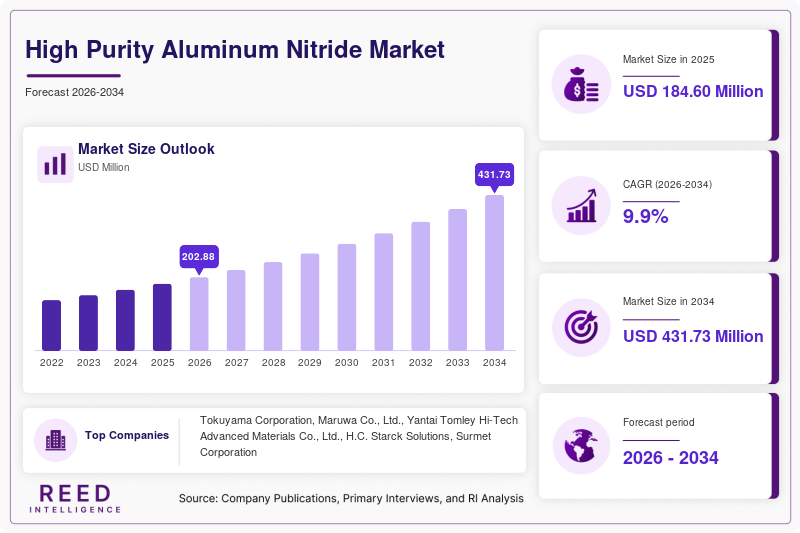
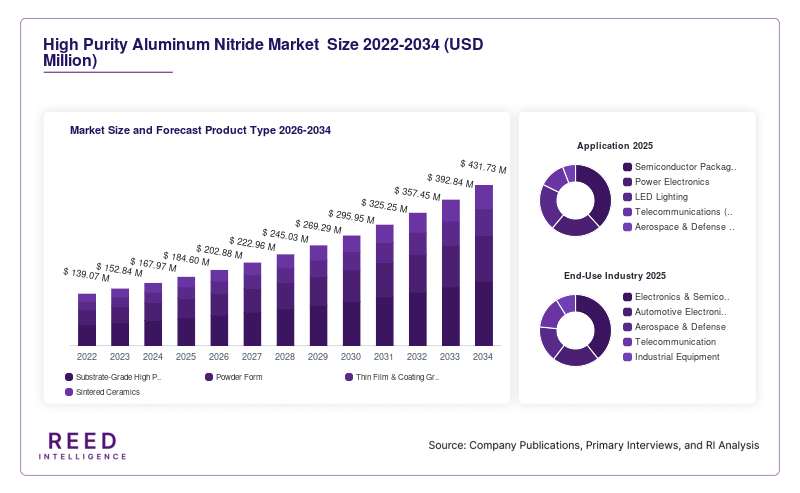
The global High Purity Aluminum Nitride Market was valued at USD 184.6 million in 2026 and is projected to reach USD 392.8 million by 2034, expanding at a CAGR of 9.9% during the forecast period from 2026 to 2034. High purity aluminum nitride has gained industrial relevance due to its superior thermal conductivity, electrical insulation, and chemical stability, making it a preferred advanced ceramic material in semiconductor packaging, power electronics, and thermal management systems.
A major global factor supporting the expansion of the High Purity Aluminum Nitride Market has been the steady rise in advanced semiconductor manufacturing. Increasing deployment of electric vehicles, 5G infrastructure, and AI-driven computing systems has accelerated demand for heat-dissipating ceramic substrates. Manufacturers are investing in ultra-high-purity powder synthesis technologies to meet stringent purity thresholds required in next-generation microelectronics.
Key Highlights:
- Asia Pacific held the dominant regional share at 42.8% in 2025, while Middle East & Africa is projected to register the fastest CAGR of 11.4%.
- By Purity Grade, 4N purity accounted for the leading share at 46.2%, while 5N purity is expected to grow fastest at 11.1% CAGR.
- By Application, substrates represented the dominant subsegment with 39.6% share, while thermal interface components will expand at 10.8% CAGR.
- China, the dominant country, recorded market values of USD 38.4 million in 2024 and USD 42.1 million in 2025.
Market Trends
Expansion of Ultra-Thin Ceramic Substrate Manufacturing
One of the defining trends in the High Purity Aluminum Nitride Market is the growing production of ultra-thin ceramic substrates for compact electronics. Miniaturized devices in EV inverters, telecom base stations, and wearable electronics require thinner substrates with high heat dissipation capability. Producers are developing precision sintering techniques to manufacture thinner aluminum nitride sheets without compromising mechanical integrity. This trend is reshaping substrate design standards in semiconductor packaging.
Shift Toward Integrated Thermal Management Assemblies
Another notable trend is the increasing integration of aluminum nitride into multifunction thermal assemblies. Instead of using separate heat spreaders and insulating layers, manufacturers are embedding high purity aluminum nitride into consolidated thermal modules. This approach reduces system size, lowers thermal resistance, and improves reliability in power-dense electronics. As demand rises for compact high-performance devices, integrated ceramic thermal systems are expected to gain broader industrial adoption.
Market Drivers
Rising Demand from Electric Mobility Electronics
The rapid electrification of transport has emerged as a major driver for the High Purity Aluminum Nitride Market. EV battery management systems, onboard chargers, and power control units require thermally conductive insulating materials capable of operating under elevated loads. High purity aluminum nitride supports stable thermal transfer and dielectric performance, making it increasingly valuable in automotive electronics architectures.
Growth in High-Frequency Communication Devices
The expansion of 5G and satellite communication systems is driving material demand in RF modules and signal transmission hardware. Aluminum nitride’s low dielectric loss and thermal reliability make it suitable for high-frequency circuits. As telecom networks continue infrastructure upgrades, demand for premium ceramic materials in communication modules is expected to rise steadily.
Market Restraints
High Production Cost of Ultra-High Purity Grades
A significant restraint affecting the High Purity Aluminum Nitride Market is the elevated cost associated with ultra-high-purity production processes. Achieving impurity-free synthesis requires advanced nitridation, controlled atmospheres, and specialized purification stages, increasing manufacturing expenses. These high costs can limit adoption among price-sensitive end users, especially in emerging industrial economies where lower-cost ceramic alternatives remain attractive.
Market Opportunities
Emerging Use in Quantum Electronics Packaging
Quantum computing hardware requires thermally stable and electrically insulating ceramic platforms. High purity aluminum nitride is gaining attention as a packaging medium for cryogenic and quantum-sensitive devices. This emerging field presents long-term growth potential for specialized ceramic suppliers.
Adoption in Aerospace Sensor Systems
Advanced aerospace sensors increasingly require materials resistant to thermal shock and corrosive environments. Aluminum nitride ceramics are being explored for avionics sensor packaging and radar modules. Expansion in satellite launches and defense electronics programs will create new commercial opportunities for market participants.
Segmental Analysis
By Purity Grade
The 4N purity segment dominated the High Purity Aluminum Nitride Market in 2025 with a 46.2% share, supported by broad usage in mainstream semiconductor substrates and industrial ceramic components where high thermal conductivity is required without extreme purification cost.
The 5N purity segment will grow fastest at 11.1% CAGR through 2034, driven by increasing demand in precision RF modules and high-end laser packaging applications requiring ultra-low contamination thresholds.
By Form
Powder form held the leading share of 51.8% in 2025 due to its widespread use as the primary feedstock in ceramic shaping, tape casting, and sintered substrate production.
Granules will witness the fastest CAGR of 10.5%, as automated molding and precision additive ceramic manufacturing will increasingly favor uniform particle-flow materials for consistent fabrication quality.
By Application
Substrates accounted for the largest application share at 39.6% in 2025, reflecting strong use in semiconductor packages, insulated gate modules, and LED heat spread assemblies.
Thermal interface components are projected to expand at 10.8% CAGR due to rising adoption in compact EV electronics requiring efficient heat dissipation between chips and heat sinks.
By End-Use Industry
Electronics and semiconductors represented the dominant end-use segment with 48.9% share in 2025, supported by demand from chip packaging, RF modules, and optoelectronic devices.
Automotive electronics will grow fastest at 10.9% CAGR as electric drivetrain architectures increasingly integrate aluminum nitride-based ceramic insulation layers in power control systems.
By Manufacturing Method
Carbothermal reduction nitridation dominated with 44.7% share in 2025 because it remains widely used for large-scale powder production with controlled purity consistency.
Direct nitridation methods will expand fastest at 10.6% CAGR as producers seek lower-emission and energy-efficient synthesis routes for specialty grades.
Regional Analysis
North America
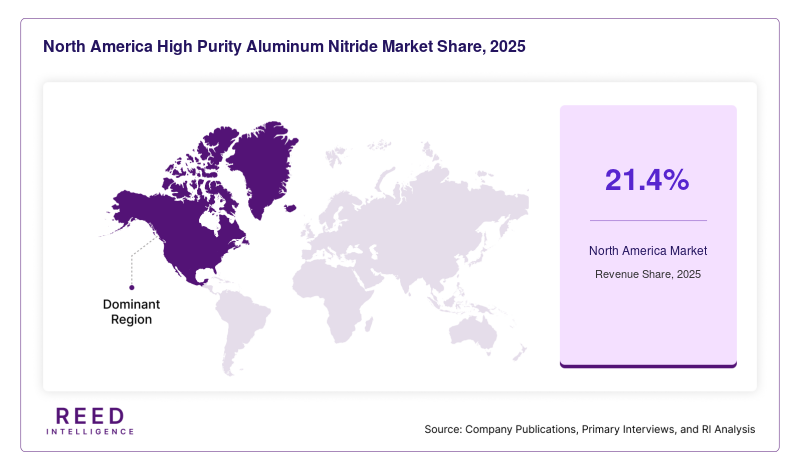
North America accounted for 21.4% of the High Purity Aluminum Nitride Market in 2025 and is projected to grow at a CAGR of 8.9% through 2034. Regional growth will be supported by increased integration of ceramic substrates into aerospace electronics and defense-grade semiconductor modules.
The United States remained the dominant country due to its strong semiconductor equipment manufacturing base. Rising investment in domestic chip fabrication plants has strengthened demand for advanced ceramic packaging materials in high-power microelectronics.
Europe
Europe represented 19.7% market share in 2025 and will expand at a CAGR of 8.6% during the forecast period. Demand will remain supported by industrial automation upgrades and renewable power conversion equipment requiring thermally conductive ceramics.
Germany led the regional market because of its industrial electronics and automotive control systems sector. Strong adoption of ceramic-based thermal substrates in EV drivetrain electronics has reinforced country-level market demand.
Asia Pacific
Asia Pacific held the largest share at 42.8% in 2025 and will register a CAGR of 10.3% through 2034. The region benefits from concentrated semiconductor assembly hubs and strong electronics export manufacturing ecosystems.
China dominated regional demand owing to its large-scale production of power semiconductors and LED packaging systems. Expansion of domestic wafer fabrication facilities has accelerated procurement of high purity ceramic powders and substrates.
Middle East & Africa
Middle East & Africa captured 8.1% of the market in 2025 and is forecast to grow at 11.4% CAGR, making it the fastest-growing region. Demand will be fueled by investments in industrial electronics localization and smart infrastructure expansion.
Saudi Arabia emerged as the leading country due to increased investment in advanced manufacturing diversification projects. Government-backed industrial material initiatives are encouraging adoption of specialty ceramics in electronics assembly.
Latin America
Latin America accounted for 8.0% market share in 2025 and will grow at a CAGR of 9.1% through 2034. Growth will be linked to increasing electronics imports, assembly expansion, and regional renewable energy control system manufacturing.
Brazil dominated the region because of its growing industrial electronics sector. Rising deployment of power modules in grid modernization projects has increased demand for thermally stable insulating ceramic components.
Competitive Landscape
The High Purity Aluminum Nitride Market remains moderately consolidated with established ceramic material manufacturers focusing on purity enhancement, production scale expansion, and electronics-grade innovation. Tokuyama Corporation leads the market through its strong portfolio in ultra-high-purity ceramic powders and recent expansion of advanced nitridation capacity in East Asia. Other notable players include H.C. Starck Solutions, Surmet Corporation, Toyo Aluminium K.K., and CeramTec GmbH, each strengthening their position through customized substrate-grade material offerings. Strategic partnerships between powder manufacturers and semiconductor packaging firms are increasing as demand for application-specific ceramic solutions grows.
Key Players List
- Tokuyama Corporation
- H.C. Starck Solutions
- Surmet Corporation
- Toyo Aluminium K.K.
- CeramTec GmbH
- Denka Company Limited
- Maruwa Co. Ltd.
- Morgan Advanced Materials
- CoorsTek Inc.
- Thrutek Applied Materials
- Precision Ceramics USA
- Ferro-Ceramic Grinding Inc.
- Fujian Huaqing Electronic Material
- Ningxia Ascendus New Material
- Eno High-Tech Material Co. Ltd.
Recent Developments
- Tokuyama Corporation expanded aluminum nitride powder purification capacity in 2025 to support semiconductor-grade demand growth.
- CeramTec GmbH introduced a new thin-sheet aluminum nitride substrate line for compact RF electronics applications in 2025.
- Surmet Corporation launched advanced thermal interface ceramic components for aerospace electronics in early 2026.
- Denka Company Limited upgraded its direct nitridation production line to improve ultra-high-purity yield efficiency.
- Maruwa Co. Ltd. expanded its automotive ceramic substrate supply agreements with EV inverter manufacturers in 2026.
High Purity Aluminum Nitride Market Segments
Product Type
- Substrate-Grade High Purity Aluminum Nitride
- Powder Form
- Thin Film & Coating Grade
- Sintered Ceramics
Application
- Semiconductor Packaging
- Power Electronics
- LED Lighting
- Telecommunications (5G Infrastructure)
- Aerospace & Defense Electronics
End-Use Industry
- Electronics & Semiconductor
- Automotive Electronics (EV Systems)
- Aerospace & Defense
- Telecommunication
- Industrial Equipment
By Region
- North America
- Europe
- APAC
- Middle East and Africa
- LATAM