High Temperature Resin Market Size, Share & Demand Report By Resin Type (Polyimide, Phenolic Resin, Epoxy Resin, Silicone Resin, Polyether Ether Ketone (PEEK), Others), By End-Use Industry (Aerospace & Defense, Automotive, Electronics & Electrical, Industrial Manufacturing), By Form (Liquid Resin, Powder Resin, Composite Resin), By Application (Coatings, Adhesives & Sealants, Composites), By Distribution Channel (Direct Sales, Distributors & Wholesalers) By Region & Segment Forecasts, 2026–2034
USD 3950
Market Overview
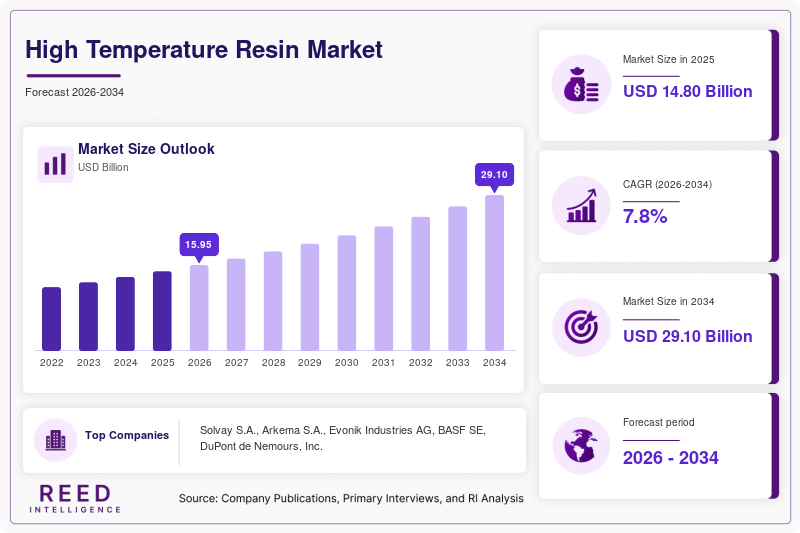
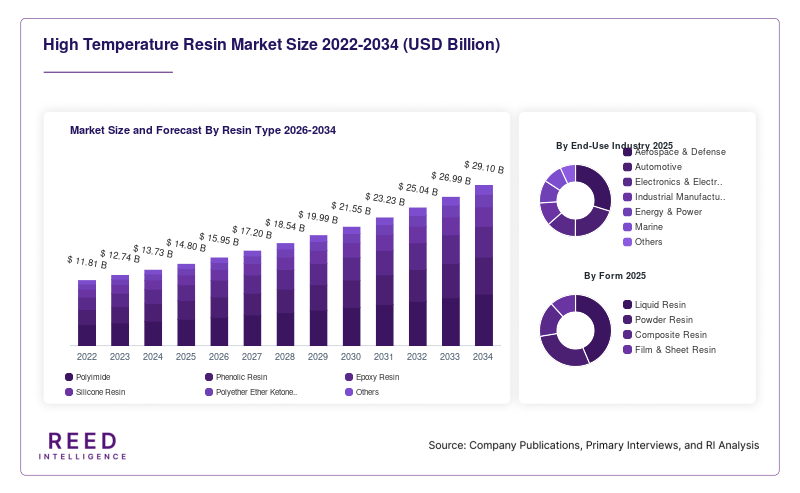
The High Temperature Resin Market size was valued at USD 14.8 billion in 2026 and is projected to reach USD 26.9 billion by 2034, expanding at a CAGR of 7.8% during the forecast period (2026–2034). The market growth is being supported by increasing industrial demand for lightweight, heat-resistant, and chemically stable materials across aerospace, automotive, electronics, and energy sectors. High temperature resins are widely used in applications that require superior thermal stability, flame resistance, and mechanical strength under extreme operating conditions. Industries are increasingly replacing conventional metals and standard polymers with advanced resin systems to improve performance efficiency and reduce maintenance costs.
A major global factor supporting the High Temperature Resin Market is the rapid expansion of advanced manufacturing and electrification technologies worldwide. Manufacturers across industrial sectors are focusing on materials that can withstand elevated operating temperatures while maintaining structural integrity. This shift has accelerated the use of high-performance thermoset and thermoplastic resin systems in electric vehicles, semiconductor manufacturing, aircraft components, and industrial insulation products. Growing investments in renewable energy infrastructure and industrial automation are also contributing to long-term market expansion.
Key Highlights
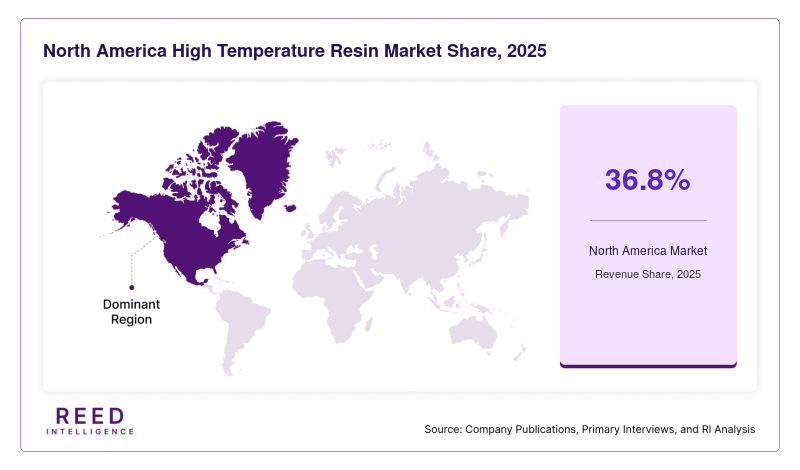
- North America dominated the High Temperature Resin Market with a 36.8% share in 2025, while Asia Pacific is expected to register the fastest CAGR of 8.9% during 2026–2034.
- By resin type, polyimide resin held the leading market share of 31.5% in 2025, while cyanate ester resin is projected to grow at a CAGR of 9.3% during the forecast period.
- By application, aerospace components accounted for 28.6% of the market share in 2025, whereas electrical & electronics applications are anticipated to expand at a CAGR of 9.1%.
- By end-use industry, automotive represented 26.2% market share in 2025, while renewable energy applications are projected to grow at a CAGR of 9.5%.
- The U.S. High Temperature Resin Market was valued at USD 3.72 billion in 2024 and reached USD 3.96 billion in 2025.
Market Trends
Increasing Adoption of Lightweight Composite Materials
One of the major trends shaping the High Temperature Resin Market is the growing use of lightweight composite materials in industrial manufacturing. Aerospace, automotive, and defense manufacturers are increasingly integrating advanced resin systems into structural composites to reduce component weight while maintaining high mechanical strength. Lightweight composite materials help improve fuel efficiency, thermal performance, and durability in demanding operating environments. High temperature resins are becoming critical in carbon fiber reinforced composites used in aircraft interiors, engine systems, and electric vehicle battery structures.
The increasing emphasis on energy efficiency and operational performance is accelerating the adoption of advanced thermosetting and thermoplastic resin solutions. Manufacturers are developing high-performance composite materials capable of operating in harsh environments without compromising stability. The trend is expected to continue as industries prioritize material innovation to support next-generation transportation and industrial technologies.
Rising Demand for Thermal Management Solutions in Electronics
Another important trend in the High Temperature Resin Market is the rising integration of thermal management solutions in electronic systems. Semiconductor manufacturers and electronics producers are increasingly using high temperature resin materials in printed circuit boards, insulation systems, and encapsulation applications. Miniaturization of electronic components and increasing heat generation within high-density systems are creating strong demand for thermally stable resin technologies.
Advanced electronic devices require materials that can maintain insulation performance under continuous thermal stress. High temperature resins are supporting the development of durable electronic systems for industrial automation, telecommunications, electric vehicles, and renewable energy infrastructure. Companies are also investing in specialty resin formulations with enhanced dielectric properties and improved heat dissipation capabilities to support next-generation electronics manufacturing.
Market Drivers
Expanding Aerospace Manufacturing Activities
The expansion of aerospace manufacturing activities is a major driver supporting the High Temperature Resin Market. Aircraft manufacturers are increasingly using advanced resin systems in structural components, insulation panels, and engine assemblies due to their excellent thermal resistance and lightweight properties. Rising investments in commercial aviation modernization and defense aircraft production are increasing demand for high-performance materials capable of withstanding elevated operating temperatures.
The aerospace industry is focusing on fuel efficiency improvements and reduced emissions, which has accelerated the transition toward lightweight composite structures. High temperature resins are playing an important role in supporting aircraft durability, thermal management, and structural integrity. Increasing aircraft production rates and rising maintenance requirements are expected to continue supporting market growth.
Growing Demand from Electric Vehicle Manufacturing
The rapid expansion of electric vehicle manufacturing is another significant factor driving the High Temperature Resin Market. Electric vehicles require advanced thermal insulation and battery protection materials capable of operating under high thermal stress conditions. High temperature resins are widely used in battery modules, charging systems, motor housings, and electronic insulation components.
Automotive manufacturers are investing heavily in advanced material technologies to improve battery efficiency and vehicle safety. Increasing production of electric passenger vehicles, buses, and commercial fleets is strengthening demand for durable resin materials. Governments worldwide are also supporting electric mobility adoption through favorable policies and emission reduction targets, which is positively influencing market expansion.
Market Restraint
High Production and Processing Costs
One of the major restraints limiting the High Temperature Resin Market is the high production and processing cost associated with specialty resin materials. Manufacturing advanced resin systems requires sophisticated processing technologies, specialized raw materials, and strict quality control standards. These factors increase overall production expenses and create pricing challenges for small-scale manufacturers.
Industries operating in cost-sensitive environments may hesitate to adopt high temperature resin solutions due to their relatively higher prices compared to conventional polymer alternatives. In addition, fluctuating raw material costs and complex manufacturing processes may affect profit margins and slow market penetration in developing economies.
Market Opportunities
Expansion of Renewable Energy Infrastructure
The rapid growth of renewable energy infrastructure is creating strong opportunities for the High Temperature Resin Market. Wind turbines, solar power systems, and energy storage solutions increasingly require thermally stable and corrosion-resistant materials. High temperature resins are being used in turbine blades, insulation systems, electrical connectors, and structural composite components.
As countries continue investing in clean energy projects, manufacturers are expected to experience rising demand for advanced resin technologies that improve operational efficiency and equipment durability. Increasing offshore wind energy installations and grid modernization projects are also expected to support long-term market opportunities.
Development of Advanced 3D Printing Materials
The development of high-performance 3D printing materials presents another promising opportunity for the market. Industrial manufacturers are increasingly adopting additive manufacturing technologies to produce lightweight and heat-resistant components for aerospace, automotive, and electronics applications. High temperature resin materials are enabling the production of precision-engineered parts capable of operating in extreme conditions.
The growing demand for rapid prototyping and customized industrial components is encouraging resin manufacturers to develop specialty formulations for advanced 3D printing systems. These innovations are expected to create new commercial opportunities across industrial manufacturing sectors.
Segmental Analysis
By Resin Type
Based on resin type, the market is segmented into polyimide resin, phenolic resin, bismaleimide resin, cyanate ester resin, and others.
Polyimide resin dominated the High Temperature Resin Market with a 31.5% share in 2025 due to its superior thermal resistance, chemical stability, and mechanical durability. The material is widely used in aerospace structures, electrical insulation systems, and industrial composites where high operating temperatures are common.
Cyanate ester resin is expected to register the fastest CAGR of 9.3% during the forecast period. The segment growth will be supported by increasing demand for low dielectric materials in advanced electronics and aerospace applications. Manufacturers are investing in specialty resin formulations to improve thermal performance and structural reliability.
By Application
Based on application, the market is categorized into aerospace components, electrical & electronics, automotive parts, industrial equipment, and coatings & adhesives.
Aerospace components accounted for 28.6% of the market share in 2025 due to rising aircraft production and increasing use of lightweight composite structures. High temperature resin materials are increasingly being integrated into engine systems, insulation panels, and aircraft interiors.
Electrical & electronics applications are projected to expand at the fastest CAGR of 9.1% during 2026–2034. Growing demand for advanced circuit protection systems and thermal insulation materials in semiconductors and electronic devices will support segment growth. Increasing production of high-density electronic systems is expected to strengthen long-term demand.
By End-Use Industry
Based on end-use industry, the market is segmented into automotive, aerospace & defense, electronics, energy, and industrial manufacturing.
Automotive represented the dominant segment with 26.2% market share in 2025 due to increasing integration of thermal-resistant materials in electric vehicles and advanced engine systems. Automotive manufacturers increasingly relied on lightweight resin composites to improve fuel efficiency and thermal stability.
Renewable energy applications within the energy segment are anticipated to grow at a CAGR of 9.5% during the forecast period. Increasing installation of wind turbines and solar energy systems will drive demand for durable high temperature resin materials capable of operating in harsh environmental conditions.
By Processing Technology
Based on processing technology, the market is divided into injection molding, compression molding, resin transfer molding, and additive manufacturing.
Injection molding held the leading market share of 38.4% in 2025 owing to its high production efficiency and ability to manufacture complex industrial components with consistent quality. Manufacturers increasingly used this technology for automotive and electronics applications.
Additive manufacturing is expected to witness the fastest CAGR of 9.7% during the forecast period. Growing adoption of industrial 3D printing technologies and increasing demand for customized heat-resistant components are expected to accelerate segment growth across multiple industries.
Regional Analysis
North America
North America accounted for 36.8% of the High Temperature Resin Market share in 2025 and is projected to grow at a CAGR of 7.4% during 2026–2034. The region benefits from advanced aerospace manufacturing capabilities, strong industrial infrastructure, and high adoption of specialty composite materials. The United States dominated the regional market due to increasing investments in aircraft manufacturing, electric vehicle production, and semiconductor development. Strong research activities focused on advanced polymer engineering have further strengthened regional market growth.
Europe
Europe held 28.1% of the global High Temperature Resin Market share in 2025 and is expected to expand at a CAGR of 7.2% during the forecast period. The regional market is being supported by rising industrial automation and increasing demand for thermally stable materials in automotive and renewable energy sectors. Germany emerged as the dominant country due to the strong presence of automotive manufacturers and advanced engineering industries. Growing investments in lightweight transportation materials are also contributing to market expansion.
Asia Pacific
Asia Pacific represented 24.6% of the High Temperature Resin Market share in 2025 and is anticipated to register the fastest CAGR of 8.9% during 2026–2034. Rapid industrialization, expanding electronics manufacturing, and increasing infrastructure investments are driving regional market growth. China led the regional market due to its strong electronics production base and large-scale electric vehicle manufacturing capacity. Rising investments in industrial modernization and renewable energy projects are further supporting market expansion across the region.
Middle East & Africa
The Middle East & Africa accounted for 5.7% of the market share in 2025 and is forecast to grow at a CAGR of 6.6% during the study period. Growing investments in energy infrastructure and industrial manufacturing are supporting regional demand for high-performance resin materials. Saudi Arabia remained the leading country due to increasing petrochemical industry expansion and infrastructure modernization projects. Industrial diversification initiatives are also contributing to the adoption of advanced material technologies.
Latin America
Latin America captured 4.8% of the High Temperature Resin Market share in 2025 and is projected to grow at a CAGR of 6.9% during 2026–2034. The regional market is benefiting from rising automotive production and expanding industrial equipment manufacturing activities. Brazil dominated the regional market due to increasing industrial investments and growing demand for thermal-resistant materials in transportation applications. Expanding renewable energy installations are also contributing to regional growth.
Competitive Landscape
The High Temperature Resin Market is moderately competitive with the presence of global chemical manufacturers and specialty polymer producers focusing on innovation, capacity expansion, and advanced composite material development. Companies are investing in research activities to improve thermal stability, chemical resistance, and lightweight properties of advanced resin systems.
Solvay S.A. remains a leading participant in the market due to its extensive portfolio of aerospace-grade and industrial high-performance resin materials. The company recently expanded its advanced thermoplastic composite production capabilities to support increasing aerospace and electric vehicle demand.
Evonik Industries AG continues to focus on specialty high-temperature polymer development for industrial and electronics applications. SABIC is strengthening its advanced resin portfolio through investments in sustainable engineering thermoplastics. Huntsman Corporation is emphasizing lightweight automotive composites, while Arkema S.A. is investing in high-performance resin solutions for additive manufacturing and renewable energy applications.
Key Players List
- Solvay S.A.
- Evonik Industries AG
- SABIC
- Huntsman Corporation
- Arkema S.A.
- Celanese Corporation
- BASF SE
- Dow Inc.
- Toray Industries Inc.
- Mitsubishi Chemical Group Corporation
- Sumitomo Bakelite Co. Ltd.
- DIC Corporation
- Hexcel Corporation
- RTP Company
- Lanxess AG
Recent Developments
- In February 2025, Solvay S.A. expanded production capacity for aerospace-grade high temperature thermoplastic resins to support growing aircraft manufacturing demand.
- In April 2025, SABIC introduced a new specialty resin portfolio designed for electric vehicle battery insulation systems.
- In August 2024, Arkema S.A. launched advanced resin materials optimized for industrial additive manufacturing applications.
- In October 2024, Evonik Industries AG developed a high-performance heat-resistant polymer solution for semiconductor manufacturing applications.
- In January 2025, Huntsman Corporation partnered with automotive manufacturers to develop lightweight composite materials for electric mobility platforms.
High Temperature Resin Market Segments
By Resin Type
- Polyimide
- Phenolic Resin
- Epoxy Resin
- Silicone Resin
- Polyether Ether Ketone (PEEK)
- Others
By End-Use Industry
- Aerospace & Defense
- Automotive
- Electronics & Electrical
- Industrial Manufacturing
- Energy & Power
- Marine
- Others
By Form
- Liquid Resin
- Powder Resin
- Composite Resin
- Film & Sheet Resin
By Application
- Coatings
- Adhesives & Sealants
- Composites
- Electrical Insulation
- Molding Compounds
- Others
By Distribution Channel
- Direct Sales
- Distributors & Wholesalers
- Online Industrial Platforms
By Region
- North America
- Europe
- APAC
- Middle East and Africa
- LATAM