High Vacuum Gauge Market Size, Share, Demand Report By Type (Ionization Gauges, Capacitance Manometers, Pirani Gauges, Cold Cathode Gauges, Thermocouple Gauges), By Application (Semiconductor Manufacturing, Research & Development Laboratories, Aerospace & Defense Testing,Thin Film & Coating Systems), By End-Use, By Region & Segment Forecasts, 2026–2034
USD 3950
Market Overview
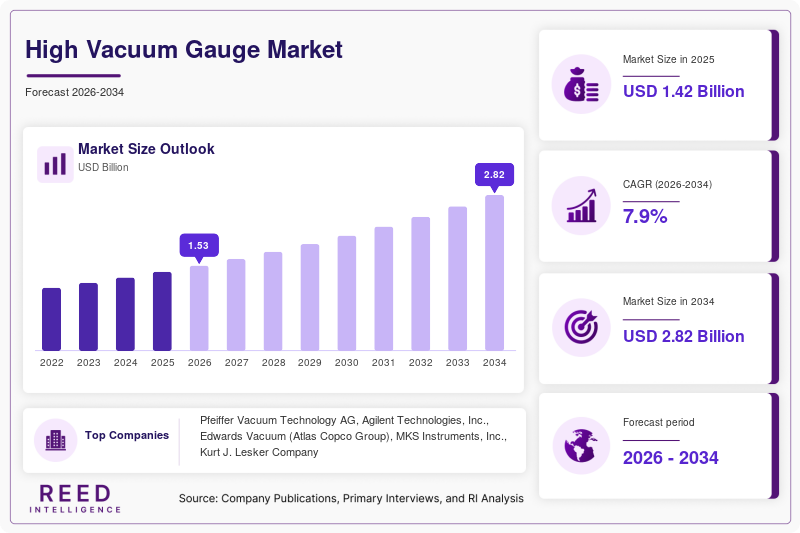
The High Vacuum Gauge Market was valued at approximately USD 1.42 billion in 2026 and is projected to reach USD 2.61 billion by 2034, expanding at a CAGR of 7.9% during the forecast period (2026–2034). The market is witnessing steady expansion due to rising demand for precise vacuum measurement technologies across semiconductor manufacturing, aerospace testing, research laboratories, and advanced coating applications. Increasing adoption of ultra-high vacuum systems in nanotechnology and thin-film deposition processes has further strengthened market penetration across industrial and scientific domains.
A key global factor supporting market growth is the rapid expansion of the semiconductor and electronics manufacturing sector. As chip fabrication processes move toward sub-5nm nodes, the requirement for accurate pressure measurement in ultra-low pressure environments has intensified. High vacuum gauges play a critical role in ensuring process stability, contamination control, and equipment calibration, thereby improving production yield and operational efficiency.
Key Highlights
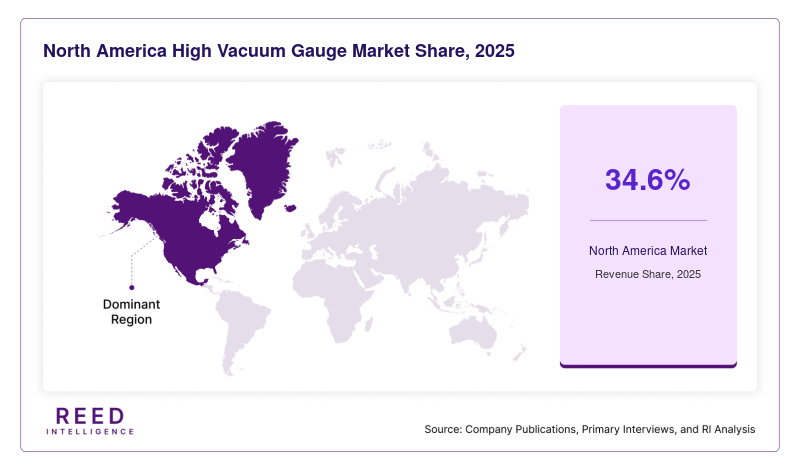
- North America dominated the market with a 34.6% share in 2025.
- Asia Pacific is expected to grow at the fastest CAGR of 11.4% during 2026–2034.
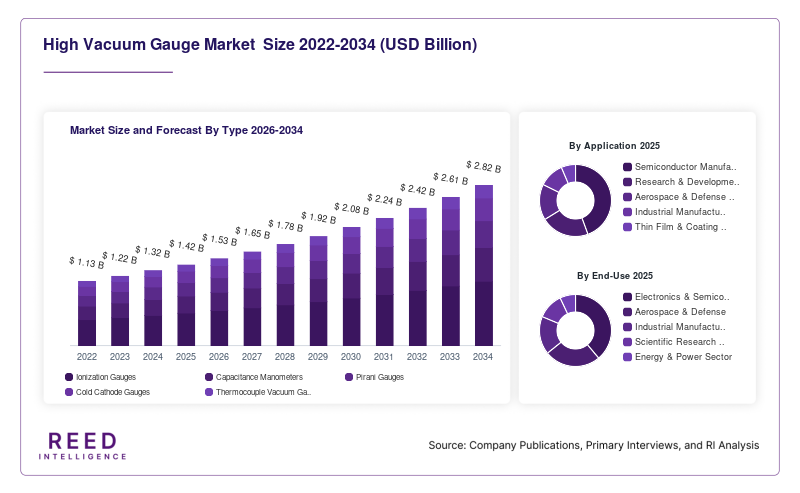
- By type, ionization gauges accounted for the largest share of 39.1%.
- while capacitance manometers are projected to grow at a CAGR of 12.1%.
- By application, semiconductor manufacturing led with a 42.3% share, whereas research & development laboratories are expected to expand at a CAGR of 10.9%.
- The United States remained the dominant country, with market values of USD 610 million in 2024 and USD 665 million in 2025.
Market Trends
Increasing Adoption in Semiconductor Fabrication
The High Vacuum Gauge Market is experiencing a strong trend driven by increasing integration within semiconductor fabrication facilities. As semiconductor nodes shrink and wafer complexity increases, precise vacuum measurement becomes essential to maintain controlled deposition and etching environments. High vacuum gauges are widely used in physical vapor deposition (PVD), chemical vapor deposition (CVD), and etching systems to ensure consistent chamber pressure. Manufacturers are investing in advanced vacuum sensing technologies with higher accuracy, digital interfaces, and real-time monitoring capabilities. The transition toward AI-assisted semiconductor production lines is further boosting the need for smart vacuum gauges capable of predictive calibration and automated diagnostics. Additionally, global chip shortages have encouraged expansion of fabrication plants, particularly in Asia, reinforcing demand for high-performance vacuum measurement systems.
Integration of Digital and Smart Vacuum Measurement Systems
Another major trend shaping the market is the increasing shift toward digitalized and smart high vacuum gauge systems. Traditional analog gauges are being replaced with digital sensors equipped with IoT connectivity, remote monitoring, and cloud-based analytics. These systems enable real-time pressure monitoring and predictive maintenance, reducing downtime in critical industrial operations. Industries such as aerospace testing and advanced research laboratories are increasingly adopting smart vacuum systems for higher operational precision. The integration of Industry 4.0 technologies has also enabled seamless communication between vacuum systems and centralized control platforms. Manufacturers are focusing on miniaturization and energy-efficient designs, which allow deployment in compact and portable systems used in field applications and mobile testing environments.
Market Drivers
Expansion of Semiconductor and Electronics Manufacturing
The rapid expansion of semiconductor and electronics manufacturing industries is a major driver of the High Vacuum Gauge Market. Semiconductor fabrication requires highly controlled vacuum environments for processes such as deposition, lithography, and plasma etching. As global demand for consumer electronics, electric vehicles, and AI-driven devices increases, semiconductor production facilities are scaling up operations. This expansion directly increases the installation of high vacuum systems, where precision gauges are essential for maintaining process stability. Governments in several countries are also investing heavily in domestic chip manufacturing ecosystems, further strengthening demand for vacuum measurement technologies. Additionally, advanced packaging technologies such as 3D IC stacking require ultra-high vacuum conditions, supporting long-term adoption of high vacuum gauges.
Growth in Research, Aerospace, and Advanced Materials
Another significant driver is the increasing use of high vacuum systems in aerospace testing, scientific research, and advanced material development. Research laboratories rely on vacuum gauges for particle physics experiments, surface science studies, and nanomaterial synthesis. In aerospace, vacuum conditions are required for propulsion testing, satellite component validation, and space simulation chambers. The rising investment in space exploration programs and private aerospace ventures has significantly increased demand for high vacuum instrumentation. Furthermore, the development of advanced coatings, graphene-based materials, and nanostructures requires precise vacuum control, further driving adoption across research institutions and industrial laboratories.
Market Restraints
High Cost and Maintenance Complexity of Vacuum Measurement Systems
One of the major restraints affecting the High Vacuum Gauge Market is the high cost associated with advanced vacuum measurement systems and their maintenance requirements. High vacuum gauges, especially ionization and capacitance-based systems, require precise calibration, periodic maintenance, and controlled operating conditions to ensure accuracy. These factors significantly increase total ownership costs, particularly for small and medium-sized enterprises. Additionally, installation of vacuum measurement systems in ultra-high vacuum environments requires specialized technical expertise, which adds to operational expenses. In industries with budget constraints, such as academic research institutions and small manufacturing units, the adoption rate is comparatively slower. Another challenge is the sensitivity of vacuum gauges to contamination and environmental variations, which may lead to frequent recalibration and downtime. This impacts productivity in continuous manufacturing environments such as semiconductor fabs. As a result, despite strong demand, cost-related barriers continue to limit widespread adoption across price-sensitive markets.
Market Opportunities
Growth in Space Exploration and Satellite Programs
The expansion of global space exploration initiatives presents a significant opportunity for the High Vacuum Gauge Market. Space simulation testing requires ultra-high vacuum conditions to replicate outer space environments for satellite components, propulsion systems, and aerospace materials. With increasing investments in lunar missions, Mars exploration, and satellite deployment programs, demand for vacuum testing infrastructure is rising. Private aerospace companies are also contributing to market expansion by developing reusable launch systems and advanced spacecraft technologies. These applications require precise vacuum measurement systems capable of operating in extreme conditions. As space agencies continue to collaborate with private players, the demand for reliable high vacuum gauges is expected to increase steadily over the forecast period.
Advancements in Nanotechnology and Material Science
Another major opportunity lies in the growing field of nanotechnology and advanced material science. The development of nanomaterials, thin films, and superconducting materials requires highly controlled vacuum environments. High vacuum gauges play a critical role in ensuring process accuracy and consistency in these applications. Research institutions and industrial R&D centers are investing in advanced vacuum systems to support innovation in electronics, biomedical devices, and energy storage technologies. The increasing focus on next-generation materials such as graphene and carbon nanotubes is further expected to drive demand. Additionally, government funding for nanotechnology research in emerging economies is creating new growth avenues for market participants.
Segmental Analysis
Type Segment
Ionization gauges held the dominant share of 39.1% in 2024, driven by their widespread use in ultra-high vacuum environments such as semiconductor fabrication and scientific research. These gauges offer high accuracy and reliability in measuring extremely low pressure ranges, making them essential in critical applications where process stability is required.
Capacitance manometers represent the fastest-growing subsegment, expected to register a CAGR of 12.1%. Growth is driven by increasing adoption in industrial automation and semiconductor manufacturing, where precise absolute pressure measurement is necessary. Their stability, accuracy, and compatibility with digital systems are enhancing their adoption across advanced manufacturing environments.
Application Segment
Semiconductor manufacturing accounted for a dominant 42.3% share in 2024, supported by extensive use of vacuum systems in deposition, etching, and lithography processes. The increasing complexity of integrated circuits has strengthened demand for precise vacuum control systems.
Research and development laboratories represent the fastest-growing application, with a projected CAGR of 10.9%. Growth is driven by increased investment in nanotechnology, material science, and physics-based research requiring advanced vacuum environments.
End-Use Segment
Industrial manufacturing dominated with a 37.8% share in 2024, due to widespread use in coating systems, heat treatment, and electronics production. These applications require consistent vacuum conditions to maintain product quality and efficiency.
Aerospace and defense is the fastest-growing end-use segment, projected to grow at a CAGR of 11.2%, driven by satellite testing, propulsion systems, and space simulation applications requiring ultra-high vacuum conditions.
Regional Analysis
North America
North America accounted for 34.6% share in 2025, with a projected CAGR of 7.4% during 2026–2034. The region maintains a strong position due to its advanced semiconductor manufacturing base and high R&D expenditure in aerospace and defense sectors. Increasing investments in chip fabrication facilities in the United States are further strengthening demand for vacuum measurement systems across industrial applications.
The United States is the dominant country in this region, supported by a strong presence of semiconductor fabs and aerospace testing facilities. Growth is further driven by the expansion of private space companies and government-funded research programs focused on advanced materials and nanotechnology.
Europe
Europe held a 27.1% market share in 2025, with a projected CAGR of 6.8% during the forecast period. The region benefits from strong industrial automation and precision engineering sectors. Demand is supported by automotive R&D, renewable energy research, and scientific laboratories across Germany, France, and the UK.
Germany leads the regional market due to its advanced manufacturing ecosystem and strong emphasis on industrial vacuum applications. The country’s focus on innovation in material science and clean energy technologies is contributing to steady adoption of high vacuum gauges.
Asia Pacific
Asia Pacific accounted for 25.8% share in 2025, and is expected to grow at the fastest CAGR of 11.4%. Rapid expansion of semiconductor manufacturing in China, South Korea, Japan, and Taiwan is a key growth driver. Rising electronics production and government incentives for chip manufacturing are accelerating market expansion.
China dominates the region due to massive semiconductor investments and large-scale industrial infrastructure. Increasing demand for consumer electronics and electric vehicles is further supporting vacuum system deployment across production facilities.
Middle East & Africa
Middle East & Africa held a 7.2% share in 2025, with a projected CAGR of 6.5%. Growth is supported by increasing investments in research institutions and aerospace testing centers. Industrial diversification initiatives are also encouraging adoption of advanced manufacturing technologies.
The United Arab Emirates leads the region, driven by aerospace research programs and investments in space exploration missions such as Mars-related initiatives.
Latin America
Latin America accounted for 5.3% share in 2025, with a CAGR of 6.2%. Growth is driven by expanding industrial manufacturing and research activities in Brazil and Mexico. Increasing adoption of advanced electronics production technologies is supporting market penetration.
Brazil is the dominant country due to its growing industrial base and investments in scientific research infrastructure, particularly in physics and material science laboratories.
Competitive Landscape
The High Vacuum Gauge Market is moderately consolidated with key players focusing on technological advancement, product accuracy, and digital integration. Leading companies include Pfeiffer Vacuum Technology, Agilent Technologies, Edwards Vacuum, MKS Instruments, and Kurt J. Lesker Company. These companies are investing in smart vacuum measurement solutions, IoT-enabled monitoring systems, and compact sensor designs to enhance product efficiency.
Pfeiffer Vacuum Technology is a prominent market leader, known for its extensive portfolio of vacuum measurement and control systems. Recently, the company expanded its digital vacuum sensor line with enhanced connectivity features for industrial automation applications. Strategic collaborations, product innovation, and global expansion strategies remain central to competitive positioning across the market.
Key Players List
- Pfeiffer Vacuum Technology
- Agilent Technologies
- Edwards Vacuum
- MKS Instruments
- Kurt J. Lesker Company
- Inficon
- Leybold GmbH
- Brooks Automation
- ULVAC Technologies
- Granville-Phillips
- Canon Anelva
- Nor-Cal Products
- VAT Group
- SMC Corporation
- Teledyne Vacuum Instruments
Recent Developments
- In 2025, leading manufacturers introduced next-generation digital high vacuum gauges with integrated IoT-based monitoring for real-time industrial diagnostics.
- Several companies expanded production facilities in Asia Pacific to support increasing semiconductor fabrication demand and reduce supply chain dependency.
- R&D collaborations between vacuum technology providers and semiconductor firms increased to improve accuracy in ultra-high vacuum measurement systems for sub-5nm chip production processes.
High Vacuum Gauge Market Segments
By Type
- Ionization Gauges
- Capacitance Manometers
- Pirani Gauges
- Cold Cathode Gauges
- Thermocouple Vacuum Gauges
By Application
- Semiconductor Manufacturing
- Research & Development Laboratories
- Aerospace & Defense Testing
- Industrial Manufacturing
- Thin Film & Coating Systems
By End-Use
- Electronics & Semiconductor Industry
- Aerospace & Defense
- Industrial Manufacturing
- Scientific Research Institutions
- Energy & Power Sector
By Region
- North America
- Europe
- APAC
- Middle East and Africa
- LATAM