High Volume Dispensing Systems Market Size, Share & Demand Report By Product Type (Automated Dispensing Systems, Manual Dispensing Systems), By Application (Adhesives and Sealants Dispensing, Electronics Dispensing, Chemical Dispensing,), By End-Use Industry (Automotive Manufacturing, Electronics and Semiconductor, Pharmaceutical and Healthcare), By Dispensing Technology (Positive Displacement Dispensing, Time Pressure Dispensing) By Region & Segment Forecasts, 2026–2034
USD 3950
Market Overview
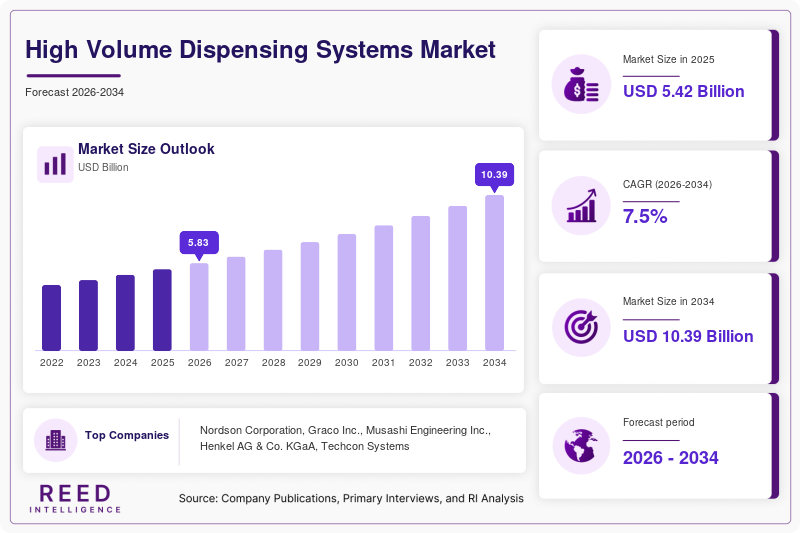
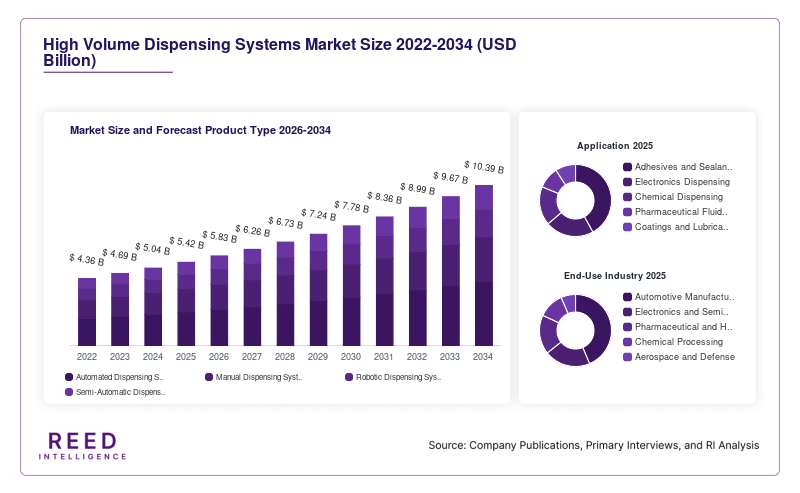
The global High Volume Dispensing Systems Market Size was valued at USD 5.42 billion in 2026 and is projected to reach USD 9.68 billion by 2034, expanding at a CAGR of 7.5% during the forecast period from 2026 to 2034. The market growth has been supported by increasing industrial automation across manufacturing, automotive, electronics, pharmaceuticals, and chemical processing sectors. High volume dispensing systems are increasingly being adopted to improve production efficiency, material accuracy, and operational consistency in high-throughput industrial environments.
The growing focus on precision manufacturing and waste reduction has accelerated demand for automated dispensing technologies worldwide. Industries are increasingly deploying advanced dispensing systems capable of handling adhesives, lubricants, sealants, chemicals, coatings, and liquid materials with minimal material loss and consistent output quality. The transition toward smart manufacturing infrastructure has also strengthened adoption of digitally controlled dispensing equipment.
Key Highlights
- North America accounted for 33.8% of the global High Volume Dispensing Systems Market share in 2025, while Asia Pacific is projected to register the fastest CAGR of 8.3% during the forecast period.
- By product type, automated dispensing systems held the leading share of 47.5% in 2025, while robotic dispensing systems are expected to witness the fastest CAGR of 8.8% through 2034.
- By application, adhesives and sealants dispensing dominated with 35.6% market share in 2025, whereas electronics dispensing applications are anticipated to grow at a CAGR of 8.6%.
- By end-use industry, automotive manufacturing represented 29.8% of the market in 2025, while pharmaceutical manufacturing is projected to expand at a CAGR of 8.4%.
- By dispensing technology, positive displacement dispensing remained the dominant segment with 39.2% share in 2025, while jet dispensing technology is expected to grow at a CAGR of 8.7%.
- The United States High Volume Dispensing Systems Market was valued at USD 1.28 billion in 2024 and reached USD 1.36 billion in 2025 due to increasing industrial automation and advanced manufacturing investments.
Market Trends
Integration of Smart Automation and IoT Connectivity
The High Volume Dispensing Systems Market is witnessing increasing integration of Industrial Internet of Things (IIoT) technologies and smart automation platforms. Manufacturers are adopting dispensing systems equipped with sensors, remote monitoring capabilities, and predictive maintenance features to improve operational efficiency. Real-time process tracking and automated performance diagnostics are becoming important for reducing downtime and enhancing production quality.
Growing Adoption of Robotic Dispensing Solutions
Robotic dispensing systems are becoming a major trend across industrial production environments. Industries are increasingly deploying robotic dispensing equipment to improve precision, speed, and repeatability in complex manufacturing applications. These systems are widely used in automotive assembly lines, electronics production, and medical device manufacturing where accurate material application is essential.
Market Drivers
Increasing Industrial Automation Across Manufacturing Facilities
The rapid expansion of industrial automation is a major factor driving the High Volume Dispensing Systems Market. Manufacturers are increasingly replacing manual dispensing processes with automated systems to improve productivity, minimize errors, and reduce material waste.
Automated dispensing systems provide consistent fluid application and faster processing speeds, making them suitable for high-volume manufacturing environments. The demand for operational efficiency and scalable production capabilities continues to support market growth across multiple industrial sectors.
Rising Demand for Precision Dispensing in Electronics Manufacturing
The growing complexity of electronic devices is significantly driving demand in the High Volume Dispensing Systems Market. Electronics manufacturers require highly accurate dispensing technologies for semiconductor packaging, circuit board assembly, and micro-component bonding applications.
High volume dispensing systems help maintain consistent material placement and minimize production defects in compact electronic assemblies. Increasing demand for consumer electronics, electric vehicles, and semiconductor components is further supporting adoption.
Market Restraint
High Installation and Maintenance Costs
The high initial investment associated with advanced dispensing systems remains a key restraint for the High Volume Dispensing Systems Market. Automated dispensing equipment, robotics integration, and programmable control systems require substantial capital expenditure, particularly for small and medium-sized manufacturers. Ongoing maintenance and software upgrade requirements can also increase operational costs.
Market Opportunities
Expansion of Electric Vehicle Manufacturing
The rapid growth of electric vehicle production is creating significant opportunities in the High Volume Dispensing Systems Market. EV battery assembly and electronic component manufacturing require precise dispensing of adhesives, thermal interface materials, and sealants. Manufacturers are increasingly investing in automated dispensing technologies to support scalable EV production processes.
Growing Demand from Pharmaceutical Packaging Operations
The pharmaceutical industry is expected to create strong opportunities for the High Volume Dispensing Systems Market. Pharmaceutical manufacturers are adopting advanced dispensing systems for liquid filling, dosing, and sterile packaging applications. Increasing investments in pharmaceutical production facilities and biologics manufacturing are expected to support future demand.
Segmental Analysis
By Product Type
Automated Dispensing Systems: Automated dispensing systems accounted for 47.5% of the High Volume Dispensing Systems Market share in 2025. Their dominance was supported by increasing demand for high-speed manufacturing automation and reduced labor dependency. These systems remained widely used in industrial production lines requiring continuous and precise material dispensing.
Robotic Dispensing Systems: Robotic dispensing systems are projected to grow at a CAGR of 8.8% through 2034. Increasing adoption of intelligent robotics and programmable manufacturing systems will support segment expansion. These systems offer enhanced movement precision and operational flexibility for complex industrial applications.
By Application
Adhesives and Sealants Dispensing: Adhesives and sealants dispensing held the largest share of 35.6% in 2025 due to increasing use in automotive assembly, electronics manufacturing, and industrial bonding applications. High volume dispensing systems improved material consistency and minimized production defects.
Electronics Dispensing Applications: Electronics dispensing applications are expected to register a CAGR of 8.6% during the forecast period. Expanding semiconductor packaging and microelectronics production activities will accelerate demand for high-precision dispensing systems.
By End-Use Industry
Automotive Manufacturing: Automotive manufacturing accounted for 29.8% of the High Volume Dispensing Systems Market share in 2025. Demand remained strong due to increasing use of dispensing systems in vehicle assembly, battery production, and component bonding processes.
Pharmaceutical Manufacturing: Pharmaceutical manufacturing is projected to grow at a CAGR of 8.4% through 2034. Rising investments in sterile production environments and automated packaging operations will strengthen adoption of dispensing technologies.
By Dispensing Technology
Positive Displacement Dispensing: Positive displacement dispensing accounted for 39.2% of the High Volume Dispensing Systems Market share in 2025. These systems remained widely preferred because of their high dispensing accuracy and ability to handle different viscosity materials.
Jet Dispensing Technology: Jet dispensing technology is expected to witness a CAGR of 8.7% during the forecast period. Increasing demand for non-contact dispensing and ultra-fast production processes will support segment growth in electronics and medical device manufacturing.
Regional Analysis
North America
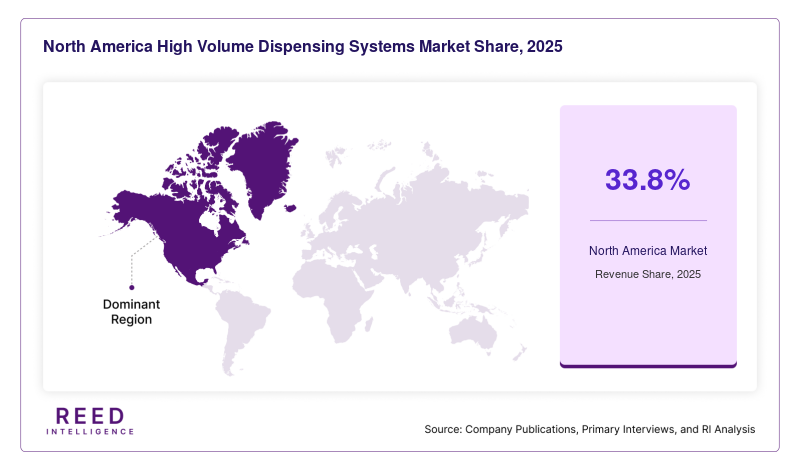
North America accounted for 33.8% of the global High Volume Dispensing Systems Market share in 2025 and is expected to grow at a CAGR of 7.0% through 2034. The regional market benefited from strong industrial automation adoption and advanced manufacturing infrastructure.
The United States dominated the regional market due to increasing investments in automotive production, semiconductor manufacturing, and aerospace assembly operations. The expansion of smart factory technologies also contributed to growing demand for automated dispensing systems.
Europe
Europe represented 27.2% of the High Volume Dispensing Systems Market in 2025 and is projected to expand at a CAGR of 7.1% during the forecast period. The market was supported by increasing adoption of precision manufacturing technologies and advanced industrial robotics.
Germany emerged as the leading country in the region owing to strong automotive production capabilities and growing implementation of Industry 4.0 technologies. Manufacturers increasingly adopted dispensing automation for high-precision assembly operations.
Asia Pacific
Asia Pacific held 24.6% of the High Volume Dispensing Systems Market share in 2025 and is anticipated to witness the fastest CAGR of 8.3% from 2026 to 2034. Rapid industrialization, electronics manufacturing expansion, and increasing factory automation supported regional growth.
China dominated the regional market due to extensive semiconductor manufacturing, consumer electronics production, and electric vehicle assembly activities. Government support for advanced manufacturing modernization also accelerated demand for dispensing technologies.
Middle East & Africa
The Middle East & Africa accounted for 7.6% of the High Volume Dispensing Systems Market in 2025 and is forecast to grow at a CAGR of 6.5% through 2034. The market benefited from increasing industrial diversification and manufacturing investments.
Saudi Arabia emerged as the dominant country in the region because of expanding industrial automation projects and growing chemical processing industries. Manufacturers increasingly adopted dispensing systems for industrial fluid handling applications.
Latin America
Latin America captured 6.8% of the High Volume Dispensing Systems Market share in 2025 and is expected to grow at a CAGR of 6.3% during the forecast period. Industrial modernization and automotive manufacturing investments supported regional market growth.
Brazil led the regional market owing to increasing production activities in automotive assembly and industrial manufacturing sectors. The expansion of electronics production facilities also supported adoption of dispensing technologies.
Segmental Analysis
By Product Type
Automated Dispensing Systems: Automated dispensing systems accounted for 47.5% of the High Volume Dispensing Systems Market share in 2025. Their dominance was supported by increasing demand for high-speed manufacturing automation and reduced labor dependency. These systems remained widely used in industrial production lines requiring continuous and precise material dispensing.
Robotic Dispensing Systems: Robotic dispensing systems are projected to grow at a CAGR of 8.8% through 2034. Increasing adoption of intelligent robotics and programmable manufacturing systems will support segment expansion. These systems offer enhanced movement precision and operational flexibility for complex industrial applications.
By Application
Adhesives and Sealants Dispensing: Adhesives and sealants dispensing held the largest share of 35.6% in 2025 due to increasing use in automotive assembly, electronics manufacturing, and industrial bonding applications. High volume dispensing systems improved material consistency and minimized production defects.
Electronics Dispensing Applications: Electronics dispensing applications are expected to register a CAGR of 8.6% during the forecast period. Expanding semiconductor packaging and microelectronics production activities will accelerate demand for high-precision dispensing systems.
By End-Use Industry
Automotive Manufacturing: Automotive manufacturing accounted for 29.8% of the High Volume Dispensing Systems Market share in 2025. Demand remained strong due to increasing use of dispensing systems in vehicle assembly, battery production, and component bonding processes.
Pharmaceutical Manufacturing: Pharmaceutical manufacturing is projected to grow at a CAGR of 8.4% through 2034. Rising investments in sterile production environments and automated packaging operations will strengthen adoption of dispensing technologies.
By Dispensing Technology
Positive Displacement Dispensing: Positive displacement dispensing accounted for 39.2% of the High Volume Dispensing Systems Market share in 2025. These systems remained widely preferred because of their high dispensing accuracy and ability to handle different viscosity materials.
Jet Dispensing Technology: Jet dispensing technology is expected to witness a CAGR of 8.7% during the forecast period. Increasing demand for non-contact dispensing and ultra-fast production processes will support segment growth in electronics and medical device manufacturing.
Competitive Landscape
The High Volume Dispensing Systems Market remains moderately competitive with the presence of industrial automation companies, dispensing equipment manufacturers, and robotics solution providers. Companies are focusing on smart automation integration, precision dispensing technologies, and robotics compatibility to strengthen their market position.
Nordson Corporation remained a leading participant in the High Volume Dispensing Systems Market due to its advanced fluid dispensing solutions and global industrial customer base. The company recently launched an intelligent dispensing platform with integrated sensor monitoring and automated calibration features designed for electronics manufacturing applications.
Graco Inc. focused on expanding industrial fluid handling systems for automotive and chemical processing applications. Musashi Engineering strengthened precision dispensing solutions for semiconductor production. Henkel AG & Co. KGaA increased dispensing automation capabilities for industrial adhesive applications. Techcon Systems emphasized compact programmable dispensing equipment for electronics assembly operations.
Key Players List
- Nordson Corporation
- Graco Inc.
- Musashi Engineering Inc.
- Henkel AG & Co. KGaA
- Techcon Systems
- Dymax Corporation
- Fisnar Inc.
- DOPAG
- ViscoTec Pumpen- u. Dosiertechnik GmbH
- Essemtec AG
- GPD Global
- Ashby Cross Company
- Sulzer Ltd.
- Valco Melton
- ITW Dynatec
Recent Developments
- In February 2026, Nordson Corporation launched an intelligent dispensing platform with automated calibration and real-time monitoring capabilities.
- In November 2025, Graco Inc. expanded high-volume industrial dispensing systems for automotive fluid applications.
- In September 2025, Musashi Engineering introduced precision robotic dispensing equipment for semiconductor packaging operations.
- In June 2025, Henkel AG & Co. KGaA strengthened dispensing automation solutions for industrial adhesive manufacturing processes.
- In March 2025, Techcon Systems launched compact programmable dispensing units designed for advanced electronics assembly applications.
High Volume Dispensing Systems Market Segments
Product Type
- Automated Dispensing Systems
- Manual Dispensing Systems
- Robotic Dispensing Systems
- Semi-Automatic Dispensing Systems
Application
- Adhesives and Sealants Dispensing
- Electronics Dispensing
- Chemical Dispensing
- Pharmaceutical Fluid Dispensing
- Coatings and Lubricants Dispensing
End-Use Industry
- Automotive Manufacturing
- Electronics and Semiconductor
- Pharmaceutical and Healthcare
- Chemical Processing
- Aerospace and Defense
Dispensing Technology
- Positive Displacement Dispensing
- Time Pressure Dispensing
- Jet Dispensing Technology
- Spray Dispensing Systems
By Region
- North America
- Europe
- APAC
- Middle East and Africa
- LATAM