Hinokitiol Market Size, Share & Demand Report By Application (Cosmetics, Pharmaceuticals, Oral Care, Others), By Form (Powder, Liquid), By End-Use Industry (Personal Care, Healthcare, Others), By Distribution Channel (Online, Offline), By Region & Segment Forecasts, 2025–2034
USD 3950
Market Overview
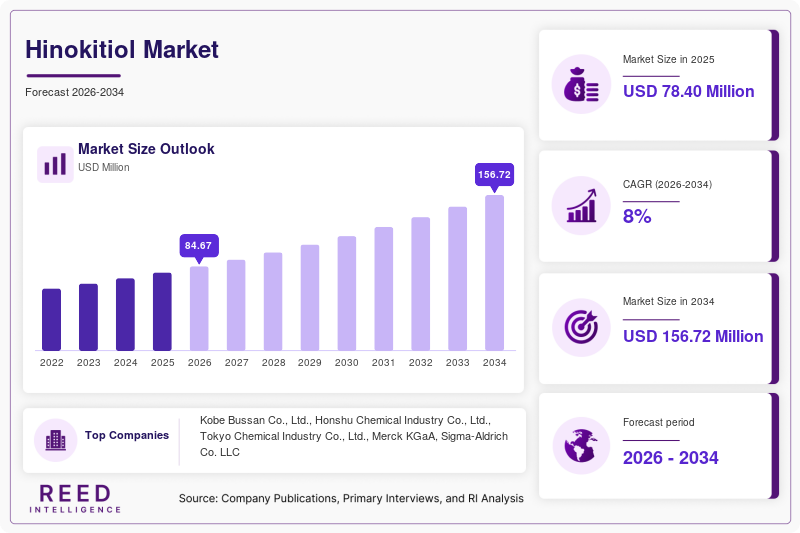
The global Hinokitiol Market size was valued at approximately USD 78.4 million in 2025 and is projected to reach USD 156.7 million by 2034, expanding at a CAGR of 8.0% during the forecast period (2025–2034). Hinokitiol, a natural tropolone derivative extracted primarily from cypress trees, has gained increasing attention due to its antimicrobial, anti-inflammatory, and antioxidant properties. Its application across cosmetics, pharmaceuticals, and oral care products has supported steady market growth globally.
A major global factor supporting the expansion of the Hinokitiol Market is the rising consumer preference for plant-derived and bioactive ingredients in personal care and healthcare formulations. As regulatory bodies and consumers continue to prioritize safety and sustainability, manufacturers are shifting toward naturally sourced compounds like hinokitiol. This transition has enhanced its adoption across premium skincare, scalp treatment solutions, and therapeutic formulations.
Key Highlights
- Asia Pacific dominated the market with a 41.3% share in 2025, while Europe is projected to be the fastest-growing region with a CAGR of 8.9%.
- The cosmetics application segment led with a 46.5% share, while pharmaceutical applications are expected to grow fastest at a CAGR of 9.2%.
- Japan remained the dominant country, with market values of USD 21.6 million in 2025 and USD 23.1 million in 2026.
Market Trends
Rising Integration in Premium Skincare Formulations
The Hinokitiol Market is witnessing increasing incorporation of hinokitiol into premium skincare and dermatological products. Its antibacterial and anti-aging properties make it suitable for formulations targeting acne, sensitive skin, and scalp health. Brands are leveraging hinokitiol as a key differentiator in high-end product lines, particularly in serums, creams, and hair care solutions. The demand for multifunctional ingredients that deliver both cosmetic and therapeutic benefits is further reinforcing this trend.
Additionally, clean-label trends have encouraged manufacturers to highlight hinokitiol as a natural active ingredient. Consumers are becoming more aware of ingredient transparency, leading to greater demand for products free from synthetic preservatives and harsh chemicals.
Expansion into Oral and Medical Applications
Another notable trend shaping the Hinokitiol Market is its growing use in oral care and medical-grade products. Hinokitiol’s antimicrobial effectiveness against bacteria responsible for dental plaque and gum diseases has driven its integration into toothpaste, mouthwash, and dental gels.
Moreover, pharmaceutical research has explored hinokitiol’s potential in antifungal and anticancer therapies. Although still in development stages, early findings have encouraged further investment in clinical studies. This expansion into medically oriented applications is expected to diversify revenue streams and strengthen long-term market growth.
Market Drivers
Growing Demand for Natural Bioactive Ingredients
The increasing shift toward natural and plant-based ingredients has significantly driven the Hinokitiol Market. Consumers are becoming more conscious about product safety, prompting manufacturers to replace synthetic chemicals with naturally derived alternatives. Hinokitiol’s proven antimicrobial and anti-inflammatory properties make it an attractive ingredient in clean-label formulations.
This demand is particularly strong in skincare and personal hygiene products, where natural actives are often perceived as safer and more effective. The trend has encouraged companies to expand their product portfolios to include hinokitiol-based solutions.
Rising Applications in Healthcare and Therapeutics
Another key driver is the growing use of hinokitiol in healthcare applications. Its effectiveness against bacterial and fungal infections has led to increased adoption in pharmaceutical and medical-grade formulations. Researchers are also exploring its role in advanced therapies, including cancer treatment and immune modulation.
The expansion of healthcare infrastructure and increased spending on research and development have further supported this growth. As clinical validation progresses, hinokitiol is expected to gain wider acceptance in therapeutic applications.
Market Restraint
Limited Raw Material Availability and High Extraction Costs
One of the primary challenges facing the Hinokitiol Market is the limited availability of raw materials and the high cost associated with extraction. Hinokitiol is primarily derived from specific species of cypress trees, which are not widely available in all regions. This geographic limitation creates supply chain constraints and restricts large-scale production.
Additionally, the extraction process requires specialized techniques to maintain purity and efficacy, leading to higher production costs. These costs are often transferred to end consumers, making hinokitiol-based products relatively expensive compared to synthetic alternatives.
The limited scalability of production also affects market penetration, particularly in price-sensitive regions. Smaller manufacturers may find it challenging to compete due to high input costs, which could limit overall market growth.
Market Opportunities
Emerging Demand in Functional Cosmetics
The growing demand for functional cosmetics presents a significant opportunity for the Hinokitiol Market. Consumers are increasingly seeking products that offer both aesthetic and therapeutic benefits. Hinokitiol’s multifunctional properties make it suitable for such applications, particularly in anti-acne, anti-aging, and scalp care products.
Manufacturers are expected to invest in product innovation and formulation development to capitalize on this trend. The integration of hinokitiol into hybrid cosmetic products could open new revenue streams.
Expansion in Emerging Markets
Emerging economies in Asia, Latin America, and the Middle East offer untapped growth potential for the Hinokitiol Market. Rising disposable incomes, increasing awareness of personal care, and growing healthcare infrastructure are driving demand in these regions.
Local manufacturers are also exploring cost-effective production methods to cater to regional markets. Strategic partnerships and distribution expansion are likely to enhance market presence and accelerate growth in these regions.
Segmental Analysis
By Application
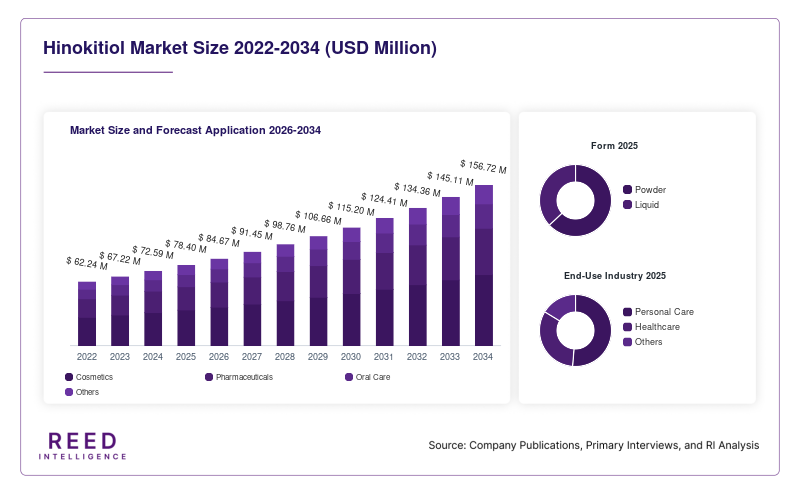
The cosmetics segment dominated the Hinokitiol Market, accounting for 46.5% of the share in 2025. Its widespread use in skincare and hair care products has supported this dominance.
The pharmaceutical segment will grow fastest at a CAGR of 9.2%, driven by increasing research and development activities. Its therapeutic properties will support future expansion.
By Form
The powder form held the largest share of 52.1% in 2025 due to its stability and ease of incorporation into formulations.
Liquid form will grow fastest at a CAGR of 8.7%, supported by its use in serums and oral care products.
By End-Use Industry
The personal care industry dominated with a 48.3% share in 2025, driven by rising demand for natural ingredients.
The healthcare sector will grow fastest at a CAGR of 9.0%, supported by expanding medical applications.
By Distribution Channel
Offline channels accounted for 61.4% of the market in 2025 due to strong retail networks.
Online channels will grow fastest at a CAGR of 10.1%, driven by increasing e-commerce adoption.
Regional Analysis
North America
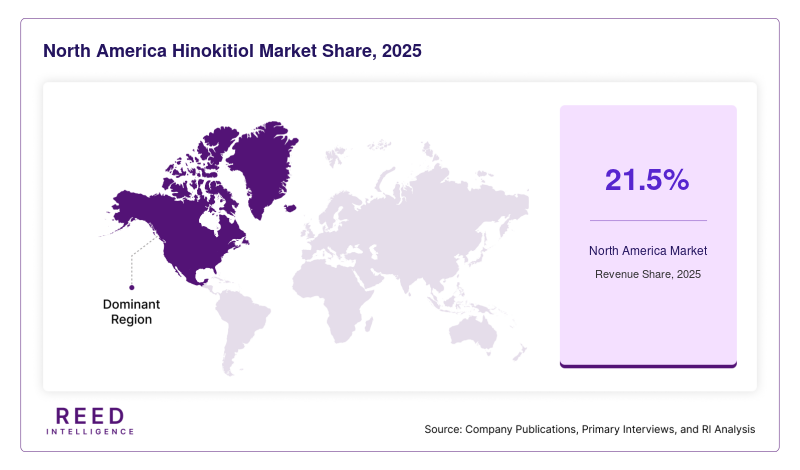
North America accounted for 21.5% of the Hinokitiol Market share in 2025 and will grow at a CAGR of 7.6% through 2034. The region will benefit from advanced research infrastructure and a strong presence of personal care brands.
The United States dominated the regional market due to its focus on product innovation and high consumer awareness. The increasing adoption of natural ingredients in skincare products has supported market expansion.
Europe
Europe held a 19.8% share in 2025 and will register the fastest CAGR of 8.9% during the forecast period. Strict regulations on synthetic chemicals will drive the demand for natural alternatives like hinokitiol.
Germany emerged as the leading country, supported by its strong cosmetics industry and emphasis on sustainable product development. The region’s focus on clean-label formulations has accelerated adoption.
Asia Pacific
Asia Pacific led the Hinokitiol Market with a 41.3% share in 2025 and will grow steadily at a CAGR of 8.2%. The region benefits from the natural availability of hinokitiol sources and strong demand for herbal products.
Japan dominated the market due to its traditional use of hinokitiol and advanced manufacturing capabilities. The country’s focus on innovation and quality has supported sustained growth.
Middle East & Africa
The Middle East & Africa accounted for 8.4% of the market in 2025 and will grow at a CAGR of 7.4%. Increasing awareness of personal care products is expected to drive growth.
The UAE led the region, supported by rising demand for premium cosmetics and expanding retail channels.
Latin America
Latin America held an 9.0% share in 2025 and will grow at a CAGR of 7.8%. The region’s expanding middle-class population is contributing to increased demand for personal care products.
Brazil dominated the market, driven by its growing cosmetics industry and rising consumer awareness.
Competitive Landscape
The Hinokitiol Market is moderately fragmented, with key players focusing on product innovation and strategic partnerships. Leading companies are investing in research and development to expand application areas and improve extraction techniques.
A prominent market leader is Kobe Bussan Co., Ltd., which has strengthened its position through continuous product development and supply chain optimization. The company recently introduced a high-purity hinokitiol extract aimed at pharmaceutical applications, enhancing its competitive edge.
Other players are focusing on expanding their global footprint and improving distribution networks to capture emerging market opportunities. The competitive environment is characterized by innovation, sustainability initiatives, and strategic collaborations.
Key Players
- Kobe Bussan Co., Ltd.
- Honshu Chemical Industry Co., Ltd.
- Tokyo Chemical Industry Co., Ltd.
- Santa Cruz Biotechnology, Inc.
- Merck KGaA
- Sigma-Aldrich Co. LLC
- Zhejiang Multinpharma Co., Ltd.
- Chengdu Biopurify Phytochemicals Ltd.
- Shaanxi Pioneer Biotech Co., Ltd.
- Wuhan Vanz Pharm Inc.
- Xi’an Lyphar Biotech Co., Ltd.
- Hunan Nutramax Inc.
- Cayman Chemical Company
- LKT Laboratories, Inc.
- Biosynth Carbosynth
Recent Developments
- In 2024, leading manufacturers introduced advanced extraction technologies to improve yield and purity.
- In 2025, companies expanded their presence in emerging markets through strategic partnerships.
- Several firms launched new skincare and oral care products incorporating hinokitiol.
- Increased investment in clinical research to explore therapeutic applications was observed.
- Expansion of e-commerce channels improved accessibility of hinokitiol-based products globally.
Hinokitiol Market Segments
Application
- Cosmetics
- Pharmaceuticals
- Oral Care
- Others
Form
- Powder
- Liquid
End-Use Industry
- Personal Care
- Healthcare
- Others
Distribution Channel
- Online Retail
- Offline Retail
By Region
- North America
- Europe
- APAC
- Middle East and Africa
- LATAM