Hirschsprungs Disease Treatment Market Size, Share Demand Report By Treatment Type (Surgical Treatment, Pharmaceutical Treatment), By Diagnosis Method (Biopsy, Imaging, Genetic Testing), By End-Use (Hospitals, Specialty Clinics, Ambulatory Surgical Centers) By Region & Segment Forecasts, 2025–2034
USD 3950
Market Overview
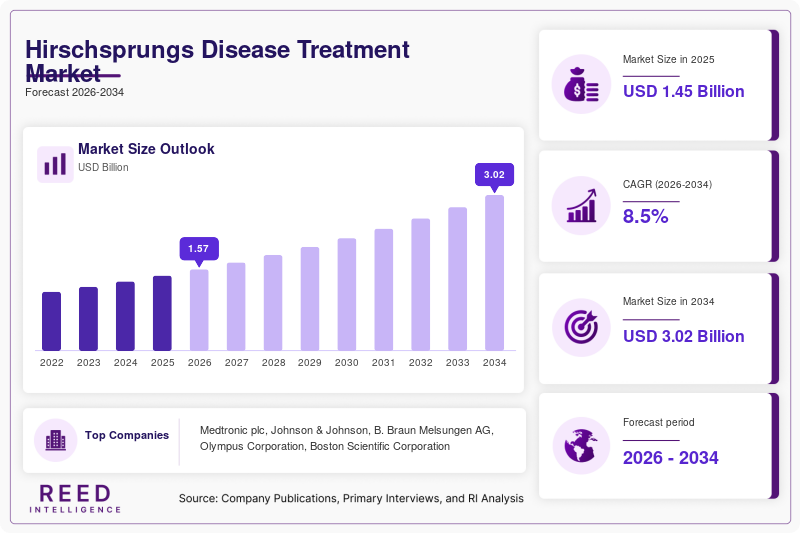
The Hirschsprungs Disease Treatment Market size is witnessing steady expansion due to rising awareness of congenital gastrointestinal disorders and improvements in neonatal diagnostic capabilities. The global market size was valued at approximately USD 1.45 billion in 2025 and is estimated to reach USD 1.58 billion in 2026. With increasing investments in pediatric healthcare and surgical advancements, the market is projected to reach USD 3.05 billion by 2034, growing at a compound annual growth rate (CAGR) of 8.5% from 2025 to 2034.
Hirschsprung’s disease is a rare congenital condition characterized by the absence of nerve cells in parts of the intestine, leading to severe bowel obstruction. The demand for treatment solutions is rising due to improved detection rates, especially in developing regions where healthcare access is expanding. Governments and healthcare organizations are increasingly focusing on early screening programs and neonatal care infrastructure, contributing to market growth.
Key Highlights
- Market size estimated at USD 1.45 billion in 2025
- Expected to reach USD 3.05 billion by 2034
- CAGR of 8.5% from 2025 to 2034
- Growth driven by surgical innovation and early diagnosis
- Increasing healthcare investments in emerging markets
Market Trends
Shift Toward Minimally Invasive and Robotic-Assisted Surgeries
The Hirschsprungs Disease Treatment Market is experiencing a notable shift toward minimally invasive surgical techniques. Traditional open surgeries are increasingly being replaced by laparoscopic and robotic-assisted procedures, which offer reduced hospital stays, faster recovery, and fewer postoperative complications. Surgeons are adopting transanal endorectal pull-through procedures that eliminate the need for large incisions, improving patient comfort and outcomes. The growing availability of surgical robots in advanced healthcare facilities is further supporting this trend. Training programs and surgical skill development initiatives are enhancing the adoption rate, especially in developed regions where healthcare infrastructure supports advanced procedures.
Increasing Role of Genetic Testing and Early Diagnosis
Another key trend shaping the market is the growing use of genetic testing and early diagnostic tools. Hirschsprung’s disease has a genetic component, and advancements in molecular diagnostics are enabling earlier detection in neonates. Hospitals are incorporating genetic screening as part of neonatal care, particularly in high-risk populations. Early diagnosis reduces complications and allows timely surgical intervention, improving survival rates. Additionally, increasing awareness among parents and healthcare providers is driving demand for early screening services. This trend is expected to continue as diagnostic technologies become more accessible and cost-effective across emerging economies.
Market Drivers
Rising Incidence of Congenital Gastrointestinal Disorders
The increasing incidence of congenital gastrointestinal disorders, including Hirschsprung’s disease, is a major driver of market growth. Improved reporting systems and diagnostic awareness have led to higher detection rates worldwide. Pediatric healthcare systems are becoming more equipped to identify such conditions early, leading to increased demand for treatment solutions. Urbanization and better healthcare access in developing countries are contributing to this rise. Additionally, growing awareness campaigns by healthcare organizations are educating parents about symptoms, leading to earlier consultations and diagnosis. This expanding patient pool is directly influencing market demand.
Advancements in Pediatric Surgical Techniques
Technological advancements in pediatric surgery are significantly driving the Hirschsprungs Disease Treatment Market. Innovations such as single-stage pull-through procedures and enhanced imaging systems have improved surgical precision and outcomes. The availability of specialized pediatric surgeons and improved postoperative care has reduced mortality and complication rates. Hospitals are investing in advanced surgical infrastructure, including robotic systems and high-definition imaging tools. These advancements not only improve patient outcomes but also encourage more healthcare providers to adopt advanced treatment protocols, thereby expanding the market.
Market Restraint
High Cost of Treatment and Limited Access in Low-Income Regions
One of the major restraints in the Hirschsprungs Disease Treatment Market is the high cost associated with surgical procedures and postoperative care. Advanced minimally invasive surgeries and robotic-assisted techniques require significant investment in equipment and skilled professionals, making them expensive. In low- and middle-income countries, access to such advanced treatment options remains limited due to inadequate healthcare infrastructure and financial constraints. Many patients rely on traditional surgical methods, which may involve longer recovery times and higher complication risks.
Additionally, the lack of trained pediatric surgeons in rural areas further restricts access to quality care. Insurance coverage for congenital disorders is also limited in several regions, leading to out-of-pocket expenses for families. This financial burden can delay treatment, resulting in complications and increased healthcare costs in the long term. Addressing these disparities remains a key challenge for market growth.
Market Opportunities
Expansion of Healthcare Infrastructure in Emerging Markets
Emerging economies present significant growth opportunities for the Hirschsprungs Disease Treatment Market. Governments in countries across Asia Pacific, Latin America, and Africa are investing in healthcare infrastructure to improve access to specialized medical services. The establishment of pediatric care centers and training programs for surgeons is enhancing treatment availability. International collaborations and funding initiatives are also supporting the adoption of advanced surgical techniques in these regions. As healthcare systems improve, the demand for effective treatment solutions is expected to rise, creating new revenue streams for market players.
Development of Post-Surgical Therapies and Supportive Care
There is growing potential in the development of post-surgical therapies and supportive care solutions for Hirschsprung’s disease patients. Many patients experience complications such as enterocolitis or chronic constipation after surgery, creating a need for long-term management solutions. Pharmaceutical companies are focusing on developing drugs and therapies to address these issues. Additionally, digital health platforms and telemedicine are being used to monitor patient recovery and provide ongoing care. These innovations are expanding the scope of the market beyond surgical interventions, offering new growth opportunities.
Segmental Analysis
By Treatment Type
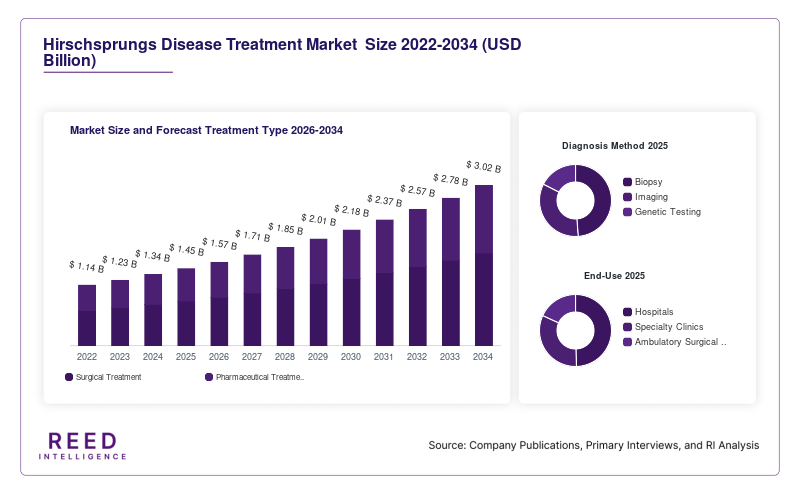
The surgical treatment segment dominated the Hirschsprungs Disease Treatment Market in 2024, accounting for approximately 72% of the market share. Surgical procedures, including pull-through surgeries, are the primary treatment for Hirschsprung’s disease. The dominance of this segment is attributed to the necessity of removing the affected portion of the intestine to restore normal bowel function. Advances in minimally invasive techniques have further strengthened this segment. Hospitals are increasingly adopting laparoscopic and robotic-assisted procedures, which improve patient outcomes and reduce recovery times, thereby maintaining the segment’s leading position.
The pharmaceutical treatment segment is expected to be the fastest-growing segment, with a projected CAGR of 9.1% during the forecast period. This growth is driven by the increasing need for post-surgical care and management of complications such as enterocolitis. Pharmaceutical companies are developing targeted therapies to address these issues, enhancing patient quality of life. The rising focus on supportive care and long-term disease management is contributing to the rapid growth of this segment.
By Diagnosis Method
The biopsy segment dominated the market in 2024, holding a share of approximately 48%. Rectal biopsy is considered the gold standard for diagnosing Hirschsprung’s disease, as it confirms the absence of nerve cells in the intestine. The reliability and accuracy of this method make it the preferred choice among healthcare providers. Technological advancements in biopsy techniques are improving diagnostic accuracy, further supporting the segment’s dominance.
Genetic testing is the fastest-growing subsegment, with a CAGR of 10.2% over the forecast period. The increasing understanding of the genetic basis of Hirschsprung’s disease is driving the adoption of genetic diagnostics. Early detection through genetic testing enables timely intervention, improving patient outcomes. The growing availability of cost-effective genetic testing solutions is also contributing to the rapid growth of this segment.
By End-Use
Hospitals dominated the Hirschsprungs Disease Treatment Market in 2024, accounting for approximately 65% of the market share. Hospitals are the primary centers for surgical treatment and postoperative care. The availability of advanced surgical infrastructure and specialized healthcare professionals makes hospitals the preferred choice for patients. The increasing number of pediatric hospitals and specialized care units is further strengthening this segment.
Specialty clinics are expected to be the fastest-growing segment, with a CAGR of 8.9% during the forecast period. These clinics focus on providing specialized care for gastrointestinal disorders, including Hirschsprung’s disease. The growth of this segment is driven by the increasing demand for personalized care and follow-up services. Specialty clinics offer targeted treatment plans and continuous monitoring, improving patient outcomes and driving segment growth.
Regional Analysis
North America
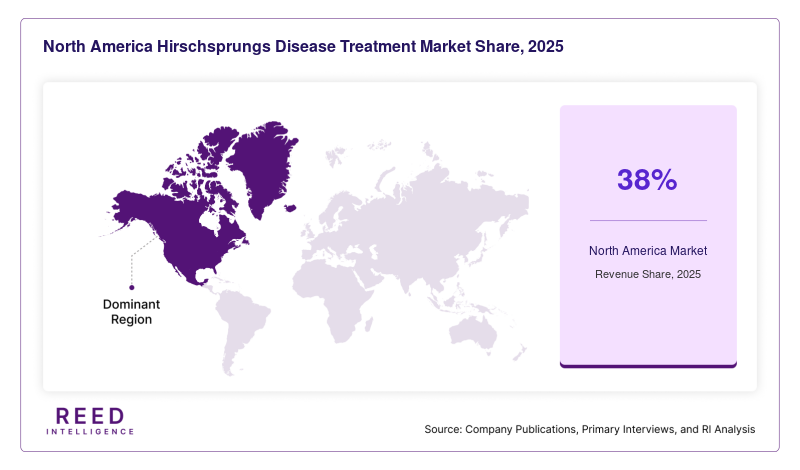
North America accounted for a significant share of the Hirschsprungs Disease Treatment Market in 2025, holding approximately 38% of the global market. The region is expected to grow at a CAGR of 7.8% during the forecast period. The presence of advanced healthcare infrastructure, high healthcare expenditure, and widespread adoption of minimally invasive surgical techniques are key factors driving market growth. The availability of specialized pediatric care centers further supports market expansion.
The United States dominates the North American market due to its well-established healthcare system and strong focus on pediatric research. A unique growth factor in this region is the integration of robotic-assisted surgery in pediatric procedures. Hospitals are increasingly adopting advanced surgical technologies, which improve precision and patient outcomes, thereby driving demand for innovative treatment solutions.
Europe
Europe held around 27% of the global market share in 2025 and is projected to grow at a CAGR of 7.5% over the forecast period. The region benefits from strong healthcare policies, universal healthcare coverage, and increasing awareness of congenital disorders. Government initiatives aimed at early diagnosis and treatment are contributing to market growth across the region.
Germany leads the European market due to its advanced medical infrastructure and strong focus on research and development. A unique growth factor is the emphasis on early screening programs for newborns, which facilitates timely diagnosis and intervention. This proactive approach is improving patient outcomes and increasing demand for treatment solutions.
Asia Pacific
Asia Pacific accounted for approximately 20% of the market share in 2025 and is expected to grow at the fastest CAGR of 9.6% during the forecast period. Rapid urbanization, increasing healthcare investments, and growing awareness of pediatric disorders are driving market growth. The region is witnessing significant improvements in healthcare infrastructure.
China dominates the Asia Pacific market due to its large population and expanding healthcare system. A unique growth factor is the government’s focus on improving maternal and child healthcare services. Investments in neonatal care units and training programs for healthcare professionals are enhancing diagnosis and treatment capabilities, boosting market growth.
Middle East & Africa
The Middle East & Africa region held around 8% of the global market share in 2025 and is expected to grow at a CAGR of 8.1%. The market is driven by increasing healthcare investments and rising awareness of congenital diseases. However, limited access to advanced treatment options remains a challenge.
Saudi Arabia leads the market in this region due to its improving healthcare infrastructure. A unique growth factor is the increasing number of specialized pediatric hospitals. Government initiatives aimed at modernizing healthcare systems are supporting the adoption of advanced treatment methods, contributing to market growth.
Latin America
Latin America accounted for approximately 7% of the global market share in 2025 and is projected to grow at a CAGR of 8.3%. The region is experiencing gradual improvements in healthcare access and infrastructure. Increasing awareness of pediatric disorders is also contributing to market growth.
Brazil dominates the Latin American market due to its expanding healthcare sector. A unique growth factor is the growing number of public healthcare programs focused on pediatric care. These initiatives are improving access to diagnosis and treatment, supporting market expansion.
Competitive Landscape
The Hirschsprungs Disease Treatment Market is moderately fragmented, with several global and regional players competing to expand their market presence. Key companies are focusing on strategic collaborations, product development, and geographic expansion to strengthen their position. The market leader is Medtronic plc, which has a strong portfolio of surgical devices and solutions tailored for pediatric procedures. The company’s focus on innovation and advanced surgical technologies has helped it maintain a leading position.
Recent developments include the introduction of advanced minimally invasive surgical tools and increased investment in research and development. Companies are also forming partnerships with healthcare providers to enhance treatment accessibility. The competitive landscape is expected to evolve as new entrants introduce innovative solutions and existing players expand their offerings.
Key Players
- Medtronic plc
- Johnson & Johnson
- B. Braun Melsungen AG
- Olympus Corporation
- Boston Scientific Corporation
- Cook Medical
- Stryker Corporation
- Smith & Nephew
- Intuitive Surgical Inc.
- Karl Storz SE & Co. KG
- ConvaTec Group PLC
- Coloplast A/S
- Abbott Laboratories
- Teleflex Incorporated
- Getinge AB
Recent Developments
- In 2024, Medtronic plc launched a new minimally invasive surgical device designed specifically for pediatric gastrointestinal procedures.
- In 2025, Intuitive Surgical Inc. expanded its robotic surgery platform to include pediatric applications, enhancing precision in Hirschsprung’s disease surgeries.
- In 2025, Olympus Corporation introduced advanced endoscopic imaging systems to improve diagnostic accuracy for congenital gastrointestinal disorders.
Hirschsprungs Disease Treatment Market Segments
Treatment Type
- Surgical Treatment
- Pharmaceutical Treatment
Diagnosis Method
- Biopsy
- Imaging
- Genetic Testing
End-Use
- Hospitals
- Specialty Clinics
- Ambulatory Surgical Centers
By Region
- North America
- Europe
- APAC
- Middle East and Africa
- LATAM