Hollow Core Insulator Market Size, Share & Demand Report By Material Type (Composite, Porcelain, Glass, Hybrid Materials), By Voltage Rating (Medium Voltage, High Voltage, Extra High Voltage), By Application (Substations and Switchgear, Circuit Breakers, Instrument Transformers, Renewable Energy Transmission), By Region & Segment Forecasts, 2026–2034
USD 3950
Market Overview
The global Hollow Core Insulator Market size was valued at approximately USD 1.68 billion in 2026 and is projected to reach USD 3.41 billion by 2034, expanding at a CAGR of 9.2% during 2026–2034. Hollow core insulators are critical components used in high-voltage transmission systems, gas-insulated switchgear, circuit breakers, instrument transformers, and substation equipment. Their ability to provide mechanical support and electrical insulation under demanding operating conditions makes them essential across modern power infrastructure projects.
A major global factor supporting market growth is the rapid expansion of electricity transmission and distribution networks. Governments and utility providers worldwide are investing heavily in grid modernization programs to improve energy reliability, integrate renewable power sources, and reduce transmission losses. As renewable energy capacity expands across wind, solar, and hydroelectric projects, demand for high-performance insulation solutions continues to increase. Hollow core insulators, particularly composite and porcelain variants, are increasingly adopted due to their durability, lightweight structure, resistance to environmental contamination, and long operational life.
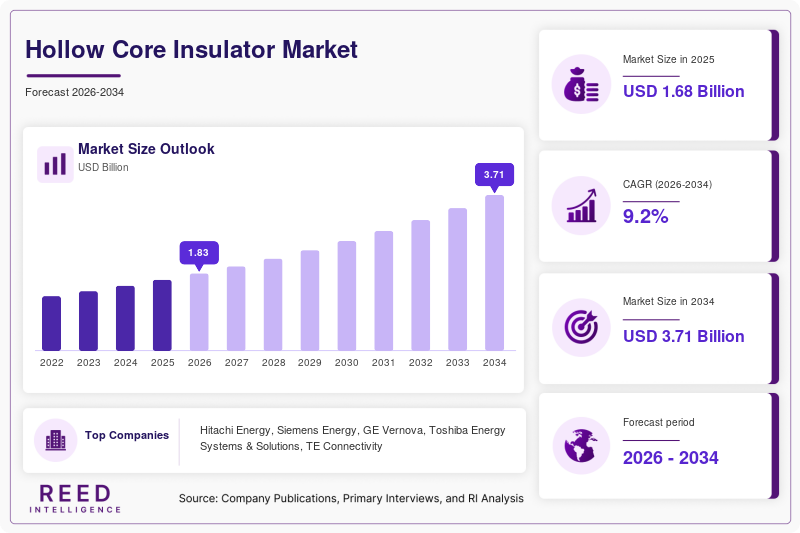
Key Highlights
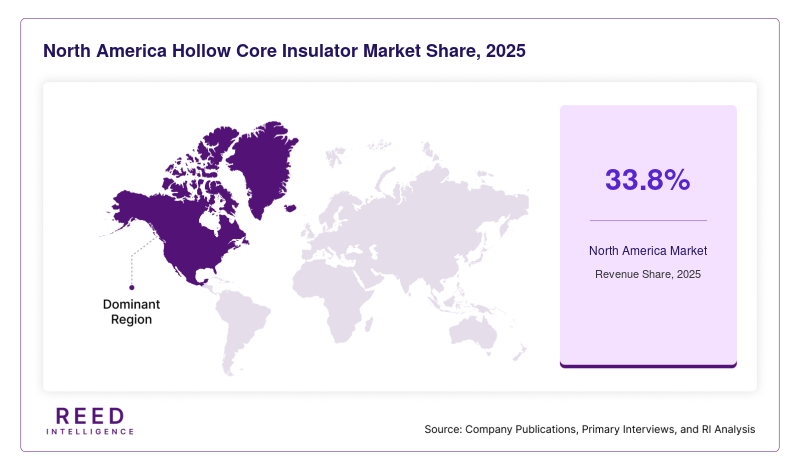
- North America dominated the market with a 33.8% share in 2025.
- Asia Pacific is expected to grow at the fastest CAGR of 10.8% during 2026–2034.
- By material type, composite hollow core insulators accounted for the largest share of 44.1%.
- while silicone rubber-based composite insulators are projected to grow at a CAGR of 11.4%.
- By voltage rating, high-voltage insulators led with a 47.3% share.
- whereas ultra-high-voltage insulators are expected to expand at a CAGR of 11.7%.
- By application, substations and switchgear systems held the largest share of 42.5%.
- while renewable energy transmission applications are forecast to grow at a CAGR of 12.1%.
- The United States remained the dominant country, with market values of USD 455 million in 2024 and USD 492 million in 2025.
Market Trends
Growing Adoption of Composite Insulation Technologies
The industry is witnessing a significant shift from traditional porcelain-based products toward advanced composite hollow core insulators. Utility companies increasingly prefer composite materials because they offer lower weight, easier installation, improved contamination resistance, and reduced maintenance requirements. These advantages are particularly important in regions with challenging environmental conditions such as coastal areas, industrial zones, and desert locations. Manufacturers are expanding production capacities for composite solutions to address growing demand from transmission utilities and equipment manufacturers. The trend is also supported by continuous innovations in silicone rubber formulations and fiberglass reinforcement technologies, enabling improved reliability and longer service life across critical electrical infrastructure applications.
Expansion of High-Voltage Grid Modernization Projects
Grid modernization initiatives are becoming a major trend influencing the Hollow Core Insulator Market. Utilities across developed and developing economies are upgrading aging transmission assets to accommodate growing electricity consumption and renewable energy integration. Smart substations, digital monitoring systems, and high-capacity transmission corridors require advanced insulation components capable of operating under higher electrical loads. Hollow core insulators are increasingly integrated into modern substations and gas-insulated systems because of their mechanical performance and insulation reliability. As governments prioritize resilient energy infrastructure and cross-border electricity networks, the demand for technologically advanced hollow core insulators continues to strengthen across multiple end-use sectors.
Market Drivers
Rising Investments in Transmission and Distribution Infrastructure
Large-scale investments in transmission and distribution infrastructure remain a primary growth driver for the Hollow Core Insulator Market. Rapid urbanization, industrial expansion, and increasing electricity consumption are placing pressure on existing power networks. Utilities are responding through extensive grid expansion projects designed to improve capacity and operational efficiency. Hollow core insulators play a critical role in ensuring safe and reliable power transmission across substations, switchgear systems, and transmission corridors. Emerging economies are particularly active in developing new power infrastructure, while mature markets are replacing aging assets. These investment activities continue to create sustained demand for advanced insulation solutions capable of supporting modern electrical systems.
Increasing Renewable Energy Integration Across Power Networks
The accelerating deployment of renewable energy projects is another important factor supporting market growth. Wind farms, solar parks, and hydroelectric facilities require robust transmission infrastructure to connect generation sites with end users. This requirement has increased demand for high-performance insulation products that can operate reliably under variable electrical conditions. Hollow core insulators are widely used in renewable energy transmission systems due to their durability and compatibility with high-voltage equipment. Governments worldwide are implementing policies that encourage renewable energy adoption, resulting in greater investments in substations and transmission facilities. Consequently, manufacturers of hollow core insulators are benefiting from expanding opportunities associated with clean energy infrastructure development.
Market Restraint
High Manufacturing and Installation Costs
One of the major challenges affecting the Hollow Core Insulator Market is the relatively high cost associated with manufacturing and installation. Advanced composite materials, precision engineering requirements, and stringent quality standards contribute to elevated production expenses. Utility companies operating under budget constraints may delay equipment replacement projects or select lower-cost alternatives where feasible. Additionally, installation procedures often require specialized technical expertise, increasing overall project expenditures. In developing regions, limited infrastructure budgets can restrict adoption rates despite the long-term operational benefits offered by hollow core insulators. For example, smaller transmission projects may prioritize conventional insulation technologies due to lower upfront costs. Although lifecycle savings and improved performance can offset initial investments over time, cost sensitivity remains a notable restraint influencing purchasing decisions across various market segments.
Market Opportunities
Development of Ultra-High-Voltage Transmission Networks
The expansion of ultra-high-voltage transmission infrastructure presents substantial opportunities for market participants. Countries seeking to transport electricity over long distances with minimal losses are increasingly investing in ultra-high-voltage networks. These projects require insulation systems capable of handling extreme electrical stress while maintaining reliability over extended operational periods. Hollow core insulators are becoming essential components in such installations due to their superior electrical and mechanical characteristics. As energy demand continues to rise and renewable power generation expands into remote regions, investments in long-distance transmission systems are expected to increase significantly, creating favorable conditions for manufacturers and suppliers operating within the market.
Growing Demand for Smart Substations and Digital Utilities
The transition toward smart utility infrastructure is creating new growth avenues for the Hollow Core Insulator Market. Modern substations increasingly incorporate digital monitoring, automation, and predictive maintenance technologies. These facilities require highly reliable insulation components that can support advanced electrical equipment while minimizing operational disruptions. Hollow core insulators align well with these requirements because they offer strong mechanical performance and long service life. Utilities seeking greater grid reliability and efficiency are accelerating investments in smart substations across both developed and emerging economies. This transformation is expected to generate sustained demand for innovative insulation solutions, encouraging manufacturers to develop products optimized for next-generation electrical infrastructure.
Segmental Analysis
By Material Type
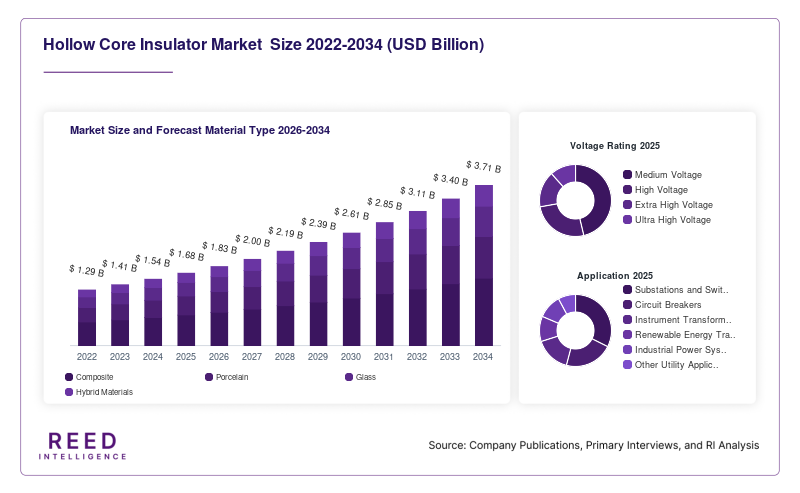
Composite hollow core insulators represented the dominant subsegment, accounting for approximately 44.1% of market share in 2024. Their leadership position is supported by favorable characteristics including lightweight construction, strong mechanical performance, excellent hydrophobic behavior, and reduced maintenance requirements. Utilities increasingly prefer composite solutions because they can be installed more efficiently and provide reliable performance in contaminated environments. Compared with traditional alternatives, composite insulators often demonstrate enhanced resistance to weathering and environmental degradation. These advantages have contributed to widespread adoption across substations, circuit breakers, and gas-insulated systems. Continuous improvements in fiberglass reinforcement materials and polymer formulations further strengthen the position of composite hollow core insulators within the global market.
Silicone rubber-based composite insulators are expected to emerge as the fastest-growing subsegment, registering a CAGR of approximately 11.4% through 2034. Growth is driven by their superior contamination resistance, high dielectric performance, and ability to maintain operational reliability in demanding environmental conditions. Utility operators increasingly deploy these products in coastal, industrial, and desert regions where pollution and weather exposure can affect conventional insulation systems. Manufacturers continue investing in advanced silicone technologies that enhance product longevity and reduce maintenance requirements. Rising investments in renewable energy infrastructure and high-voltage transmission projects are expected to accelerate demand for silicone rubber-based hollow core insulators throughout the forecast period.
By Voltage Rating
High-voltage hollow core insulators held the largest market share, accounting for approximately 47.3% of global revenue in 2024. These products are widely used across substations, transmission systems, and industrial power networks. Their extensive adoption reflects the ongoing need for reliable insulation solutions capable of supporting growing electricity demand and infrastructure expansion. Utilities continue investing in high-voltage equipment to improve network efficiency and reliability. The increasing deployment of renewable energy generation facilities also contributes to demand for high-voltage insulation products. Manufacturers are introducing improved designs that enhance electrical performance while minimizing operational risks, supporting the continued dominance of this subsegment.
Ultra-high-voltage hollow core insulators are projected to record the fastest CAGR of 11.7% during the forecast period. The growth trajectory is linked to expanding investments in long-distance power transmission projects designed to reduce energy losses and improve grid connectivity. Countries with large renewable energy resources are increasingly utilizing ultra-high-voltage infrastructure to transport electricity efficiently across vast distances. These systems require specialized insulation products capable of withstanding extreme electrical stress and environmental conditions. As governments pursue energy security objectives and modernize transmission networks, demand for ultra-high-voltage hollow core insulators is expected to rise significantly, creating attractive growth opportunities for industry participants.
By Application
Substations and switchgear systems accounted for the largest application share, representing approximately 42.5% of market revenue in 2024. These installations require highly reliable insulation components to ensure safe operation and uninterrupted power delivery. Hollow core insulators are extensively used in circuit breakers, instrument transformers, and gas-insulated switchgear due to their strong mechanical and electrical performance. Increasing investments in grid modernization, smart substations, and utility infrastructure upgrades continue to support demand within this segment. Utility operators prioritize products that enhance operational reliability and reduce maintenance requirements, contributing to the sustained leadership of substations and switchgear applications.
Renewable energy transmission applications are anticipated to register the fastest CAGR of 12.1% through 2034. The rapid expansion of wind, solar, and hydroelectric generation capacity is creating substantial demand for transmission infrastructure capable of connecting renewable power sources with end users. Hollow core insulators play a critical role in ensuring reliable operation of these transmission systems. Governments worldwide are implementing policies aimed at accelerating clean energy deployment, leading to increased investments in substations, transmission corridors, and grid integration projects. These developments are expected to generate strong demand for advanced insulation technologies throughout the forecast period.
Regional Analysis
North America
North America accounted for approximately 33.8% of the global Hollow Core Insulator Market in 2025 and continues to represent the largest regional market. The region is projected to expand at a CAGR of 8.5% through 2034, supported by ongoing investments in grid modernization and transmission infrastructure upgrades. Utility operators are actively replacing aging electrical equipment to improve reliability and resilience. Demand for advanced insulation systems is increasing as utilities focus on reducing maintenance requirements and improving operational performance across transmission networks.
The United States remains the dominant country within the regional market. One unique growth factor is the increasing deployment of renewable energy transmission corridors connecting wind and solar generation facilities to population centers. Federal and state-level infrastructure investments have accelerated the development of modern substations and high-voltage transmission projects. These initiatives continue to generate demand for hollow core insulators capable of supporting advanced power system requirements while maintaining long-term operational reliability.
Europe
Europe held approximately 27.1% of the global market share in 2025 and is forecast to grow at a CAGR of 8.8% during the assessment period. The region benefits from strong investments in renewable energy integration, cross-border electricity transmission, and smart grid development. Several countries are replacing aging transmission infrastructure while also expanding grid capacity to accommodate increasing renewable energy generation. These factors continue to support stable demand for high-performance insulation products across utility and industrial applications.
Germany remains the leading national market in Europe. A unique growth factor is the country's commitment to energy transition initiatives, which require extensive grid reinforcement and modernization. Investments in offshore wind transmission connections and advanced substation infrastructure have increased the need for durable insulation components. Manufacturers operating in the region are also focusing on sustainability and product innovation, contributing to broader adoption of advanced hollow core insulator technologies.
Asia Pacific
Asia Pacific represented approximately 24.6% of global market revenue in 2025 and is expected to record the fastest CAGR of 10.8% through 2034. Rapid industrialization, urbanization, and electricity demand growth are driving substantial investments in transmission and distribution infrastructure. Governments across the region are expanding grid networks to improve energy access and support economic development. The deployment of renewable energy projects and large-scale industrial facilities further contributes to increasing demand for hollow core insulators.
China dominates the Asia Pacific market due to its extensive investment in power infrastructure and ultra-high-voltage transmission systems. A unique growth factor is the country's continued expansion of long-distance electricity transmission networks connecting renewable energy resources with major consumption centers. Significant government funding for grid modernization and energy security initiatives is encouraging widespread adoption of advanced insulation technologies, strengthening regional market growth prospects.
Middle East & Africa
The Middle East & Africa accounted for nearly 8.1% of the global market in 2025 and is projected to grow at a CAGR of 9.4% during the forecast period. Rising electricity demand, infrastructure development, and industrial expansion are supporting market growth across several countries. Utility providers are investing in transmission and distribution networks to improve reliability and accommodate expanding urban populations. Increasing renewable energy investments also contribute to the demand for advanced insulation solutions.
Saudi Arabia represents the leading market within the region. A unique growth factor is the country's large-scale investment in power infrastructure associated with economic diversification and industrial development programs. New substations, transmission corridors, and renewable energy projects require reliable insulation systems capable of operating under harsh environmental conditions. These developments continue to create favorable opportunities for hollow core insulator manufacturers and suppliers.
Latin America
Latin America captured approximately 6.4% of global revenue in 2025 and is anticipated to expand at a CAGR of 8.9% through 2034. Growing electricity consumption, urban expansion, and investments in renewable energy projects are supporting demand for transmission infrastructure. Governments and utilities are focusing on improving grid efficiency and reliability through equipment modernization programs. These initiatives are increasing adoption of advanced insulation technologies across transmission and distribution applications.
Brazil remains the dominant country in the regional market. A unique growth factor is the country's extensive hydroelectric and renewable energy network, which requires continuous expansion and modernization of transmission systems. Investments in long-distance power transmission infrastructure have increased demand for durable hollow core insulators capable of supporting high-voltage operations. Ongoing energy sector development is expected to sustain market growth throughout the forecast period.
Competitive Landscape
The Hollow Core Insulator Market is moderately consolidated, with leading manufacturers focusing on product innovation, capacity expansion, and strategic partnerships. Companies are investing in advanced composite materials and enhanced manufacturing technologies to improve product performance and operational reliability. Competitive strategies also include regional expansion, collaboration with utilities, and development of customized insulation solutions for high-voltage applications.
Among major participants, Hitachi Energy maintains a strong market position due to its extensive product portfolio and global utility relationships. A recent development involved the expansion of advanced insulation manufacturing capabilities to support growing demand from grid modernization projects. Other significant companies continue investing in composite material technologies and digital manufacturing processes to strengthen competitiveness. Market participants are also emphasizing sustainability, longer product lifecycles, and reduced maintenance requirements as key differentiators. Increasing demand for renewable energy transmission infrastructure and ultra-high-voltage networks is expected to intensify competition and encourage further innovation across the industry.
Key Players
- Hitachi Energy
- Siemens Energy
- GE Vernova
- Toshiba Energy Systems & Solutions
- TE Connectivity
- LAPP Insulators
- PPC Insulators
- NGK Insulators Ltd.
- Aditya Birla Insulators
- MacLean Power Systems
- INAEL Electrical Systems
- Sediver
- Hubbell Incorporated
- Pfisterer Holding SE
- Modern Insulators Ltd.
Recent Developments
- Hitachi Energy expanded composite hollow core insulator production capacity to support increasing global demand from transmission and substation projects.
- Siemens Energy introduced a new generation of lightweight composite insulation solutions designed for high-voltage and gas-insulated switchgear applications.
- NGK Insulators announced investments in advanced manufacturing technologies aimed at improving product durability and operational efficiency.
- GE Vernova strengthened its transmission equipment portfolio through enhanced insulation technologies targeted at grid modernization projects.
- TE Connectivity launched upgraded hollow core insulator designs optimized for renewable energy transmission infrastructure and smart substation applications.
Hollow Core Insulator Market Segments
Material Type
- Composite
- Porcelain
- Glass
- Hybrid Materials
Voltage Rating
- Medium Voltage
- High Voltage
- Extra High Voltage
- Ultra High Voltage
Application
- Substations and Switchgear
- Circuit Breakers
- Instrument Transformers
- Renewable Energy Transmission
- Industrial Power Systems
- Other Utility Applications
By Region
- North America
- Europe
- APAC
- Middle East and Africa
- LATAM