Holotomographic Imaging Market Size, Share & Demand Report By Application (Cell Biology, Drug Discovery, Clinical Diagnostics, Material Science), By End-Use (Research Institutes, Pharmaceutical Companies, Biotechnology Firms, Academic Institutions), By Product Type (Holotomographic Microscopes, Software Solutions), By Technology (Quantitative Phase Imaging, Hybrid Imaging Technologies), By Region & Segment Forecasts, 2025–2034
USD 3950
Market Overview
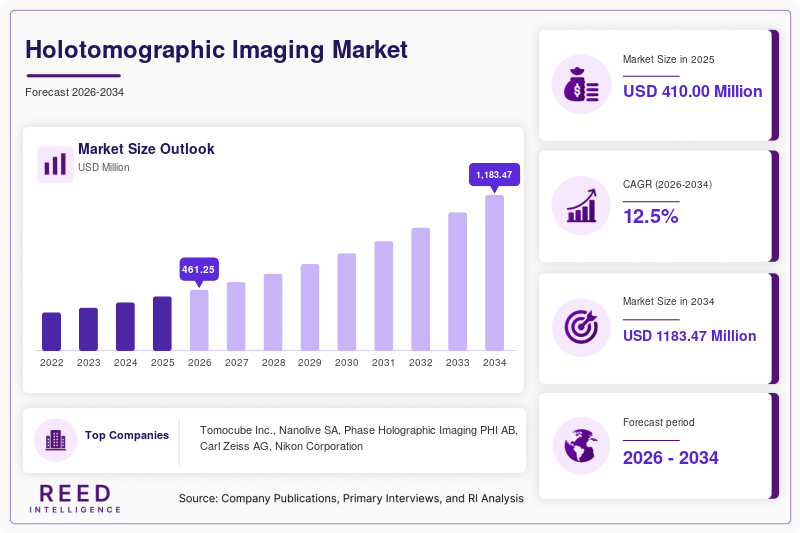
The global Holotomographic Imaging Market size was valued at approximately USD 410 million in 2025 and is projected to reach USD 1.18 billion by 2034, registering a compound annual growth rate (CAGR) of 12.5% during the forecast period (2025–2034). The market has gained steady traction due to increasing demand for high-resolution, label-free imaging technologies across life sciences, material sciences, and medical diagnostics. Holotomographic imaging, known for its ability to provide three-dimensional refractive index maps of live cells, continues to reshape research methodologies and diagnostic workflows.
One major global factor supporting the growth of the Holotomographic Imaging Market is the rising investment in advanced microscopy techniques within biomedical research. Governments and private institutions are allocating higher funding toward cell-based research, regenerative medicine, and drug discovery, which rely heavily on non-invasive imaging tools.
Key Highlights
- North America dominated the market with a 38% share in 2025, while Asia Pacific is expected to register the fastest CAGR of 14.1% during the forecast period.
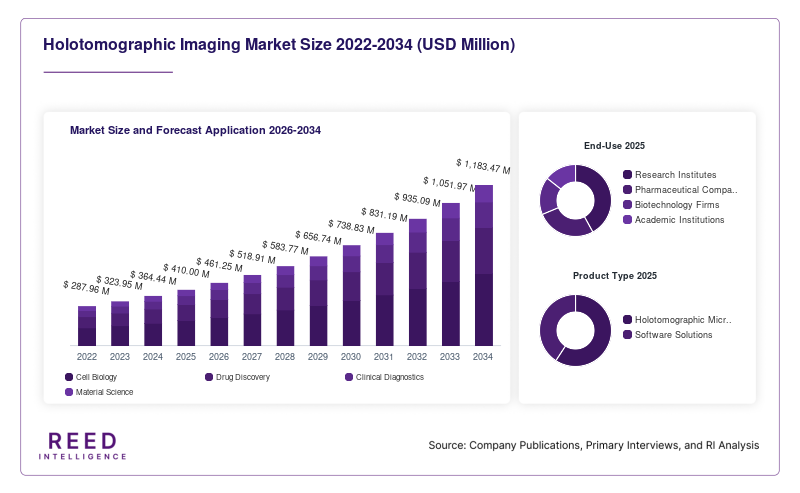
- By application, cell biology held the largest share (42%), while drug discovery is projected to grow fastest at a CAGR of 13.8%.
- By end-use, research institutes dominated with 46% share, while pharmaceutical companies are expected to grow fastest at a CAGR of 13.2%.
- The United States remained the dominant country, with market values of USD 145 million in 2025 and USD 160 million in 2026.
Market Trends
Integration of AI in Imaging Analysis
Artificial intelligence is increasingly being integrated into holotomographic imaging systems to enhance image reconstruction and interpretation. AI-based algorithms allow faster data processing and improved accuracy in identifying cellular structures and abnormalities. This trend is transforming the Holotomographic Imaging Market by enabling automation in research workflows and reducing manual analysis time.
Shift Toward Label-Free Imaging Technologies
There is a growing shift toward label-free imaging solutions due to their ability to study live cells without chemical staining. Researchers are prioritizing methods that preserve cell integrity and enable long-term observation. Holotomographic imaging aligns well with this requirement, leading to its rising adoption across academic and industrial laboratories.
Market Drivers
Growing Demand for Advanced Cell Imaging Techniques
The increasing need for precise and non-invasive cellular analysis is a primary driver of the Holotomographic Imaging Market. Traditional imaging techniques often require labeling or staining, which can alter cell behavior. Holotomography provides real-time, high-resolution imaging without affecting cell viability, making it a preferred choice in biological research.
Expansion of Pharmaceutical and Biotechnology Research
The rapid expansion of pharmaceutical and biotechnology industries is contributing significantly to market growth. Drug discovery processes require detailed visualization of cellular responses, which holotomographic imaging enables effectively. As R&D spending increases globally, the adoption of advanced imaging systems is expected to rise steadily.
Market Restraint
High Cost of Equipment and Limited Accessibility
The high cost associated with holotomographic imaging systems remains a major barrier to widespread adoption. These systems involve sophisticated optical components and advanced software, resulting in significant upfront investment. Smaller research institutions and laboratories with limited budgets often find it challenging to procure such equipment.
Additionally, maintenance and operational costs further restrict adoption. The need for skilled personnel to operate these systems adds to the overall expense, limiting their penetration in emerging economies. While technological advancements may reduce costs over time, affordability continues to be a key challenge for the Holotomographic Imaging Market.
Market Opportunities
Emerging Applications in Clinical Diagnostics
Holotomographic imaging is gradually finding applications in clinical diagnostics, particularly in hematology and pathology. Its ability to analyze live cells without staining presents new possibilities for early disease detection and monitoring. As healthcare systems move toward precision medicine, the demand for advanced imaging tools is expected to increase.
Growth in Emerging Economies
Emerging economies present significant growth opportunities due to increasing investments in healthcare infrastructure and research capabilities. Countries in Asia Pacific and Latin America are expanding their biotechnology sectors, creating demand for advanced imaging technologies. Market players focusing on cost-effective solutions and regional partnerships can tap into these high-growth markets.
Segmental Analysis
By Application
Cell biology emerged as the dominant subsegment, accounting for 42% of the Holotomographic Imaging Market share in 2025. The widespread use of holotomographic imaging in studying cell morphology and dynamics contributed to its leading position.
Drug discovery is expected to be the fastest-growing subsegment, registering a CAGR of 13.8% during the forecast period. The increasing need for efficient drug screening methods will drive adoption, as holotomographic imaging enables detailed visualization of cellular responses.
By End-Use
Research institutes held the largest share of 46% in 2025, driven by extensive use of imaging technologies in academic and scientific studies. These institutions rely on advanced imaging tools for fundamental research and innovation.
Pharmaceutical companies are projected to grow at the fastest CAGR of 13.2%. The rising focus on drug development and clinical research will drive demand for holotomographic imaging systems in this segment.
By Product Type
Holotomographic microscopes dominated the market with a share of 58% in 2025. Their ability to provide high-resolution, three-dimensional imaging has made them widely adopted across research applications.
Software solutions are expected to grow at the fastest CAGR of 14.5%, driven by advancements in image analysis and data processing technologies. The integration of AI and machine learning will further enhance growth.
By Technology
Quantitative phase imaging technology held the largest share of 51% in 2025 due to its widespread application in biological studies. Its ability to provide detailed cellular information without labeling has driven adoption.
Hybrid imaging technologies are expected to grow at a CAGR of 13.6%, supported by their ability to combine multiple imaging modalities for enhanced analysis.
Regional Analysis
North America
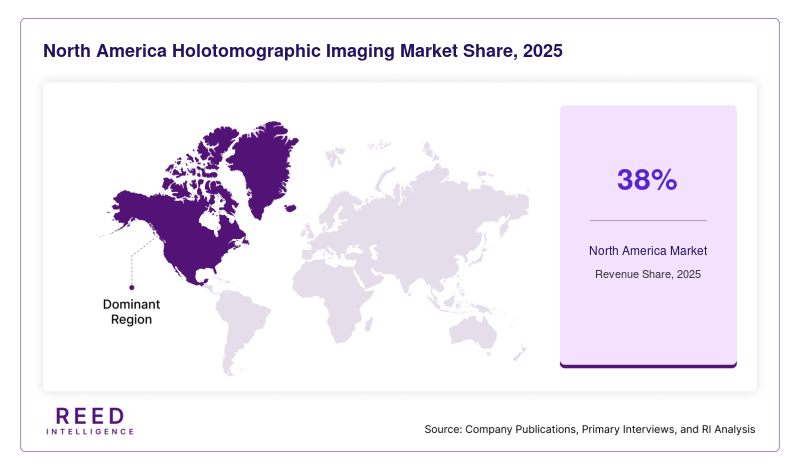
North America accounted for approximately 38% of the global Holotomographic Imaging Market share in 2025 and will continue to grow at a CAGR of 11.8% through 2034. The region’s strong presence of advanced research infrastructure and consistent funding in life sciences contributed to its dominant position.
The United States led the regional market due to its extensive network of research institutions and biotechnology firms. The increasing focus on personalized medicine and advanced diagnostics has supported the adoption of holotomographic imaging technologies.
Europe
Europe held around 27% share of the Holotomographic Imaging Market in 2025 and is expected to expand at a CAGR of 11.5% during the forecast period. The region’s growth was supported by strong academic research activities and government funding for innovation in imaging technologies.
Germany emerged as the dominant country, driven by its well-established healthcare system and focus on medical technology advancements. The country’s emphasis on research collaborations has facilitated the adoption of advanced imaging systems.
Asia Pacific
Asia Pacific captured nearly 22% of the global market share in 2025 and is projected to register the fastest CAGR of 14.1% from 2025 to 2034. Rapid expansion of healthcare infrastructure and increasing R&D investments have driven regional growth.
China dominated the regional market due to its growing biotechnology sector and government initiatives supporting scientific research. The rising number of research laboratories and academic institutions has boosted demand for holotomographic imaging systems.
Middle East & Africa
The Middle East & Africa accounted for approximately 7% of the Holotomographic Imaging Market in 2025 and will grow at a CAGR of 10.6% during the forecast period. The region’s growth was supported by gradual improvements in healthcare infrastructure and research capabilities.
The United Arab Emirates emerged as a key country, driven by investments in advanced medical technologies and research facilities. The country’s focus on healthcare innovation has supported the adoption of imaging solutions.
Latin America
Latin America held about 6% share of the global market in 2025 and is expected to grow at a CAGR of 10.9% through 2034. The region’s growth was driven by increasing awareness of advanced diagnostic technologies and expanding research activities.
Brazil led the regional market due to its growing healthcare sector and investments in biotechnology research. The country’s expanding academic and research ecosystem has contributed to market growth.
Competitive Landscape
The Holotomographic Imaging Market is characterized by the presence of several established players and emerging companies focusing on technological innovation. Key market participants are investing in research and development to enhance imaging capabilities and expand their product portfolios.
The market leader, Tomocube Inc., has strengthened its position through continuous innovation in holotomographic microscopy systems. The company recently introduced an advanced imaging platform integrating AI-based analysis, improving efficiency and accuracy.
Other major players are focusing on strategic collaborations, product launches, and regional expansion to gain a competitive edge. The competitive landscape remains moderately consolidated, with companies competing on technology differentiation and application-specific solutions.
Key Players List
- Tomocube Inc.
- Nanolive SA
- Phase Holographic Imaging PHI AB
- Carl Zeiss AG
- Nikon Corporation
- Olympus Corporation
- Bruker Corporation
- Leica Microsystems
- Agilent Technologies
- PerkinElmer Inc.
- Thermo Fisher Scientific Inc.
- Hitachi High-Tech Corporation
- JEOL Ltd.
- Keyence Corporation
- Oxford Instruments
Recent Developments
- Tomocube Inc. launched an upgraded holotomographic imaging system with enhanced AI-based analytics in 2025.
- Nanolive SA expanded its product portfolio with next-generation live-cell imaging solutions.
- Phase Holographic Imaging introduced improved software for real-time image processing.
- Carl Zeiss AG invested in advanced microscopy technologies to strengthen its imaging segment.
- Nikon Corporation partnered with research institutions to develop innovative imaging applications.
Holotomographic Imaging Market Segments
Application
- Cell Biology
- Drug Discovery
- Clinical Diagnostics
- Material Science
End-Use
- Research Institutes
- Pharmaceutical Companies
- Biotechnology Firms
- Academic Institutions
Product Type
- Holotomographic Microscopes
- Software Solutions
Technology
- Quantitative Phase Imaging
- Hybrid Imaging Technologies
By Region
- North America
- Europe
- APAC
- Middle East and Africa
- LATAM