Home Based Semen Analysis Kit Market Size, Share & Demand Report By Product Type (Smartphone-Based Kits, AI-Enabled Kits, Manual Kits), By Test Parameter (Sperm Count, Motility, Morphology, Multi-Parameter), By Distribution Channel (Online, Pharmacy Retail, Specialty Stores), By End-User (Individuals, Healthcare Providers), By Region & Segment Forecasts, 2025–2034
USD 3950
Market Overview
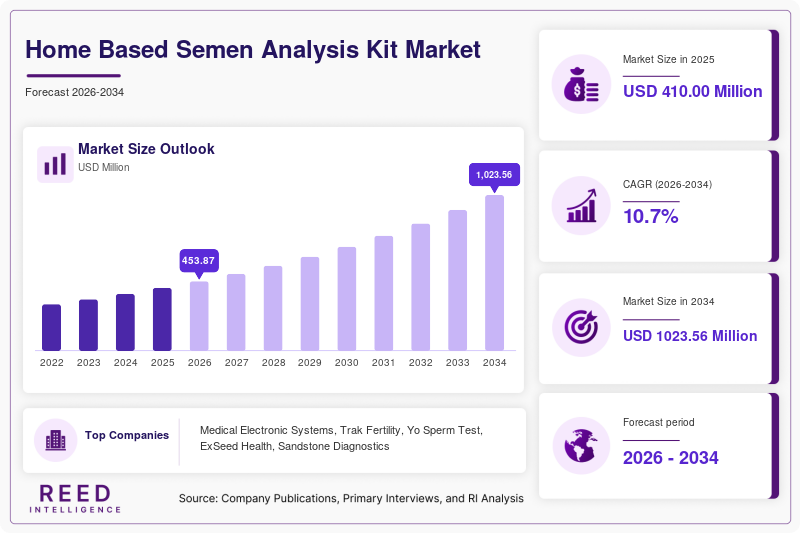
The global Home Based Semen Analysis Kit Market size was valued at USD 410 million in 2025 and is projected to reach USD 1,020 million by 2034, expanding at a CAGR of 10.7% from 2025 to 2034. The market has witnessed steady traction due to rising awareness regarding male fertility health and increasing preference for private, convenient diagnostic solutions.
A major global factor supporting market growth is the shift toward at-home healthcare diagnostics. Consumers increasingly favor self-testing kits that provide quick results without the need for clinical visits. This shift has been further reinforced by digital health integration, enabling smartphone-based analysis and result tracking, thereby improving accessibility and user engagement.
Key Highlights
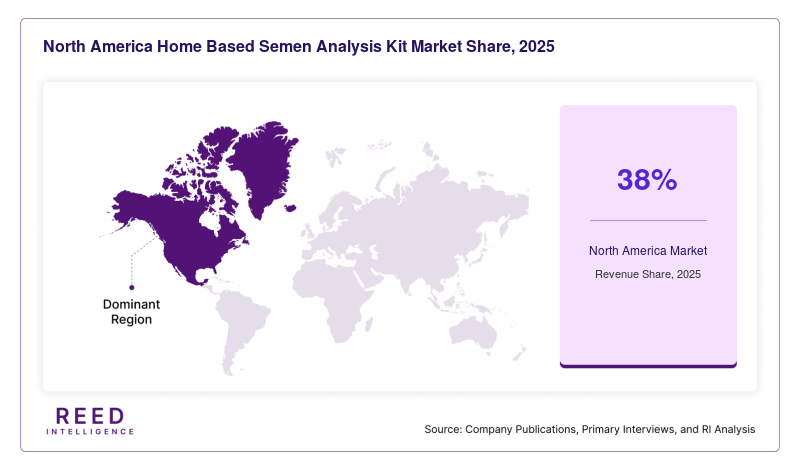
- North America dominated the market with a 38% share in 2025, while Asia Pacific is projected to be the fastest-growing region with a CAGR of 12.6%
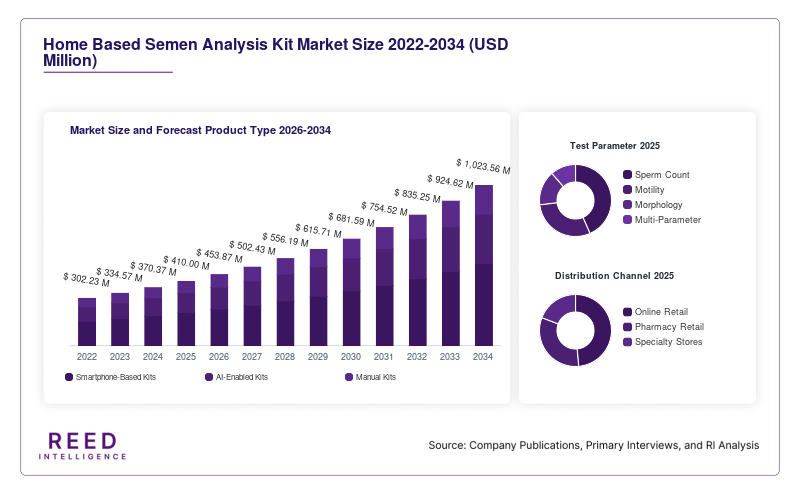
- By product type, smartphone-based kits led with a 56% share, while AI-enabled kits are expected to grow fastest at a CAGR of 13.4%
- By distribution channel, online sales dominated with 61% share, while pharmacy retail is anticipated to grow at 11.8% CAGR
- The U.S. market was valued at USD 145 million in 2025 and is expected to reach USD 158 million in 2026
Market Trends
Integration of Digital Health and Smartphone Connectivity
A prominent trend shaping the Home Based Semen Analysis Kit Market is the integration of smartphone applications and digital health platforms. Modern kits are equipped with optical attachments that connect to mobile devices, enabling real-time semen analysis through dedicated apps. These platforms offer detailed metrics such as sperm count, motility, and morphology. Additionally, users can track historical data and share results with healthcare professionals. This trend enhances user convenience and encourages early diagnosis, supporting market expansion.
Rising Adoption of AI-Based Fertility Diagnostics
Artificial intelligence is increasingly being incorporated into home-based semen testing kits to improve diagnostic accuracy. AI-powered algorithms analyze sperm movement patterns and morphology more precisely than traditional methods. These systems reduce user error and provide clinically relevant insights. The trend is particularly significant in developed markets, where consumers demand reliable and technologically advanced healthcare solutions. As AI becomes more accessible, manufacturers are integrating it into compact, user-friendly kits, driving innovation across the Home Based Semen Analysis Kit Market.
Market Drivers
Increasing Male Infertility Awareness
Growing awareness regarding male infertility is a key driver of the Home Based Semen Analysis Kit Market. Educational campaigns and increasing public discourse around reproductive health have encouraged men to take proactive steps toward fertility assessment. Lifestyle factors such as stress, poor diet, and environmental exposure have contributed to declining sperm quality, prompting individuals to seek convenient diagnostic tools. Home-based kits provide a discreet solution, reducing social stigma and encouraging early testing.
Demand for Convenient and Private Testing Solutions
The demand for privacy and convenience in healthcare services has significantly boosted the adoption of home-based semen analysis kits. Traditional fertility testing often involves clinical visits, which can be time-consuming and uncomfortable for many individuals. Home kits allow users to perform tests in a private setting with minimal effort. Rapid results and ease of use have made these kits appealing, particularly among urban populations with busy lifestyles. This shift toward user-centric healthcare solutions continues to support market growth.
Market Restraint
Limited Accuracy Compared to Laboratory Testing
Despite technological advancements, one of the primary restraints in the Home Based Semen Analysis Kit Market is the perceived limitation in accuracy compared to laboratory-based semen analysis. While modern kits offer improved reliability, they may not provide comprehensive assessments, such as detailed morphology or advanced motility parameters. This limitation can affect user confidence, particularly in cases requiring precise clinical evaluation.
Additionally, improper usage or lack of technical understanding can lead to inaccurate results. Variability in sample handling and environmental conditions further contributes to inconsistencies. Healthcare professionals often recommend confirmatory laboratory testing, which can reduce the standalone value of home kits. As a result, some consumers may hesitate to rely solely on these products, thereby restraining widespread adoption in certain segments of the market.
Market Opportunities
Expansion in Emerging Markets
Emerging economies present significant growth opportunities for the Home Based Semen Analysis Kit Market. Increasing healthcare awareness, rising disposable income, and expanding access to e-commerce platforms are enabling wider adoption of home diagnostic kits. Governments and healthcare organizations in these regions are also promoting reproductive health initiatives, which further support market penetration. Manufacturers can capitalize on this opportunity by offering cost-effective and localized products tailored to regional needs.
Development of Multi-Parameter Testing Kits
The development of advanced kits capable of analyzing multiple fertility parameters represents another key opportunity. Current kits primarily focus on sperm count and motility; however, there is growing demand for comprehensive solutions that include hormone analysis and DNA fragmentation assessment. Integrating these features into a single device can enhance product value and attract a broader consumer base. Companies investing in research and development to expand testing capabilities are likely to gain a competitive advantage in the evolving Home Based Semen Analysis Kit Market.
Segmental Analysis
By Product Type
Smartphone-based kits dominated the Home Based Semen Analysis Kit Market with a 56% share in 2025. These kits gained popularity due to their ease of use and ability to provide real-time results through mobile applications.
AI-enabled kits are expected to be the fastest-growing segment, with a CAGR of 13.4%. These kits will benefit from advanced analytics capabilities that enhance accuracy and provide detailed insights, making them highly attractive to tech-savvy consumers.
By Test Parameter
Sperm count analysis held the largest share of 48% in 2025. This parameter is the most commonly used indicator of male fertility, making it a primary focus for home testing kits.
Multi-parameter testing, including motility and morphology, will grow at a CAGR of 12.9%. These kits will offer comprehensive insights, addressing the limitations of single-parameter analysis.
By Distribution Channel
Online sales dominated the market with a 61% share in 2025. The convenience of e-commerce platforms and discreet purchasing options contributed to this dominance.
Pharmacy retail is projected to grow at a CAGR of 11.8%. Increased availability of home diagnostic kits in pharmacies will enhance accessibility for consumers who prefer offline purchasing.
By End-User
Individual consumers accounted for 72% of the market share in 2025, driven by the preference for private testing solutions.
Healthcare providers are expected to grow at a CAGR of 10.5%, as clinics incorporate home testing kits into patient care programs to improve early diagnosis and monitoring.
Regional Analysis
North America
North America accounted for 38% of the Home Based Semen Analysis Kit Market share in 2025 and will grow at a CAGR of 9.8% during the forecast period. The region’s established healthcare infrastructure and high awareness of reproductive health contributed to its leading position.
The United States dominated the regional market due to widespread adoption of digital health technologies. The presence of advanced healthcare systems and a strong focus on preventive care supported the growth of home diagnostic solutions. Additionally, increasing acceptance of telehealth services has facilitated the integration of semen analysis kits with digital consultation platforms.
Europe
Europe held approximately 26% market share in 2025 and is expected to grow at a CAGR of 10.1%. The region benefited from strong healthcare policies and increasing awareness about fertility issues.
Germany emerged as the dominant country due to its emphasis on healthcare innovation and research. The country’s well-developed pharmaceutical and medical device sectors have supported the introduction of advanced home testing kits. Public awareness campaigns on reproductive health further contributed to market expansion.
Asia Pacific
Asia Pacific captured 22% of the market share in 2025 and will register the fastest growth at a CAGR of 12.6%. Rapid urbanization and increasing healthcare access drove demand for home-based diagnostic solutions.
China led the regional market due to its large population base and rising awareness of fertility health. The growing middle class and expansion of e-commerce platforms enabled greater accessibility to home testing kits. Government initiatives promoting family planning also supported market growth.
Middle East & Africa
The Middle East & Africa region held 8% market share in 2025 and is projected to grow at a CAGR of 9.2%. Increasing healthcare investments and rising awareness of infertility issues contributed to market development.
The United Arab Emirates dominated the region due to its advanced healthcare infrastructure and high adoption of digital health solutions. The country’s focus on modernizing healthcare services facilitated the introduction of innovative diagnostic tools.
Latin America
Latin America accounted for 6% of the market share in 2025 and is anticipated to grow at a CAGR of 9.5%. Improving healthcare access and rising consumer awareness supported market growth.
Brazil emerged as the leading country due to its expanding healthcare sector and increasing focus on reproductive health. Growing adoption of online retail channels enabled easier availability of home-based semen analysis kits across the region.
Competitive Landscape
The Home Based Semen Analysis Kit Market is moderately fragmented, with several established and emerging players competing based on technology, accuracy, and pricing. The market leader, Medical Electronic Systems, has maintained a strong position through continuous innovation and product development. The company recently introduced an upgraded smartphone-compatible kit with enhanced imaging capabilities, strengthening its market presence.
Other key players are focusing on expanding their product portfolios and leveraging digital health platforms to improve user experience. Strategic partnerships and investments in research and development remain central to maintaining competitiveness in this evolving market.
Key Players
- Medical Electronic Systems
- Trak Fertility
- Yo Sperm Test
- ExSeed Health
- Sandstone Diagnostics
- Fertility Focus
- MotilityCount
- Microspt
- Labcorp
- Legacy
- SpermCheck
- Ro Health
- LetsGetChecked
- Everlywell
- Path Fertility
Recent Developments
- 2024: A leading manufacturer launched an AI-integrated semen analysis kit with enhanced accuracy metrics.
- 2024: Several companies expanded their e-commerce presence to reach wider consumer bases.
- 2025: New product launches focused on multi-parameter testing capabilities.
- 2025: Strategic collaborations between diagnostic firms and telehealth providers increased market accessibility.
- 2025: Advancements in microfluidics technology improved test precision in home-based kits.
Home Based Semen Analysis Kit Market Segments
Product Type
- Smartphone-Based Kits
- AI-Enabled Kits
- Manual Kits
Test Parameter
- Sperm Count
- Motility
- Morphology
- Multi-Parameter
Distribution Channel
- Online Retail
- Pharmacy Retail
- Specialty Stores
End-User
- Individuals
- Healthcare Providers
By Region
- North America
- Europe
- APAC
- Middle East and Africa
- LATAM