Homocysteine Testing Market Size, Share, Growth Demand Report By Product Type (Immunoassay-Based Testing, Chromatography-Based Testing), By Application (Cardiovascular Disease Testing, Neurological Disorder Testing), By End User (Hospitals, Diagnostic Laboratories, Academic Research Institutes, Specialty Clinics), By Technology (ELISA, Fluorescence Polarization Immunoassay) By Region & Segment Forecasts, 2026–2034
USD 3950
Market Overview
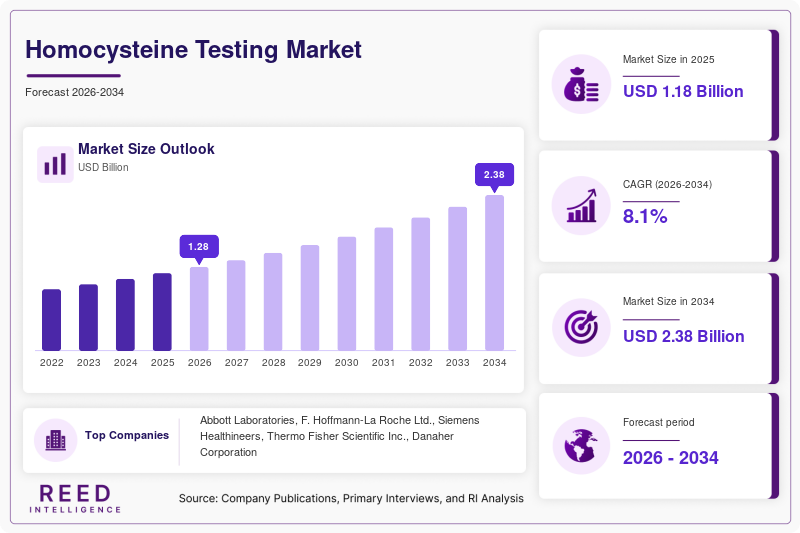
The global Homocysteine Testing Market Size was valued at approximately USD 1.18 billion in 2026 and is projected to reach nearly USD 2.21 billion by 2034, expanding at a CAGR of 8.1% during the forecast period from 2026 to 2034. The market is experiencing stable expansion due to the increasing prevalence of cardiovascular disorders, growing awareness regarding preventive diagnostics, and rising adoption of biomarker-based testing solutions across hospitals and diagnostic laboratories. Homocysteine testing plays an important role in evaluating cardiovascular risk, vitamin B deficiency, metabolic disorders, and neurological conditions. The growing focus on early disease detection and personalized healthcare management is contributing significantly to the long-term development of the market.
A major global factor supporting the growth of the Homocysteine Testing Market is the rising burden of chronic cardiovascular diseases and metabolic disorders worldwide. Healthcare providers are increasingly adopting advanced blood biomarker screening methods to identify patients at risk of stroke, heart disease, and vascular complications. In addition, growing healthcare expenditure, expanding preventive screening programs, and technological advancements in laboratory automation are positively influencing the overall market outlook. The increasing demand for accurate and rapid diagnostic procedures is also encouraging healthcare institutions to integrate homocysteine testing into routine health assessment programs.
Key Highlights
- North America dominated the market with 39% share in 2025, while Asia Pacific is projected to witness the fastest growth at a 9.4% CAGR during 2026–2034.
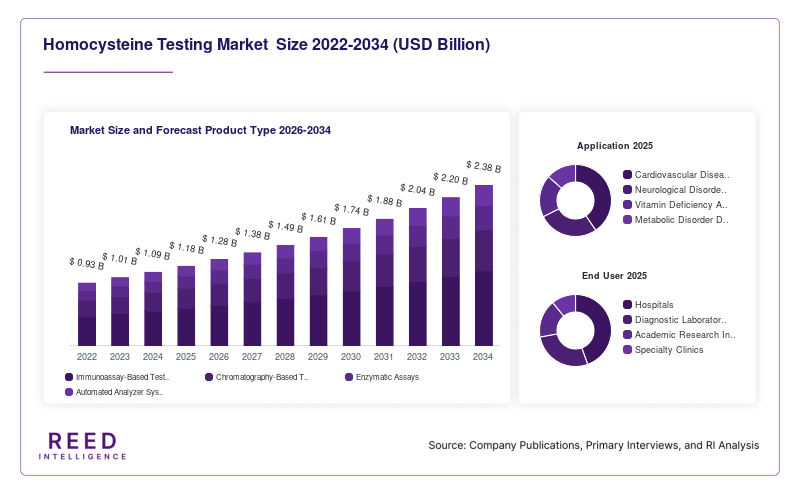
- By product type, immunoassay-based testing accounted for the largest market share of 46% in 2025, while automated analyzer systems are expected to grow at a CAGR of 9.1% during the forecast period.
- By application, cardiovascular disease testing remained the dominant segment with 52% market share in 2025, whereas neurological disorder testing is projected to expand at a CAGR of 8.8% through 2034.
- The United States remained the leading country market and was valued at approximately USD 322 million in 2024 and USD 348 million in 2025.
Market Trends
Increasing Adoption of Preventive Diagnostic Screening
One of the key trends shaping the Homocysteine Testing Market is the increasing adoption of preventive diagnostic screening among healthcare providers and consumers. Medical professionals are increasingly emphasizing early disease identification to reduce long-term treatment costs and improve patient outcomes. Homocysteine level testing is becoming an important component of cardiovascular and metabolic risk assessments because elevated homocysteine concentrations are associated with several chronic diseases. Growing public awareness regarding preventive healthcare and regular wellness testing is supporting broader market penetration across developed and developing economies.
Diagnostic laboratories and hospitals are also integrating advanced screening packages that include homocysteine analysis alongside lipid profile and vitamin deficiency testing. This trend is expected to strengthen the demand for high-throughput testing solutions and automated laboratory systems. Increasing patient preference for routine health monitoring and personalized diagnostics is further contributing to market growth.
Expansion of Automated and High-Sensitivity Testing Technologies
Another important trend in the Homocysteine Testing Market is the rapid adoption of automated laboratory analyzers and high-sensitivity testing platforms. Diagnostic companies are focusing on developing advanced immunoassay systems and chromatography-based testing solutions that provide faster turnaround times and improved analytical accuracy. Automation is reducing operational errors and improving testing efficiency in large diagnostic laboratories and hospital networks.
The growing use of artificial intelligence and digital laboratory management systems is also improving workflow optimization and test reporting accuracy. Healthcare institutions are increasingly investing in automated analyzers capable of handling multiple biomarker tests simultaneously. These innovations are expected to improve diagnostic reliability and enhance market growth during the forecast period.
Market Drivers
Rising Incidence of Cardiovascular and Neurological Disorders
The growing prevalence of cardiovascular disorders is a major driver supporting the growth of the Homocysteine Testing Market. Elevated homocysteine levels are strongly associated with vascular inflammation, arterial damage, and increased cardiovascular risk. As the global burden of heart disease and stroke continues to rise, healthcare providers are increasingly recommending homocysteine testing for risk assessment and preventive care planning.
The increasing prevalence of neurological disorders such as dementia, cognitive impairment, and Alzheimer’s disease is also contributing to market demand. Researchers and healthcare professionals are exploring the relationship between elevated homocysteine levels and neurological degeneration, which is encouraging the adoption of homocysteine testing in neurological diagnostics and long-term disease monitoring.
Growing Awareness Regarding Vitamin Deficiency Testing
Another important growth driver for the Homocysteine Testing Market is the increasing awareness regarding vitamin B12 and folate deficiencies. Elevated homocysteine levels are commonly associated with nutritional deficiencies that can negatively affect cardiovascular and neurological health. Healthcare providers are increasingly using homocysteine testing to evaluate nutritional status and identify metabolic abnormalities in patients.
The growing popularity of preventive nutrition programs and personalized wellness plans is further increasing the use of homocysteine testing across healthcare facilities. Rising health awareness among aging populations and increased access to diagnostic services are also contributing to market expansion.
Market Restraint
Limited Awareness in Low-Income Healthcare Markets
One of the major restraints affecting the Homocysteine Testing Market is the limited awareness and adoption of advanced biomarker testing in low-income and underdeveloped healthcare markets. Many healthcare systems continue to prioritize conventional diagnostic procedures due to budget limitations and inadequate laboratory infrastructure. Limited reimbursement support for preventive diagnostic tests may also restrict market penetration in certain regions.
Market Opportunities
Expansion of Personalized Medicine Programs
The increasing adoption of personalized medicine is creating strong opportunities for the Homocysteine Testing Market. Personalized healthcare approaches rely heavily on biomarker analysis to identify disease risk factors and develop individualized treatment strategies. Homocysteine testing is becoming increasingly relevant in customized cardiovascular and nutritional management programs.
Healthcare providers are also integrating homocysteine analysis into comprehensive wellness and preventive care packages. This trend is expected to create additional demand for advanced testing solutions and laboratory automation technologies.
Rising Demand for Point-of-Care Diagnostic Solutions
The growing demand for point-of-care diagnostics presents another major opportunity for the market. Portable diagnostic devices capable of providing rapid homocysteine analysis are gaining attention among healthcare providers seeking faster clinical decision-making tools. Point-of-care solutions are expected to improve testing accessibility in remote healthcare facilities and outpatient clinics.
Manufacturers are increasingly focusing on compact diagnostic platforms that offer rapid results with simplified operational workflows. These advancements are likely to support future market growth and expand testing adoption across emerging economies.
Segmental Analysis
By Product Type
Based on product type, the Homocysteine Testing Market is segmented into immunoassay-based testing, chromatography-based testing, enzymatic assays, and automated analyzer systems. Immunoassay-based testing dominated the market with approximately 46% share in 2025 due to its high sensitivity, cost efficiency, and widespread laboratory adoption. Automated analyzer systems are expected to witness the fastest growth at a CAGR of 9.1% during the forecast period because healthcare institutions are increasingly investing in high-throughput automated laboratory technologies to improve testing efficiency and reduce operational errors.
By Application
By application, the market is segmented into cardiovascular disease testing, neurological disorder testing, vitamin deficiency analysis, and metabolic disorder diagnostics. Cardiovascular disease testing accounted for the largest market share of 52% in 2025 because homocysteine biomarkers are widely used for assessing vascular risk factors and heart disease progression. Neurological disorder testing is expected to grow at a CAGR of 8.8% through 2034 due to increasing research regarding the relationship between homocysteine levels and neurodegenerative conditions.
By End User
Based on end user, the market includes hospitals, diagnostic laboratories, academic research institutes, and specialty clinics. Diagnostic laboratories held the dominant share of approximately 44% in 2025 due to increasing patient testing volumes and expanding laboratory automation capabilities. Specialty clinics are projected to grow at a CAGR of 8.5% during the forecast period because preventive healthcare centers are increasingly integrating biomarker testing services into routine wellness programs.
By Technology
The market is segmented into ELISA, fluorescence polarization immunoassay, high-performance liquid chromatography, and chemiluminescence immunoassay technologies. Chemiluminescence immunoassay technology accounted for approximately 37% share in 2025 due to its high analytical precision and broad clinical adoption. High-performance liquid chromatography is expected to witness a CAGR of 8.7% during the forecast period owing to increasing demand for highly accurate biomarker quantification in specialized laboratories.
Regional Analysis
North America
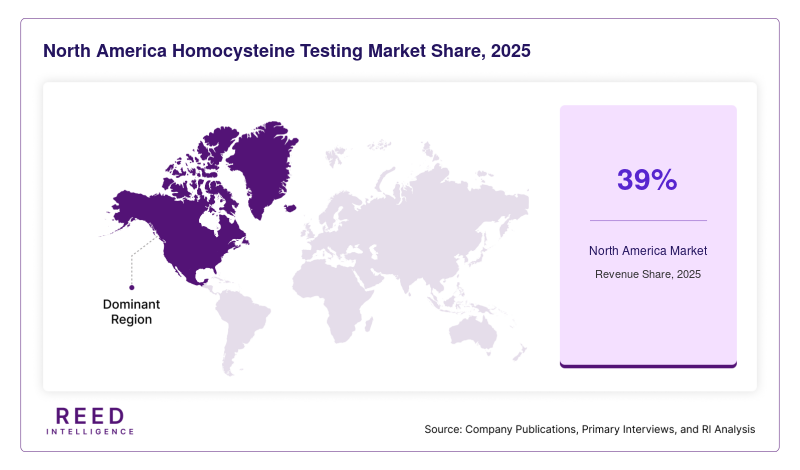
North America accounted for approximately 39% share of the Homocysteine Testing Market in 2025 and is projected to grow at a CAGR of 7.8% during the forecast period. The region benefits from advanced healthcare infrastructure, strong adoption of preventive diagnostics, and rising healthcare expenditure. The United States remained the dominant regional market due to increasing cardiovascular screening programs and strong laboratory automation adoption.
Europe
Europe held around 28% share in 2025 and is expected to expand at a CAGR of 7.6% through 2034. Increasing awareness regarding preventive healthcare and rising demand for biomarker-based diagnostics are supporting regional market growth. Germany dominated the European market due to the presence of advanced diagnostic laboratories and expanding chronic disease management programs.
Asia Pacific
Asia Pacific represented nearly 22% market share in 2025 and is projected to witness the fastest growth at a CAGR of 9.4% during the forecast period. Increasing healthcare investments, expanding diagnostic laboratory infrastructure, and growing awareness regarding cardiovascular health are supporting market expansion. China remained the leading regional contributor due to rising healthcare modernization and growing preventive screening adoption.
Middle East & Africa
The Middle East & Africa accounted for approximately 6% share in 2025 and is expected to grow at a CAGR of 7.2% during the forecast period. Increasing healthcare infrastructure development and rising awareness regarding chronic disease management are supporting market demand. Saudi Arabia dominated the region because of increasing healthcare expenditure and expanding diagnostic service networks.
Latin America
Latin America held around 5% market share in 2025 and is projected to expand at a CAGR of 7.0% through 2034. Brazil remained the dominant country market due to increasing investment in laboratory diagnostics and growing public health screening initiatives. Expanding access to preventive healthcare services is also supporting regional market growth.
Competitive Landscape
The Homocysteine Testing Market is moderately competitive with the presence of several global diagnostic companies focusing on laboratory automation, biomarker innovation, and advanced immunoassay technologies. Market participants are investing in product development, strategic collaborations, and expansion of diagnostic service capabilities to strengthen their market position.
Abbott Laboratories remained one of the leading participants in the market due to its extensive diagnostic portfolio and advanced laboratory automation systems. The company recently expanded its immunoassay testing capabilities to support high-volume cardiovascular biomarker analysis across clinical laboratories.
F. Hoffmann-La Roche Ltd. continues to strengthen its diagnostic business through automation-focused laboratory platforms and biomarker testing innovation. Siemens Healthineers is focusing on high-throughput diagnostic analyzers and digital laboratory solutions, while Thermo Fisher Scientific and Danaher Corporation are expanding their biomarker testing product portfolios through strategic partnerships and technology development initiatives.
Key Players List
- Abbott Laboratories
- F. Hoffmann-La Roche Ltd.
- Siemens Healthineers
- Thermo Fisher Scientific Inc.
- Danaher Corporation
- Bio-Rad Laboratories Inc.
- Randox Laboratories Ltd.
- DiaSys Diagnostic Systems GmbH
- Quest Diagnostics Incorporated
- Laboratory Corporation of America Holdings
- PerkinElmer Inc.
- Sysmex Corporation
- Beckman Coulter Inc.
- Ortho Clinical Diagnostics
- Trinity Biotech plc
Homocysteine Testing Market Segments
Product Type
- Immunoassay-Based Testing
- Chromatography-Based Testing
- Enzymatic Assays
- Automated Analyzer Systems
Application
- Cardiovascular Disease Testing
- Neurological Disorder Testing
- Vitamin Deficiency Analysis
- Metabolic Disorder Diagnostics
End User
- Hospitals
- Diagnostic Laboratories
- Academic Research Institutes
- Specialty Clinics
Technology
- ELISA
- Fluorescence Polarization Immunoassay
- High-Performance Liquid Chromatography
- Chemiluminescence Immunoassay
Region
- North America
- Europe
- Asia Pacific
- Middle East & Africa
- Latin America
By Region
- North America
- Europe
- APAC
- Middle East and Africa
- LATAM