Honing Oil Market Size, Share & Demand Report By Product Type (Synthetic Honing Oil, Semi-Synthetic Honing Oil, Bio-Based Honing Oil), By Application (Hydraulic Equipment Honing, Industrial Machinery Honing, Precision Engineering Components), By End-Use Industry (Automotive Manufacturing, Aerospace and Defense, Industrial Machinery, Energy and Power, General Manufacturing), By Region & Segment Forecasts, 2026–2034
USD 3950
Market Overview
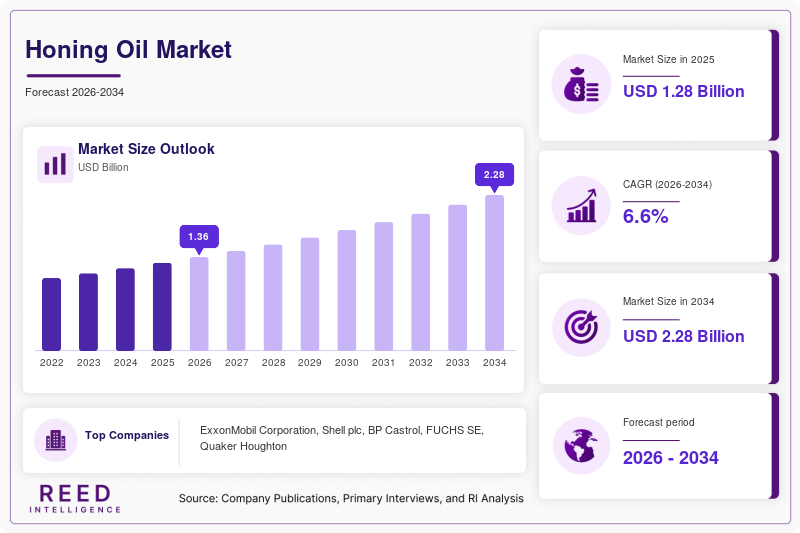
The global Honing Oil Market size was valued at approximately USD 1.28 billion in 2026 and is projected to reach USD 2.14 billion by 2034, expanding at a CAGR of 6.6% during 2026–2034. Honing oil plays a critical role in precision machining operations by improving surface finish, reducing friction, extending tool life, and supporting dimensional accuracy during honing processes. Industries such as automotive, aerospace, industrial machinery, energy equipment, and precision engineering continue to depend on honing oils to achieve stringent manufacturing standards.
A major factor supporting market growth is the increasing demand for high-precision metal components across global manufacturing industries. As production technologies become more advanced, manufacturers are focusing on achieving tighter tolerances and improved surface quality. This has increased the adoption of specialized honing oils capable of enhancing machining efficiency while minimizing wear on expensive tooling systems. Additionally, growing investments in industrial automation and advanced machining centers have strengthened demand for premium lubrication solutions.
Key Highlights
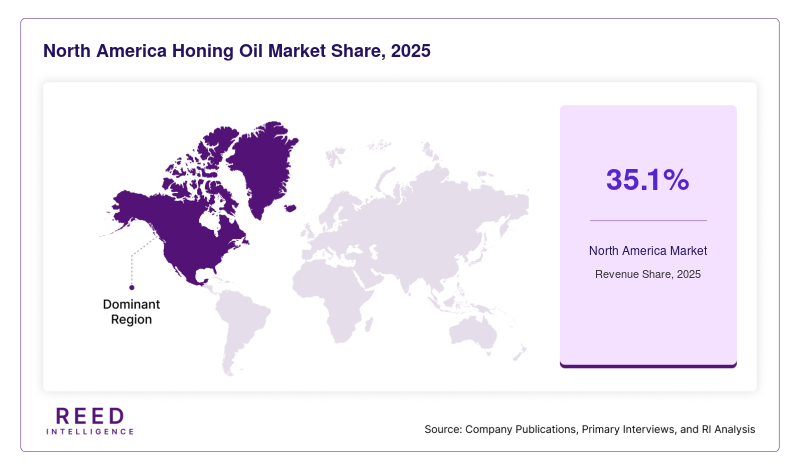
- North America dominated the market with a 35.1% share in 2025.
- Asia Pacific is expected to grow at the fastest CAGR of 8.1% during 2026–2034.
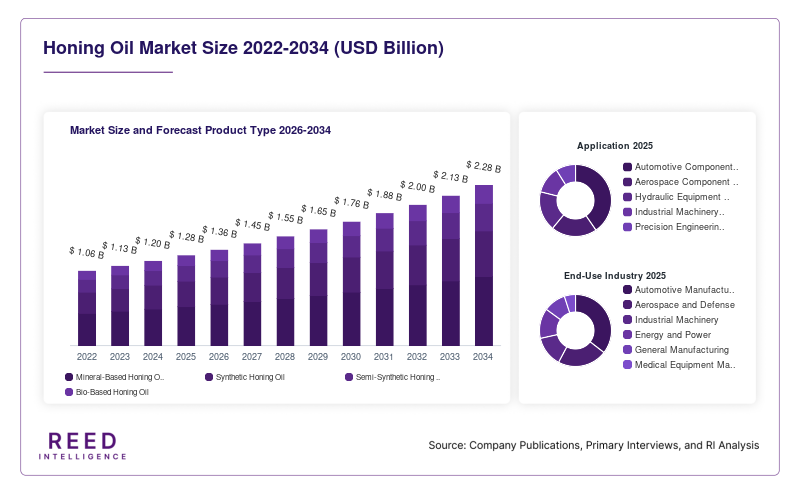
- By product type, mineral-based honing oils accounted for the largest share of 43.8%.
- while synthetic honing oils are projected to grow at a CAGR of 8.7%.
- By application, automotive component honing led with a 39.6% share.
- whereas aerospace component honing is expected to expand at a CAGR of 8.9%.
- By end-use industry, automotive manufacturing accounted for the largest share of 37.2%.
- while aerospace and defense is projected to grow at a CAGR of 8.5%.
- The United States remained the dominant country, with market values of USD 322 million in 2024 and USD 346 million in 2025.
Market Trends
Growing Preference for Synthetic and Low-Residue Honing Oils
Manufacturers are increasingly adopting synthetic and semi-synthetic honing oils due to their superior lubrication characteristics and improved operational efficiency. These products offer better thermal stability, lower mist formation, and enhanced surface finish quality compared to conventional formulations. As machining operations become more precise, industries are seeking lubricants that can maintain consistent performance under demanding operating conditions. Synthetic products also support longer fluid life and reduced maintenance requirements, making them attractive for high-volume production facilities. The trend is particularly visible in aerospace and precision engineering sectors where component tolerances are extremely strict and operational reliability remains a key requirement.
Integration of Sustainable Metalworking Fluid Technologies
Sustainability has become an important consideration in industrial lubrication markets. Honing oil manufacturers are investing in environmentally responsible formulations that reduce hazardous emissions and improve workplace safety. Biodegradable ingredients, lower sulfur content, and improved recyclability are increasingly being incorporated into product development strategies. Regulatory authorities across several industrialized economies are encouraging the use of cleaner metalworking fluids, prompting end users to upgrade their lubrication systems. This trend is creating demand for advanced honing oils that deliver both environmental compliance and machining performance. As sustainability objectives gain importance across manufacturing sectors, eco-friendly honing oil solutions are expected to capture a larger market share.
Market Drivers
Expansion of Precision Manufacturing Activities Worldwide
The rapid expansion of precision manufacturing across automotive, aerospace, medical device, and industrial machinery sectors continues to drive demand for honing oils. Modern production facilities require highly accurate machining processes capable of delivering consistent surface quality and dimensional precision. Honing oils support these objectives by reducing friction, minimizing heat generation, and improving cutting efficiency. Increasing investments in advanced machine tools and automated production systems have further strengthened market demand. As manufacturers seek to improve productivity while maintaining strict quality standards, the need for reliable honing lubricants continues to rise across both developed and emerging industrial economies.
Rising Automotive Production and Engine Component Demand
The automotive sector remains one of the largest consumers of honing oils due to extensive honing requirements in engine blocks, cylinders, transmission systems, and fuel injection components. Rising vehicle production across Asia Pacific, North America, and Europe is creating sustained demand for high-performance machining fluids. The transition toward fuel-efficient engines and advanced powertrain technologies requires tighter component tolerances, increasing the importance of honing operations. Electric vehicle manufacturers are also utilizing precision-machined components that benefit from specialized lubrication solutions. Consequently, growth in automotive manufacturing continues to represent a significant driver supporting expansion of the global Honing Oil Market.
Market Restraint
Volatility in Raw Material Prices and Environmental Compliance Costs
Fluctuations in base oil prices and additive costs remain a notable challenge for market participants. Many honing oil formulations rely on petroleum-derived ingredients, making production costs sensitive to changes in global crude oil markets. Sudden increases in feedstock prices can affect profitability and create pricing pressure across the supply chain. In addition, manufacturers must comply with increasingly stringent environmental regulations governing metalworking fluids. Developing formulations that meet safety and sustainability standards often requires additional research, testing, and certification expenditures. Smaller suppliers may face difficulties investing in such upgrades, limiting their competitive position. For example, industrial facilities transitioning to low-emission lubricant systems often require equipment modifications and fluid management investments, increasing operational costs. These factors can slow adoption rates in price-sensitive markets and create challenges for sustained market growth.
Market Opportunities
Increasing Industrialization Across Emerging Economies
Rapid industrialization in emerging economies presents substantial growth opportunities for honing oil manufacturers. Countries across Asia, Latin America, and parts of Africa are expanding their manufacturing capabilities through investments in automotive production, industrial machinery, and metal fabrication facilities. As these industries develop, demand for precision machining processes continues to increase. Honing operations are becoming more common in facilities seeking to improve product quality and production efficiency. Local manufacturers are also upgrading machinery to meet international standards, creating opportunities for advanced honing oil suppliers. Companies capable of establishing regional distribution networks and technical support services are likely to benefit from rising demand in these developing industrial markets.
Development of High-Performance Specialty Formulations
Technological advancements in machining equipment are creating opportunities for specialized honing oil products designed for challenging applications. Aerospace components, medical devices, hydraulic systems, and advanced industrial equipment often require exceptional surface finish quality and dimensional accuracy. This demand encourages innovation in lubricant chemistry, including synthetic blends with enhanced cooling, lubrication, and filtration performance. Specialty formulations capable of extending tool life and improving productivity can command premium pricing while offering measurable operational benefits. As manufacturers increasingly focus on process optimization and quality control, demand for customized honing oil solutions is expected to create attractive growth prospects throughout the forecast period.
Segmental Analysis
By Product Type
Mineral-based honing oils represented the dominant product segment and accounted for approximately 43.8% of market share in 2024. Their widespread adoption is largely attributed to cost-effectiveness, broad availability, and proven performance across conventional machining applications. Many automotive and industrial machinery manufacturers continue to utilize mineral-based products because they provide adequate lubrication and cooling characteristics while maintaining operational affordability. The segment also benefits from established distribution networks and extensive compatibility with existing honing equipment. Small and medium-sized manufacturing facilities particularly favor these products due to their familiarity and lower procurement costs.
Synthetic honing oils are expected to register the fastest CAGR of 8.7% during 2026–2034. Growth is driven by increasing demand for advanced lubrication solutions capable of delivering superior thermal stability, extended fluid life, and improved surface finish quality. Manufacturers operating high-speed or precision machining systems are increasingly adopting synthetic products to enhance process efficiency and reduce maintenance requirements. These oils also support sustainability objectives through lower consumption rates and improved filtration performance. As industrial facilities continue investing in advanced manufacturing technologies, demand for synthetic honing oils is anticipated to rise steadily.
By Application
Automotive component honing emerged as the largest application segment, accounting for approximately 39.6% of global revenue in 2024. Honing processes are extensively used in engine cylinders, transmission systems, hydraulic assemblies, and fuel injection components. The need for precise dimensional accuracy and smooth surface finishes continues to support demand for specialized honing oils. Global vehicle production remains a key contributor to segment growth, while ongoing technological improvements in automotive engineering are increasing machining requirements. Manufacturers rely on honing oils to improve component performance, reduce wear, and achieve strict production tolerances.
Aerospace component honing is projected to witness the fastest CAGR of 8.9% through 2034. The aerospace industry requires extremely high levels of precision and quality assurance, making honing an essential manufacturing process. Components used in aircraft engines, landing gear systems, and hydraulic equipment often require specialized finishing operations. Growth in commercial aviation, defense procurement programs, and aircraft maintenance activities is supporting increased demand for advanced honing oils. Suppliers capable of offering products with superior lubrication and contamination control characteristics are expected to benefit significantly from this expanding application segment.
By End-Use Industry
Automotive manufacturing held the largest share of approximately 37.2% in 2024, making it the dominant end-use industry within the Honing Oil Market. Vehicle production involves extensive machining and finishing operations that require reliable lubrication solutions. Engine blocks, transmission components, braking systems, and steering assemblies frequently undergo honing processes to achieve desired performance specifications. The industry's ongoing focus on efficiency, durability, and emissions reduction continues to support demand for high-quality honing oils. Furthermore, expanding vehicle production in emerging economies contributes to sustained consumption across global automotive supply chains.
Aerospace and defense is expected to record the fastest CAGR of 8.5% during the forecast period. Increasing aircraft production, military modernization programs, and demand for high-performance engineering components are driving market expansion. Aerospace manufacturers require advanced honing oils capable of supporting precision machining under demanding operating conditions. The sector's strict quality standards encourage adoption of premium lubrication products designed to enhance surface finish and dimensional consistency. Continued investment in commercial aviation and defense manufacturing is expected to create favorable growth opportunities for suppliers serving this rapidly expanding end-use segment.
Regional Analysis
North America
North America accounted for approximately 35.1% of the global Honing Oil Market in 2025, making it the leading regional market. The region is expected to register a CAGR of 5.8% through 2034. Demand remains supported by a mature manufacturing ecosystem and extensive use of precision machining technologies. Automotive, aerospace, industrial machinery, and defense sectors continue to invest in advanced production systems that require high-quality lubrication products. Growing adoption of automated machining centers is further strengthening market demand across the region.
The United States remains the dominant contributor to regional revenue generation. A key growth factor is the country's strong aerospace manufacturing sector, which requires highly precise component finishing operations. Continuous investments in aircraft production, defense equipment modernization, and advanced manufacturing technologies are supporting increased consumption of premium honing oils. The presence of leading metalworking fluid manufacturers also contributes to product innovation and market expansion.
Europe
Europe represented nearly 28.4% of global market revenue in 2025 and is projected to expand at a CAGR of 5.9% during the forecast period. The region benefits from a well-established industrial base and extensive adoption of precision engineering practices. Demand is particularly strong in automotive manufacturing hubs where honing operations remain essential for engine and transmission component production. Increasing emphasis on sustainable industrial processes is encouraging the use of environmentally compliant honing oil formulations.
Germany dominates the European market due to its extensive manufacturing infrastructure and engineering expertise. A unique growth factor is the country's focus on advanced industrial automation and Industry 4.0 implementation. Manufacturers are increasingly integrating intelligent machining systems that require high-performance lubrication solutions. This transition is supporting demand for specialized honing oils capable of maintaining productivity and consistent machining quality.
Asia Pacific
Asia Pacific held approximately 24.6% of the Honing Oil Market in 2025 and is expected to record the fastest CAGR of 8.1% through 2034. Rapid industrialization, expanding automotive production, and growing investments in manufacturing infrastructure are contributing to regional growth. Countries across the region are increasing production capacity for machinery, transportation equipment, and industrial components, creating significant demand for precision machining fluids.
China remains the largest market within the region. A key growth factor is the continued expansion of domestic manufacturing capabilities across multiple industrial sectors. Government support for advanced manufacturing initiatives and investments in high-precision machining facilities are driving increased consumption of honing oils. Rising exports of industrial goods and automotive components are also contributing to sustained market development.
Middle East & Africa
The Middle East & Africa accounted for approximately 6.3% of global market share in 2025 and is anticipated to grow at a CAGR of 6.4% through 2034. Although relatively smaller in size, the region is witnessing increased demand for industrial lubricants due to investments in manufacturing diversification. Expansion of metal fabrication, machinery production, and industrial maintenance activities is creating opportunities for honing oil suppliers seeking regional growth.
Saudi Arabia represents the leading country market in the region. A unique growth factor is the country's economic diversification strategy, which emphasizes industrial development beyond the energy sector. Investments in manufacturing zones, industrial equipment production, and engineering facilities are supporting demand for machining consumables. These developments are expected to create favorable conditions for market expansion throughout the forecast period.
Latin America
Latin America captured around 5.6% of the global Honing Oil Market in 2025 and is projected to grow at a CAGR of 6.1% by 2034. The region is benefiting from gradual industrial modernization and increasing demand for precision-machined components. Automotive assembly operations and machinery manufacturing remain important sources of demand. Rising awareness regarding machining efficiency and equipment longevity is encouraging adoption of advanced honing oil products.
Brazil continues to dominate the regional market due to its large industrial sector and established automotive manufacturing industry. A distinctive growth factor is the country's increasing investment in domestic machinery production. Manufacturers are seeking productivity improvements and enhanced component quality, leading to greater utilization of honing processes. This trend is supporting consistent demand for high-performance honing oils across multiple industrial applications.
Competitive Landscape
The Honing Oil Market is moderately consolidated, with global and regional manufacturers competing through product innovation, distribution expansion, and strategic partnerships. Companies are increasingly investing in environmentally responsible formulations and advanced additive technologies to differentiate their offerings. Product performance, regulatory compliance, and technical support services remain important competitive factors influencing purchasing decisions across industrial sectors.
ExxonMobil Corporation continues to hold a leading position due to its broad industrial lubricant portfolio and strong global distribution network. The company recently expanded its specialty metalworking fluid development program to address growing demand for sustainable machining solutions. Other major participants are focusing on synthetic lubricant technologies, regional manufacturing expansion, and customized formulations tailored to specific industrial applications. Competitive intensity is expected to increase as manufacturers seek opportunities in emerging markets and high-precision machining sectors.
Key Players
- ExxonMobil Corporation
- Shell plc
- BP Castrol
- FUCHS SE
- Quaker Houghton
- TotalEnergies SE
- Chevron Corporation
- Petrofer Chemie
- Blaser Swisslube
- Master Fluid Solutions
- Idemitsu Kosan Co., Ltd.
- Yushiro Chemical Industry Co., Ltd.
- Indian Oil Corporation Ltd.
- Lubrizol Corporation
- Cimcool Industrial Products LLC
Recent Developments
- ExxonMobil introduced a next-generation low-residue honing oil designed to improve filtration efficiency and extend fluid service life in precision machining operations.
- FUCHS SE expanded its metalworking fluid production capacity in Asia to support growing demand from automotive and industrial manufacturing customers.
- Quaker Houghton launched a synthetic honing lubricant platform focused on improving tool life and reducing environmental impact in high-precision machining applications.
- Shell plc enhanced its industrial lubricant portfolio with advanced additive technologies aimed at improving machining performance and operational reliability.
- Blaser Swisslube expanded technical support programs for aerospace manufacturers utilizing advanced honing processes and specialty lubrication solutions.
Honing Oil Market Segments
Product Type
- Mineral-Based Honing Oil
- Synthetic Honing Oil
- Semi-Synthetic Honing Oil
- Bio-Based Honing Oil
Application
- Automotive Component Honing
- Aerospace Component Honing
- Hydraulic Equipment Honing
- Industrial Machinery Honing
- Precision Engineering Components
End-Use Industry
- Automotive Manufacturing
- Aerospace and Defense
- Industrial Machinery
- Energy and Power
- General Manufacturing
- Medical Equipment Manufacturing
By Region
- North America
- Europe
- APAC
- Middle East and Africa
- LATAM