Hook Extractor Market Size, Share & Demand Report By Product Type (Stainless Steel Hook Extractors, Aluminum Alloy Hook Extractors, Plastic Hook Extractors, Multifunctional Hook Extractors), By Application (Recreational Fishing, Commercial Fisheries, Aquaculture Operations, Fishing Tournaments), By Distribution Channel (Offline Retail Stores, Online Sales Channels, Specialty Fishing Stores, Direct Manufacturer Sales), By Region & Segment Forecasts, 2026–2034
USD 3950
Market Overview
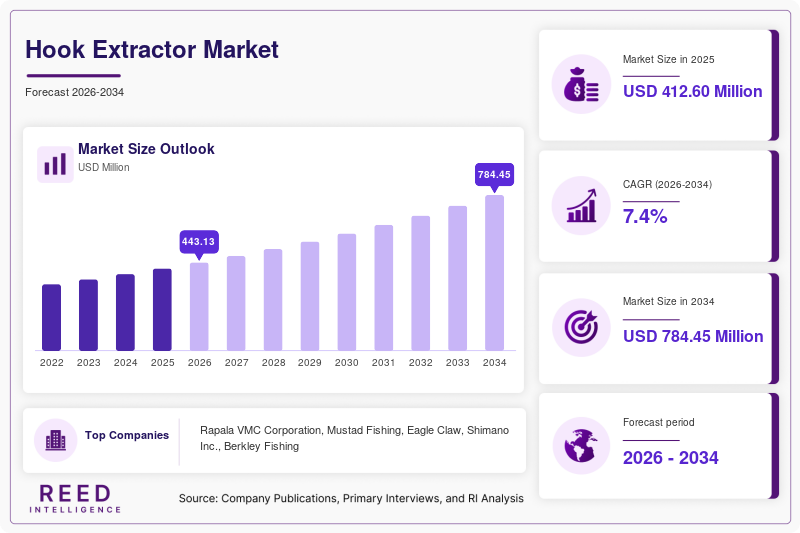
The global Hook Extractor Market size was valued at USD 412.6 million in 2026 and is projected to reach USD 731.4 million by 2034, expanding at a CAGR of 7.4% during the forecast period from 2026 to 2034. The market is experiencing stable expansion due to the increasing participation in recreational fishing, commercial angling activities, and marine tourism across developed and emerging economies. Hook extractors are widely used for safe fish handling and hook removal, particularly in sport fishing, catch-and-release practices, and commercial fisheries where minimizing fish injury has become increasingly important. Rising awareness regarding sustainable fishing methods has also encouraged consumers and fisheries to adopt specialized fish handling tools that improve operational efficiency and reduce fish mortality.
The growing influence of outdoor recreational culture has supported product demand across North America, Europe, and Asia Pacific. Governments and fishing associations in several countries are promoting responsible fishing practices, which has increased the adoption of fish handling accessories including hook extractors, pliers, and dehooking tools. In addition, product manufacturers are introducing lightweight aluminum designs, corrosion-resistant stainless steel variants, and ergonomic grip technologies to improve user comfort and durability in freshwater and saltwater environments. The expansion of e-commerce channels and online fishing equipment marketplaces has further improved product accessibility for individual consumers and small-scale commercial fishing operators.
Key Highlights
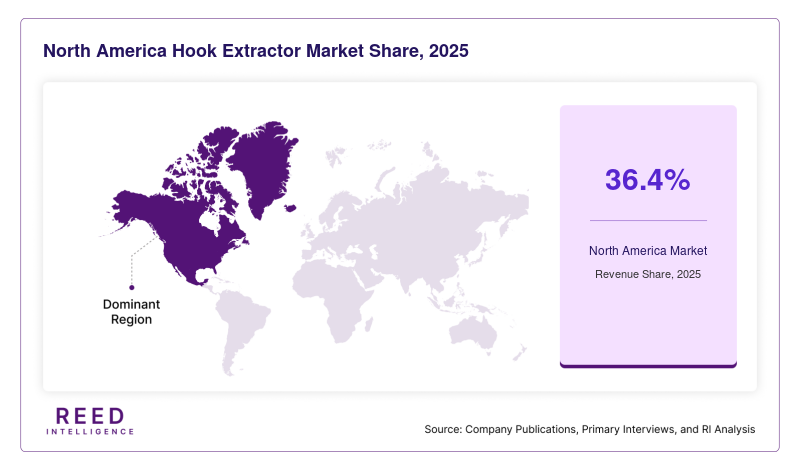
- North America dominated the market with a 36.4% share in 2025, while Asia Pacific is expected to grow at the fastest CAGR of 9.1% during 2026–2034.
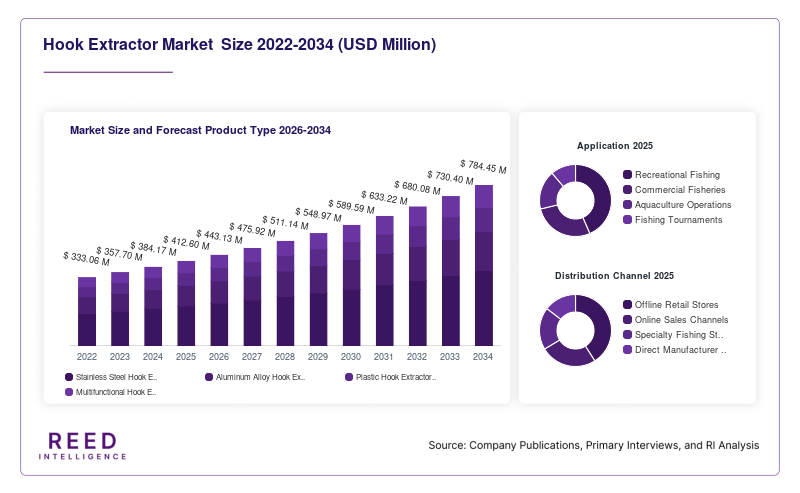
- By product type, stainless steel hook extractors accounted for the largest share of 42.7%, while aluminum alloy hook extractors are projected to grow at a CAGR of 8.8%.
- By application, recreational fishing led with a 48.3% share, whereas commercial fisheries are expected to expand at a CAGR of 8.5%.
- By distribution channel, offline retail stores held the dominant share of 61.5%, while online sales channels are anticipated to grow at a CAGR of 10.2%.
- The United States remained the dominant country, with market values of USD 128 million in 2024 and USD 139 million in 2025.
Market Trends
Integration of Ergonomic and Corrosion-Resistant Materials
Manufacturers in the Hook Extractor Market are increasingly focusing on ergonomic product development and advanced corrosion-resistant materials to improve durability and user comfort. Fishing activities in saltwater environments expose equipment to harsh conditions that accelerate rust formation and material degradation. As a result, demand for stainless steel and titanium-coated hook extractors has increased among recreational anglers and commercial fishing operators. Companies are integrating non-slip rubber handles, lightweight aluminum frames, and compact locking systems to improve handling efficiency during prolonged fishing activities. These design enhancements reduce hand fatigue and improve operational safety while handling aggressive fish species.
The trend is particularly visible in premium product categories where consumers are willing to pay higher prices for multifunctional tools that combine hook extraction, cutting, and gripping capabilities. Product customization options, including interchangeable heads and retractable designs, are also gaining attention in developed markets. Manufacturers are leveraging this trend to differentiate products in a competitive fishing accessories industry while supporting higher profit margins through value-added innovations.
Expansion of Online Fishing Equipment Retail Platforms
The rapid expansion of e-commerce platforms dedicated to outdoor sports and fishing equipment is influencing purchasing behavior in the Hook Extractor Market. Consumers increasingly prefer online channels because they provide product comparisons, customer reviews, wider inventory availability, and direct discounts from manufacturers. Digital retail platforms are enabling small and medium-sized fishing equipment brands to reach international customers without depending heavily on traditional retail distribution networks. This shift is particularly beneficial in emerging economies where organized offline fishing equipment stores remain limited.
Online marketplaces are also supporting the introduction of niche hook extractor products designed for specific fish species and fishing techniques. Manufacturers are investing in digital marketing campaigns, tutorial videos, and influencer collaborations with professional anglers to improve product visibility. Subscription-based outdoor equipment platforms and seasonal fishing gear bundles are further driving online sales growth. The convenience of doorstep delivery and access to global product catalogs continue to strengthen the role of e-commerce in expanding market penetration.
Market Drivers
Rising Participation in Recreational Fishing Activities
The increasing popularity of recreational fishing across coastal and inland regions is a major factor supporting the growth of the Hook Extractor Market. Recreational fishing has become a widely preferred outdoor activity among families, sports enthusiasts, and tourists seeking leisure experiences connected with nature. Growing disposable income levels and increased spending on outdoor recreation equipment are encouraging consumers to purchase specialized fishing accessories that improve convenience and fish handling safety. Fishing tournaments and charter fishing services are also contributing to the rising demand for professional-grade hook extraction tools.
Several countries are promoting recreational fishing tourism through lake management programs, coastal tourism initiatives, and fishing license reforms. These developments are increasing the number of amateur anglers who require easy-to-use hook extractors for catch-and-release activities. Product manufacturers are introducing beginner-friendly models with simplified operating mechanisms and affordable pricing to attract first-time buyers. The expanding recreational fishing community is therefore creating a stable customer base for fishing accessory manufacturers worldwide.
Growing Focus on Sustainable and Humane Fishing Practices
The increasing emphasis on sustainable fishing methods and fish conservation practices is accelerating demand for efficient hook extraction tools. Environmental organizations and fisheries management authorities are encouraging anglers to minimize fish injuries during catch-and-release activities to preserve aquatic biodiversity. Hook extractors help remove hooks quickly and safely, reducing stress and physical damage to fish populations. This functionality is particularly important in regulated fishing zones where conservation standards are strictly monitored.
Commercial fisheries are also adopting improved fish handling equipment to comply with sustainability certifications and responsible fishing regulations. The growing awareness of marine ecosystem preservation among consumers is influencing product purchasing decisions, particularly in North America and Europe. Educational campaigns by fishing associations and marine conservation groups are promoting the use of specialized hook removal tools instead of manual extraction methods. These initiatives are supporting the adoption of advanced hook extractor products across both recreational and commercial fishing sectors.
Market Restraint
Limited Product Awareness in Developing Fishing Markets
Limited awareness regarding specialized fish handling tools remains a key restraint affecting the growth of the Hook Extractor Market in several developing regions. Many small-scale anglers in parts of Asia, Africa, and Latin America continue to rely on traditional manual hook removal techniques because of low product familiarity and restricted access to organized fishing equipment retailers. Price sensitivity among consumers in these markets also limits the adoption of premium stainless steel and multifunctional hook extractor products.
The lack of educational programs related to sustainable fish handling practices further slows product penetration in rural fishing communities. In some countries, recreational fishing remains underdeveloped compared to commercial fishing activities, which reduces demand for advanced fishing accessories. Counterfeit and low-quality products available through unorganized retail channels also create challenges for established manufacturers attempting to build consumer trust. These low-cost alternatives often fail to provide durability and safety benefits, negatively influencing customer perceptions regarding specialized hook extractor tools.
In addition, inconsistent import regulations and fluctuating raw material costs affect pricing structures for international brands operating in emerging markets. Smaller manufacturers may struggle to maintain competitive pricing while investing in quality improvements and product innovation. These factors collectively restrain market expansion in regions where awareness and purchasing power remain comparatively low.
Market Opportunities
Growth Potential in Commercial Aquaculture Operations
The expansion of commercial aquaculture and fish farming activities is creating new opportunities for the Hook Extractor Market. Aquaculture operators increasingly require specialized fish handling equipment to improve operational efficiency and reduce fish injury during harvesting and sorting processes. Hook extractors designed for large-scale operations are gaining demand because they support faster hook removal and improve worker productivity. Growing global seafood consumption and increasing investments in fish farming infrastructure are expected to strengthen demand for professional fish handling tools over the forecast period.
Manufacturers are developing heavy-duty hook extractors suitable for larger fish species commonly cultivated in commercial aquaculture systems. Corrosion-resistant coatings and antimicrobial handle materials are becoming important product features in high-volume fish farming environments. In addition, regulatory pressure related to fish welfare standards is encouraging aquaculture operators to adopt improved handling practices. These developments create favorable conditions for equipment suppliers targeting industrial-scale fisheries and aquaculture enterprises.
Increasing Demand for Smart and Multifunctional Fishing Tools
The growing consumer preference for multifunctional outdoor equipment presents a significant opportunity for hook extractor manufacturers. Anglers increasingly seek compact fishing tools that combine several functions, including hook extraction, line cutting, fish gripping, and measuring capabilities. This trend is encouraging manufacturers to introduce integrated fishing accessory systems that improve convenience while reducing the need to carry multiple tools during fishing trips.
Smart fishing technologies are also influencing product development strategies. Some manufacturers are exploring digital measurement integrations, floating tool designs, and modular attachment systems that improve usability in professional fishing environments. Premium product demand is particularly strong among experienced anglers who prioritize durability and operational efficiency. The increasing popularity of sport fishing content on social media platforms is further encouraging consumers to purchase innovative fishing accessories. Companies investing in research and ergonomic product design are expected to gain competitive advantages as consumer preferences continue evolving toward advanced multifunctional tools.
Segmental Analysis
By Product Type
Stainless steel hook extractors accounted for the largest market share in 2024, representing 42.7% of total industry revenue. These products remain widely preferred because of their high durability, corrosion resistance, and suitability for both freshwater and saltwater fishing environments. Professional anglers and commercial fisheries favor stainless steel variants due to their long operational life and reduced maintenance requirements. Manufacturers are increasingly incorporating ergonomic grip designs and rust-resistant coatings to improve product functionality and user comfort. The segment also benefits from rising demand for heavy-duty fishing tools capable of handling large fish species during offshore and tournament fishing activities.
Aluminum alloy hook extractors are expected to grow at the fastest CAGR of 8.8% during the forecast period. The segment is gaining momentum because lightweight products are becoming increasingly popular among recreational anglers seeking portability and ease of use. Aluminum variants offer a balance between durability and affordability, making them attractive for beginner and intermediate fishing consumers. Manufacturers are introducing anodized aluminum coatings to improve corrosion resistance and enhance product appearance. The expansion of online fishing accessory sales is also increasing visibility for aluminum-based products, particularly among younger consumers who prefer compact and multifunctional fishing tools.
By Application
Recreational fishing represented the dominant application segment in 2024, accounting for 48.3% of the Hook Extractor Market. The segment’s leadership is supported by rising participation in leisure fishing activities across North America, Europe, and Asia Pacific. Consumers increasingly purchase hook extractors as part of broader fishing equipment kits used for freshwater angling, coastal fishing, and sport fishing tournaments. Growing interest in catch-and-release practices has also encouraged anglers to adopt specialized fish handling tools that minimize fish injuries and improve handling efficiency. Product manufacturers are responding by introducing colorful, compact, and user-friendly designs aimed at casual fishing enthusiasts.
Commercial fisheries are projected to expand at the fastest CAGR of 8.5% over the forecast period due to increasing focus on operational efficiency and fish welfare standards. Commercial fishing operators require durable hook extraction equipment capable of supporting high-volume fish handling processes. The adoption of mechanized fishing systems and professional fish handling protocols is driving demand for industrial-grade hook extractors. Fisheries are increasingly investing in corrosion-resistant and easy-to-clean equipment to improve hygiene standards and reduce maintenance costs. In addition, the expansion of global seafood trade and aquaculture production is expected to create sustained demand for professional fish handling tools within commercial operations.
By Distribution Channel
Offline retail stores held the dominant share of the Hook Extractor Market in 2024, contributing 61.5% of total revenue. Sporting goods stores, fishing specialty retailers, and outdoor equipment chains remain important sales channels because consumers often prefer physically evaluating fishing tools before purchasing. Retail staff recommendations and in-store product demonstrations continue to influence purchasing decisions among first-time buyers and professional anglers. Established retail networks also enable manufacturers to build brand recognition and customer trust through direct product visibility. Seasonal fishing promotions and regional outdoor sporting events further support sales through offline retail channels.
Online sales channels are anticipated to register the fastest CAGR of 10.2% during the forecast period. E-commerce platforms are transforming the purchasing landscape by providing consumers with broader product selections, competitive pricing, and detailed customer reviews. Online channels are particularly attractive to younger consumers who prefer digital shopping experiences and direct access to international fishing equipment brands. Manufacturers are increasingly investing in social media marketing, digital product tutorials, and influencer partnerships to strengthen online visibility. Subscription-based fishing gear packages and fast delivery services are also encouraging consumers to purchase hook extractors through online marketplaces.
Regional Analysis
North America
North America accounted for the largest share of the Hook Extractor Market in 2025, representing 36.4% of global revenue. The region is projected to expand at a CAGR of 6.8% during the forecast period due to strong participation in recreational fishing and well-established outdoor sports industries. The United States and Canada maintain high consumer spending on fishing equipment, including specialized fish handling accessories. Growing awareness regarding catch-and-release fishing practices and sustainable marine conservation policies has strengthened product demand among professional anglers and hobbyists.
The United States remained the dominant country in the North American market due to its extensive recreational fishing community and advanced retail distribution networks. The country benefits from a large number of freshwater lakes, coastal fishing destinations, and organized fishing tournaments that generate continuous demand for hook extractors. Manufacturers are increasingly collaborating with sporting goods retailers and e-commerce platforms to expand product accessibility. Rising interest in marine tourism and guided fishing experiences is also supporting long-term regional market growth.
Europe
Europe held a substantial share of the Hook Extractor Market in 2025 and is expected to register a CAGR of 6.5% through 2034. The region benefits from strict environmental regulations promoting responsible fishing practices and fish conservation initiatives. Countries including Germany, France, and the United Kingdom have established recreational fishing sectors supported by organized fishing clubs and government licensing systems. Demand for durable stainless steel and corrosion-resistant hook extractors is increasing among freshwater and saltwater anglers throughout the region.
Germany dominated the European market due to strong consumer preference for premium outdoor sports equipment and sustainable fishing accessories. The country has witnessed increasing participation in leisure fishing activities among younger consumers seeking outdoor recreation experiences. Product manufacturers operating in Europe are focusing on environmentally friendly packaging materials and recyclable components to align with sustainability regulations. In addition, the presence of specialized fishing exhibitions and trade fairs supports product visibility and encourages innovation within the regional market.
Asia Pacific
Asia Pacific is expected to emerge as the fastest-growing regional market, expanding at a CAGR of 9.1% during the forecast period. The region accounted for a considerable share of global revenue in 2025 due to rising fishing participation rates and expanding marine tourism activities. Countries such as China, Japan, Australia, and India are witnessing increasing demand for recreational fishing equipment as disposable income levels continue rising. Rapid urbanization and the growing popularity of outdoor leisure activities are further contributing to regional market expansion.
China remained the dominant country in the Asia Pacific market because of its extensive fishing industry and growing domestic manufacturing capabilities. The country benefits from a large consumer base and increasing exports of fishing accessories to international markets. Government initiatives supporting coastal tourism and aquaculture development are also strengthening demand for fish handling equipment. In addition, digital retail platforms in China are enabling manufacturers to reach broader customer segments through direct online sales and promotional campaigns.
Middle East & Africa
The Middle East & Africa region represented a developing market for hook extractors in 2025 and is forecast to grow at a CAGR of 5.9% during the assessment period. Market expansion is supported by increasing marine tourism activities, particularly in coastal economies with growing recreational fishing industries. Countries across the Gulf region are investing in tourism infrastructure and water-based leisure activities, creating opportunities for fishing equipment suppliers. Demand for saltwater-resistant hook extractors is increasing due to the region’s harsh marine conditions.
South Africa dominated the regional market because of its established recreational fishing culture and extensive coastline supporting sport fishing activities. The country has experienced rising participation in competitive fishing tournaments and eco-tourism programs linked with marine conservation efforts. Fishing equipment retailers are expanding their product portfolios to include advanced fish handling tools designed for offshore fishing environments. The increasing popularity of guided fishing excursions among international tourists is also contributing to market growth across the region.
Latin America
Latin America accounted for a moderate share of the Hook Extractor Market in 2025 and is expected to register a CAGR of 6.2% through 2034. The region benefits from abundant freshwater and coastal fishing resources that support recreational and commercial fishing activities. Countries such as Brazil, Mexico, and Argentina are witnessing growing interest in outdoor recreational sports, including sport fishing and eco-tourism experiences. Rising urban middle-class populations are also increasing consumer spending on fishing accessories and outdoor equipment.
Brazil emerged as the dominant country within the Latin American market due to its extensive river systems and expanding recreational tourism sector. The country’s growing participation in freshwater fishing tournaments and guided fishing tours has increased demand for professional fish handling tools. Manufacturers are focusing on affordable product variants tailored to regional consumer preferences and price-sensitive markets. In addition, the expansion of regional e-commerce platforms is improving access to imported fishing accessories across urban and semi-urban locations.
Competitive Landscape
The Hook Extractor Market is moderately fragmented, with a combination of international fishing equipment manufacturers and regional outdoor accessory suppliers competing across recreational and commercial fishing segments. Companies are focusing on ergonomic product designs, corrosion-resistant materials, and multifunctional tool integration to strengthen their competitive positioning. Product innovation, strategic partnerships with sporting goods retailers, and expansion into online distribution channels remain key competitive strategies adopted by market participants.
Rapala VMC Corporation maintained a leading position in the market due to its broad fishing accessory portfolio and established global distribution network. The company has continued investing in lightweight stainless steel hook extractor designs tailored for professional anglers and tournament fishing applications. In 2025, the company introduced a new premium fish handling tool series featuring anti-slip grips and saltwater-resistant coatings to improve durability in marine environments.
Key Players
- Rapala VMC Corporation
- Mustad Fishing
- Eagle Claw
- Shimano Inc.
- Berkley Fishing
- Bubba Fishing
- Booms Fishing
- Piscifun
- South Bend Fishing Equipment
- KastKing
- Frabill Inc.
- Okuma Fishing Tackle
- Cuda Fishing Tools
- Gerber Gear
- Tackle Factory
Recent Developments
- In March 2026, Rapala VMC Corporation launched a new corrosion-resistant hook extractor series designed specifically for offshore saltwater fishing applications.
- In November 2025, Shimano Inc. expanded its fishing accessory manufacturing operations in Southeast Asia to strengthen regional distribution capabilities and reduce supply chain lead times.
- In August 2025, Mustad Fishing introduced multifunctional hook extractor tools featuring integrated line cutters and ergonomic anti-slip grip technology for recreational anglers.
- In January 2026, Berkley Fishing partnered with online outdoor retail platforms to expand direct-to-consumer sales of premium fish handling accessories across North America and Europe.
- In June 2025, Bubba Fishing released lightweight aluminum alloy hook extractors developed for freshwater tournament fishing applications and competitive angling events.
Hook Extractor Market Segments
Product Type
- Stainless Steel Hook Extractors
- Aluminum Alloy Hook Extractors
- Plastic Hook Extractors
- Multifunctional Hook Extractors
Application
- Recreational Fishing
- Commercial Fisheries
- Aquaculture Operations
- Fishing Tournaments
Distribution Channel
- Offline Retail Stores
- Online Sales Channels
- Specialty Fishing Stores
- Direct Manufacturer Sales
By Region
- North America
- Europe
- APAC
- Middle East and Africa
- LATAM