Hook Lifts And Skip Loader Market Size, Share, Demand Report By Equipment Type (Hook Lift Systems, Skip Loaders), By Application (Municipal Waste Management, Construction & Demolition Waste, Industrial Waste Handling), By End-Use (Municipal Authorities, Private Waste Operators, Construction Companies) By Region & Segment Forecasts, 2026–2034
USD 3950
Market Overview
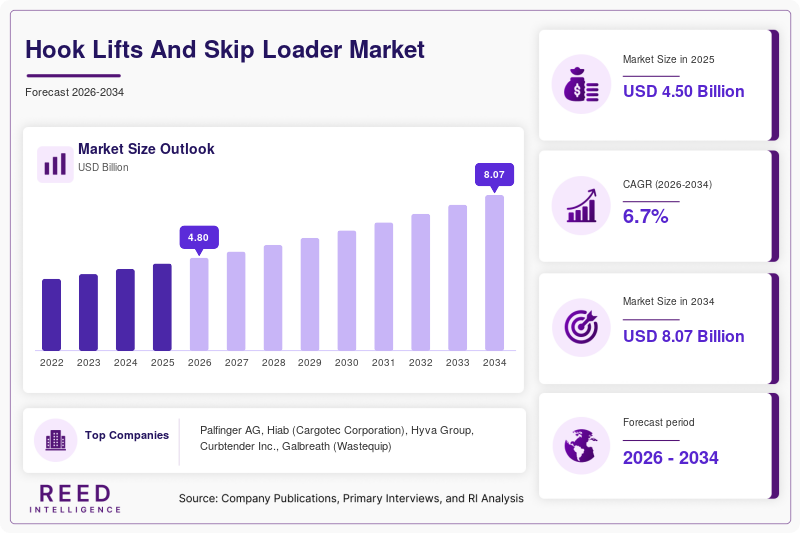
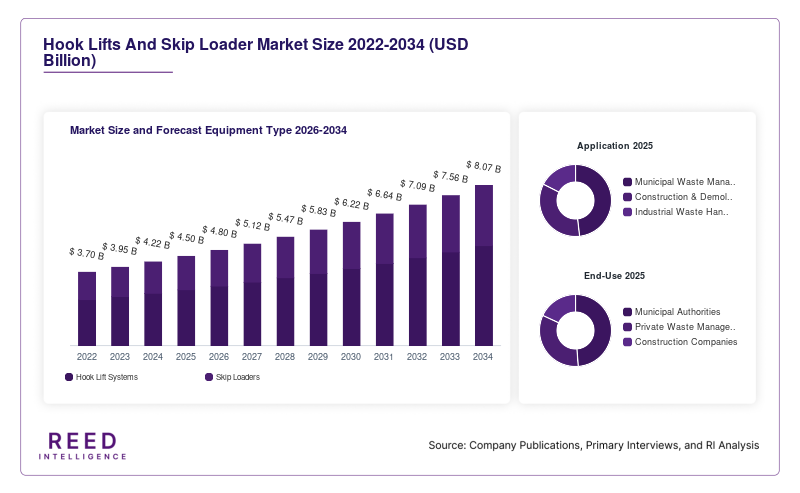
The Hook Lifts And Skip Loader Market size is projected to reach approximately USD 4.8 billion in 2026 and is anticipated to attain nearly USD 8.1 billion by 2034, registering a compound annual growth rate (CAGR) of 6.7% during the forecast period (2026–2034). Growth in the market is primarily supported by rising demand for efficient waste collection systems, increasing municipal solid waste generation, and the expansion of construction and demolition activities across urban regions. Hook lift systems and skip loaders are gaining importance due to their operational flexibility, ability to handle multiple container sizes, and suitability for both municipal and industrial applications.
One global factor significantly supporting market expansion is the rapid urbanization trend, particularly in emerging economies. As cities expand, waste volumes increase, requiring more efficient logistics and collection systems. Municipal authorities and private waste management companies are increasingly investing in modular truck-mounted lifting systems that improve turnaround time and reduce operational costs. Additionally, environmental regulations promoting structured waste handling systems are further accelerating adoption
Key Highlights
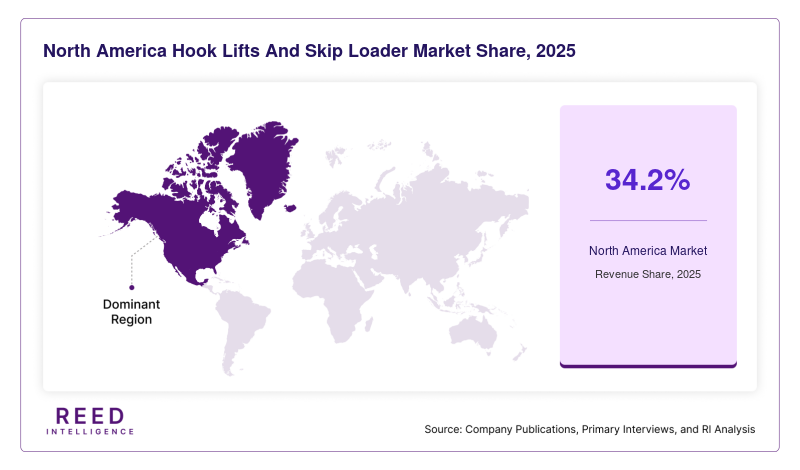
- North America dominated the Hook Lifts And Skip Loader Market with a 34.2% share in 2025.
- while Asia Pacific is expected to grow at the fastest CAGR of 11.2% during 2026–2034.
- By equipment type, hook lift systems accounted for the largest share of 57.4%.
- while skip loaders are projected to grow at a CAGR of 7.9%.
- By application, municipal waste management led with a 46.3% share, whereas construction & demolition waste handling is expected to expand at a CAGR of 8.4%.
- The United States remained the dominant country, with market values of USD 1.42 billion in 2024 and USD 1.55 billion in 2025.
Market Trends
A notable trend in the Hook Lifts And Skip Loader Market is the increasing integration of telematics and fleet management software in waste handling vehicles. Operators are adopting digital monitoring systems that track load cycles, fuel consumption, container location, and route optimization. This integration improves operational efficiency and reduces downtime, especially for municipal and large-scale private waste management operators. Additionally, smart sensors installed in hook lift systems enhance safety by preventing overload and ensuring proper container locking mechanisms. The shift toward connected fleet ecosystems is expected to redefine operational standards across waste logistics networks globally.
Another emerging trend is the growing preference for lightweight yet high-strength materials in equipment manufacturing. Manufacturers are increasingly utilizing advanced high-tensile steel and aluminum alloys to reduce vehicle weight while maintaining load-bearing capacity. This trend improves fuel efficiency and enables higher payloads, which is particularly beneficial in long-distance waste transport operations. Furthermore, modular design innovations are enabling easier maintenance and faster container swapping, making hook lifts and skip loaders more adaptable for multi-industry applications, including construction, mining, and municipal services.
Market Drivers
One of the key drivers of the Hook Lifts And Skip Loader Market is the rapid increase in global waste generation driven by urban population growth and industrial expansion. Municipal bodies are under pressure to manage rising volumes of solid waste efficiently, leading to higher adoption of mechanized lifting systems. Hook lifts and skip loaders offer a cost-effective solution by enabling quick container exchange, reducing labor dependency, and improving route efficiency. This is particularly significant in densely populated urban areas where waste collection time windows are limited and operational efficiency is critical.
Another major driver is the expansion of construction and infrastructure development activities across both developed and developing economies. Large-scale construction projects generate significant volumes of debris that require efficient collection and transport systems. Hook lift trucks are widely used due to their ability to handle multiple skip sizes and heavy loads with minimal downtime. Government investments in smart city projects, road infrastructure, and industrial zones further enhance demand for flexible waste handling equipment, thereby strengthening market growth.
Market Restraint
A key restraint affecting the Hook Lifts And Skip Loader Market is the high initial investment and maintenance cost associated with advanced lifting systems. Hook lift trucks and skip loaders require specialized hydraulic systems, reinforced chassis, and durable container mechanisms, which increase overall procurement costs. Small and medium-sized waste management operators often face budget constraints that limit adoption. Additionally, maintenance requires skilled technicians, and any hydraulic failure can result in operational downtime and increased repair expenses. In price-sensitive markets, this becomes a significant barrier to widespread adoption, particularly in developing economies where municipal budgets are limited.
Market Opportunities
One significant opportunity in the Hook Lifts And Skip Loader Market is the growing adoption of electric and hybrid waste collection vehicles. Governments across several regions are introducing emission reduction policies, encouraging the transition from diesel-powered fleets to cleaner alternatives. This shift creates opportunities for manufacturers to integrate hook lift and skip loader systems with electric chassis platforms. Electric-powered systems also offer lower operating costs and reduced noise levels, making them suitable for urban waste collection. As charging infrastructure expands, adoption of eco-friendly lifting vehicles is expected to increase steadily.
Another major opportunity lies in the expansion of rental and leasing models for waste handling equipment. Many municipal bodies and private contractors prefer leasing hook lift trucks instead of outright purchase due to lower upfront costs and operational flexibility. Equipment leasing companies are increasingly expanding their portfolios with modular lifting systems, offering maintenance-inclusive contracts. This model improves accessibility for smaller operators and supports market penetration in developing regions where capital investment constraints are high.
Segmental Analysis
By Equipment Type
Hook lift systems accounted for approximately 57.4% share in 2024, driven by their versatility and ability to handle multiple container types efficiently. Their widespread adoption in municipal waste collection and construction waste handling makes them a preferred choice across developed markets. Their compatibility with different truck chassis further strengthens their market position.
Skip loaders are projected to grow at a CAGR of 7.9%, supported by their cost-effectiveness and suitability for smaller-scale waste collection operations. Increasing adoption in developing regions and construction sites is driving demand, particularly where flexible and compact waste handling solutions are required.
By Application
Municipal waste management held around 46.3% share in 2024, driven by rising urban waste generation and government investments in sanitation infrastructure. Hook lifts and skip loaders are widely deployed in city waste collection systems due to operational efficiency.
Construction & demolition waste handling is expected to grow at a CAGR of 8.4%, supported by global infrastructure development activities. Increasing construction projects generate high volumes of debris requiring efficient transport systems.
By End-Use
Municipal authorities accounted for 49.1% share in 2024, driven by structured waste collection programs and public infrastructure management systems. Their large-scale procurement of waste handling vehicles supports steady demand.
Private waste management companies are projected to grow at a CAGR of 8.1%, driven by outsourcing trends and increasing participation in municipal contracts.
Regional Analysis
North America
North America accounted for approximately 34.2% share of the Hook Lifts And Skip Loader Market in 2025, and is expected to grow at a CAGR of around 6.1% from 2026 to 2034. The region’s growth is supported by well-established waste management infrastructure and strong regulatory frameworks promoting efficient waste segregation and recycling practices. High adoption of mechanized waste handling systems in both municipal and industrial sectors further supports market stability across the region.
The United States remains the most dominant country in the region due to its extensive municipal waste collection networks and high construction activity. A key growth factor is the modernization of urban waste logistics systems, where cities are investing in smart fleet management solutions and automated lifting technologies to improve efficiency and reduce operational costs.
Europe
Europe held around 27.5% market share in 2025, with a projected CAGR of 5.8% through 2034. The region benefits from strict environmental regulations and strong emphasis on circular economy practices. Countries across Europe are actively adopting advanced waste collection systems to meet recycling and landfill reduction targets, supporting steady demand for hook lift and skip loader systems.
Germany leads the regional market due to its advanced waste processing infrastructure and strong engineering capabilities. A key growth driver is the increasing integration of low-emission and electric waste collection vehicles supported by government sustainability initiatives.
Asia Pacific
Asia Pacific accounted for 22.3% market share in 2025 and is projected to grow at the fastest CAGR of 11.2% during 2026–2034. Rapid urbanization, industrial expansion, and infrastructure development are key contributors to market growth. Rising municipal solid waste generation across densely populated countries is driving demand for efficient collection systems.
China dominates the region due to large-scale urban development and strong investments in smart city infrastructure. A key growth factor is government-led waste management modernization programs aimed at improving urban cleanliness and operational efficiency.
Middle East & Africa
Middle East & Africa held a 9.1% market share in 2025, with a CAGR of 6.9% expected through 2034. The region is witnessing increasing adoption of structured waste management systems due to urban expansion and tourism-driven infrastructure development. Demand for mechanized waste handling equipment is gradually rising in metropolitan areas.
The United Arab Emirates leads the region due to its advanced urban infrastructure and smart city initiatives. A key growth factor is the development of large-scale construction and commercial projects requiring efficient waste handling solutions.
Latin America
Latin America accounted for 6.9% share in 2025, with a projected CAGR of 6.4% through 2034. Growth is driven by improving municipal waste management systems and increasing investment in urban infrastructure. Countries in the region are gradually shifting toward mechanized waste handling solutions to improve operational efficiency.
Brazil dominates the regional market due to its large urban population and expanding construction sector. A key growth factor is the modernization of municipal waste collection systems in major metropolitan cities.
Competitive Landscape
The Hook Lifts And Skip Loader Market is moderately consolidated, with several global and regional manufacturers competing based on product durability, hydraulic efficiency, and service networks. Key companies include Palfinger AG, Hiab (Cargotec Corporation), Curbtender Inc., Galbreath (Wastequip), and Hyva Group. These players focus on technological improvements such as lightweight systems, enhanced safety features, and integration with telematics platforms. Palfinger AG holds a strong position due to its broad product portfolio and global distribution network. A recent development includes expansion of modular hook lift systems designed for electric truck compatibility and improved load optimization.
Key Players List
- Palfinger AG
- Hiab (Cargotec Corporation)
- Hyva Group
- Curbtender Inc.
- Galbreath (Wastequip)
- Ampliroll (Palfinger France)
- Geesinknorba
- AJK NV
- Transcover Systems
- Meiller Group
- VDL Container Systems
- Heil Environmental
- Labrie Environmental Group
- Skipline Systems
- AMS Skip Loaders
Recent Developments
- Manufacturers have introduced electric-compatible hook lift systems designed for integration with battery-powered truck platforms, improving sustainability performance.
- Several companies have expanded production facilities in Asia Pacific to meet rising demand from urban infrastructure and waste management projects.
- Telematics-enabled skip loader systems have been launched, offering real-time monitoring of load cycles and route optimization for fleet operators.
Hook Lifts And Skip Loader Market Segments
Equipment Type
- Hook Lift Systems
- Skip Loaders
Application
- Municipal Waste Management
- Construction & Demolition Waste Handling
- Industrial Waste Handling
End-Use
- Municipal Authorities
- Private Waste Management Operators
- Construction Companies
By Region
- North America
- Europe
- APAC
- Middle East and Africa
- LATAM