Horizontal Grinder Market Size, Share & Trends Analysis Report By Grinder Type (Towable Horizontal Grinders, Tracked Horizontal Grinders), By Application (Forestry & Land Clearing, Biomass Processing, Construction & Demolition Waste Recycling), By End Use (Mulch & Compost Production, Biomass Fuel & Energy, Land Clearing & Storm Debris), By Power Source (Diesel, Electric), and By Region (North America, Europe, APAC, Middle East and Africa, LATAM) Forecasts, 2026-2034
USD 3950
Horizontal Grinder Market Size
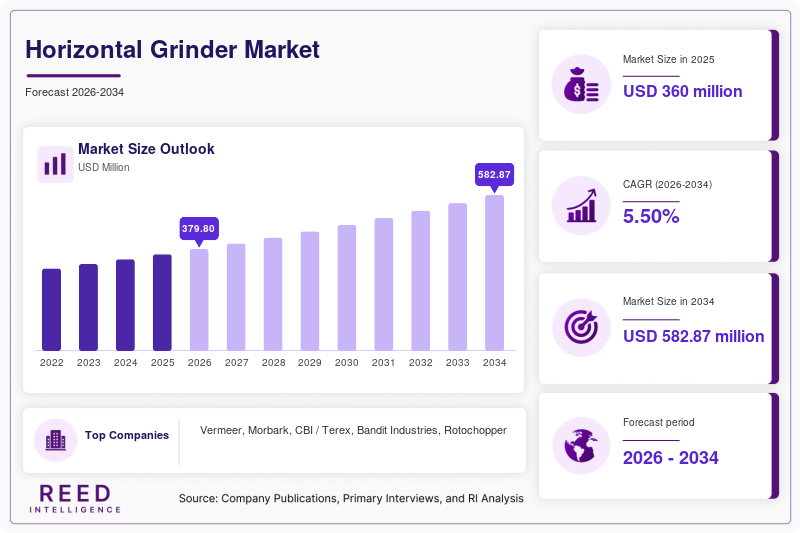
The Horizontal Grinder Market was valued at USD 360 million in 2025 and is estimated at USD 379.80 million in 2026. Based on the supplied forecast, the market is projected to reach USD 582.87 million by 2034.
The supplied forecast specifies a 5.50% CAGR for 2026–2034. However, the supplied 2025 value of USD 360 million and 2034 value of USD 582.87 million mathematically imply an approximately 4.82% CAGR over the nine-year period. This report preserves all user-supplied market figures and uses the stated 5.50% CAGR where explicitly referenced; segment and regional allocations are modeled separately to remain directionally consistent with the supplied 2034 market value.
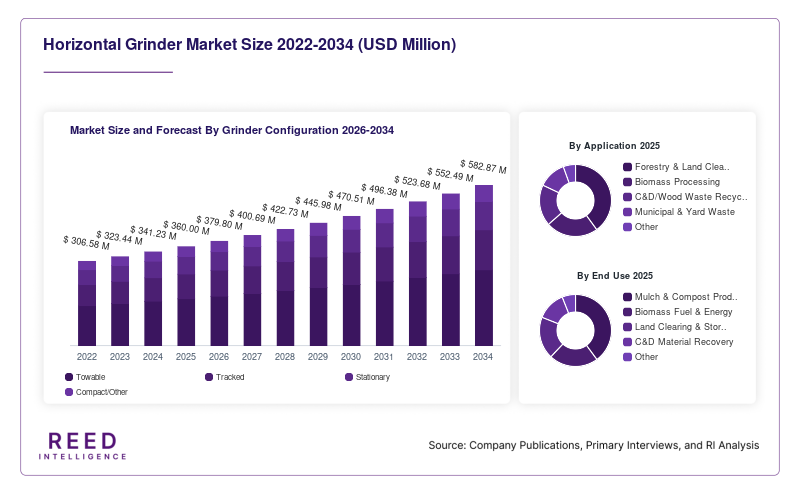
Using the supplied 5.50% rate for historical back-calculation gives indicative market values of approximately USD 341.24 million in 2024, USD 323.45 million in 2023, and USD 306.11 million in 2022. These are analytical back-calculations, not independently reported historical market sizes.
Horizontal grinders occupy an important position in the wood-waste, forestry-residue, land-clearing, municipal organics and biomass-processing equipment chain. The equipment converts bulky woody feedstock into more manageable and commercially usable material such as mulch, biomass fuel, compost feedstock and recovered wood products.
Demand is increasingly connected to the economics of material recovery. U.S. EPA guidance identifies clean wood, forest residues, tree trimmings, stumps and clean construction wood as relevant biomass streams, while European policy increasingly emphasizes higher-quality recovery of construction and demolition materials.
Horizontal grinders are high-throughput material-processing machines designed to reduce wood, green waste, forestry residues, construction wood and other woody feedstocks into controlled particle sizes.
Horizontal Grinder Market Drivers
Expansion of Wood-Waste and Biomass Recovery
The largest structural demand mechanism is the increasing need to convert woody residuals into usable products rather than simply dispose of them.
Horizontal grinders can process tree trimmings, storm debris, forestry residues, pallets, clean construction wood and other woody material into mulch, biomass fuel and other products. This creates an economic pathway between waste generation and secondary-material markets.
The U.S. EPA's material-specific data shows the scale of relevant feedstock streams: its published data estimated 35.4 million tons of yard trimmings were generated in the U.S. in 2018, while 22.3 million tons were composted or used as wood waste mulch. Although the data is not a current market forecast, it demonstrates the large material base that supports grinding equipment demand.
Growth in Land Clearing and Storm-Debris Processing
Land development, utility work, infrastructure projects and severe weather events generate large volumes of branches, trunks, stumps and woody debris.
Horizontal grinders are particularly valuable when material must be processed close to the generation site because transportation of unprocessed woody debris can be inefficient.
Tracked grinders strengthen this use case by allowing operators to position equipment directly on difficult terrain, while towable grinders provide mobility between multiple processing locations.
Rising Value of Forest Residues
Forest residues are increasingly being evaluated as a resource rather than solely as a disposal problem.
Recent U.S. Forest Service research identifies multiple potential uses for forest residues, including electricity, briquettes, sustainable aviation fuel, particleboard, biochar and mulch. Grinding and preprocessing are necessary steps for many of these pathways.
The commercial mechanism is straightforward: better preprocessing can convert low-value heterogeneous biomass into feedstock with more consistent physical characteristics, increasing the number of potential downstream buyers.
Horizontal Grinder Market Restraints
High Initial Capital Cost
Horizontal grinders are capital-intensive machines, particularly high-capacity tracked and towable systems.
Large models can use engines exceeding 1,000 horsepower and require substantial transport, service and wear-part infrastructure. This makes financing availability and expected annual utilization important purchasing considerations.
Smaller contractors may therefore prefer compact machines, used equipment or rental arrangements rather than purchasing the largest available configuration.
Fuel and Operating Costs
Diesel-powered grinders consume significant quantities of fuel because grinding is an energy-intensive process.
Operators must therefore consider not only purchase price but fuel consumption per ton or cubic yard processed. Lower throughput, excessive idle time or poorly matched screens and feed systems can weaken unit economics.
Electric grinders can reduce dependence on diesel but require suitable electrical infrastructure and are generally less flexible for mobile applications.
Wear-Part Replacement
Hammers, knives, screens, anvils, cutter bodies and other components experience substantial wear when processing abrasive or contaminated material.
Contaminants such as metal, dirt, stones and construction debris can accelerate wear and create downtime.
The economic consequence is that maintenance capability and parts availability can be almost as important as nominal machine horsepower.
Horizontal Grinder Market Opportunities
Expansion of Biomass Fuel Markets
The use of woody biomass for heat and electricity provides an established downstream application for ground material.
The U.S. Department of Energy's 2025 energy employment reporting identifies woody biomass as a fuel category covering wood and wood waste such as bark, sawdust, wood chips and wood scrap.
As biomass users seek consistent particle size and moisture characteristics, grinders can become an upstream quality-control asset rather than simply a waste-processing machine.
Growth in Biochar and Higher-Value Biomass Products
Forest-residue utilization is expanding beyond conventional fuel markets.
Research from the U.S. Forest Service has examined biochar, particleboard, briquettes, mulch and other forest-residue pathways. This broadens the potential customer base for grinders because preprocessing can support several downstream products.
Electric and Stationary Grinding Systems
Stationary processing facilities represent an attractive opportunity for electric grinders.
Operators processing consistent volumes of wood waste may prefer electric systems when grid capacity is available because the powertrain can reduce onsite diesel consumption and potentially simplify continuous operation.
Segmental Analysis
By Grinder Configuration
Towable horizontal grinders represent approximately 40% of the 2025 market, equivalent to about USD 144.00 million under the internal analytical allocation. The segment is modeled at approximately 4.7% CAGR through 2034, producing an indicative USD 217.71 million by 2034. Towable equipment remains attractive for contractors and processors that move between jobsites and need road-transport flexibility.
Tracked horizontal grinders represent approximately 35% of the 2025 market, equivalent to about USD 126.00 million. The segment is modeled at approximately 5.2% CAGR, reaching around USD 198.84 million by 2034. Tracked configurations benefit from their ability to position themselves on rough terrain and within land-clearing and storm-debris operations.
Stationary horizontal grinders represent approximately 15% of the 2025 market, or about USD 54.00 million. The segment is modeled at approximately 4.3% CAGR, reaching approximately USD 78.88 million by 2034. Stationary equipment is suited to recycling yards, biomass facilities and high-volume sites where mobility is less important than continuous throughput.
By Application
Forestry & Land Clearing represents approximately 35% of the 2025 market, equivalent to about USD 126.00 million. The segment is modeled at approximately 5.0% CAGR, reaching approximately USD 195.47 million by 2034. Demand is supported by clearing activity, forest-residue management, utility work and processing of large woody material at or near the worksite.
Biomass Processing represents approximately 25% of the 2025 market, equivalent to about USD 90.00 million. It is modeled at approximately 5.5% CAGR, reaching around USD 145.72 million by 2034. The higher modeled growth reflects diversification of woody biomass into fuel, biochar, mulch, engineered wood and other products.
C&D/Wood Waste Recycling represents approximately 20% of the 2025 market, equivalent to about USD 72.00 million. The segment is modeled at approximately 5.2% CAGR, reaching approximately USD 113.63 million by 2034. The opportunity depends on effective sorting because clean wood commands more downstream options than mixed contaminated waste.
Municipal & Yard Waste represents approximately 12% of the 2025 market, or about USD 43.20 million, and is modeled at approximately 4.3% CAGR, reaching around USD 63.10 million by 2034. Municipal tree trimming, storm cleanup and yard-waste programs provide relatively recurring feedstock.
By End Use
Mulch & Compost Production represents approximately 32% of the 2025 market, equivalent to about USD 115.20 million. It is modeled at approximately 4.8% CAGR, reaching approximately USD 175.67 million by 2034. Mulch and compost processors benefit from established downstream markets and the ability to convert green waste into saleable landscaping and soil products.
Biomass Fuel & Energy represents approximately 24% of the 2025 market, equivalent to about USD 86.40 million. The segment is modeled at approximately 5.5% CAGR, reaching around USD 139.89 million by 2034. Consistent particle size and preprocessing make grinding relevant to biomass combustion and energy applications.
Land Clearing & Storm Debris represents approximately 20% of the 2025 market, or about USD 72.00 million. It is modeled at approximately 5.0% CAGR, reaching approximately USD 111.70 million by 2034. The segment benefits from infrastructure development, vegetation management and recurring storm-related cleanup.
C&D Material Recovery represents approximately 14% of the 2025 market, equivalent to about USD 50.40 million. The segment is modeled at approximately 5.2% CAGR, reaching approximately USD 79.54 million by 2034. Growth depends on greater separation of recoverable wood from mixed construction waste.
By Power Source
Diesel-powered horizontal grinders represent approximately 85% of the 2025 market, equivalent to about USD 306.00 million. The segment is modeled at approximately 4.5% CAGR, reaching around USD 454.75 million by 2034. Diesel remains dominant because grinders frequently operate at remote land-clearing, forestry and storm-cleanup locations without dependable grid access.
Electric horizontal grinders represent approximately 10% of the 2025 market, equivalent to about USD 36.00 million. The segment is modeled at approximately 7.0% CAGR, reaching approximately USD 66.18 million by 2034. Electric equipment has greater relevance for stationary recycling, biomass and industrial facilities where electrical infrastructure can support continuous processing.
Hybrid/Other power configurations represent approximately 5% of the 2025 market, equivalent to about USD 18.00 million. The segment is modeled at approximately 6.5% CAGR, reaching approximately USD 31.73 million by 2034. This category represents emerging or application-specific powertrain configurations where operators seek lower fuel consumption without fully sacrificing mobility.
Regional Analysis
North America Horizontal Grinder Market
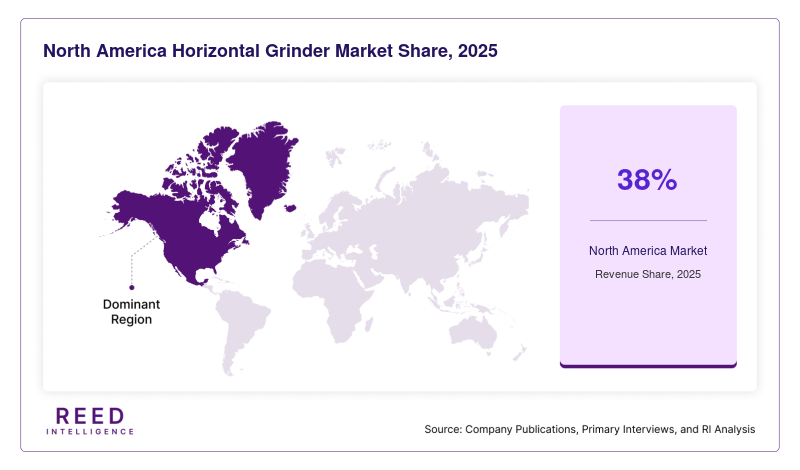
North America represents approximately 38% of the 2025 market, equivalent to about USD 136.80 million under the internal analytical allocation. It is modeled at approximately 4.5% CAGR, reaching around USD 203.30 million by 2034.
The region has a mature equipment base, established municipal green-waste programs, large forestry operations, extensive land-clearing activity and a substantial mulch-production industry.
The U.S. also has a large installed ecosystem of horizontal grinders serving tree services, recycling yards, municipalities, biomass facilities and land-clearing contractors.
Europe Horizontal Grinder Market
Europe represents approximately 22% of the 2025 market, equivalent to about USD 79.20 million. It is modeled at approximately 4.7% CAGR, reaching approximately USD 119.74 million by 2034.
The principal demand mechanism is the transition toward higher-quality resource recovery. EU policy identifies construction and demolition waste as a priority waste stream and emphasizes selective demolition, sorting, reuse and recycling.
European operators also face tighter environmental and operational requirements, which can increase demand for efficient, controllable and lower-emission processing systems.
APAC Horizontal Grinder Market
APAC represents approximately 20% of the 2025 market, equivalent to about USD 72.00 million. It is modeled at approximately 5.8% CAGR, the highest regional rate in this internal allocation, reaching approximately USD 119.59 million by 2034.
Demand is supported by infrastructure construction, urban development, forestry activity, biomass utilization and expansion of organized waste-management systems.
Australia, Japan, China, India and Southeast Asian markets provide different demand pathways, ranging from forestry and biomass processing to municipal waste and construction-related material recovery.
Middle East and Africa Horizontal Grinder Market
Middle East and Africa represent approximately 8% of the 2025 market, equivalent to about USD 28.80 million. The segment is modeled at approximately 5.2% CAGR, reaching approximately USD 45.45 million by 2034.
Demand is concentrated in markets with significant infrastructure development, landscaping activity, municipal waste programs, forestry resources or biomass initiatives.
The primary constraints are equipment financing, service infrastructure, parts availability and the economics of transporting heavy equipment across large operating territories.
LATAM Horizontal Grinder Market
LATAM represents approximately 12% of the 2025 market, equivalent to about USD 43.20 million. It is modeled at approximately 5.0% CAGR, reaching approximately USD 67.02 million by 2034.
Brazil and other forestry-intensive markets provide opportunities for horizontal grinders through wood residues, plantation forestry, biomass processing and land clearing.
The region's long-term potential is also linked to greater commercialization of agricultural and forestry residues, although investment cycles and currency conditions can affect equipment purchasing.
Competitive Landscape
The Horizontal Grinder Market is characterized by specialized equipment manufacturers competing primarily on throughput, power, mobility, feed control, durability, maintenance access, fuel efficiency, automation and dealer support.
The market includes manufacturers with different strategic strengths. Vermeer emphasizes intelligent feeding, remote controls, productivity monitoring and equipment configurations ranging from compact machines to high-capacity tracked grinders.
Morbark competes through the Wood Hog portfolio, including high-capacity equipment with integrated control systems, vibration monitoring and multiple configurations.
CBI, part of Terex, focuses on high-performance grinders for forestry, recycling and biomass applications and continues to develop higher-throughput mobile systems.
Bandit competes with its Beast range and offers cuttermill and hammermill grinding approaches, allowing equipment to be configured for different feedstocks and output requirements.
Key Market Players
- Vermeer
- Morbark
- CBI / Terex
- Bandit Industries
- Rotochopper
- Diamond Z
- HogZilla
Recent Market Developments
January 2026 - CBI Prepares New 5900T Horizontal Grinder for CONEXPO-CON/AGG 2026
In January 2026, CBI announced that it would showcase its next-generation 5900T horizontal grinder at CONEXPO-CON/AGG 2026. The machine combines a 755-horsepower engine, 60-inch infeed rotor, redesigned dolly system and an 8-foot-6-inch legal transport width. CBI also incorporated a Metal Detection System and upgraded discharge components to improve machine protection and uptime.
May 2026 - Rotochopper Expands European Operations and Launches B-66 at IFAT
In May 2026, Rotochopper announced an expansion of its European operations and appointed Michael Lackner as Senior Advisor for European Operations. At IFAT Munich, the company presented the B-66 high-speed horizontal grinder for the European market. The grinder is designed for wood waste, biomass and mixed feedstocks and is available in both diesel and electric configurations.
Horizontal Grinder Market Segments
By Grinder Configuration
- Towable
- Tracked
- Stationary
- Compact/Other
By Application
- Forestry & Land Clearing
- Biomass Processing
- C&D/Wood Waste Recycling
- Municipal & Yard Waste
- Other
By End Use
- Mulch & Compost Production
- Biomass Fuel & Energy
- Land Clearing & Storm Debris
- C&D Material Recovery
- Other
By Power Source
- Diesel
- Electric
- Hybrid/Other
By Region
- North America
- Europe
- APAC
- Middle East and Africa
- LATAM