Horse Bunk Feeder Market Size, Share Demand Report By Material (Metal, Plastic, Composite), By Type (Stationary Bunk Feeders, Portable Bunk Feeders), By Application (Farms, Equestrian Centers, Breeding Facilities), By Distribution Channel (Online Retail, Offline Retail), By Region & Segment Forecasts, 2026–2034
USD 3950
Market Overview
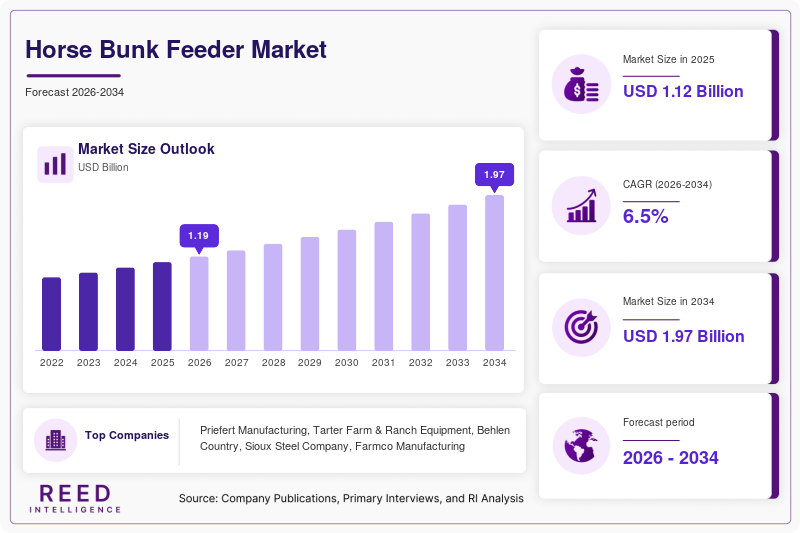
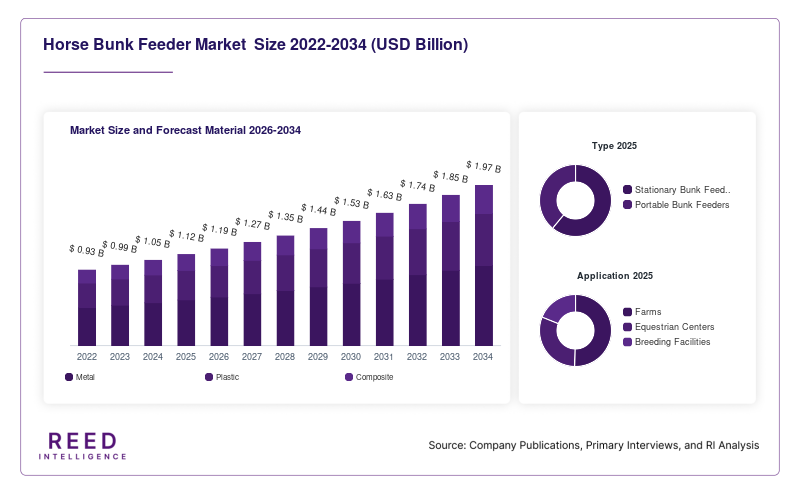
The Horse Bunk Feeder Market size was valued at USD 1.12 billion in 2026 and is projected to reach USD 1.85 billion by 2034, expanding at a CAGR of 6.5% during the forecast period (2026–2034). The market reflects steady expansion due to increasing awareness of efficient livestock feeding systems and rising investments in equine health and farm infrastructure.
One of the key global factors supporting market growth is the rising adoption of structured feeding systems in commercial horse farms and equestrian facilities, which enhances feed efficiency, minimizes wastage, and improves animal health outcomes.
Key Highlights
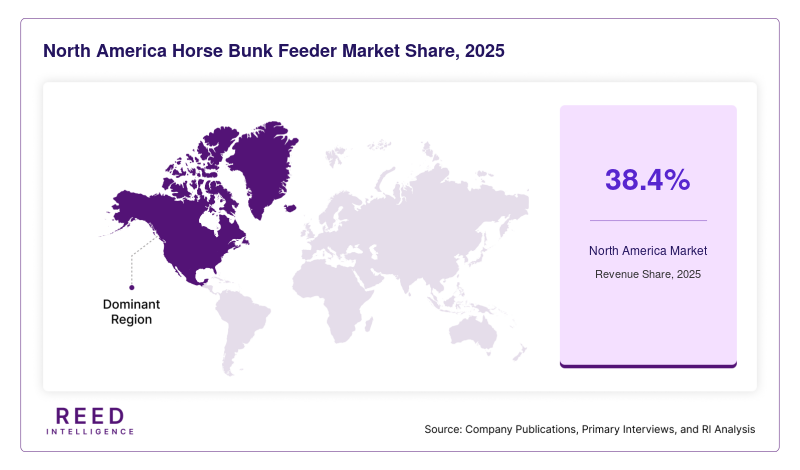
- North America dominated the market with 38.4% share in 2025, while Asia Pacific is expected to register the fastest growth at a CAGR of 7.8%.
- Metal bunk feeders emerged as the leading material segment with 41.2% share, while composite feeders are projected to grow at a CAGR of 8.1%.
- The farm application segment led with 52.6% share, while equestrian centers are expected to grow at a CAGR of 7.3%.
- The United States remained the dominant country, with market values of USD 0.31 billion in 2024 and USD 0.33 billion in 2025.
Market Trends
Smart Feeding Infrastructure Integration
The Horse Bunk Feeder Market is witnessing a gradual integration of smart feeding solutions, including automated feeding systems and IoT-enabled monitoring tools. These systems help track feed consumption patterns and reduce operational inefficiencies, making them increasingly attractive for large-scale horse farms.
Durable and Weather-Resistant Materials
Manufacturers are focusing on advanced materials such as UV-resistant plastics and corrosion-resistant metals. These innovations extend product lifespan and reduce maintenance costs, making them suitable for outdoor environments and diverse climatic conditions.
Market Drivers
Increasing Commercial Horse Farming Activities
The expansion of commercial horse farms, breeding facilities, and racing industries is driving the demand for efficient feeding equipment. Structured feeding systems such as bunk feeders help maintain consistent nutrition, which is essential for performance and health.
Focus on Feed Efficiency and Waste Reduction
Rising feed costs have encouraged farm operators to adopt feeding solutions that minimize wastage. Horse bunk feeders provide controlled feeding environments, ensuring optimal feed utilization and reducing operational costs.
Market Restraint
High Initial Investment Costs
The upfront cost associated with durable and advanced bunk feeders can be a limiting factor, especially for small-scale farm owners. Installation and maintenance expenses further restrict adoption in price-sensitive markets.
Market Opportunities
Expansion in Emerging Agricultural Economies
Developing regions are increasingly investing in livestock infrastructure, creating opportunities for manufacturers to expand their presence. Government support for modern farming practices is likely to accelerate adoption.
Customization and Modular Feeder Designs
There is growing demand for customizable bunk feeders tailored to different horse breeds and farm layouts. Modular designs allow scalability and flexibility, making them appealing to diverse end-users.
Segmental Analysis
By Material
Metal bunk feeders dominated the Horse Bunk Feeder Market with a 41.2% share in 2025, owing to their durability, strength, and suitability for large-scale operations. These feeders are widely used in outdoor environments where robustness is essential.
Composite materials are expected to be the fastest-growing segment, projected to expand at a CAGR of 8.1%. Their lightweight nature, corrosion resistance, and design flexibility will drive adoption, particularly in modern equestrian facilities.
By Type
Stationary bunk feeders held the largest share at 54.7% in 2025, as they are commonly used in fixed feeding areas and provide stability for daily feeding routines.
Portable bunk feeders are anticipated to grow at a CAGR of 7.4%, supported by increasing demand for flexible feeding solutions in rotational grazing systems and temporary setups.
By Application
Farm applications accounted for 52.6% share in 2025, driven by widespread use in livestock farms where efficient feeding systems are critical for operational efficiency.
Equestrian centers are projected to grow at a CAGR of 7.3%, fueled by rising participation in horse riding activities and increased focus on structured feeding practices.
By Distribution Channel
Offline distribution channels dominated with 63.5% share in 2025, as buyers prefer direct inspection and supplier relationships for agricultural equipment purchases.
Online channels are expected to expand at a CAGR of 8.5%, supported by the growth of e-commerce platforms offering a wide range of products and competitive pricing.
Regional Analysis
North America
North America accounted for 38.4% market share in 2025 and is expected to grow at a CAGR of 5.9% during 2026–2034. The United States dominated the region due to its well-established equine industry and strong presence of commercial horse farms. The adoption of advanced feeding infrastructure remains a key growth factor.
Europe
Europe held 27.6% share in 2025 and is projected to expand at a CAGR of 6.1%. Germany led the region, supported by a strong equestrian culture and increasing investments in animal welfare standards, which drive demand for efficient feeding systems.
Asia Pacific
Asia Pacific captured 18.3% share in 2025 and is anticipated to grow at a CAGR of 7.8%, the fastest globally. China dominated the region due to rising livestock modernization and increasing interest in equestrian sports, contributing to higher adoption of bunk feeders.
Middle East & Africa
The Middle East & Africa held 8.1% share in 2025 and is expected to grow at a CAGR of 6.7%. The UAE emerged as a key country, driven by investments in premium horse breeding and racing facilities.
Latin America
Latin America accounted for 7.6% share in 2025 and is forecasted to grow at a CAGR of 6.3%. Brazil led the region due to expanding agricultural activities and increasing awareness of efficient livestock management practices.
Competitive Landscape
The Horse Bunk Feeder Market is moderately fragmented, with a mix of global and regional players focusing on product durability, innovation, and cost efficiency. Key companies include Priefert Manufacturing, Tarter Farm & Ranch Equipment, Behlen Country, Sioux Steel Company, and Farmco Manufacturing. Among these, Priefert Manufacturing is a leading player, known for its extensive product portfolio and strong distribution network.
The company recently introduced enhanced corrosion-resistant bunk feeders designed for long-term outdoor use, strengthening its competitive position. Other players are emphasizing lightweight materials and modular designs to cater to evolving customer needs. Strategic initiatives such as product launches, partnerships with farm equipment distributors, and expansion into emerging markets are shaping competition. Companies are also investing in research and development to improve product longevity and reduce maintenance requirements, ensuring sustained market presence.
Key Players List
- Priefert Manufacturing
- Tarter Farm & Ranch Equipment
- Behlen Country
- Sioux Steel Company
- Farmco Manufacturing
- Powder River Livestock Handling Equipment
- Lakeland Farm and Ranch Direct
- Sturdy Built Manufacturing
- Arrowquip
- Ranch Equipment USA
- Pearson Livestock Equipment
- Agri Supply Co.
- FarmTek
- Hutchison Incorporated
- Osborne Industries
Recent Developments
- In 2025, leading manufacturers introduced UV-resistant plastic bunk feeders to improve durability in extreme weather conditions.
- Several companies expanded their distribution networks in Asia Pacific, targeting emerging agricultural markets.
- New product launches focused on modular feeder systems, enabling customization based on farm size and requirements.
- Strategic collaborations between manufacturers and farm equipment suppliers enhanced market reach and product accessibility.
- Investments in research and development led to innovations in lightweight yet high-strength materials, improving product performance and lifespan.
Horse Bunk Feeder Market Segments
Material
- Metal
- Plastic
- Composite
Type
- Stationary Bunk Feeders
- Portable Bunk Feeders
Application
- Farms
- Equestrian Centers
- Breeding Facilities
Distribution Channel
- Online Retail
- Offline Retail
By Region
- North America
- Europe
- APAC
- Middle East and Africa
- LATAM