Hospital Capacity Management Solution Market Size, Share & Demand Report By Component (Software, Services), By Deployment Mode (On-Premise, Cloud-Based), By End-Use (Hospitals, Ambulatory Care Centers, Others), By Region & Segment Forecasts, 2025–2034
USD 3950
Market Overview
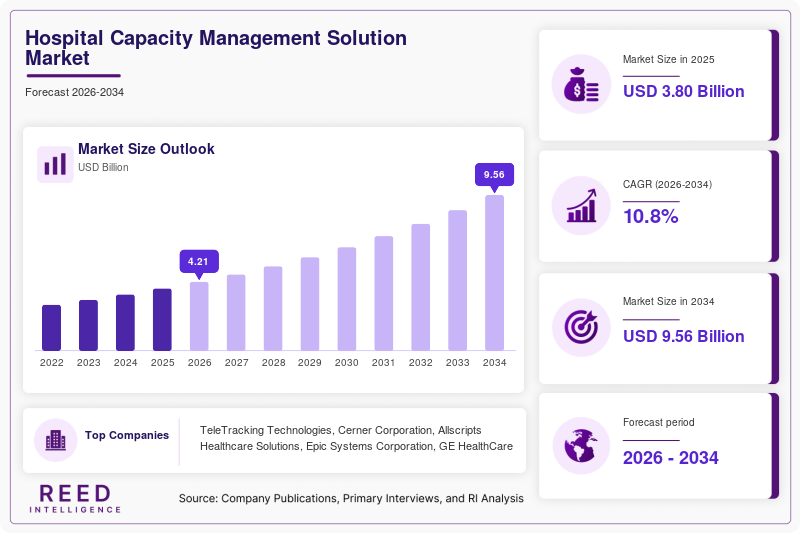
The Hospital Capacity Management Solution Market size is experiencing steady expansion as healthcare systems worldwide face increasing pressure to optimize resource utilization and improve patient flow. In 2025, the global market size is estimated at USD 3.8 billion, and it is projected to reach approximately USD 4.4 billion in 2026. Over the forecast period from 2025 to 2034, the market is expected to grow at a compound annual growth rate (CAGR) of 10.8%, reaching nearly USD 10.5 billion by 2034. This growth reflects the rising need for advanced digital solutions that help hospitals manage bed availability, staff allocation, operating room scheduling, and patient throughput.
One of the primary growth factors driving the market is the increasing burden on healthcare infrastructure due to aging populations and rising chronic disease prevalence. Hospitals are seeking scalable solutions that enable real-time visibility into capacity utilization to reduce bottlenecks and improve clinical outcomes. Additionally, the shift toward value-based care models is encouraging healthcare providers to adopt data-driven tools that enhance operational efficiency while maintaining quality standards.
Key Highlights
- Market size estimated at USD 3.8 billion in 2025
- Expected to reach USD 10.5 billion by 2034
- CAGR of 10.8% during 2025–2034
- Increasing demand for real-time capacity visibility
- Strong adoption of AI-driven and cloud-based solutions
Market Trends
Integration of Artificial Intelligence and Predictive Analytics
The integration of artificial intelligence (AI) and predictive analytics into hospital capacity management solutions is transforming how healthcare providers manage patient flow and resource allocation. AI-powered systems can analyze historical and real-time data to predict patient admissions, discharge timings, and peak occupancy periods. This enables hospitals to make proactive decisions, reduce wait times, and improve bed turnover rates. Predictive analytics also supports emergency preparedness by forecasting surges in demand, allowing hospitals to allocate staff and resources more effectively. As healthcare organizations continue to digitize operations, the demand for intelligent capacity management platforms is expected to rise steadily.
Growing Adoption of Cloud-Based and SaaS Solutions
Cloud-based and software-as-a-service (SaaS) models are becoming increasingly popular in the hospital capacity management solution market. These solutions offer scalability, cost efficiency, and remote accessibility, making them attractive for healthcare providers of all sizes. Cloud platforms enable real-time data sharing across departments and facilities, enhancing coordination and decision-making. Additionally, they reduce the need for extensive on-premise infrastructure and maintenance, lowering overall operational costs. The growing emphasis on interoperability and data integration is further driving the adoption of cloud-based solutions, as they facilitate seamless connectivity with electronic health records and other hospital information systems.
Market Drivers
Rising Demand for Efficient Patient Flow Management
The increasing need to improve patient flow within healthcare facilities is a major driver of the hospital capacity management solution market. Hospitals are under constant pressure to reduce patient wait times, optimize bed utilization, and ensure timely access to care. Inefficient patient flow can lead to overcrowding, delayed treatments, and reduced patient satisfaction. Capacity management solutions provide real-time visibility into hospital operations, enabling administrators to identify bottlenecks and implement corrective measures. These systems also support better coordination between departments, ensuring that patients move smoothly through the care continuum. As patient volumes continue to rise, the demand for efficient flow management solutions is expected to grow significantly.
Increasing Healthcare Digitalization and IT Investments
The ongoing digital transformation in the healthcare sector is another key driver of market growth. Hospitals are investing heavily in health IT infrastructure to improve operational efficiency and patient outcomes. Capacity management solutions are being integrated with electronic health records, telehealth platforms, and other digital systems to create a unified healthcare ecosystem. This integration enables seamless data exchange and enhances decision-making capabilities. Governments and healthcare organizations are also promoting the adoption of digital tools to address resource constraints and improve service delivery. As a result, the demand for advanced capacity management solutions is increasing across both developed and emerging markets.
Market Restraint
High Implementation Costs and Integration Challenges
Despite the growing demand for hospital capacity management solutions, high implementation costs and integration challenges remain significant barriers to market growth. Deploying these systems often requires substantial investment in software, hardware, and staff training. Smaller healthcare facilities, in particular, may find it difficult to allocate the necessary resources for adoption. Additionally, integrating capacity management solutions with existing hospital information systems can be complex and time-consuming. Many healthcare providers operate legacy systems that are not easily compatible with modern digital platforms, leading to interoperability issues.
These challenges can delay implementation and limit the effectiveness of capacity management solutions. For example, a hospital attempting to integrate a new capacity management system with outdated electronic health records may face data inconsistencies and workflow disruptions. Such issues can reduce user adoption and hinder the overall return on investment. To address these challenges, vendors are focusing on developing flexible and interoperable solutions, but cost and integration complexities continue to pose constraints in the market.
Market Opportunities
Expansion in Emerging Healthcare Markets
Emerging economies present significant growth opportunities for the hospital capacity management solution market. Countries in Asia, Latin America, and Africa are investing in healthcare infrastructure to meet the needs of growing populations. As these regions modernize their healthcare systems, there is a rising demand for digital solutions that improve efficiency and patient care. Capacity management systems can help hospitals in these regions optimize limited resources and enhance service delivery. Governments and private investors are also supporting digital health initiatives, creating a favorable environment for market expansion.
Integration with Telehealth and Remote Monitoring Systems
The integration of capacity management solutions with telehealth and remote patient monitoring systems is another promising opportunity. As telehealth adoption increases, hospitals are looking for ways to manage both in-person and virtual patient flows effectively. Capacity management platforms can provide a unified view of patient demand across different care settings, enabling better resource allocation. This integration also supports continuity of care by ensuring that patients receive timely interventions, whether in the hospital or at home. The growing adoption of digital health technologies is expected to drive innovation and create new opportunities in the market.
Segmental Analysis
By Component
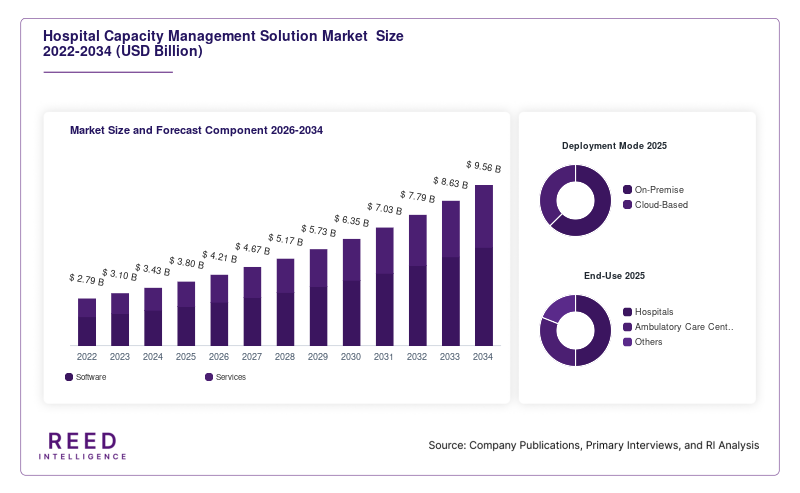
The software segment dominated the market in 2024, accounting for approximately 68% of the total share. This dominance is attributed to the increasing demand for advanced digital platforms that enable real-time monitoring and management of hospital capacity. Software solutions provide comprehensive features such as bed management, patient flow optimization, and predictive analytics, making them essential for modern healthcare operations. Hospitals are increasingly adopting integrated software systems to streamline workflows and improve decision-making. The growing emphasis on interoperability and data-driven healthcare is further supporting the dominance of the software segment.
The services segment is expected to be the fastest-growing, with a projected CAGR of 11.9% during the forecast period. This growth is driven by the increasing need for implementation, training, and support services associated with capacity management solutions. Healthcare providers require specialized services to ensure successful deployment and integration of these systems. Additionally, the rising complexity of healthcare operations is creating demand for consulting and managed services. As hospitals continue to adopt advanced technologies, the demand for services is expected to increase significantly.
By Deployment Mode
The on-premise segment held the largest share in 2024, accounting for approximately 55% of the market. This dominance is primarily due to concerns related to data security and control, as many healthcare providers prefer to maintain their data within internal systems. On-premise solutions offer greater customization and integration capabilities, making them suitable for large hospitals with complex operations. Despite the higher initial costs, these solutions remain popular among organizations that prioritize data privacy and regulatory compliance.
The cloud-based segment is expected to grow at the fastest rate, with a CAGR of 13.2% during the forecast period. This growth is driven by the increasing adoption of cloud technologies in the healthcare sector. Cloud-based solutions offer scalability, flexibility, and cost efficiency, making them attractive for small and medium-sized healthcare providers. They also enable real-time data access and remote management, improving operational efficiency. The growing emphasis on digital transformation and interoperability is further supporting the adoption of cloud-based capacity management solutions.
By End-Use
Hospitals dominated the market in 2024, accounting for approximately 72% of the total share. This dominance is attributed to the high demand for capacity management solutions in large healthcare facilities that handle significant patient volumes. Hospitals require efficient systems to manage bed occupancy, staff allocation, and patient flow. The increasing pressure to improve operational efficiency and patient outcomes is driving the adoption of capacity management solutions in this segment. Additionally, hospitals are investing in advanced technologies to enhance their competitive position.
Ambulatory care centers are expected to be the fastest-growing segment, with a CAGR of 12.4% during the forecast period. This growth is driven by the increasing shift toward outpatient care and the rising demand for cost-effective healthcare services. Ambulatory care centers are adopting capacity management solutions to optimize resource utilization and improve patient scheduling. The growing focus on preventive care and minimally invasive procedures is also contributing to the expansion of this segment.
Regional Analysis
North America
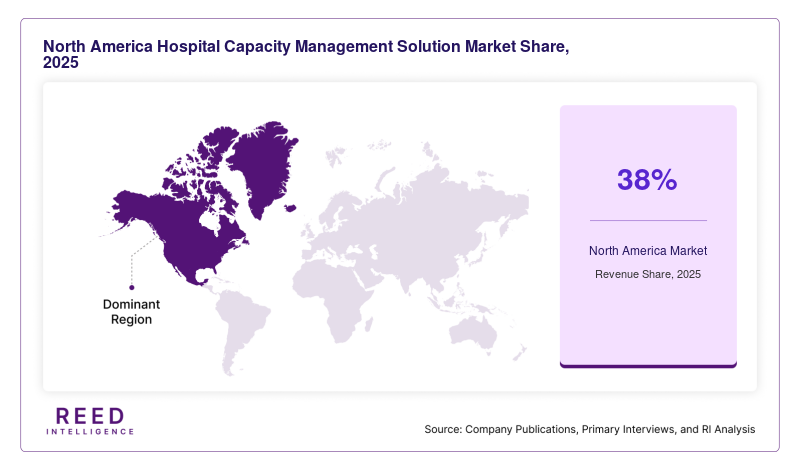
North America accounted for the largest share of the hospital capacity management solution market in 2025, contributing approximately 38% of the global revenue. The region is expected to maintain its dominance during the forecast period, with a projected CAGR of 9.8% from 2025 to 2034. The strong presence of advanced healthcare infrastructure, high adoption of digital health technologies, and significant investments in healthcare IT are key factors driving market growth. Additionally, the increasing focus on improving patient outcomes and reducing operational inefficiencies is encouraging hospitals to adopt capacity management solutions.
The United States dominates the North American market, driven by its well-established healthcare system and high healthcare spending. One unique growth factor in the country is the widespread adoption of value-based care models, which emphasize efficiency and quality outcomes. Hospitals are increasingly using capacity management solutions to meet performance metrics and reduce costs, further supporting market expansion.
Europe
Europe held a significant share of the market in 2025, accounting for around 27% of global revenue, and is expected to grow at a CAGR of 10.2% during the forecast period. The region’s growth is supported by increasing government initiatives aimed at modernizing healthcare systems and improving patient care. European countries are investing in digital health technologies to address challenges such as aging populations and rising healthcare costs. The adoption of capacity management solutions is also driven by the need to optimize hospital operations and reduce waiting times.
Germany leads the European market due to its advanced healthcare infrastructure and strong focus on technological innovation. A unique growth factor in Germany is the implementation of nationwide digital health programs, which encourage the adoption of integrated healthcare solutions. These initiatives are driving the demand for capacity management systems across hospitals and healthcare networks.
Asia Pacific
Asia Pacific is expected to witness the highest growth rate, with a CAGR of 12.6% from 2025 to 2034, and accounted for approximately 20% of the market share in 2025. The region’s growth is driven by rapid urbanization, increasing healthcare investments, and the rising adoption of digital technologies. Governments in countries such as China and India are focusing on improving healthcare infrastructure, creating opportunities for capacity management solutions. The growing demand for efficient healthcare services is further supporting market expansion.
China is the dominant country in the Asia Pacific market, driven by its large population and increasing healthcare expenditure. A unique growth factor in China is the government’s emphasis on smart hospital initiatives, which integrate advanced technologies into healthcare operations. These initiatives are accelerating the adoption of capacity management solutions across the country.
Middle East & Africa
The Middle East & Africa region accounted for approximately 8% of the global market in 2025 and is expected to grow at a CAGR of 9.5% during the forecast period. The region is witnessing gradual adoption of digital health solutions, supported by increasing investments in healthcare infrastructure. Governments are focusing on improving healthcare access and quality, which is driving the demand for capacity management solutions. However, limited resources and infrastructure challenges may impact growth in some areas.
Saudi Arabia leads the market in this region due to its significant healthcare investments and modernization efforts. A unique growth factor in the country is the implementation of national healthcare transformation programs, which aim to enhance efficiency and patient care. These initiatives are encouraging hospitals to adopt advanced capacity management solutions.
Latin America
Latin America held around 7% of the global market share in 2025 and is expected to grow at a CAGR of 10.1% during the forecast period. The region is experiencing increasing adoption of digital health technologies, driven by the need to improve healthcare efficiency and accessibility. Governments and private healthcare providers are investing in IT infrastructure to modernize healthcare systems. Capacity management solutions are gaining traction as hospitals seek to optimize resource utilization and improve patient flow.
Brazil dominates the Latin American market, supported by its large healthcare sector and growing investments in digital transformation. A unique growth factor in Brazil is the increasing adoption of private healthcare services, which are focusing on operational efficiency and patient satisfaction. This trend is driving the demand for capacity management solutions in the country.
Competitive Landscape
The hospital capacity management solution market is moderately competitive, with several global and regional players offering a range of solutions. Key companies are focusing on product innovation, strategic partnerships, and mergers to strengthen their market position. The market is characterized by continuous technological advancements, particularly in artificial intelligence and cloud-based solutions.
One of the leading players in the market is TeleTracking Technologies, which is recognized for its comprehensive capacity management platforms. The company has recently introduced enhanced predictive analytics features to improve patient flow management. Other major companies are also investing in research and development to expand their product portfolios and address evolving customer needs. The competitive landscape is expected to intensify as new entrants bring innovative solutions to the market.
Key Players
- TeleTracking Technologies
- Cerner Corporation
- Allscripts Healthcare Solutions
- Epic Systems Corporation
- GE HealthCare
- McKesson Corporation
- Koninklijke Philips N.V.
- Oracle Health
- Infor Inc.
- Siemens Healthineers
- Central Logic
- LeanTaaS
- Qventus
- Care Logistics
- Health Catalyst
Recent Developments
- In 2024, TeleTracking Technologies launched an AI-powered capacity management module designed to enhance predictive patient flow analysis.
- In 2025, a major healthcare IT provider partnered with hospitals in Asia to deploy cloud-based capacity management solutions, expanding its regional presence.
- In 2025, a leading vendor introduced an integrated platform combining capacity management with telehealth capabilities to improve operational efficiency.
Hospital Capacity Management Solution Market Segments
Component
- Software
- Services
Deployment Mode
- On-Premise
- Cloud-Based
End-Use
- Hospitals
- Ambulatory Care Centers
- Others
By Region
- North America
- Europe
- APAC
- Middle East and Africa
- LATAM