Hot Forging Press Machine Market Size, Share, Demand Report By Type (Mechanical Hot Forging Press, Hydraulic Hot Forging Press, Servo-Hydraulic Hot Forging Press), By Application (Automotive, Aerospace, Industrial Machinery), By Region & Segment Forecasts, 2026–2034
USD 3950
Hot Forging Press Machine Market Size
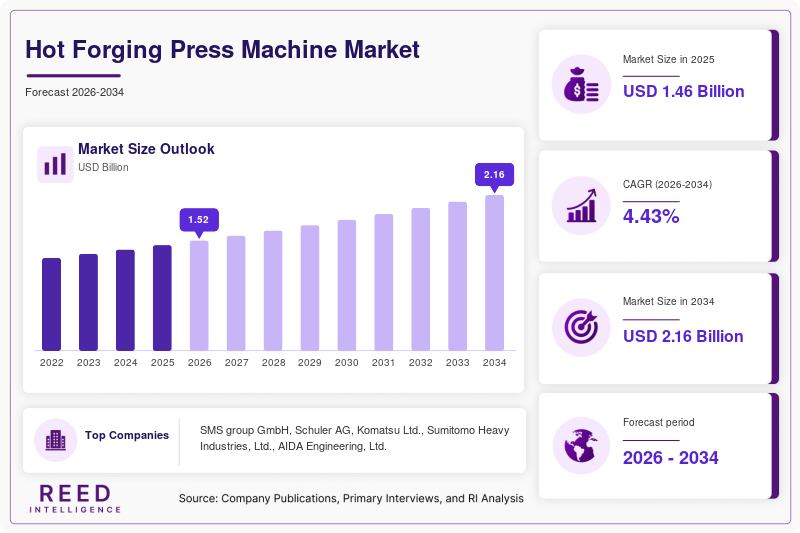
Hot Forging Press Machine Market size is projected at USD 1.53 billion in 2026 and is expected to hit USD 2.16 billion by 2034 with a CAGR of 4.43%. The market is supported by rising demand for high-strength forged components across automotive, aerospace, industrial machinery, construction, and heavy engineering industries. Detailed market data covering machine technologies, production volumes, application demand, regional performance, and competitive positioning is increasingly important for manufacturers planning capacity expansion and technology investments.
Key Takeaways
- Asia Pacific is the dominant region, accounting for approximately 45% of the global market in 2026, while it is also among the fastest-growing regions through 2034.
- Hydraulic hot forging presses represent the leading machine type with approximately 55% market share, supported by their flexibility and suitability for complex and large components.
- Automotive is the dominant application, contributing approximately 60% of market demand, while aerospace is projected to register one of the fastest growth rates through 2034.
- China remains the largest country market in Asia Pacific, while India is emerging as a high-growth market due to automotive manufacturing, infrastructure development, and industrial localization.
- India's hot forging press machine demand is expected to expand at approximately 7% CAGR through 2034, supported by automotive components, industrial machinery, defense, and engineering manufacturing.
The hot forging press machine market comprises equipment designed to form heated metal billets and preforms into high-strength components through controlled compressive force. These machines are available in different configurations and capacities and are used for producing gears, shafts, connecting rods, crankshafts, axle components, aerospace structures, valves, and other precision-engineered parts. Global production of hot forging press machines is estimated at approximately 4,000 units in 2026, with production expected to increase steadily through 2034 as manufacturers modernize aging forging lines. Adoption is particularly strong in automotive and industrial manufacturing, where forged components provide high strength, durability, and fatigue resistance. Hydraulic presses account for the largest share of machine installations because of their ability to handle large components and complex forming operations, while mechanical and servo-controlled systems are gaining adoption in high-volume and energy-efficient production environments. Automotive applications contribute around 60% of total demand, followed by industrial machinery and aerospace applications.
Hot Forging Press Machine Market Trends
Automation and Digital Control Transforming Forging Operations
The hot forging press machine industry is increasingly shifting toward automated and digitally controlled equipment. Manufacturers are integrating programmable logic controllers, servo-hydraulic systems, force monitoring, temperature sensors, automated lubrication, robotic material handling, and predictive maintenance capabilities into modern forging lines. These technologies enable more consistent forming cycles, improve dimensional accuracy, reduce downtime, and provide real-time monitoring of critical production parameters. Automation penetration in new forging lines is increasing as manufacturers seek higher productivity while reducing dependence on manual operations.
Sector-specific demand is also influencing machine development. Automotive manufacturers require high-speed presses capable of producing large volumes of lightweight and high-strength components, while aerospace manufacturers prioritize precision, repeatability, traceability, and controlled processing of titanium, nickel-based alloys, aluminum, and advanced steels. Industrial machinery manufacturers require larger-capacity presses for shafts, gears, flanges, valves, and other heavy components. The expansion of electric vehicle production is also creating new requirements for forged drivetrain, suspension, steering, and structural components.
Hot Forging Press Machine Drivers
Growing Demand for High-Strength Forged Components
The increasing use of forged components across automotive, aerospace, industrial machinery, construction, and energy applications is a major market driver. Forging produces components with high mechanical strength, fatigue resistance, and structural integrity, making the process particularly suitable for safety-critical parts. Automotive manufacturers are increasing their use of forged gears, shafts, connecting rods, steering components, and suspension parts, while aerospace manufacturers are expanding the use of forged components for engines, landing systems, and structural assemblies. This sustained demand encourages forging companies to invest in modern high-capacity presses.
Hot Forging Press Machine Restraints
High Capital and Maintenance Requirements
High initial investment remains a major restraint for small and medium-sized forging companies. Large-capacity presses require substantial capital expenditure, specialized foundations, electrical or hydraulic infrastructure, installation expertise, and commissioning time. Maintenance costs can also be significant because hydraulic systems, dies, control systems, lubrication systems, and mechanical components require regular servicing. Volatility in steel, alloy, electronic, and hydraulic component prices can further increase machine acquisition costs and extend investment payback periods.
Hot Forging Press Machine Opportunities
Smart Manufacturing and Energy-Efficient Press Technology
The transition toward smart manufacturing presents substantial opportunities for hot forging press manufacturers. Servo-hydraulic systems, connected sensors, digital twins, automated material handling, predictive maintenance, and real-time production analytics can improve machine utilization and reduce energy consumption. Retrofitting older presses with modern controls and monitoring systems also creates a significant aftermarket opportunity. Emerging manufacturing economies, particularly India, China, Southeast Asia, Mexico, and Eastern Europe, provide additional opportunities as automotive and industrial manufacturers establish localized production facilities.
Challenges in Hot Forging Press Machine
Complex Process Control and Skilled Workforce Requirements
Hot forging requires precise control over billet temperature, forging pressure, ram speed, die temperature, lubrication, and cooling conditions. Incorrect process parameters can result in dimensional deviations, cracks, incomplete filling, die damage, and excessive material consumption. The increasing sophistication of automated presses also creates demand for skilled engineers and technicians with knowledge of mechanical systems, hydraulics, automation, controls, and forging metallurgy. Manufacturers must therefore combine equipment investments with workforce training and technical service capabilities.
Hot Forging Press Machine Market Segmentation Analysis
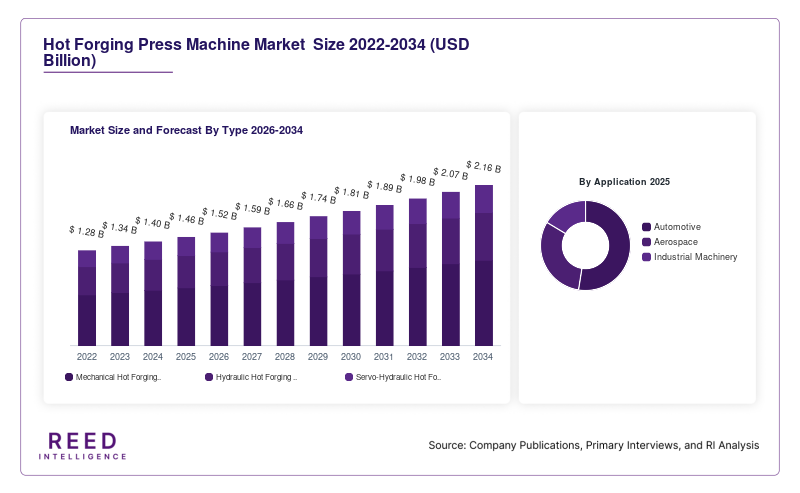
The market is segmented by type and application, with hydraulic hot forging presses representing the largest machine category. Hydraulic systems account for approximately 55% of market revenue because of their flexibility, high force capability, and suitability for large and complex components. Mechanical presses account for approximately 35%, while servo-hydraulic and other advanced configurations represent around 10%. By application, automotive dominates with approximately 60% share, followed by industrial machinery at approximately 25% and aerospace at approximately 15%.
By Type
Mechanical hot forging presses account for approximately 35% of the global market and represent an estimated 1,400 newly produced units in 2026. These machines use crank, eccentric, or toggle mechanisms to generate high forming forces and are particularly suitable for high-volume production. Typical machines range from several hundred tonnes to several thousand tonnes of capacity, with high operating speeds and repeatable stroke characteristics. Automotive manufacturers use mechanical presses extensively for gears, connecting rods, steering components, and other standardized parts. Their relatively high production speed makes them attractive for applications where cycle time and throughput are major priorities.
Hydraulic hot forging presses represent the dominant type with approximately 55% market share and an estimated 2,200 units produced in 2026. These systems can range from medium-capacity equipment to presses exceeding 10,000 tonnes. Hydraulic systems provide adjustable pressure, stroke, and forming speed, allowing manufacturers to control complex deformation processes more precisely. They are widely used for automotive, aerospace, energy, heavy machinery, and large industrial components. Modern hydraulic presses increasingly incorporate variable-speed pumps, digital controls, force monitoring, and energy-saving systems.
Servo-hydraulic presses account for approximately 10% of market demand but represent one of the fastest-growing technology segments. These systems combine hydraulic force generation with electronically controlled operation, allowing manufacturers to program ram movement, pressure profiles, dwell times, and forming cycles. Typical applications include precision automotive parts, aerospace components, and complex industrial forgings. Their ability to reduce unnecessary energy consumption and improve process repeatability is increasing their attractiveness among manufacturers investing in modern smart forging facilities.
By Application
Automotive manufacturing represents approximately 60% of global hot forging press machine demand and accounts for nearly 2,400 new machine units in 2026. Presses are used for producing crankshafts, connecting rods, gears, wheel hubs, steering knuckles, axle components, suspension parts, and other structural and drivetrain components. Demand comes from passenger vehicles, commercial vehicles, electric vehicles, and hybrid vehicles. Manufacturers are increasingly adopting automated forging cells to improve production rates and consistency. The transition toward electric vehicles is also creating opportunities for forged components used in motors, reduction gears, suspension systems, steering assemblies, and lightweight structural applications.
Aerospace contributes approximately 15% of market demand and represents an estimated 600 new machine units in 2026. Hot forging presses are used to manufacture high-strength components from titanium, aluminum, nickel-based alloys, and specialized steels. Applications include aircraft structural parts, engine components, landing-gear components, brackets, and other safety-critical products. Aerospace manufacturers place strong emphasis on dimensional accuracy, process repeatability, material traceability, and automated process monitoring. Rising aircraft production and fleet modernization are expected to support above-average growth in aerospace forging equipment demand.
Industrial machinery accounts for approximately 25% of global demand and represents about 1,000 machine units in 2026. The segment includes construction equipment, agricultural machinery, mining equipment, energy equipment, pumps, valves, gears, shafts, flanges, and heavy-duty mechanical components. Large hydraulic presses are particularly important because many industrial components require high forming forces and large working envelopes. Increasing infrastructure investment and modernization of industrial manufacturing facilities are supporting replacement and expansion demand for forging presses.
Hot Forging Press Machine Market Regional Analysis
North America Hot Forging Press Machine Market
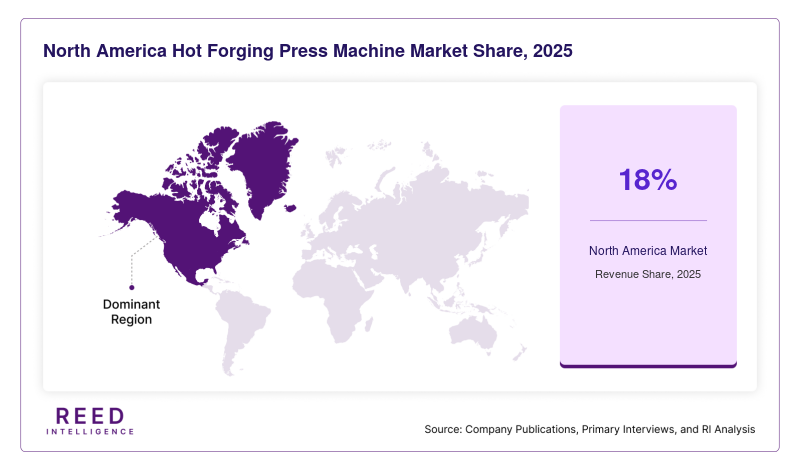
North America accounts for approximately 18% of global market revenue in 2026. The United States represents the largest regional contributor, supported by aerospace, defense, automotive, energy, and heavy industrial manufacturing. Aerospace and defense applications have a relatively high contribution because manufacturers require high-capacity and precision-controlled forging systems for titanium and advanced alloy components. Mexico is also gaining importance through automotive manufacturing and nearshoring investments.
Europe Hot Forging Press Machine Market
Europe contributes approximately 22% of the global market. Germany, Italy, France, the United Kingdom, and Spain are key contributors, supported by automotive manufacturing, aerospace, engineering, and industrial machinery production. Germany represents the leading European country market, while France and the United Kingdom have significant aerospace demand. European manufacturers are increasingly focused on energy efficiency, automation, digital controls, and environmentally efficient manufacturing processes.
Asia Pacific Hot Forging Press Machine Market
Asia Pacific represents approximately 45% of the global market and remains the largest regional market. China contributes the largest share because of its extensive automotive, industrial machinery, infrastructure, and metal-processing industries. Japan and South Korea have strong demand for high-precision forging systems used in automotive and advanced engineering. India is one of the fastest-growing markets, supported by expanding automotive production, defense manufacturing, infrastructure investment, and increasing localization of industrial equipment.
Latin America Hot Forging Press Machine Market
Latin America accounts for approximately 8% of global market demand. Brazil is the leading contributor, with demand generated by automotive, agricultural machinery, mining, energy, and general engineering industries. Mexico also has a significant role because of its automotive manufacturing base and integration with North American supply chains. Market growth is expected to be supported by industrial modernization and investments in local component production.
Middle East & Africa Hot Forging Press Machine Market
The Middle East & Africa region represents approximately 7% of global demand. Gulf economies are creating opportunities through industrial diversification, infrastructure development, energy projects, and local manufacturing initiatives. South Africa contributes through automotive, mining, and heavy engineering applications. Demand is expected to gradually increase as regional manufacturers expand local production and reduce dependence on imported components.
Top players in the Hot Forging Press Machine Market
- SMS group GmbH
- Schuler AG
- Komatsu Ltd.
- Sumitomo Heavy Industries, Ltd.
- AIDA Engineering, Ltd.
- Fagor Arrasate
- LASCO Umformtechnik GmbH
- Erie Press Systems
- Ajax-CECO
- Macrodyne Technologies Inc.
- Hatebur Umformmaschinen AG
- Kurimoto, Ltd.
Recent Developments in Hot Forging Press Machine Market
- March 2023: Schuler introduced developments in hydraulic forging press technology focused on high-performance applications and greater automation of forging operations.
- July 2024: AIDA Engineering expanded its focus on customized hot forging solutions for automotive component manufacturing, including applications associated with lightweight vehicle components.
- January 2025: Forging-equipment manufacturers increased development of digitally connected press systems incorporating process monitoring, automated control, and predictive maintenance capabilities.
- June 2025: Equipment suppliers expanded advanced hydraulic and servo-controlled press offerings designed to improve energy efficiency and process repeatability in high-volume forging operations.
- September 2026: Forging-machine manufacturers intensified investment in automated and flexible production systems designed for automotive, aerospace, and industrial component manufacturing.
Hot Forging Press Machine Market Segments
By Type
- Mechanical Hot Forging Press
- Hydraulic Hot Forging Press
- Servo-Hydraulic Hot Forging Press
By Application
- Automotive
- Aerospace
- Industrial Machinery
By Region
- North America
- Europe
- APAC
- Middle East and Africa
- LATAM