Hot Melt Glue Labeler Market Size, Share & Demand Report By Product Type (Automatic Hot Melt Glue Labelers, Semi-Automatic Hot Melt Glue Labelers), By Application (Food & Beverage, Pharmaceuticals, Personal Care & Cosmetics), By Container Type (Plastic Containers, Glass Containers), By End-Use Industry (Consumer Goods, Healthcare, Chemical Industry, Retail Packaging) & Regional Forecasts, 2026–2034
USD 3950
Market Overview
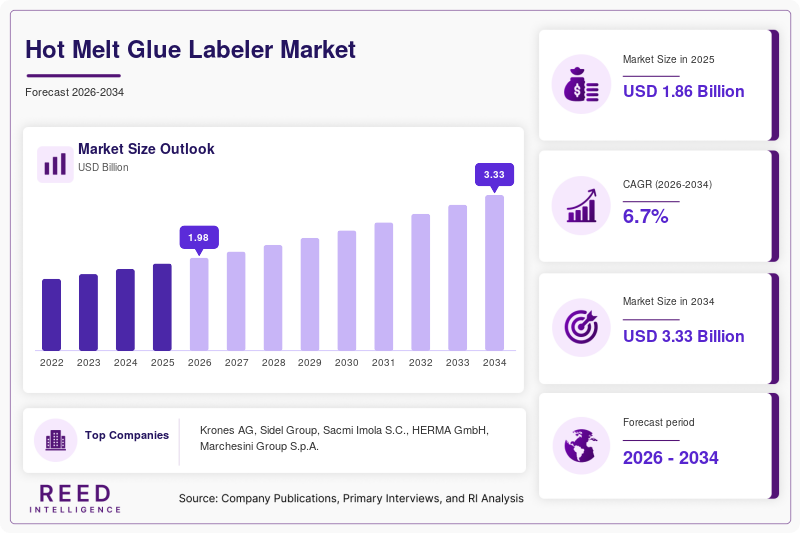
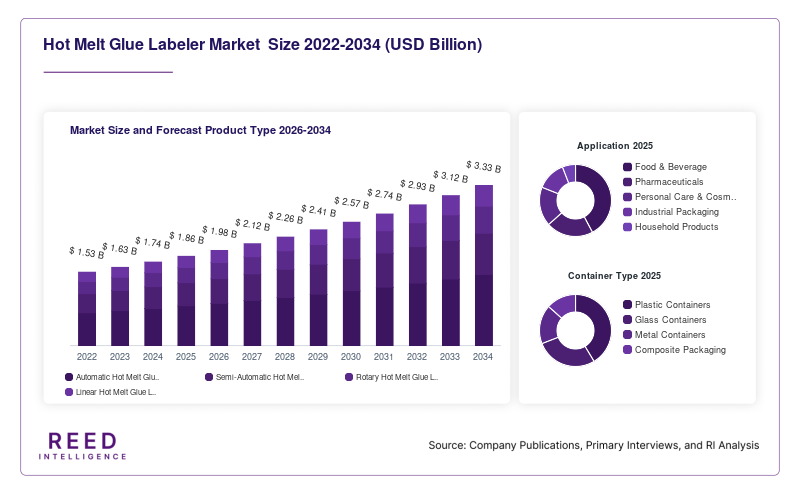
The Hot Melt Glue Labeler Market was valued at approximately USD 1.86 billion in 2026 and is projected to reach USD 3.12 billion by 2034, expanding at a CAGR of 6.7% during 2026–2034. The market is witnessing sustained growth due to rising automation in packaging operations and increasing demand for high-speed labeling systems across food & beverage, pharmaceuticals, personal care, and industrial packaging industries. Manufacturers are increasingly adopting hot melt glue labelers because they provide faster application speed, improved adhesive strength, and better operational efficiency compared to traditional wet glue systems.
One of the major global factors supporting the growth of the Hot Melt Glue Labeler Market is the rapid expansion of the packaged consumer goods sector. The increasing demand for packaged beverages, bottled products, ready-to-consume food items, and personal care products has significantly increased the requirement for efficient labeling solutions capable of operating at high production speeds. As global supply chains continue to modernize, manufacturers are investing in automated labeling systems to improve productivity, minimize material wastage, and maintain product consistency across large-scale production facilities.
Key Highlights
- Europe dominated the Hot Melt Glue Labeler Market with a market share of 33.4% in 2025.
- Asia Pacific is expected to register the fastest growth with a projected CAGR of 7.8% during 2026–2034.
- By product type, automatic hot melt glue labelers held the dominant share of 61.8% in 2025.
- By product type, rotary hot melt glue labelers are projected to grow at a 7.5% CAGR through 2034.
- By application, the food & beverage segment accounted for the largest market share in 2025.
- By application, the pharmaceutical labeling segment is forecast to expand at a 7.3% CAGR during the forecast period.
- Germany remained the dominant country in Europe with market values of approximately USD 172 million in 2024 and USD 184 million in 2025.
Market Trends
Smart Labeling Integration and Industry 4.0 Adoption
The integration of smart automation technologies is becoming a significant trend in the Hot Melt Glue Labeler Market. Packaging manufacturers are increasingly deploying Industry 4.0-enabled labeling systems equipped with sensors, machine monitoring software, predictive maintenance tools, and automated quality inspection capabilities. These technologies help reduce machine downtime, improve labeling accuracy, and optimize adhesive usage across production lines.
Smart hot melt glue labelers are gaining popularity among large beverage and food processing facilities because they support real-time operational monitoring and remote diagnostics. Companies are increasingly focusing on digitally connected manufacturing environments where labeling equipment can communicate with other packaging systems to improve overall plant efficiency. This trend is expected to reshape packaging automation strategies over the next decade.
Rising Demand for Sustainable and Lightweight Packaging
Sustainability has emerged as a key trend influencing the Hot Melt Glue Labeler Market. Packaging manufacturers are increasingly adopting lightweight containers and recyclable packaging materials to meet evolving environmental regulations and consumer preferences. This shift has increased the need for labeling systems capable of applying labels effectively on thinner and lightweight substrates without compromising adhesion performance.
Hot melt glue labelers are increasingly being designed with energy-efficient heating systems and optimized adhesive application technologies to minimize material wastage. Manufacturers are also focusing on adhesives compatible with recyclable packaging formats, especially in the beverage and consumer goods sectors. The growing emphasis on sustainable packaging solutions is expected to create long-term demand for advanced labeling technologies.
Market Drivers
Expansion of the Global Beverage Packaging Industry
The continuous growth of the bottled beverage industry is one of the primary drivers of the Hot Melt Glue Labeler Market. Increasing consumption of bottled water, carbonated drinks, juices, alcoholic beverages, and dairy products has significantly increased demand for high-speed labeling machinery. Beverage manufacturers require efficient systems capable of handling large production volumes while maintaining labeling precision and operational reliability.
Hot melt glue labelers are widely used in beverage packaging because they provide fast label application speeds and strong adhesion across different bottle materials, including PET, glass, and aluminum containers. The expansion of beverage production facilities in emerging economies is further accelerating market demand.
Increasing Automation Across Packaging Operations
Industrial automation continues to play an important role in the growth of the Hot Melt Glue Labeler Market. Manufacturing companies are increasingly investing in automated packaging systems to improve production efficiency, reduce labor dependency, and minimize operational errors. Automatic labeling machines support faster production cycles and help manufacturers maintain consistent product presentation.
The rising adoption of robotic packaging systems and integrated production lines has further increased the deployment of advanced labeling equipment. Automated hot melt glue labelers offer improved operational flexibility and can support multiple container sizes and packaging formats, making them highly suitable for modern production environments.
Market Restraint
High Initial Investment and Maintenance Costs
One of the major restraints affecting the Hot Melt Glue Labeler Market is the high capital investment associated with advanced labeling machinery. Fully automated hot melt glue labeling systems require substantial installation costs, specialized maintenance, and operator training. Small and medium-sized manufacturers often face financial limitations when upgrading to automated labeling technologies, which can restrict market penetration in cost-sensitive regions.
Market Opportunities
Growth of E-Commerce Packaging Applications
The rapid expansion of e-commerce and direct-to-consumer packaging operations is creating new opportunities for the Hot Melt Glue Labeler Market. Online retail companies increasingly require durable and visually appealing product packaging to improve customer experience and brand recognition. This trend is driving demand for reliable labeling systems capable of supporting high-volume packaging environments.
As fulfillment centers continue to expand globally, labeling equipment manufacturers are expected to benefit from increased investments in automated packaging infrastructure. Hot melt glue labeling technology is particularly suitable for fast-moving packaging operations where speed and accuracy are critical.
Increasing Demand from Pharmaceutical Packaging
The pharmaceutical industry presents significant growth opportunities for the Hot Melt Glue Labeler Market due to rising medicine production and stricter packaging regulations. Pharmaceutical manufacturers require precise labeling systems that ensure product traceability, tamper resistance, and regulatory compliance.
The growing production of over-the-counter medicines, healthcare supplements, and vaccine packaging solutions is expected to increase demand for advanced labeling technologies. Manufacturers are increasingly developing compact and hygienic hot melt glue labelers specifically designed for pharmaceutical applications.
Segmental Analysis
By Product Type
Automatic hot melt glue labelers dominated the Hot Melt Glue Labeler Market with a share of 61.8% in 2025. These systems are widely used in large-scale manufacturing operations because they provide higher production speed, reduced downtime, and improved labeling accuracy. Food and beverage manufacturers continue to prefer automatic systems for high-volume production lines.
Rotary hot melt glue labelers are projected to witness the fastest growth at a 7.5% CAGR during 2026–2034. Their ability to support continuous high-speed labeling operations and accommodate multiple container formats is expected to drive demand across beverage bottling industries.
By Application
The food & beverage segment accounted for the largest share of 48.6% in 2025 within the Hot Melt Glue Labeler Market. Rising production of bottled beverages, dairy products, sauces, and packaged food items significantly contributed to segment dominance.
The pharmaceutical segment is expected to expand at a 7.3% CAGR during the forecast period due to rising pharmaceutical manufacturing activities and increasing packaging compliance requirements. The growing need for accurate and durable product labeling is expected to accelerate adoption.
By Container Type
Plastic containers represented the dominant segment with 54.1% market share in 2025 because of their widespread use in beverage, personal care, and household product packaging applications.
Glass containers are anticipated to register the fastest CAGR of 6.9% during 2026–2034 due to increasing premium beverage packaging and growing demand for sustainable packaging materials in food and cosmetic applications.
By End-Use Industry
The consumer goods industry held the dominant position in 2025 with a market share of 39.5% in the Hot Melt Glue Labeler Market. Rapid expansion of packaged household products and personal care items supported segment growth.
The pharmaceutical industry is projected to grow at a 7.1% CAGR during the forecast period due to increasing medicine production and strict labeling standards across healthcare packaging operations.
Regional Analysis
North America
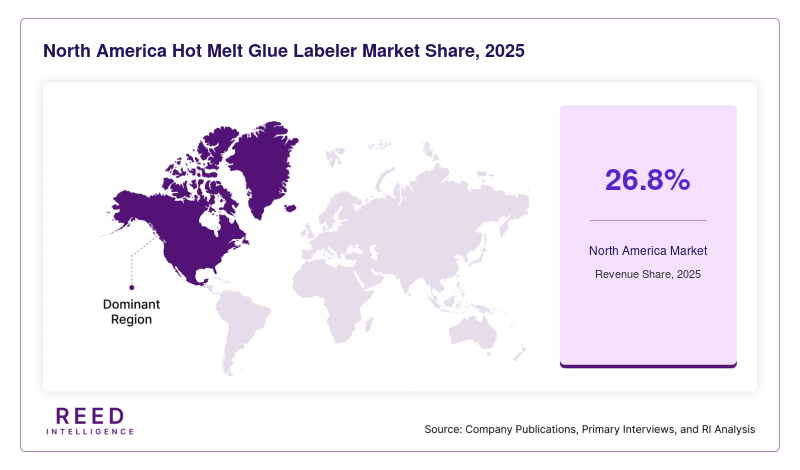
North America accounted for approximately 26.8% of the Hot Melt Glue Labeler Market in 2025 and is projected to grow at a 6.1% CAGR during 2026–2034. The region benefits from a highly developed packaging machinery industry and strong adoption of automated manufacturing systems. The United States remained the dominant country due to high demand for packaged beverages and processed consumer goods.
The regional market is also supported by the modernization of industrial packaging facilities and increasing investment in smart manufacturing technologies. Demand for efficient labeling systems continues to rise among beverage bottling companies and pharmaceutical manufacturers.
Europe
Europe held the largest market share of 33.4% in 2025 and is anticipated to expand at a 5.9% CAGR through 2034. Germany dominated the regional market because of its advanced industrial machinery sector and strong food & beverage packaging infrastructure.
European manufacturers are increasingly focusing on energy-efficient labeling systems and environmentally sustainable packaging solutions. The region also benefits from high adoption of automated packaging technologies across consumer goods industries.
Asia Pacific
Asia Pacific represented 24.3% of the global Hot Melt Glue Labeler Market in 2025 and is forecast to register the fastest CAGR of 7.8% during 2026–2034. China remained the leading country in the region due to rapid industrialization, expanding beverage production, and rising investments in packaging automation.
The growth of manufacturing industries across India, China, Vietnam, and Indonesia continues to create strong demand for industrial labeling systems. Increasing urbanization and packaged food consumption are further supporting regional market growth.
Middle East & Africa
The Middle East & Africa accounted for 8.2% of the Hot Melt Glue Labeler Market in 2025 and is projected to grow at a 6.5% CAGR during the forecast period. The United Arab Emirates remained the dominant market due to rising packaged food imports and expanding beverage production facilities.
Regional demand is also supported by increasing investments in industrial packaging infrastructure and food processing operations. Growth in tourism and hospitality industries has further contributed to packaged product consumption.
Latin America
Latin America held approximately 7.3% share in 2025 and is expected to expand at a 6.4% CAGR through 2034. Brazil dominated the region because of its large beverage manufacturing industry and growing packaged consumer goods sector.
The expansion of food processing facilities and increasing retail distribution networks are contributing to rising demand for automated labeling systems across the region.
Competitive Landscape
The Hot Melt Glue Labeler Market remains moderately competitive, with manufacturers focusing on technological advancements, automation capabilities, and global distribution expansion.
Krones AG emerged as the leading player due to its strong packaging machinery portfolio and extensive global customer base. The company recently introduced an upgraded high-speed hot melt labeling system equipped with digital monitoring capabilities to improve operational efficiency.
Sidel Group continues to focus on advanced beverage packaging solutions and energy-efficient labeling technologies. Sacmi Imola S.C. is expanding its rotary labeling equipment portfolio for high-volume production applications. HERMA GmbH emphasizes precision labeling systems for pharmaceutical and industrial packaging. Marchesini Group S.p.A. remains active in healthcare packaging automation and integrated labeling technologies.
Key Players List
- Krones AG
- Sidel Group
- Sacmi Imola S.C.
- HERMA GmbH
- Marchesini Group S.p.A.
- Fuji Seal International Inc.
- Barry-Wehmiller Companies Inc.
- Accraply Inc.
- ProMach Inc.
- Langguth GmbH
- BBK Etikettier- und Sondermaschinenbau GmbH
- Pack Leader Machinery Inc.
- Quadrel Labeling Systems
- MPI Label Systems
- Multivac Group
Recent Developments
- In 2025, several manufacturers introduced AI-enabled monitoring systems for automated label inspection and predictive maintenance applications.
- Krones AG expanded its smart labeling equipment portfolio for beverage packaging operations in Europe and Asia Pacific.
- Packaging machinery companies increased investment in energy-efficient adhesive heating technologies to reduce operational power consumption.
- Pharmaceutical packaging companies adopted compact hot melt glue labelers designed for high-precision medicine labeling applications.
- Multiple regional packaging equipment manufacturers expanded production facilities to meet rising demand from food processing and beverage industries.
Hot Melt Glue Labeler Market Segments
Product Type
- Automatic Hot Melt Glue Labelers
- Semi-Automatic Hot Melt Glue Labelers
- Rotary Hot Melt Glue Labelers
- Linear Hot Melt Glue Labelers
Application
- Food & Beverage
- Pharmaceuticals
- Personal Care & Cosmetics
- Industrial Packaging
- Household Products
Container Type
- Plastic Containers
- Glass Containers
- Metal Containers
- Composite Packaging
End-Use Industry
- Consumer Goods
- Healthcare
- Chemical Industry
- Retail Packaging
- Industrial Manufacturing
By Region
- North America
- Europe
- APAC
- Middle East and Africa
- LATAM