Hot Stamping Foil Market Size, Share & Demand Report By Type (Metallic Foils, Pigment Foils, Holographic Foils, Specialty Foils), By Application (Packaging, Printing, Textiles, Security Printing), By End-Use Industry (Consumer Goods, Pharmaceuticals, Food & Beverages, Electronics, Automotive) By Region & Segment Forecasts, 2026–2034
USD 3950
Market Overview
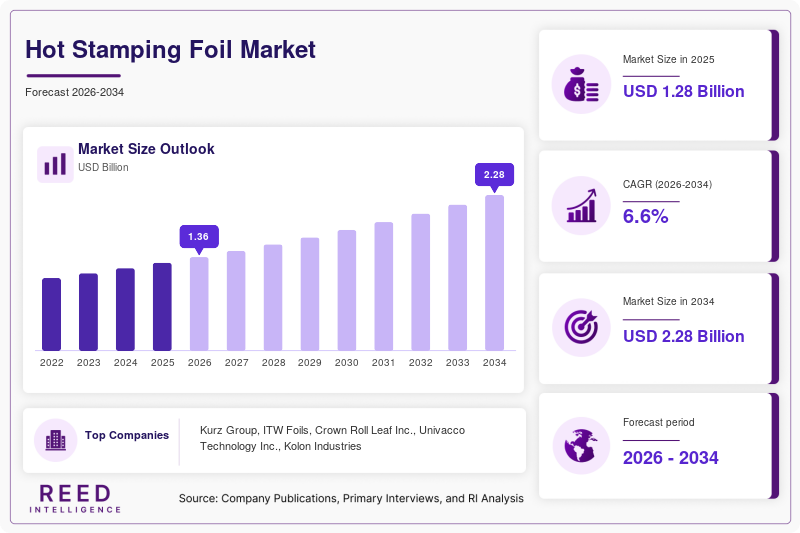
The global Hot Stamping Foil Market size was valued at approximately USD 1.28 billion in 2026 and is projected to reach USD 2.14 billion by 2034, expanding at a CAGR of 6.6% during the forecast period. The market reflects steady demand across packaging, printing, textiles, and consumer goods industries, where premium aesthetics and product differentiation remain important. The increasing use of decorative and functional foils in luxury packaging, particularly for cosmetics, personal care, and premium beverages, continues to drive consistent consumption patterns.
A major global factor supporting market growth is the rising emphasis on brand visibility and anti-counterfeiting measures. Manufacturers are increasingly integrating hot stamping foils with holographic and security features to enhance product authentication while improving visual appeal. This dual functionality has expanded the adoption of hot stamping foils beyond traditional decorative uses into security labeling and pharmaceutical packaging. Additionally, advancements in foil chemistry and compatibility with various substrates, including plastics and paperboard, have improved efficiency and broadened application scope.
Key Highlights
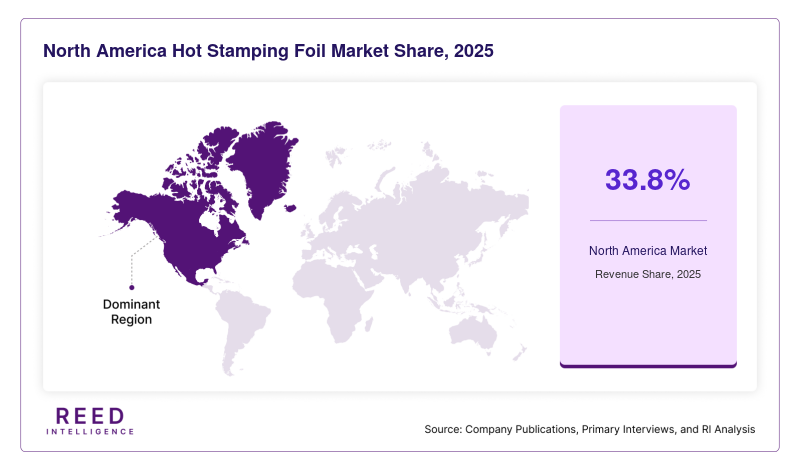
- North America dominated the market with a 33.8% share in 2025.
- Asia Pacific is expected to grow at the fastest CAGR of 7.4% during 2026–2034.
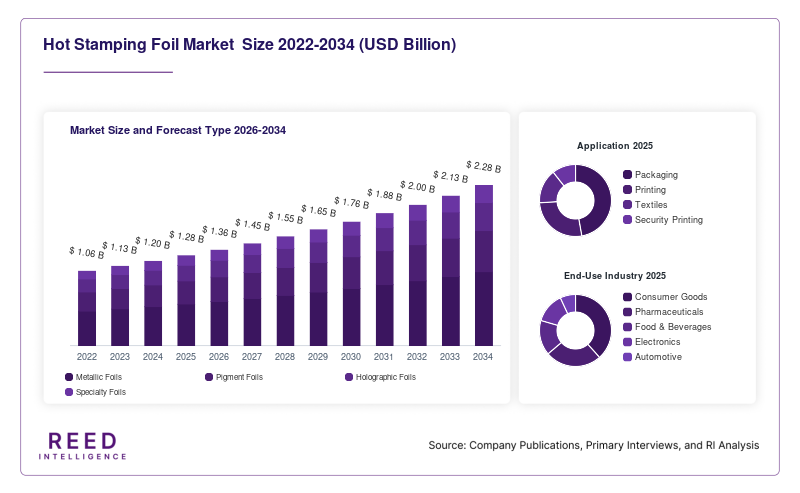
- By type, metallic foils accounted for the largest share of 42.6%, while holographic foils are projected to grow at a CAGR of 7.9%.
- By application, packaging led with a 48.3% share, whereas security printing is expected to expand at a CAGR of 7.6%.
- The United States remained the dominant country, with market values of USD 390 million in 2024 and USD 420 million in 2025.
Market Trends
Rising demand for sustainable and eco-friendly foils
Sustainability is becoming a central trend in the Hot Stamping Foil Market as regulatory pressure and consumer awareness continue to increase. Manufacturers are focusing on developing recyclable and biodegradable foil materials that reduce environmental impact without compromising performance. Water-based coatings and solvent-free adhesive systems are gaining traction, particularly in regions with strict environmental standards. Packaging companies are also demanding foils that align with circular economy principles, especially for paper-based packaging solutions. This trend is encouraging innovation in raw materials and production processes, leading to the introduction of thinner foils that use fewer resources while maintaining visual quality and durability.
Integration of advanced decorative technologies
Another notable trend is the integration of advanced decorative effects such as holography, micro-embossing, and multi-layer coatings. These technologies are increasingly used to create distinctive product appearances and enhance brand differentiation. Industries such as cosmetics and luxury goods are leveraging these features to improve shelf appeal and consumer engagement. Additionally, digital printing compatibility with hot stamping processes is expanding the customization capabilities of foils. This trend supports short-run production and personalized packaging, which is becoming more relevant in e-commerce and niche product segments. As a result, manufacturers are investing in research to improve precision, color consistency, and adaptability across substrates.
Market Drivers
Expansion of premium packaging across industries
The growth of premium packaging is a key driver of the Hot Stamping Foil Market. Brands across cosmetics, food and beverages, and consumer electronics are increasingly adopting high-quality packaging to enhance product positioning. Hot stamping foils provide a cost-effective method to achieve metallic finishes, embossing effects, and luxury aesthetics. This is particularly important in competitive retail environments where visual differentiation influences purchasing decisions. The rise in disposable income and urbanization in emerging economies has further increased demand for premium packaged goods, thereby boosting the use of decorative foils in packaging applications.
Increasing need for anti-counterfeiting solutions
The growing prevalence of counterfeit products has driven demand for secure packaging and labeling solutions. Hot stamping foils with holographic and tamper-evident features are widely used to prevent duplication and ensure product authenticity. Industries such as pharmaceuticals, electronics, and luxury goods rely heavily on these solutions to protect brand integrity and consumer safety. Governments and regulatory bodies are also mandating stricter labeling requirements, which has increased the adoption of advanced foil technologies. This driver is particularly significant in regions with high counterfeit activity, where companies are investing in innovative foil-based security features.
Market Restraint
Fluctuating raw material costs and environmental concerns
The Hot Stamping Foil Market faces challenges due to fluctuating prices of raw materials such as aluminum and polymer films. These cost variations can impact profit margins and pricing strategies for manufacturers. Additionally, environmental concerns related to foil disposal and recyclability pose constraints, especially in regions with strict sustainability regulations. Traditional foils often involve multi-layer structures that are difficult to recycle, leading to increased scrutiny from regulatory authorities. For example, packaging companies in Europe are under pressure to adopt eco-friendly materials, which can increase production costs and require significant investment in research and development. These factors may limit market growth in the short term.
Market Opportunities
Growth in emerging economies
Emerging markets in Asia Pacific, Latin America, and parts of Africa present significant opportunities for the Hot Stamping Foil Market. Rapid industrialization, urbanization, and rising consumer spending are driving demand for packaged goods and printed materials. Local manufacturers are expanding their production capacities to cater to increasing domestic consumption. Additionally, multinational companies are investing in these regions to establish manufacturing bases and distribution networks. The growing retail sector and e-commerce penetration further support the demand for visually appealing packaging, creating favorable conditions for market expansion.
Advancements in digital and hybrid printing technologies
Technological advancements in digital and hybrid printing are opening new avenues for hot stamping foil applications. These innovations enable faster production cycles, reduced waste, and greater design flexibility. Manufacturers are developing foils that are compatible with digital printing systems, allowing seamless integration into modern production workflows. This opportunity is particularly relevant for short-run and customized packaging, where traditional methods may not be cost-effective. The ability to combine digital printing with hot stamping enhances product aesthetics and functionality, making it an attractive solution for brands seeking differentiation.
Segmental Analysis
By Type
Metallic foils represent the dominant subsegment in the Hot Stamping Foil Market, accounting for approximately 42.6% of the market share in 2024. These foils are widely used due to their ability to provide a reflective and premium finish, making them suitable for packaging, labeling, and decorative applications. Industries such as cosmetics and beverages rely heavily on metallic foils to enhance product appeal. The versatility of these foils across different substrates, including paper, plastic, and leather, further supports their widespread adoption. Additionally, advancements in coating technologies have improved the durability and adhesion properties of metallic foils, making them a preferred choice for manufacturers.
Holographic foils are emerging as the fastest-growing subsegment, with a projected CAGR of 7.9% during the forecast period. The growth is driven by increasing demand for security features and anti-counterfeiting measures. Holographic foils offer unique visual effects that are difficult to replicate, making them ideal for authentication purposes. Industries such as pharmaceuticals and electronics are adopting these foils to protect products from counterfeiting. Furthermore, advancements in holographic technology have enabled the production of intricate designs and patterns, enhancing their application scope and driving market growth.
By Application
Packaging is the leading application segment, accounting for 48.3% of the market share in 2024. The segment’s dominance is attributed to the widespread use of hot stamping foils in consumer goods packaging. Companies use these foils to create visually appealing designs that enhance brand identity and attract consumers. The growth of e-commerce and retail sectors has further increased the demand for high-quality packaging solutions. Additionally, the ability of hot stamping foils to provide both decorative and functional benefits makes them a preferred choice in the packaging industry.
Security printing is the fastest-growing application segment, with a CAGR of 7.6% during the forecast period. The increasing need for product authentication and anti-counterfeiting measures is driving the adoption of hot stamping foils in this segment. Governments and regulatory bodies are mandating the use of secure labeling solutions, particularly in pharmaceuticals and consumer goods. The integration of holographic and tamper-evident features in foils enhances their effectiveness in preventing counterfeiting. This growth is further supported by technological advancements that improve the precision and reliability of security printing applications.
By End-Use Industry
The consumer goods industry dominates the market, accounting for a significant share in 2024. The demand for visually appealing packaging and branding solutions drives the use of hot stamping foils in this segment. Products such as cosmetics, personal care items, and packaged foods rely on decorative foils to enhance shelf appeal and brand recognition. The increasing competition among brands has further boosted the adoption of high-quality packaging solutions. Additionally, the growth of e-commerce has increased the importance of packaging aesthetics, supporting the demand for hot stamping foils.
The pharmaceutical industry is the fastest-growing end-use segment, with a projected CAGR of 7.2% during the forecast period. The growth is driven by the increasing need for secure and compliant packaging solutions. Hot stamping foils are used to incorporate anti-counterfeiting features and ensure product authenticity. Regulatory requirements for labeling and packaging are becoming more stringent, which has increased the adoption of advanced foil technologies. Furthermore, the expansion of the pharmaceutical industry in emerging markets is expected to drive demand for hot stamping foils.
Regional Analysis
North America
North America held a significant share of the Hot Stamping Foil Market in 2025, accounting for approximately 33.8% of global revenue. The region is expected to grow at a CAGR of 5.9% during the forecast period, supported by strong demand from packaging and printing industries. The presence of established manufacturers and advanced production technologies contributes to market stability. Additionally, the region’s focus on premium packaging and product differentiation continues to drive consistent demand for decorative foils.
The United States dominates the regional market due to its well-developed consumer goods and packaging sectors. A key growth factor is the increasing adoption of anti-counterfeiting solutions across industries such as pharmaceuticals and electronics. Companies are investing in advanced foil technologies to enhance product security and brand protection, which supports market expansion in the country.
Europe
Europe accounted for around 27.4% of the global market share in 2025 and is projected to grow at a CAGR of 5.7% through 2034. The region’s growth is driven by stringent environmental regulations and a strong focus on sustainable packaging solutions. Manufacturers are adopting eco-friendly materials and processes to comply with regulatory requirements, which is influencing market dynamics.
Germany leads the European market, supported by its robust manufacturing and packaging industries. A unique growth factor is the increasing demand for recyclable and biodegradable foils. Companies in the region are investing in research and development to create sustainable products, which is expected to drive innovation and market growth.
Asia Pacific
Asia Pacific is the fastest-growing region in the Hot Stamping Foil Market, with a CAGR of 7.4% during the forecast period. The region held a 25.6% market share in 2025, driven by rapid industrialization and expanding consumer markets. Increasing demand for packaged goods and rising disposable incomes are key factors contributing to market growth.
China dominates the regional market due to its large manufacturing base and growing consumer demand. A major growth factor is the expansion of the e-commerce sector, which requires visually appealing and durable packaging solutions. This has increased the adoption of hot stamping foils in various applications, supporting market growth.
Middle East & Africa
The Middle East & Africa region accounted for approximately 7.1% of the global market share in 2025 and is expected to grow at a CAGR of 5.4% during the forecast period. The market is supported by increasing investments in packaging and printing industries, particularly in urban centers.
The United Arab Emirates is a key market in the region, driven by its strong retail and luxury goods sectors. A unique growth factor is the rising demand for premium packaging in the cosmetics and fragrance industries. This has led to increased adoption of decorative foils to enhance product presentation.
Latin America
Latin America held a market share of around 6.1% in 2025 and is projected to grow at a CAGR of 5.6% through 2034. The region’s growth is driven by expanding consumer markets and increasing demand for packaged goods. Economic development and urbanization are contributing to market expansion.
Brazil dominates the regional market, supported by its large consumer base and growing retail sector. A key growth factor is the increasing adoption of branded packaging in food and beverage industries. Companies are using hot stamping foils to improve product visibility and attract consumers, which supports market growth.
Competitive Landscape
The Hot Stamping Foil Market is characterized by the presence of several established players focusing on product innovation and strategic partnerships. Companies are investing in research and development to introduce eco-friendly and high-performance foils. The competitive environment is moderately fragmented, with key players competing on product quality, pricing, and technological advancements.
A leading company in the market is Kurz Group, which has maintained a strong position through continuous innovation and global expansion. The company recently introduced a new range of sustainable foils designed to meet environmental standards while maintaining performance. Other major players are also focusing on expanding their product portfolios and strengthening their distribution networks to gain a competitive edge.
Key Players
- Kurz Group
- ITW Foils
- Crown Roll Leaf Inc.
- Univacco Technology Inc.
- Kolon Industries
- API Group
- Nakai Industrial Co. Ltd.
- Foilco Limited
- Katani Ltd.
- Infinity Foils Inc.
- Oike & Co. Ltd.
- Zhejiang Jinghua Laser Technology
- Shanghai Yuncheng Plate Making Group
- Daetwyler Holding Inc.
- Crown Holdings Inc.
Recent Developments
- A leading manufacturer launched a recyclable hot stamping foil range to address sustainability requirements in packaging.
- A major player expanded its production facility in Asia Pacific to meet increasing regional demand.
- A global company introduced advanced holographic foil solutions for enhanced anti-counterfeiting applications.
Hot Stamping Foil Market Segments
Type
- Metallic Foils
- Pigment Foils
- Holographic Foils
- Specialty Foils
Application
- Packaging
- Printing
- Textiles
- Security Printing
End-Use Industry
- Consumer Goods
- Pharmaceuticals
- Food & Beverages
- Electronics
- Automotive
By Region
- North America
- Europe
- APAC
- Middle East and Africa
- LATAM