Hour Meter Market Size, Share & Demand Report By Product Type (Analog Hour Meters, Digital Hour Meters), By Application (Industrial Equipment, Automotive, Agricultural Machinery, Marine Equipment), By End-Use Industry (Construction, Agriculture, Manufacturing, Transportation & Logistics) By Region & Segment Forecasts, 2026–2034
USD 3950
Market Overview
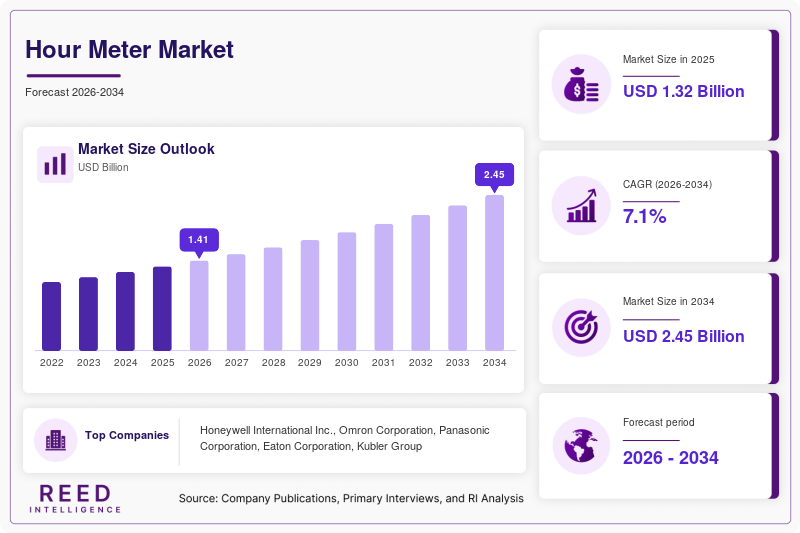
The Hour Meter Market size was valued at approximately USD 1.32 billion in 2026 and is projected to reach USD 2.28 billion by 2034, expanding at a CAGR of 7.1% during the forecast period (2026–2034). The market growth is primarily supported by the increasing adoption of maintenance tracking solutions across heavy equipment, industrial machinery, and automotive applications. Hour meters are essential tools used to measure operational time, enabling predictive maintenance, improved asset utilization, and cost optimization. As industries shift toward data-driven asset management, the demand for precise monitoring instruments continues to rise steadily.
A key global factor driving the market is the growing focus on equipment lifecycle management. Industries such as construction, agriculture, mining, and logistics increasingly rely on real-time usage tracking to minimize downtime and reduce repair costs. The integration of digital and IoT-enabled hour meters has further strengthened their value proposition, allowing remote monitoring and analytics, which enhances operational efficiency.
Key Highlights
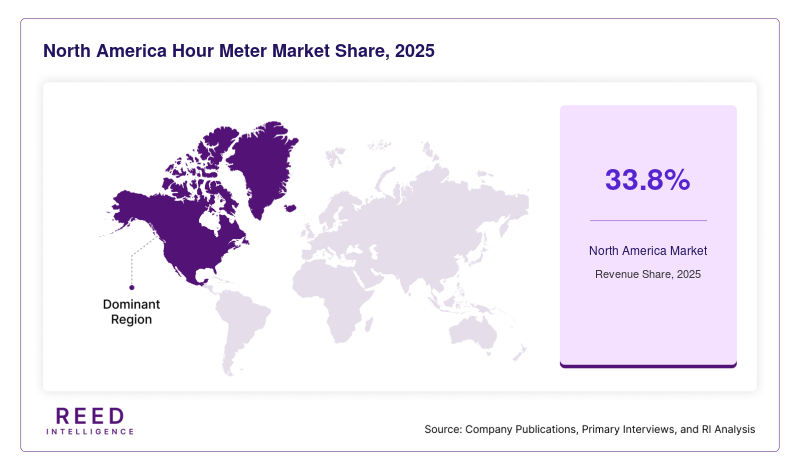
- North America dominated the market with a 33.8% share in 2025.
- Asia Pacific is expected to grow at the fastest CAGR of 8.6% during 2026–2034.
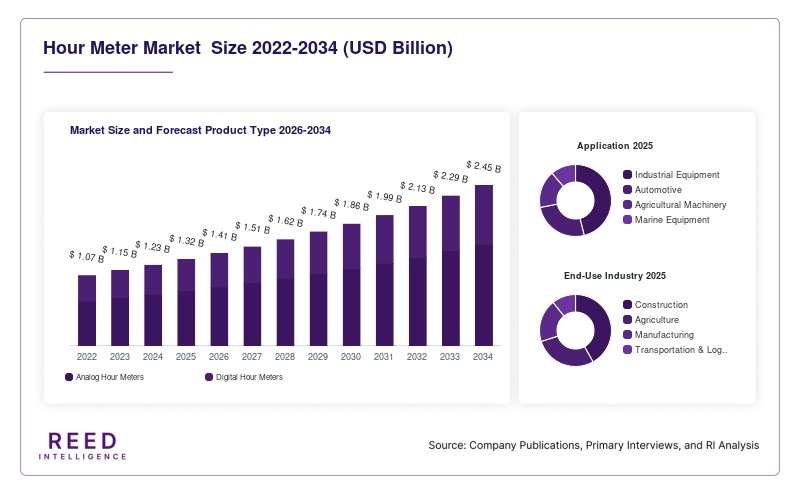
- By type, analog hour meters accounted for the largest share of 44.3%, while digital hour meters are projected to grow at a CAGR of 9.1%.
- By application, industrial equipment led with a 39.6% share, whereas automotive applications are expected to expand at a CAGR of 8.8%.
- The United States remained the dominant country, with market values of USD 420 million in 2024 and USD 455 million in 2025.
Market Trends
Rising integration of IoT-enabled hour meters in equipment monitoring
The market is witnessing a shift toward IoT-enabled hour meters that provide real-time monitoring and data analytics capabilities. These advanced devices allow operators to track equipment usage remotely, generate maintenance alerts, and analyze performance patterns. The integration with cloud-based platforms enables seamless data storage and accessibility, supporting decision-making processes. Industries such as construction and logistics are increasingly adopting these solutions to enhance operational efficiency and reduce unexpected downtime. Additionally, IoT-based hour meters support predictive maintenance strategies, which help extend equipment lifespan and lower operational costs. This trend is expected to reshape traditional hour meter applications by adding value beyond basic time tracking.
Growing preference for digital and multifunctional hour meters
There is a noticeable transition from conventional analog hour meters to digital and multifunctional variants. Digital hour meters offer higher accuracy, durability, and ease of installation compared to traditional counterparts. Many models now include features such as tachometer integration, maintenance reminders, and wireless connectivity. This shift is driven by the increasing need for compact, user-friendly, and feature-rich devices across industries. The automotive and agricultural sectors, in particular, are adopting digital solutions to streamline maintenance schedules and improve productivity. As technology advances, manufacturers are focusing on enhancing display interfaces, battery life, and compatibility with various equipment types, further accelerating the adoption of digital hour meters.
Market Drivers
Increasing demand for preventive maintenance across industries
The growing emphasis on preventive maintenance is a major factor driving the Hour Meter Market. Industries are increasingly adopting maintenance strategies that rely on accurate usage data to schedule servicing and avoid unexpected equipment failures. Hour meters play a crucial role in tracking machine operation time, enabling timely maintenance interventions. This approach helps reduce downtime, improve equipment reliability, and lower repair costs. Sectors such as construction, mining, and manufacturing heavily depend on these devices to maintain operational continuity. As companies aim to optimize asset performance and extend equipment lifespan, the demand for reliable hour meters continues to expand significantly.
Expansion of construction and agricultural machinery markets
The rapid growth of construction and agricultural sectors is fueling the demand for hour meters globally. Infrastructure development projects and mechanized farming practices are increasing the deployment of heavy equipment that requires efficient monitoring solutions. Hour meters are widely used in machinery such as excavators, tractors, and generators to track usage and schedule maintenance. The rising investments in infrastructure development, especially in emerging economies, are contributing to the increased adoption of these devices. Additionally, the need for improved productivity and operational efficiency in agriculture is further driving the integration of hour meters into modern farming equipment.
Market Restraint
Limited adoption in small-scale and low-budget operations
One of the key restraints affecting the Hour Meter Market is the limited adoption among small-scale businesses and low-budget operations. Many small enterprises and individual equipment owners often rely on manual tracking methods or basic maintenance schedules, which reduces the demand for hour meters. The cost of advanced digital and IoT-enabled devices can be a barrier for these users, especially in developing regions where budget constraints are significant. This limitation restricts market penetration and slows overall growth. Additionally, the lack of awareness regarding the benefits of hour meters in improving equipment efficiency and reducing maintenance costs further hinders adoption. As a result, manufacturers face challenges in expanding their customer base in price-sensitive markets.
Market Opportunities
Increasing adoption of telematics and connected equipment
The integration of telematics systems with hour meters presents a significant growth opportunity for the market. Connected equipment solutions allow users to monitor machine performance, location, and usage data in real time. Hour meters integrated with telematics platforms enhance operational visibility and enable predictive maintenance strategies. This trend is gaining traction in industries such as transportation, construction, and logistics, where efficiency and asset tracking are critical. The growing adoption of smart equipment is expected to create new avenues for manufacturers to develop advanced, connected hour meter solutions that cater to evolving industry needs.
Growth potential in emerging economies
Emerging economies offer substantial growth opportunities for the Hour Meter Market due to rapid industrialization and infrastructure development. Countries in Asia Pacific, Latin America, and Africa are witnessing increased investments in construction, mining, and agriculture, leading to higher demand for machinery and monitoring devices. As awareness about preventive maintenance and operational efficiency increases, the adoption of hour meters is expected to rise significantly. Additionally, the availability of cost-effective digital solutions is making these devices more accessible to a broader customer base. Manufacturers can capitalize on this opportunity by expanding their presence in these regions and offering tailored products that meet local market requirements.
Segmental Analysis
By Type
Analog hour meters held the dominant position in 2024, accounting for approximately 44.3% of the market share. These devices are widely used due to their simplicity, reliability, and cost-effectiveness. Analog hour meters are commonly found in older equipment and applications where basic time tracking is sufficient. Their durability and ease of installation make them suitable for harsh operating conditions, particularly in construction and agricultural sectors. Despite the growing adoption of digital solutions, analog devices continue to maintain a strong presence due to their affordability and widespread availability.
Digital hour meters are the fastest-growing subsegment, expected to expand at a CAGR of 9.1% during the forecast period. The growth is driven by the increasing demand for advanced features such as precise time tracking, maintenance alerts, and connectivity options. Digital hour meters offer enhanced functionality and integration capabilities, making them suitable for modern equipment. The adoption of these devices is increasing across industries that require accurate monitoring and data analysis, further supporting their growth.
By Application
Industrial equipment emerged as the leading application segment, accounting for around 39.6% of the market share in 2024. Hour meters are extensively used in machinery such as generators, compressors, and construction equipment to track operational hours and schedule maintenance. The growing emphasis on equipment efficiency and reliability is driving the adoption of hour meters in industrial applications. These devices help reduce downtime and improve productivity by ensuring timely maintenance.
Automotive applications are the fastest-growing segment, with a projected CAGR of 8.8%. The increasing use of hour meters in commercial vehicles and fleet management systems is driving growth in this segment. These devices enable accurate tracking of engine hours, supporting maintenance planning and operational efficiency. The rise in transportation and logistics activities further contributes to the demand for hour meters in automotive applications.
By End-Use Industry
The construction sector dominated the market in 2024, accounting for approximately 36.8% of the total share. The extensive use of heavy machinery in construction projects drives the demand for hour meters to monitor equipment usage and ensure timely maintenance. The growth of infrastructure development projects worldwide further supports the adoption of these devices in the construction industry.
The agriculture sector is expected to be the fastest-growing end-use segment, with a CAGR of 8.4%. The increasing mechanization of farming operations and the need for efficient equipment management are driving the adoption of hour meters in this sector. These devices help farmers track machine usage, optimize maintenance schedules, and improve productivity, contributing to their growing demand.
Regional Analysis
North America
North America accounted for approximately 33.8% of the Hour Meter Market share in 2025 and is expected to grow at a CAGR of 6.5% during the forecast period. The region’s growth is driven by the widespread adoption of advanced equipment monitoring technologies and the presence of well-established industrial sectors. The increasing use of IoT-enabled devices in construction and manufacturing further supports market expansion.
The United States remains the dominant country in this region, driven by its strong infrastructure development and high adoption of advanced maintenance practices. A unique growth factor is the increasing integration of telematics in heavy machinery, which enhances equipment monitoring capabilities and drives demand for advanced hour meters.
Europe
Europe held a significant share of around 25.6% in 2025 and is projected to grow at a CAGR of 6.8% through 2034. The market is supported by stringent regulations related to equipment maintenance and safety standards. The adoption of digital hour meters is increasing across industrial and automotive sectors in the region.
Germany leads the European market due to its strong manufacturing base and technological advancements. A key growth factor is the emphasis on industrial automation, which drives the demand for precise monitoring tools such as hour meters in various applications.
Asia Pacific
Asia Pacific is the fastest-growing region, with a projected CAGR of 8.6% from 2026 to 2034, and accounted for approximately 22.4% of the market share in 2025. The region’s growth is fueled by rapid industrialization, infrastructure development, and increasing mechanization in agriculture.
China dominates the regional market, supported by large-scale construction activities and industrial expansion. A unique growth factor is the rising adoption of smart equipment and digital technologies, which boosts the demand for advanced hour meters.
Middle East & Africa
The Middle East & Africa region captured around 9.2% of the market share in 2025 and is expected to grow at a CAGR of 6.3%. The growth is driven by increasing investments in infrastructure and construction projects, particularly in Gulf countries.
Saudi Arabia is the leading country in this region, benefiting from large-scale infrastructure initiatives. A key growth factor is the expansion of oil and gas operations, where hour meters are widely used for equipment monitoring and maintenance.
Latin America
Latin America accounted for approximately 9.0% of the market share in 2025 and is projected to grow at a CAGR of 6.7% during the forecast period. The market growth is supported by the expansion of agricultural and mining activities in the region.
Brazil dominates the market due to its strong agricultural sector and increasing use of mechanized equipment. A unique growth factor is the rising demand for efficient farm management solutions, which drives the adoption of hour meters in agricultural machinery.
Competitive Landscape
The Hour Meter Market is moderately fragmented, with several established players competing on product innovation, pricing, and technological advancements. Leading companies are focusing on developing digital and IoT-enabled hour meters to meet evolving industry demands. The competitive landscape is characterized by strategic partnerships, product launches, and expansions to strengthen market presence.
One of the leading players in the market is Honeywell International Inc., known for its advanced industrial monitoring solutions. The company has recently introduced a new range of connected hour meters with enhanced data analytics capabilities, targeting industrial and commercial applications. Other companies are also investing in research and development to introduce innovative products and expand their product portfolios, ensuring sustained competition in the market.
Key Players
- Honeywell International Inc.
- Omron Corporation
- Panasonic Corporation
- Eaton Corporation
- Kubler Group
- Redington Counters
- Trumeter Company Ltd.
- Curtis Instruments Inc.
- Hengstler GmbH
- Veeder-Root
- Schneider Electric
- Danaher Corporation
- Siemens AG
- Rockwell Automation
- ABB Ltd.
Recent Developments
- Honeywell introduced a new IoT-enabled hour meter series designed for industrial automation applications, enhancing remote monitoring capabilities.
- Omron Corporation launched a compact digital hour meter with extended battery life and improved accuracy for automotive applications.
- Eaton Corporation expanded its product portfolio by introducing multifunctional hour meters integrated with tachometers for heavy machinery.
Hour Meter Market Segments
Product Type
- Analog Hour Meters
- Digital Hour Meters
Application
- Industrial Equipment
- Automotive
- Agricultural Machinery
- Marine Equipment
End-Use Industry
- Construction
- Agriculture
- Manufacturing
- Transportation & Logistics
By Region
- North America
- Europe
- APAC
- Middle East and Africa
- LATAM