Household Coffee Grinding Machines Market Size, Share, Demand Report By Equipment Type (Burr Grinders, Blade Grinders, Smart Connected Grinders), By Operation Mode (Manual Grinders, Electric Grinders, Automatic Programmable Grinders), By Distribution Channel (Online Retail, Offline Retail, Direct-to-Consumer Sales) and Regional Forecasts, 2026–2034
USD 3950
Market Overview
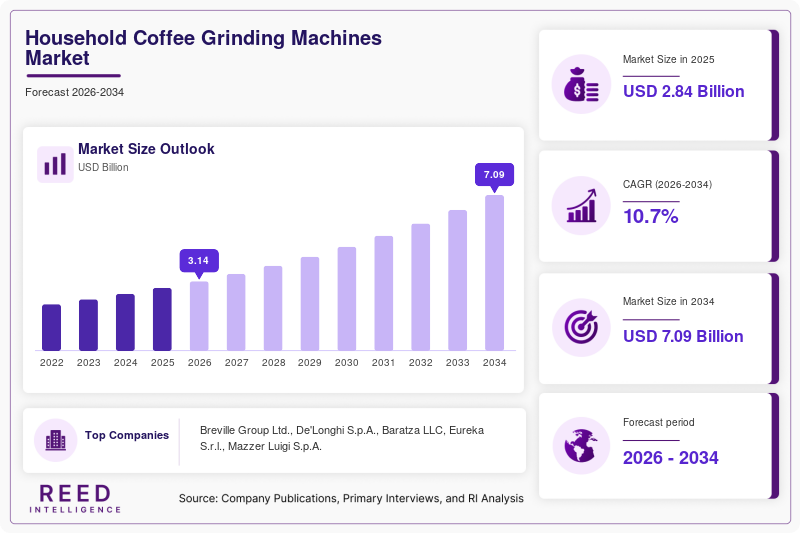
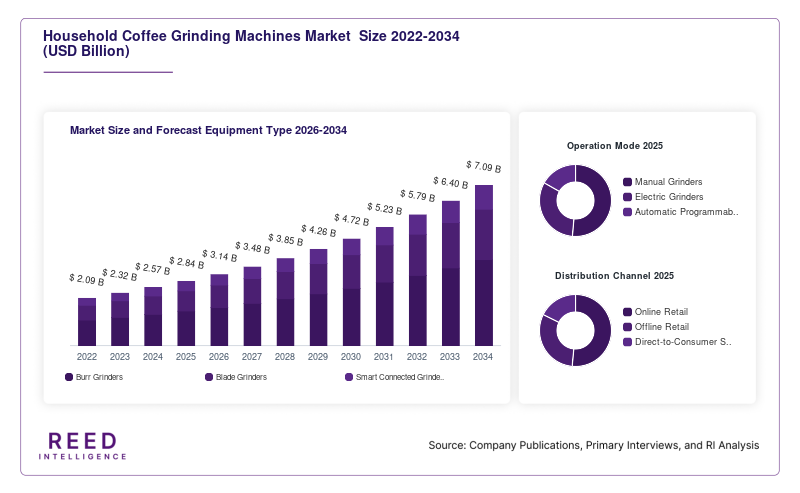
The global Household Coffee Grinding Machines Market size was valued at USD 2.84 billion in 2026 and is projected to reach USD 6.41 billion by 2034, expanding at a CAGR of 10.7% during 2026–2034. The market continues to gain momentum as consumers increasingly prefer freshly ground coffee at home and seek greater control over flavor, aroma, and brewing quality. Rising awareness regarding specialty coffee consumption, coupled with growing investments in premium kitchen appliances, has accelerated adoption across both developed and emerging economies.
The shift toward home-based coffee preparation has significantly transformed purchasing behavior. Consumers are moving beyond traditional instant coffee consumption and embracing bean-to-cup experiences. Household coffee grinding machines have become an important component of modern coffee routines, enabling users to customize grind size according to brewing methods such as espresso, pour-over, French press, and cold brew. Technological improvements, including quieter motors, precision burr systems, digital controls, and compact designs, are further supporting market expansion.
Key Highlights
- North America dominated the market with a 35.1% share in 2025, while Asia Pacific is expected to grow at the fastest CAGR of 12.3% during 2026–2034.
- By equipment type, burr grinders accounted for the largest share of 61.4%, while smart connected grinders are projected to grow at a CAGR of 13.5%.
- By operation mode, electric grinders led with a 73.8% share, whereas automatic programmable grinders are expected to expand at a CAGR of 12.8%.
- By distribution channel, online retail accounted for the largest share of 46.2%, while direct-to-consumer sales are projected to grow at a CAGR of 13.1%.
- The United States remained the dominant country, with market values of USD 690 million in 2024 and USD 755 million in 2025.
Market Trends
Growing Adoption of Smart and Connected Coffee Appliances
The integration of smart technologies into household coffee grinding machines has emerged as a major trend influencing market development. Consumers increasingly seek convenience, customization, and connectivity in kitchen appliances. Manufacturers are responding by introducing grinders equipped with mobile application support, programmable settings, grind memory functions, and digital interfaces. These features allow users to save preferred grinding profiles and achieve greater consistency across different brewing methods. The growing penetration of smart homes and connected ecosystems is creating favorable conditions for adoption. Consumers value automation and precision, particularly those investing in premium coffee experiences at home. As wireless connectivity becomes more affordable and consumer awareness increases, smart grinders are expected to gain wider acceptance across both mature and developing markets.
Rising Demand for Specialty Coffee and Home Brewing Experiences
The specialty coffee movement continues to reshape consumer preferences globally. Coffee enthusiasts are increasingly purchasing premium beans from local roasters and international suppliers to recreate café-quality beverages at home. This shift has elevated the importance of grind consistency, freshness, and customization. Household coffee grinding machines have become essential tools for achieving desired brewing outcomes across espresso, drip coffee, French press, and pour-over methods. Social media influence, coffee education platforms, and growing exposure to artisanal coffee culture have accelerated consumer interest. Younger demographics are particularly willing to invest in equipment that improves beverage quality. This trend is encouraging manufacturers to introduce premium grinding solutions that cater to both beginner users and experienced coffee enthusiasts.
Market Drivers
Expanding Consumer Preference for Freshly Ground Coffee
Consumer preference for freshly ground coffee remains a primary factor driving market growth. Fresh grinding preserves volatile aromatic compounds and enhances flavor quality compared with pre-ground alternatives. As awareness regarding coffee freshness increases, more households are investing in dedicated grinding equipment. Educational content from coffee professionals and brewing communities has strengthened consumer understanding of the relationship between grind quality and beverage taste. The growing popularity of premium coffee beans further supports demand because whole beans require grinding before brewing. This driver is particularly visible in urban areas where specialty coffee consumption is increasing rapidly. The desire to replicate professional coffee experiences at home continues to encourage purchases across multiple product categories and price ranges.
Increasing Availability Through Digital Retail Channels
The rapid expansion of e-commerce has significantly improved product visibility and accessibility. Consumers can compare specifications, prices, and reviews across numerous brands before making purchasing decisions. Online retail platforms provide manufacturers with direct access to wider audiences, including consumers in regions where specialty appliance stores are limited. Digital marketing campaigns, influencer partnerships, and targeted advertising have increased awareness of household coffee grinding machines among first-time buyers. Subscription-based coffee services often recommend grinders as complementary products, further boosting sales. Additionally, online channels facilitate the launch of niche and premium models that may not be available through traditional retail outlets. This expanding distribution network continues to contribute positively to market growth worldwide.
Market Restraint
Price Sensitivity and Competition from Pre-Ground Coffee Products
Despite positive growth prospects, price sensitivity remains a significant restraint affecting broader market penetration. High-quality household coffee grinding machines, particularly burr grinder models, often require a larger initial investment than basic kitchen appliances. Consumers in cost-conscious markets may hesitate to purchase dedicated grinding equipment when pre-ground coffee products remain widely available and convenient. The challenge becomes more pronounced in developing economies where disposable income levels vary considerably. Furthermore, some consumers perceive grinding as an additional step that complicates coffee preparation routines. Manufacturers must therefore balance product quality, affordability, and convenience to attract new buyers. Intense competition from ready-to-use coffee solutions also limits adoption among casual coffee drinkers. These factors can slow purchasing decisions and create pressure on manufacturers to offer competitively priced products without compromising performance, durability, or user experience.
Market Opportunities
Expansion Across Emerging Economies
Emerging economies present substantial opportunities for household coffee grinding machine manufacturers. Rising middle-class populations, increasing urbanization, and improving disposable incomes are encouraging consumers to purchase premium kitchen appliances. Coffee culture is expanding rapidly across several Asian, Latin American, and Middle Eastern countries, creating favorable demand conditions. International coffee chains and local specialty cafés are educating consumers about coffee quality and brewing methods, indirectly supporting grinder adoption. Manufacturers can capitalize on these trends by introducing affordable entry-level models tailored to regional preferences. Strategic partnerships with e-commerce platforms and local distributors can further improve market reach. As consumer awareness regarding freshly ground coffee increases, emerging markets are expected to contribute a growing share of future industry revenues.
Product Innovation Focused on Sustainability and User Experience
Sustainability-oriented innovation represents another major opportunity for market participants. Consumers increasingly favor products that combine performance with environmental responsibility. Manufacturers are exploring recyclable materials, energy-efficient motors, longer product lifecycles, and repair-friendly designs to meet evolving expectations. At the same time, user experience improvements such as noise reduction, compact footprints, and enhanced grinding precision continue to attract buyers. Multifunctional appliances that integrate grinding with brewing preparation workflows may also gain popularity. The premium appliance segment remains particularly receptive to innovation-driven products. Companies capable of combining sustainability, convenience, and advanced functionality are likely to strengthen their competitive positions while attracting environmentally conscious consumers seeking long-term value.
Segmental Analysis
By Equipment Type
Burr grinders dominated the equipment type segment and accounted for approximately 61.4% of the market share in 2024. Their leadership position is primarily attributed to superior grinding consistency, precise particle size control, and compatibility with a wide range of brewing methods. Consumers seeking premium coffee experiences often prefer burr grinders because they produce uniform grounds that contribute to balanced extraction and improved flavor quality. The segment also benefits from increasing demand among specialty coffee enthusiasts who prioritize brewing precision. Manufacturers continue to introduce enhanced burr designs, quieter motors, and compact product formats, helping sustain strong adoption rates across residential markets worldwide.
Smart connected grinders represent the fastest-growing equipment type and are projected to expand at a CAGR of 13.5% through 2034. Growth is driven by increasing demand for automation, customization, and integration with digital ecosystems. These grinders allow users to control settings through mobile applications, save preferred profiles, and achieve consistent results across multiple brewing methods. Smart technology appeals particularly to younger consumers who value convenience and personalized experiences. As connected-home adoption increases globally, manufacturers are investing in software-enabled functionality and advanced user interfaces. Continuous innovation in connectivity features is expected to accelerate adoption throughout the forecast period.
By Operation Mode
Electric grinders accounted for the largest share of the operation mode segment, representing approximately 73.8% of global revenue in 2024. Their dominance reflects consumer preference for convenience, speed, and ease of use. Electric models significantly reduce manual effort while providing consistent grinding performance. The segment benefits from rising household appliance ownership and increasing demand for time-saving kitchen solutions. Manufacturers have expanded product portfolios to include compact designs, multiple grind settings, and improved energy efficiency. These enhancements make electric grinders suitable for a broad range of consumers, from casual coffee drinkers to dedicated enthusiasts seeking precision and reliability in everyday brewing routines.
Automatic programmable grinders are expected to register the fastest growth, advancing at a CAGR of 12.8% during the forecast period. Growth is supported by increasing consumer demand for customized coffee preparation and simplified operation. These products allow users to preselect grind sizes, quantities, and timing preferences, ensuring repeatable results. The segment also benefits from growing interest in smart appliances and connected kitchen ecosystems. Manufacturers are incorporating advanced controls and intuitive interfaces that enhance user convenience. As consumers continue to prioritize efficiency and consistency, automatic programmable grinders are expected to gain significant traction across residential markets.
By Distribution Channel
Online retail emerged as the dominant distribution channel, capturing approximately 46.2% of the market share in 2024. The segment benefits from broad product availability, competitive pricing, and convenient purchasing experiences. Consumers increasingly rely on digital platforms to compare specifications, read reviews, and evaluate product performance before making purchasing decisions. Online channels also enable manufacturers to reach customers beyond traditional retail boundaries. Promotional campaigns, influencer marketing, and direct digital engagement contribute to higher product visibility. As internet penetration and e-commerce adoption continue to increase globally, online retail is expected to maintain its leading position within the market.
Direct-to-consumer sales represent the fastest-growing distribution channel and are projected to expand at a CAGR of 13.1% through 2034. Manufacturers increasingly use brand-owned websites and digital platforms to build direct relationships with customers. This approach provides greater control over branding, customer experience, and product education. Direct engagement also enables companies to gather consumer insights and introduce personalized offerings. Subscription programs, loyalty initiatives, and bundled coffee equipment packages further strengthen channel growth. As digital commerce evolves and brands seek stronger customer connections, direct-to-consumer strategies are expected to become increasingly important for long-term market expansion.
Regional Analysis
North America
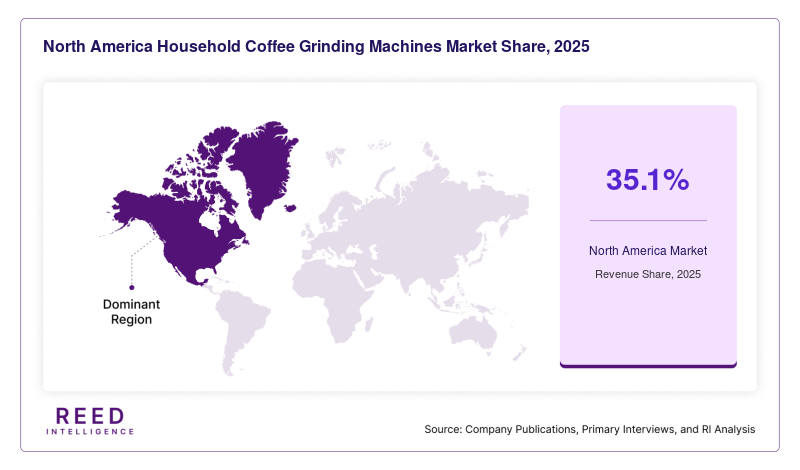
North America accounted for approximately 35.1% of the global market share in 2025 and maintained its position as the largest regional market. The region is expected to expand at a CAGR of 9.8% through 2034, supported by strong household coffee consumption and widespread adoption of premium kitchen appliances. Consumers in the region continue to prioritize convenience and beverage quality, encouraging demand for advanced grinding equipment. High penetration of specialty coffee culture and established distribution networks further contribute to sustained market growth.
The United States remained the dominant country within North America. A key growth factor is the widespread popularity of home espresso preparation and premium brewing systems. Consumers increasingly invest in complementary equipment to enhance beverage consistency and freshness. Growing interest in specialty coffee subscriptions and direct bean purchases has further increased the importance of household grinding solutions, creating favorable conditions for continued market expansion.
Europe
Europe represented approximately 28.4% of global market revenue in 2025 and is projected to register a CAGR of 9.4% during the forecast period. The region benefits from a strong coffee-drinking tradition and high consumer awareness regarding brewing quality. Demand for burr grinders remains particularly strong due to consumer preference for precision and consistency. Manufacturers continue to introduce compact and energy-efficient products tailored to urban households and smaller living spaces.
Germany emerged as the dominant country within Europe. A unique growth factor is the region’s emphasis on premium engineering and durable household appliances. Consumers often prioritize long product lifecycles and performance reliability when making purchasing decisions. This preference supports demand for high-quality coffee grinding machines and encourages manufacturers to focus on advanced grinding technologies and durable construction materials.
Asia Pacific
Asia Pacific held around 22.7% of the market share in 2025 and is anticipated to record the fastest CAGR of 12.3% between 2026 and 2034. Rapid urbanization, expanding middle-income populations, and increasing exposure to global coffee culture are supporting market development. Coffee consumption is rising across several countries as consumers adopt modern lifestyles and premium beverage preferences. The growth of digital retail channels further strengthens accessibility and product awareness throughout the region.
China remains the dominant country in Asia Pacific. A major growth factor is the rapid expansion of specialty coffee chains and independent cafés that influence consumer behavior. Exposure to premium coffee experiences encourages households to purchase equipment capable of delivering similar results at home. Growing interest in premium kitchen appliances and smart-home technologies also contributes significantly to market expansion.
Middle East & Africa
The Middle East & Africa accounted for approximately 7.2% of the global market in 2025 and is forecast to grow at a CAGR of 10.1% through 2034. Although market penetration remains relatively modest, increasing urban development and changing consumer lifestyles are creating new opportunities. Coffee consumption continues to expand in metropolitan areas where younger consumers are exploring specialty beverages and premium home preparation methods.
The United Arab Emirates led regional demand due to its strong hospitality culture and growing specialty coffee ecosystem. A unique growth factor is the influence of premium lifestyle trends and luxury household products. Consumers increasingly seek sophisticated appliances that complement modern kitchens while delivering enhanced beverage quality. These preferences support rising adoption of advanced household coffee grinding machines.
Latin America
Latin America captured nearly 6.6% of the global market share in 2025 and is expected to achieve a CAGR of 10.4% during the forecast period. The region benefits from its strong association with coffee production and growing domestic appreciation for premium coffee experiences. Consumers are becoming more interested in controlling brewing variables and preserving bean freshness, which supports household grinder demand across multiple income groups.
Brazil remained the dominant country within Latin America. One unique growth factor is the growing domestic consumption of premium locally sourced coffee beans. Consumers increasingly value freshness and origin-specific flavors, encouraging investments in grinding equipment. The presence of a large coffee-producing industry also supports awareness regarding bean quality, creating favorable long-term growth prospects for household coffee grinding machines.
Competitive Landscape
The Household Coffee Grinding Machines Market is moderately competitive, with global appliance manufacturers and specialized coffee equipment companies competing through innovation, product quality, and distribution reach. Companies continue to invest in advanced grinding technologies, digital functionality, and premium user experiences to strengthen market positioning. Product differentiation increasingly focuses on grind consistency, noise reduction, smart connectivity, and sustainability features.
Breville Group Ltd. remains a leading participant due to its strong brand recognition and extensive portfolio of premium coffee preparation equipment. The company recently introduced upgraded grinding systems designed to improve precision and reduce operational noise. Other major participants continue expanding their product offerings to address evolving consumer preferences.
Key Players
- Breville Group Ltd.
- De'Longhi S.p.A.
- Baratza LLC
- Eureka S.r.l.
- Mazzer Luigi S.p.A.
- Fellow Industries Inc.
- Capresso
- Krups GmbH
- KitchenAid
- Hamilton Beach Brands Holding Company
- Cuisinart
- Wilfa AS
- Bodum Holding AG
- Hario Co., Ltd.
- Melitta Group
Recent Developments
- In 2025, leading coffee appliance manufacturers expanded their production capacity for precision burr grinding systems to meet rising global demand for premium household coffee grinding machines and improved supply chain efficiency across North America and Europe.
- In 2025, several brands introduced next-generation smart coffee grinders featuring app-based controls, grind memory settings, and IoT-enabled connectivity to enhance customization and support growing smart kitchen ecosystems.
- In 2024, a major household appliance company launched a compact high-performance grinder designed for urban households, focusing on noise reduction technology and multi-brew compatibility for espresso, pour-over, and French press.
- In 2024, manufacturers increased investment in research and development programs aimed at improving burr durability, grind consistency, and energy-efficient motor systems to extend product lifespan and enhance performance.
- In 2025, strategic partnerships between coffee equipment brands and specialty coffee roasters expanded, enabling bundled product offerings and accelerating adoption of home brewing solutions across emerging and developed markets.
Household Coffee Grinding Machines Market Segments
Equipment Type
- Burr Grinders
- Blade Grinders
- Smart Connected Grinders
Operation Mode
- Manual Grinders
- Electric Grinders
- Automatic Programmable Grinders
Distribution Channel
- Online Retail
- Offline Retail
- Direct-to-Consumer Sales
By Region
- North America
- Europe
- APAC
- Middle East and Africa
- LATAM