Household Vacuum Cleaner Market Size, Share & Trends Analysis Report By Product Type (Canister, Upright, Stick, Handheld, Robotic), By Power Source (Corded, Cordless), By Dust Collection Type (Bagged, Bagless), By Application (Hard Floors, Carpets & Rugs, Upholstery & Above-Floor Cleaning), By Distribution Channel (Online, Offline), By Price Range (Economy, Mid-Range, Premium) Forecasts, 2026–2034
USD 3950
Household Vacuum Cleaner Market Size
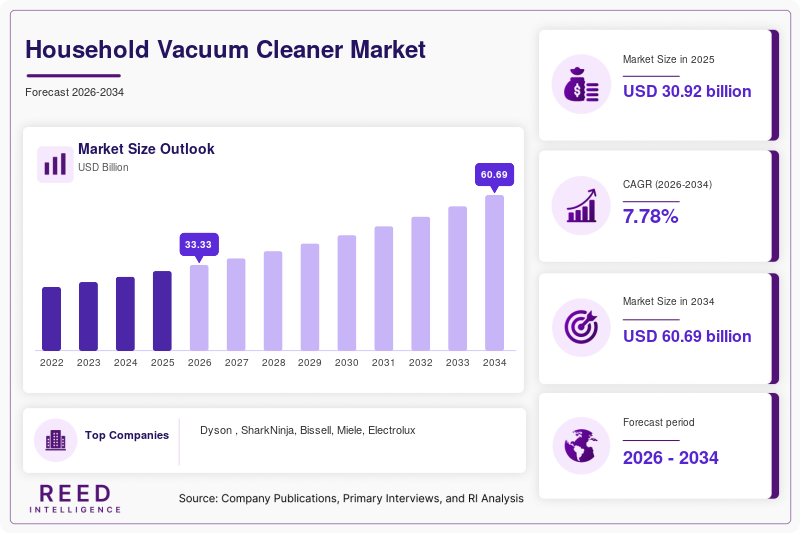
The Household Vacuum Cleaner Market was valued at USD 30.92 billion in 2025 and is estimated at USD 33.33 billion in 2026. Based on the supplied forecast, the market is projected to reach USD 60.69 billion by 2034, at a stated CAGR of 7.78% during 2026–2034.
The supplied 2026 and 2034 market values imply a CAGR of approximately 7.78%, making the forecast internally consistent after rounding. The report retains the supplied global values as its controlling estimates.
Household vacuum cleaners include appliances designed to remove dust, dirt, debris and other particles from residential floors, carpets, upholstery and other surfaces. The category spans conventional canister and upright models, cordless stick and handheld products, and robotic systems that automate routine cleaning. Wet-and-dry products are included where they are designed and marketed for household cleaning.
Competition increasingly centers on convenience and task-specific performance rather than suction power alone. Cordless models reduce setup and storage friction; robotic products automate recurring cleaning; and newer designs focus on hair detangling, filtration, maneuverability and multi-surface performance. Dyson's 2025 V16 Piston Animal launch, for example, featured an anti-tangle cleaner head and automatic adjustment to different floor types. These product features indicate the direction of competition, although a product launch alone does not establish category-wide adoption.
The market's growth will depend on household purchasing power, replacement cycles, urban living patterns, product affordability, battery performance, maintenance costs and consumers' willingness to pay for automation. Premium innovation can increase average selling prices, but high prices and the availability of lower-cost alternatives can limit adoption in more price-sensitive households.
Household Vacuum Cleaner Market Drivers
Cordless Designs Make Frequent Cleaning More Convenient
Cordless vacuum cleaners remove the need to find a power outlet or manage a cord while cleaning. This can make quick, frequent cleaning easier and reduce friction for households that need to move between rooms, stairs and different surfaces.
Product development is focused on improving the balance among suction, weight, runtime, charging, filtration and maneuverability. Dyson's May 2025 PencilVac launch, for example, emphasized a slim form factor and a redesigned cleaner head intended to prevent long hair from tangling around the brush bar.
The commercial mechanism is that convenience can increase the perceived value of a cordless appliance and support replacement or upgrade purchases. However, battery life, replacement-battery availability, cleaning performance at different power settings and purchase price remain important constraints. Some households may still prefer corded products for longer cleaning sessions or larger areas.
Robotic Vacuum Cleaners Automate Routine Floor Care
Robotic vacuum cleaners address the time and effort associated with regular floor cleaning. Scheduling, mapping, obstacle avoidance and automated docking allow a device to clean with limited manual intervention once the home and product have been set up.
Higher-feature products may add self-emptying docks, mop functions and automated maintenance. These capabilities can raise selling prices and create differentiation in a competitive category. They may be particularly attractive to consumers who value convenience or want to maintain floor cleanliness between deeper manual cleaning sessions.
The limitations are practical. Robots can struggle with clutter, cords, stairs, uneven thresholds and certain floor transitions. Docking stations require space, while brushes, filters and water-related components may need periodic attention. Adoption therefore depends on how well a device performs in real homes rather than on automation claims alone.
Product Innovation Encourages Replacement and Premiumization
Vacuum cleaner manufacturers compete through motor design, brush-roll engineering, filtration, weight reduction, surface detection and improved user interfaces. Features such as anti-tangle brush heads, dust illumination, automated suction adjustment and easier bin emptying can address identifiable consumer frustrations.
Dyson's September 2025 V16 Piston Animal launch highlighted a cleaner head designed to detangle long hair, automatic adjustment across floor types and a compacting dust bin. These features illustrate how manufacturers are differentiating products through the cleaning experience and maintenance convenience.
Product innovation can encourage consumers to replace older appliances or move into a higher-priced tier. Nevertheless, premiumization depends on demonstrable performance and affordability. If buyers perceive new features as incremental or difficult to maintain, they may retain existing products or select less expensive alternatives.
Household Vacuum Cleaner Market Restraints
Premium Pricing Limits Adoption of Feature-Rich Models
Advanced cordless and robotic vacuum cleaners can carry higher purchase prices than conventional models. Battery packs, sensors, navigation systems, docking stations and additional cleaning functions contribute to product cost.
Consumers may not be willing or able to pay more for features that offer only a modest improvement over an existing appliance. This is especially relevant where a household has limited cleaning needs or can purchase a basic model that adequately performs its primary task.
Manufacturers can address this constraint through entry-level models, product-tier differentiation, promotions and replacement-part availability. The trade-off is that lower-priced products may generate less revenue per unit and face intense competition.
Battery Runtime and Replacement Costs Affect Cordless Products
Cordless vacuum cleaners depend on battery capacity, motor efficiency, cleaning mode and the power required for different surfaces. High-power modes can shorten runtime, while battery aging can reduce usable operating time over the product's life.
Consumers may also consider the cost and availability of replacement batteries. If a battery is difficult to replace or expensive relative to the original product, the perceived lifetime value can deteriorate. Manufacturers must balance compact design and lightweight handling with adequate runtime and serviceability.
Robotic Navigation Has Practical Limitations
Robotic cleaners need to navigate varied home environments that may include clutter, cords, dark surfaces, thresholds, furniture and different floor coverings. Mapping and obstacle-avoidance systems can improve navigation, but they do not eliminate every failure mode.
A robot may still require preparation of the cleaning area, manual rescue or periodic deep cleaning by another appliance. When advertised autonomy does not match a household's layout, consumer satisfaction can decline. Product demonstrations and navigation claims should therefore be grounded in representative test conditions.
Household Vacuum Cleaner Market Opportunities
Robotic Vacuum Cleaners with Improved Navigation and Maintenance
Robotic vacuum cleaners provide opportunities for product development around obstacle recognition, mapping, route planning, self-emptying and simplified maintenance. More capable systems may appeal to households that want regular floor cleaning with less manual effort.
The opportunity is not limited to adding sensors. Improvements in handling clutter, recognizing room boundaries, managing carpets and simplifying brush or filter maintenance can make products more useful in daily life. Manufacturers that can demonstrate reliable performance in varied homes may differentiate more effectively than brands focused only on technical specifications.
The main challenge is price. More sensors, computing capability and advanced docks can increase cost, so suppliers need to show that the additional convenience justifies the premium for the intended customer.
Cordless Products with Better Battery and Weight Balance
Cordless vacuum cleaners can improve through more efficient motors, better battery chemistry, optimized airflow and lighter construction. Consumers may value a device that is easy to lift and maneuver without sacrificing practical runtime or cleaning performance.
Suppliers can also differentiate through replaceable batteries, convenient charging, maintenance alerts and accessible spare parts. A better ownership experience can strengthen brand loyalty and reduce dissatisfaction caused by declining battery performance.
However, improvements must be validated under realistic operating conditions. Runtime claims can vary materially by power setting, attachment and floor type, so product comparisons should use consistent test conditions.
Multi-Function and Wet-and-Dry Cleaning Appliances
Some households prefer a single device that can handle multiple floor-cleaning tasks. Wet-and-dry and multi-function products can appeal to buyers who want to manage spills, hard-floor cleaning and dry debris with fewer separate appliances.
This creates opportunities in product design, roller technology, tank management, hygienic maintenance and storage. Manufacturers can compete by reducing setup and cleaning effort rather than merely combining functions in one unit.
The limitation is that additional functions can increase weight, cost and maintenance complexity. The strongest products will be those that perform their core tasks reliably and make post-use cleaning manageable.
Segmental Analysis
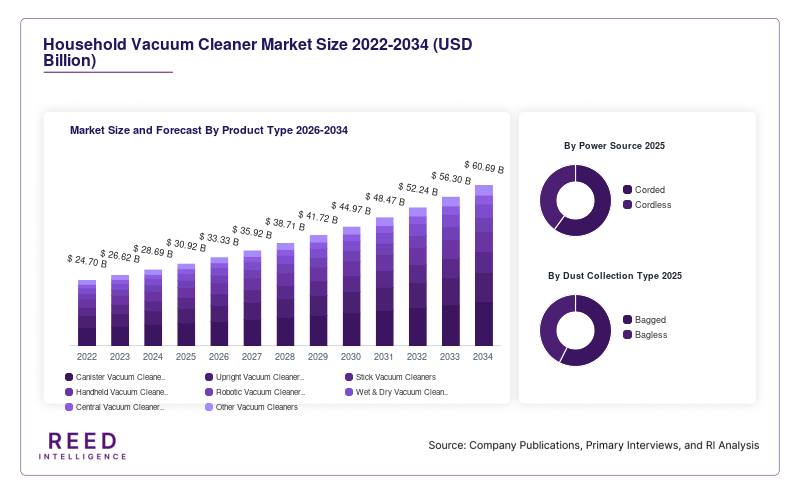
The segment shares, market values, CAGRs and 2034 estimates below are internal analytical allocations, not independently published segment forecasts. Shares are modeled against the supplied 2025 global market value of USD 30.92 billion. The 2034 values allocate the supplied USD 60.69 billion forecast across each segmentation, with the shares summing to 100% within each category. Indicative segment CAGRs are calculated from allocated endpoints and represent modeling assumptions, not observed market data.
By Product Type
Canister Vacuum Cleaners represent approximately 18% of the 2025 market, equivalent to about USD 5.57 billion under the internal allocation. The segment is modeled to reach approximately USD 10.32 billion by 2034, implying an indicative CAGR of about 7.1%. Canister models remain relevant where consumers value continuous power, flexible attachments and cleaning across multiple surfaces. Their future performance depends on product convenience, storage requirements and competition from cordless alternatives.
Upright Vacuum Cleaners represent approximately 16% of the 2025 market, equivalent to about USD 4.95 billion. The segment is modeled to reach approximately USD 9.10 billion by 2034, at an indicative CAGR of about 7.0%. Upright models can be attractive for carpet-focused cleaning and familiar operating routines. Their prospects depend on weight, maneuverability, performance on hard floors and the ability to compete with lighter stick products.
Stick Vacuum Cleaners represent approximately 22% of the 2025 market, equivalent to about USD 6.80 billion. The segment is modeled to reach approximately USD 14.56 billion by 2034, implying an indicative CAGR of about 8.8%. Cordless convenience, compact storage and improvements in motor, battery and brush-head design support the segment's modeled position. Battery runtime, replacement costs and the price of premium products remain important constraints.
Handheld Vacuum Cleaners represent approximately 8% of the 2025 market, equivalent to about USD 2.47 billion. The segment is modeled to reach approximately USD 4.25 billion by 2034, at an indicative CAGR of about 6.2%. Handheld products serve spot cleaning, vehicle interiors, upholstery and other smaller tasks. Their value proposition is portability rather than whole-home performance, which limits their role as a substitute for larger vacuum cleaners.
By Power Source
Corded Vacuum Cleaners represent approximately 45% of the 2025 market, equivalent to about USD 13.91 billion. The segment is modeled to reach approximately USD 24.28 billion by 2034, implying an indicative CAGR of about 6.4%. Corded products offer continuous access to mains power and can suit longer cleaning sessions. Their prospects depend on purchase price, cleaning performance and whether consumers prefer uninterrupted operation over the convenience of cordless designs.
Cordless Vacuum Cleaners represent approximately 55% of the 2025 market, equivalent to about USD 17.01 billion. The segment is modeled to reach approximately USD 36.41 billion by 2034, corresponding to an indicative CAGR of about 8.8%. Convenience, maneuverability and improvements in battery and motor design support the modeled growth assumption. Battery longevity, runtime under high-power settings and replacement costs remain important determinants of consumer satisfaction.
By Dust Collection Type
Bagged Vacuum Cleaners represent approximately 30% of the 2025 market, equivalent to about USD 9.28 billion. The segment is modeled to reach approximately USD 16.99 billion by 2034, at an indicative CAGR of about 6.9%. Bagged systems can offer contained dust disposal and predictable maintenance routines. Ongoing bag purchases, compatibility and availability influence lifetime cost and repeat purchases.
Bagless Vacuum Cleaners represent approximately 70% of the 2025 market, equivalent to about USD 21.64 billion. The segment is modeled to reach approximately USD 43.70 billion by 2034, implying an indicative CAGR of about 8.1%. Bagless systems avoid the need to purchase replacement bags and allow users to see when the dust container needs emptying. Their trade-offs include emptying-related dust exposure, filter maintenance and the need to keep airflow paths clean.
By Application
Hard Floors represent approximately 35% of the 2025 market, equivalent to about USD 10.82 billion. The segment is modeled to reach approximately USD 22.45 billion by 2034, at an indicative CAGR of about 8.5%. Hard-floor cleaning places emphasis on fine-dust pickup, edge cleaning, maneuverability and avoiding surface damage. Lightweight cordless and robotic models can serve these needs, although brush design and debris pickup remain product-specific.
Carpets & Rugs represent approximately 30% of the 2025 market, equivalent to about USD 9.28 billion. The segment is modeled to reach approximately USD 17.60 billion by 2034, implying an indicative CAGR of about 7.4%. Carpet cleaning may require suitable agitation, airflow and brush-roll performance. Products must also handle hair and fibers without excessive tangling, while robotic models need adequate mobility and power management across different pile heights.
Upholstery & Above-Floor Cleaning represent approximately 15% of the 2025 market, equivalent to about USD 4.64 billion. The segment is modeled to reach approximately USD 8.19 billion by 2034, at an indicative CAGR of about 6.5%. This application includes furniture, stairs, curtains and other areas requiring compact tools or flexible hoses. Specialized attachments and handheld configurations can add value, but the segment's revenue often overlaps with products used for several cleaning tasks.
Multi-Surface Cleaning represents approximately 20% of the 2025 market, equivalent to about USD 6.18 billion. The segment is modeled to reach approximately USD 12.45 billion by 2034, implying an indicative CAGR of about 8.1%. Consumers may prefer a single appliance that adapts to hard floors, carpets and upholstery. Automatic surface adjustment and interchangeable tools can support this proposition, although actual performance depends on the combination of flooring types and the product's design.
By Distribution Channel
Online Distribution represents approximately 38% of the 2025 market, equivalent to about USD 11.75 billion. The segment is modeled to reach approximately USD 25.49 billion by 2034, at an indicative CAGR of about 9.0%. Online channels support specification comparisons, product demonstrations, reviews and direct brand engagement. Price transparency, advertising costs, returns and the difficulty of assessing physical handling before purchase remain challenges.
Offline Distribution represents approximately 62% of the 2025 market, equivalent to about USD 19.17 billion. The segment is modeled to reach approximately USD 35.20 billion by 2034, implying an indicative CAGR of about 7.0%. Physical retailers allow consumers to assess weight, ergonomics, build quality and attachments before purchase. Retailer shelf space and promotions can strongly influence visibility, while store costs and competitive pricing affect margins.
By Price Range
Economy Vacuum Cleaners represent approximately 30% of the 2025 market, equivalent to about USD 9.28 billion. The segment is modeled to reach approximately USD 16.99 billion by 2034, at an indicative CAGR of about 6.9%. Economy products address affordability and basic cleaning needs. Their competitive position depends on reliability, practical performance and accessible after-sales support rather than advanced features alone.
Mid-Range Vacuum Cleaners represent approximately 45% of the 2025 market, equivalent to about USD 13.91 billion. The segment is modeled to reach approximately USD 26.10 billion by 2034, implying an indicative CAGR of about 7.2%. Mid-range products balance price, performance and convenience. They can appeal to consumers seeking cordless operation, useful attachments or selected smart features without paying the highest premium.
Premium Vacuum Cleaners represent approximately 25% of the 2025 market, equivalent to about USD 7.73 billion. The segment is modeled to reach approximately USD 17.60 billion by 2034, at an indicative CAGR of about 9.6%. Premium products often compete on navigation, automation, filtration, advanced brush systems and convenience features. The higher modeled growth assumes that consumers continue to pay for measurable improvements, but the outcome depends on disposable income, product reliability and competition from lower-priced alternatives.
Regional Analysis
The regional shares and values below are internal analytical allocations, not independently reported regional market estimates. They are modeled to sum to the supplied global market values. Regional vacuum-cleaner demand is influenced by household purchasing power, housing type, floor surfaces, retail structures, appliance penetration, replacement cycles and the availability of local service support.
North America Household Vacuum Cleaner Market
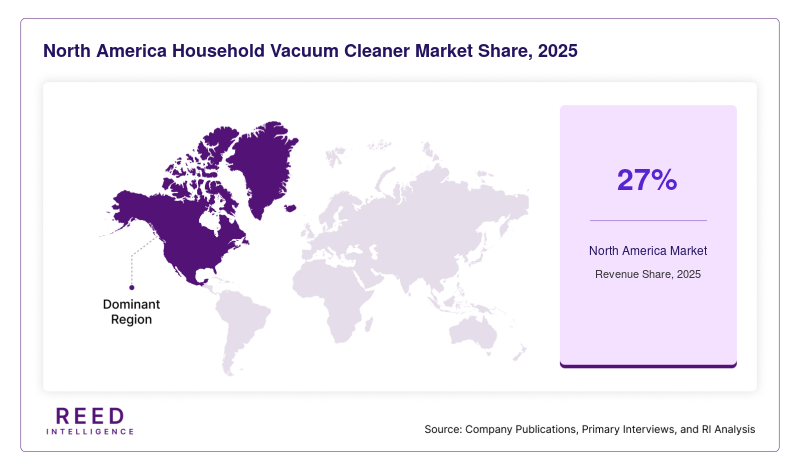
North America is modeled to represent approximately 27% of the 2025 market, equivalent to about USD 8.35 billion. It is modeled to reach approximately USD 15.17 billion by 2034, implying an indicative CAGR of about 6.9%.
The market includes established demand for upright, canister, cordless and robotic vacuum cleaners. Consumers may value carpet-cleaning performance, pet-hair removal, product convenience and the ability to purchase through major retailers or online channels. Manufacturers compete through feature differentiation, price tiers and frequent product updates.
SharkNinja's 2025 Form 10-K identifies cleaning appliances including corded and cordless vacuums, handheld models and robotic vacuums as part of its product portfolio. The company reported 6.9% growth in cleaning-appliance net sales in 2025, with growth driven by carpet extraction and cordless vacuums. This provides company-level evidence of product-category activity, not a measurement of total North American market growth.
Competition is intense, and consumers can compare products across several price tiers. Brands that demonstrate useful improvements in cleaning performance, maintenance, battery life and reliability may be better positioned than those relying on feature counts alone.
Europe Household Vacuum Cleaner Market
Europe is modeled to represent approximately 23% of the 2025 market, equivalent to about USD 7.11 billion. The allocation reaches approximately USD 13.35 billion by 2034, corresponding to an indicative CAGR of about 7.2%.
The region's demand spans conventional corded products, cordless stick models, robotic cleaners and selected wet-and-dry appliances. Housing layouts, flooring types, consumer preferences and retail conditions differ across countries, so product design and marketing need to account for local use cases.
The European Commission's ecodesign framework for covered mains-operated vacuum cleaners addresses energy efficiency, performance and product information. The Commission also explains that the former EU vacuum-cleaner energy-label regulation no longer applies, following its annulment. Suppliers should therefore verify the current requirements for each product category instead of assuming that the historical energy label remains in force.
Manufacturers can compete through cleaning performance, energy use, durability, repairability and convenient maintenance. The importance of these factors varies by product and national market, while price competition and differing household budgets influence the adoption of premium models.
APAC Household Vacuum Cleaner Market
APAC is modeled to represent approximately 32% of the 2025 market, equivalent to about USD 9.89 billion. It is modeled to reach approximately USD 20.63 billion by 2034, the largest regional value in this allocation, with an indicative CAGR of about 8.5%.
The region contains a diverse range of markets, from high-income households purchasing advanced robotic and cordless models to price-sensitive consumers prioritizing basic functionality. Urban living, changing household structures, online retail and the availability of locally manufactured appliances can influence product adoption, but these factors differ across countries.
APAC also includes major manufacturing and technology ecosystems for household appliances and robotic cleaning products. This can support competition on product development, manufacturing scale and price. However, market revenue depends on where products are sold, not only where they are manufactured, and export production should not be counted as local consumer demand.
The region's modeled growth reflects the potential for wider adoption of convenient cleaning formats and a broad range of price tiers. Actual performance will depend on purchasing power, distribution coverage, consumer trust, service networks and the ability of manufacturers to offer products suited to local housing and cleaning practices.
Middle East and Africa Household Vacuum Cleaner Market
Middle East and Africa are modeled to account for approximately 7% of the 2025 market, equivalent to about USD 2.16 billion. The allocation reaches approximately USD 4.25 billion by 2034, implying an indicative CAGR of about 7.8%.
Demand varies substantially by country, income level, housing type and retail access. Consumers may purchase conventional vacuum cleaners, cordless models or robotic products depending on budgets, home size and cleaning routines. Premium products can serve higher-income segments, while entry-level appliances remain important in price-sensitive markets.
Retail distribution, reliable warranties, spare-parts availability and service coverage can influence consumer confidence. Suppliers that tailor product ranges to local conditions and support products after purchase may be better placed to sustain sales than brands that rely on imports without adequate service infrastructure.
The modeled growth reflects potential expansion in appliance access and adoption of more convenient cleaning formats. Currency fluctuations, import costs and household spending conditions remain important constraints.
LATAM Household Vacuum Cleaner Market
LATAM is modeled to represent approximately 11% of the 2025 market, equivalent to about USD 3.40 billion. It is modeled to reach approximately USD 7.29 billion by 2034, at an indicative CAGR of about 8.9%.
Regional demand includes conventional and cordless vacuum cleaners, with purchasing decisions influenced by affordability, product durability, floor surfaces, housing type and the availability of service support. Online marketplaces can broaden product access, while physical retail remains useful for consumers who want to compare products before purchase.
Premium robotic and cordless products may find demand among consumers who value convenience, but the addressable market depends on price and household purchasing power. Manufacturers can reach broader customer groups through tiered portfolios and locally appropriate service arrangements.
The region's modeled growth is an analytical assumption rather than a published regional forecast. Currency volatility, credit conditions and import costs may influence average selling prices and the timing of consumer replacement purchases.
Competitive Landscape
The Household Vacuum Cleaner Market is competitive and includes diversified home-appliance manufacturers, specialist floor-care brands, robotic-cleaning companies and manufacturers offering products across economy, mid-range and premium tiers. Competition is based on cleaning performance, battery life, navigation reliability, filtration, ease of maintenance, price, brand reputation and distribution strength.
Established floor-care brands compete through a broad product range and retail relationships. Specialist robotic-cleaning companies differentiate through mapping, obstacle avoidance, docking and automation. Premium brands may emphasize motor performance, brush design, filtration and product engineering, while value-oriented suppliers compete on practical functionality at lower prices.
Product development is a central competitive mechanism. Manufacturers are adding or improving anti-tangle brush heads, surface detection, compact designs, automated dust disposal and multi-function cleaning. The challenge is to ensure that new features solve real consumer problems and do not make products too expensive or difficult to maintain.
Key Market Players
The following companies are relevant participants in household vacuum cleaners and related floor-care products. Their inclusion does not imply equal market share or a verified ranking.
- Dyson
- SharkNinja
- Bissell
- Miele
- Electrolux
- Samsung
- LG Electronics
- Roborock
- Ecovacs Robotics
- Dreame Technology
- iRobot
- Philips
- Panasonic
Recent Market Developments
- In April 2026, SharkNinja filed its 2025 annual report, detailing company-wide performance and its cleaning-appliance portfolio. The report states that cleaning-appliance net sales increased by 6.9% in 2025, with growth driven by carpet extraction and cordless vacuums. The disclosure provides evidence that cordless and specialized floor-care products contributed to a major competitor's category performance. It also illustrates why company-level growth should not be treated as equivalent to growth in the global household vacuum cleaner market.
- In September 2025, Dyson announced the V16 Piston Animal cordless vacuum and a wet-and-dry version. The product announcement highlighted an anti-tangle cleaner head, automatic adjustment to floor types and a dust bin designed to compress collected debris. The launch demonstrates continued competition around maintenance convenience, floor adaptation and cordless performance. Such features can support premium positioning, but consumer adoption will depend on verified performance, price and product reliability.
Household Vacuum Cleaner Market Segments
By Product Type
- Canister Vacuum Cleaners
- Upright Vacuum Cleaners
- Stick Vacuum Cleaners
- Handheld Vacuum Cleaners
- Robotic Vacuum Cleaners
- Wet & Dry Vacuum Cleaners
- Central Vacuum Cleaners
- Other Vacuum Cleaners
By Power Source
- Corded
- Cordless
By Dust Collection Type
- Bagged
- Bagless
By Application
- Hard Floors
- Carpets & Rugs
- Upholstery & Above-Floor Cleaning
- Multi-Surface Cleaning
By Distribution Channel
- Online
- Offline
By Price Range
- Economy
- Mid-Range
- Premium
By Region
- North America
- Europe
- APAC
- Middle East and Africa
- LATAM