Hoverbikes Market Size, Share & Demand Report By Propulsion Type (Electric Hoverbikes, Hybrid Hoverbikes, Fuel-Based Hoverbikes), By Application (Defense & Surveillance, Emergency Medical Services, Logistics & Delivery, Recreational), By End-Use (Government & Defense, Commercial, Individual Consumers), By Region & Segment Forecasts, 2026–2034
USD 3950
Market Overview
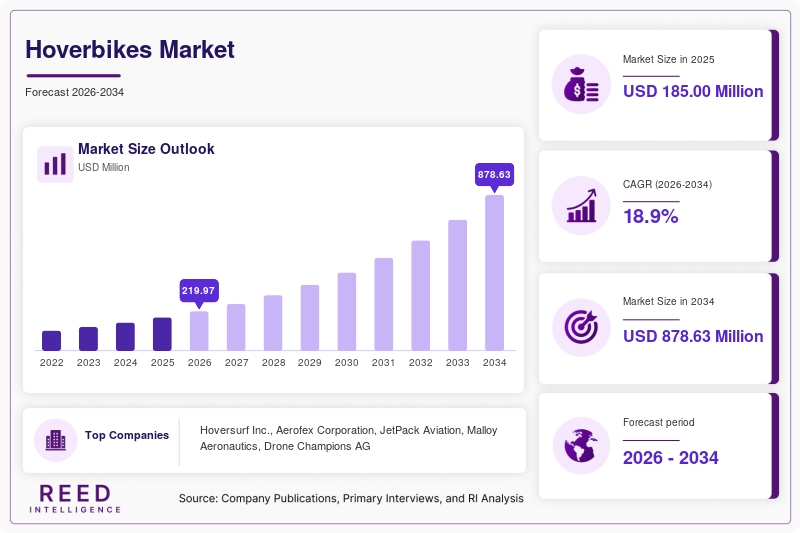
The global Hoverbikes Market was valued at approximately USD 185 million in 2026 and is projected to reach USD 742 million by 2034, expanding at a CAGR of 18.9% during 2026–2034. The market is gaining traction due to rising interest in next-generation personal air mobility solutions and increasing investment in urban air transportation infrastructure. Hoverbikes, often described as compact aerial vehicles capable of vertical takeoff and landing, are gradually transitioning from experimental prototypes to commercially viable solutions for defense, emergency services, and recreational use.
A key global factor supporting market growth is the increasing demand for advanced mobility solutions in congested urban environments. Rapid urbanization, coupled with limitations in ground transportation systems, has driven governments and private companies to explore alternative mobility platforms. Hoverbikes offer a compact and flexible option for short-distance aerial commuting, particularly in densely populated regions where infrastructure expansion is constrained.
Key Highlights
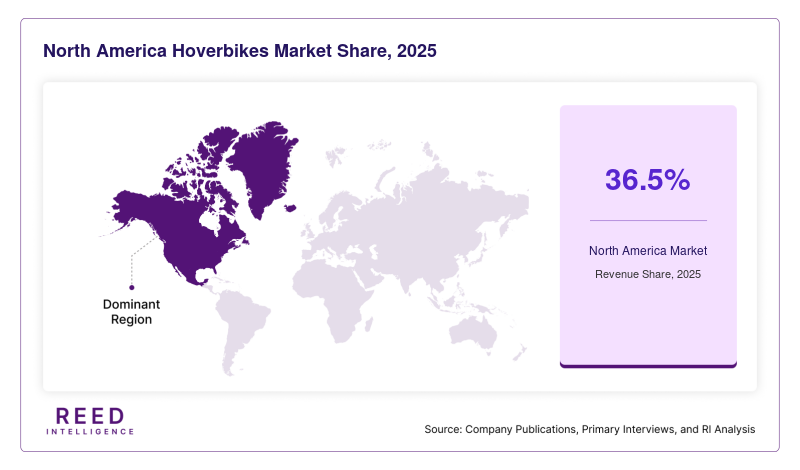
- North America dominated the market with a 36.5% share in 2025.
- Asia Pacific is expected to grow at the fastest CAGR of 20.8% during 2026–2034.
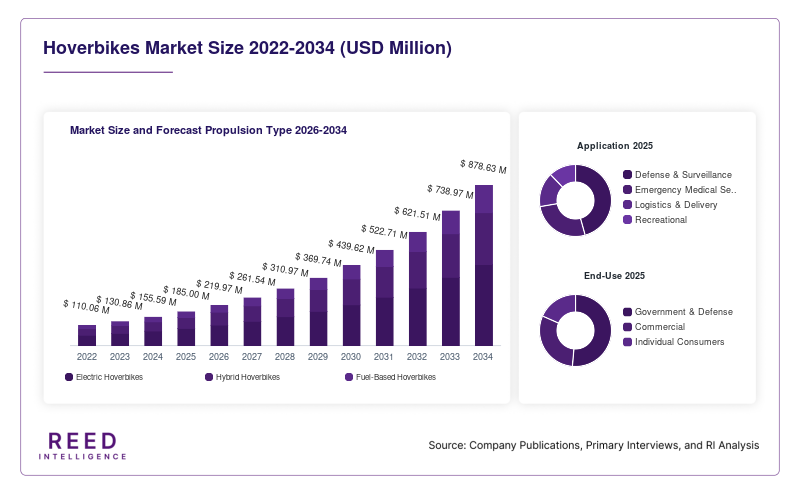
- By propulsion type, electric hoverbikes accounted for the largest share of 44.3%.
- while hybrid propulsion systems are projected to grow at a CAGR of 21.6%.
- By application, defense and surveillance led with a 39.8% share, whereas emergency medical services are expected to expand at a CAGR of 22.1%.
- The United States remained the dominant country, with market values of USD 62 million in 2024 and USD 71 million in 2025.
Market Trends
Integration of Autonomous and AI-Based Navigation Systems
One of the most notable trends in the Hoverbikes Market is the integration of artificial intelligence and autonomous navigation technologies. Manufacturers are increasingly focusing on incorporating real-time obstacle detection, automated flight stabilization, and route optimization systems. These technologies reduce the need for highly skilled pilots, thereby lowering operational barriers and expanding the potential user base. AI-driven systems also enhance safety by minimizing human error, which has historically been a major concern in aerial mobility platforms. Additionally, the use of machine learning algorithms allows hoverbikes to adapt to varying weather conditions and terrain, improving reliability. As regulatory frameworks evolve, semi-autonomous and fully autonomous hoverbikes are expected to gain approval for commercial applications, particularly in logistics and emergency response sectors.
Shift Toward Electric and Sustainable Propulsion Systems
Another prominent trend is the growing adoption of electric propulsion systems in hoverbike design. Environmental concerns and stricter emission regulations are encouraging manufacturers to move away from conventional fuel-based engines. Electric hoverbikes offer reduced noise levels, lower emissions, and improved energy efficiency, making them suitable for urban environments. Advances in battery technology, including higher energy density and faster charging capabilities, are addressing earlier limitations related to flight duration and range. Furthermore, the integration of renewable energy charging infrastructure is being explored to support sustainable operations. This shift aligns with broader trends in the mobility sector, where electrification is becoming a central focus for innovation and investment.
Market Drivers
Rising Demand for Urban Air Mobility Solutions
The increasing need for efficient transportation in densely populated cities is a key driver of the Hoverbikes Market. Urban congestion has reached critical levels in many metropolitan areas, leading to longer commute times and higher environmental impact. Hoverbikes present a viable alternative by enabling point-to-point aerial travel, bypassing ground traffic. Governments and urban planners are exploring air mobility corridors and regulatory frameworks to support such innovations. Additionally, the compact size and vertical takeoff capabilities of hoverbikes make them suitable for operation in limited spaces, such as rooftops and designated landing zones. This growing focus on urban air mobility is expected to significantly boost demand for hoverbikes in both developed and emerging economies.
Increasing Adoption in Defense and Emergency Services
The defense sector is a major contributor to the growth of the Hoverbikes Market. Military organizations are investing in hoverbikes for reconnaissance, surveillance, and rapid troop deployment in challenging terrains. These vehicles provide enhanced mobility in areas where traditional vehicles are ineffective, such as mountainous regions and disaster zones. Similarly, emergency services are adopting hoverbikes for rapid response operations, including medical evacuations and firefighting support. The ability to access remote or inaccessible locations quickly makes hoverbikes a valuable tool in critical situations. Continuous advancements in payload capacity and flight stability are further enhancing their utility in these high-demand applications.
Market Restraint
Regulatory and Safety Challenges
Despite significant advancements, regulatory and safety concerns remain a major restraint for the Hoverbikes Market. The operation of low-altitude aerial vehicles in urban environments raises complex issues related to airspace management, collision avoidance, and public safety. Many countries lack clear regulatory frameworks for hoverbikes, leading to delays in commercialization and deployment. Certification processes for aerial vehicles are stringent and time-consuming, which can hinder innovation and increase development costs.
Safety concerns also play a critical role in limiting adoption. Hoverbikes operate in close proximity to people and infrastructure, increasing the risk of accidents. Ensuring reliable flight control systems, fail-safe mechanisms, and robust design standards is essential to gain public trust. Additionally, noise pollution and privacy concerns associated with aerial surveillance capabilities can lead to resistance from communities. For example, pilot projects in urban areas have faced opposition due to concerns about safety and environmental impact. Addressing these challenges requires coordinated efforts between manufacturers, regulators, and policymakers to establish clear guidelines and standards.
Market Opportunities
Expansion in Emergency Medical Services (EMS)
The use of hoverbikes in emergency medical services represents a significant growth opportunity. These vehicles can drastically reduce response times in critical situations, such as cardiac emergencies or accidents in remote locations. Hoverbikes equipped with medical kits or capable of transporting patients can provide immediate assistance before traditional ambulances arrive. This capability is particularly valuable in regions with limited healthcare infrastructure or challenging geography. Technological advancements in stabilization and payload capacity are enabling the development of specialized EMS hoverbikes. Governments and healthcare providers are increasingly exploring partnerships with manufacturers to pilot such solutions, creating new revenue streams for the market.
Growth in Recreational and Tourism Applications
Another promising opportunity lies in the recreational and tourism sectors. Hoverbikes offer a unique and immersive experience, attracting adventure enthusiasts and tourists. Resorts and tourism operators are beginning to incorporate hoverbike experiences as premium offerings, particularly in scenic locations. This trend is supported by rising disposable incomes and a growing preference for experiential travel. Manufacturers are developing user-friendly models with enhanced safety features to cater to non-professional users. Additionally, the integration of virtual reality and augmented reality technologies can further enhance the user experience. As awareness increases, recreational applications are expected to become a key growth driver for the market.
Segmental Analysis
By Propulsion Type
Electric propulsion dominated the Hoverbikes Market in 2024, accounting for approximately 44.3% of the total market share. The dominance of this subsegment is attributed to increasing environmental concerns and the global shift toward sustainable mobility solutions. Electric hoverbikes offer several advantages, including lower emissions, reduced noise levels, and lower operational costs compared to conventional fuel-based systems. Additionally, advancements in battery technology have improved energy density and reduced charging times, making electric hoverbikes more practical for various applications. Governments and regulatory bodies are also promoting the adoption of electric vehicles through incentives and policies, further supporting the growth of this subsegment.
Hybrid propulsion systems are expected to be the fastest-growing subsegment, with a projected CAGR of 21.6% during the forecast period. The growth of this subsegment is driven by the need to overcome the limitations of fully electric systems, particularly in terms of range and payload capacity. Hybrid hoverbikes combine the benefits of electric and fuel-based propulsion, offering extended flight durations and improved performance. This makes them suitable for applications such as defense, logistics, and emergency services, where reliability and endurance are critical. Continuous research and development efforts are focused on optimizing hybrid systems to enhance efficiency and reduce environmental impact.
By Application
The defense and surveillance segment held the largest share of 39.8% in 2024, reflecting the strong demand for advanced mobility solutions in military operations. Hoverbikes provide unique advantages in terms of maneuverability, speed, and accessibility in challenging terrains. They are used for reconnaissance missions, border patrol, and rapid deployment of personnel. The ability to operate in remote and inaccessible areas makes them a valuable asset for defense forces. Increasing geopolitical tensions and the need for enhanced security measures are further driving demand in this segment.
Emergency medical services are projected to be the fastest-growing application segment, with a CAGR of 22.1%. The growth is driven by the increasing need for rapid response solutions in critical situations. Hoverbikes can significantly reduce response times and improve patient outcomes by providing immediate access to medical assistance. Technological advancements in stabilization and payload capacity are enabling the development of specialized EMS hoverbikes. Partnerships between manufacturers and healthcare providers are also contributing to the growth of this segment, as pilot programs and trials demonstrate the effectiveness of hoverbikes in emergency scenarios.
By End-Use
Government and defense organizations dominated the market in 2024, accounting for approximately 46.7% of the total share. This dominance is due to the high adoption of hoverbikes for military and security applications. Governments are investing in advanced mobility solutions to enhance operational efficiency and response capabilities. The use of hoverbikes in surveillance, search and rescue, and disaster management is driving demand in this segment. Additionally, funding and support from government agencies are facilitating research and development activities.
Commercial end-use is expected to be the fastest-growing segment, with a CAGR of 19.8% during the forecast period. The growth is driven by increasing adoption in logistics, tourism, and recreational applications. Companies are exploring the use of hoverbikes for last-mile delivery and aerial transportation of goods. The tourism sector is also adopting hoverbikes to offer unique experiences to customers. As technology advances and costs decrease, commercial applications are expected to expand, creating new opportunities for market players.
Regional Analysis
North America
North America held a significant share of approximately 36.5% in the Hoverbikes Market in 2025 and is projected to grow at a CAGR of 17.5% during the forecast period. The region benefits from strong technological infrastructure, high investment in research and development, and early adoption of advanced mobility solutions. The presence of key manufacturers and supportive regulatory initiatives further contribute to market growth. Increasing interest in urban air mobility and defense applications is driving demand across the region.
The United States dominates the North American market, driven by substantial investments in defense and aerospace technologies. A unique growth factor is the increasing collaboration between private companies and government agencies to develop urban air mobility ecosystems. Pilot programs and test flights in controlled environments are accelerating innovation and commercialization. The country’s focus on technological leadership continues to support market expansion.
Europe
Europe accounted for around 24.3% of the global market share in 2025 and is expected to grow at a CAGR of 16.8% through 2034. The region’s emphasis on sustainability and environmental regulations is encouraging the adoption of electric hoverbikes. Strong government support for green mobility solutions and investments in smart city initiatives are key factors driving growth.
Germany is the dominant country in the European market, supported by its advanced engineering capabilities and focus on innovation. A unique growth factor is the integration of hoverbikes into broader urban mobility frameworks, including multimodal transportation systems. Collaborative efforts between automotive and aerospace industries are fostering the development of efficient and sustainable hoverbike solutions.
Asia Pacific
Asia Pacific is expected to register the fastest CAGR of 20.8% during the forecast period, with a market share of 21.7% in 2025. Rapid urbanization, increasing population density, and rising investments in smart city projects are driving demand for alternative mobility solutions. The region’s growing middle class and technological advancements further support market growth.
China leads the Asia Pacific market, driven by large-scale manufacturing capabilities and government support for innovation. A unique growth factor is the integration of hoverbikes into logistics and delivery systems, particularly in urban and semi-urban areas. The country’s focus on infrastructure development and technological adoption is accelerating market expansion.
Middle East & Africa
The Middle East & Africa region held a market share of approximately 9.8% in 2025 and is projected to grow at a CAGR of 18.2%. The region is witnessing increasing interest in advanced mobility solutions, particularly in urban centers and tourism hubs. Investments in smart city projects and infrastructure development are supporting market growth.
The United Arab Emirates is the leading country in this region, driven by its focus on innovation and futuristic transportation solutions. A unique growth factor is the adoption of hoverbikes for tourism and security applications. Government initiatives aimed at positioning the country as a hub for advanced mobility technologies are creating growth opportunities.
Latin America
Latin America accounted for around 7.7% of the market share in 2025 and is expected to grow at a CAGR of 17.1%. The region is gradually adopting advanced mobility solutions, supported by improving economic conditions and increasing urbanization. However, limited infrastructure and regulatory challenges may impact growth.
Brazil dominates the Latin American market, supported by its large population and growing interest in innovative transportation solutions. A unique growth factor is the use of hoverbikes in remote and rural areas, where traditional transportation options are limited. This application is expected to drive demand in the coming years.
Competitive Landscape
The Hoverbikes Market is characterized by a mix of established aerospace companies and emerging startups focusing on innovation and niche applications. Key players are investing heavily in research and development to enhance product performance, safety, and efficiency. Strategic partnerships, mergers, and acquisitions are common as companies aim to strengthen their market position and expand their product portfolios.
One of the leading players in the market is Hoversurf Inc., known for its advanced hoverbike designs and focus on law enforcement and defense applications. The company recently introduced an upgraded model with improved flight stability and extended battery life, targeting both commercial and government customers. Other major players are focusing on developing electric and hybrid propulsion systems, as well as integrating autonomous navigation technologies.
Competition is intensifying as new entrants bring innovative solutions to the market. Companies are also exploring collaborations with technology providers and regulatory bodies to accelerate commercialization. The focus on safety, reliability, and cost-effectiveness remains a key differentiator in the competitive landscape.
Key Players List
- Hoversurf Inc.
- Aerofex Corporation
- JetPack Aviation
- Malloy Aeronautics
- Drone Champions AG
- SkyDrive Inc.
- Opener Aero Inc.
- Volocopter GmbH
- LIFT Aircraft Inc.
- EHang Holdings Limited
- Urban Aeronautics Ltd.
- Alaka’i Technologies
- Workhorse Group Inc.
- Neva Aerospace
- Bell Textron Inc.
Recent Developments
- In 2025, Hoversurf Inc. launched an upgraded hoverbike model with enhanced AI-based navigation and improved battery efficiency.
- In 2024, JetPack Aviation conducted successful test flights of its hybrid-powered hoverbike for military applications.
- In 2025, Malloy Aeronautics partnered with a defense agency to develop heavy-lift hoverbikes for logistics and cargo transport.
Hoverbikes Market Segments
Propulsion Type
- Electric Hoverbikes
- Hybrid Hoverbikes
- Fuel-Based Hoverbikes
Application
- Defense & Surveillance
- Emergency Medical Services
- Logistics & Delivery
- Recreational
End-Use
- Government & Defense
- Commercial
- Individual Consumers
By Region
- North America
- Europe
- APAC
- Middle East and Africa
- LATAM