Global Human Biospecimens Market Size, Share & Trends Analysis Report By Specimen Type (Tissue SpecimensFFPE (Formalin-Fixed Paraffin-Embedded) TissueFresh Frozen TissueTumor BiopsiesNormal Tissue Samples, BiofluidsWhole BloodPlasmaSerumUrineSalivaCSF (Cerebrospinal Fluid)Fastest Growing: Plasma, Cellular MaterialPBMCs (Peripheral Blood Mononuclear Cells)Buccal CellsStem Cells, Nucleic AcidsGenomic DNARNActDNA/cfDNA (circulating tumor/DNA) â Fastest Growing), By Ap (Cancer Research, Drug Disco
USD 3950
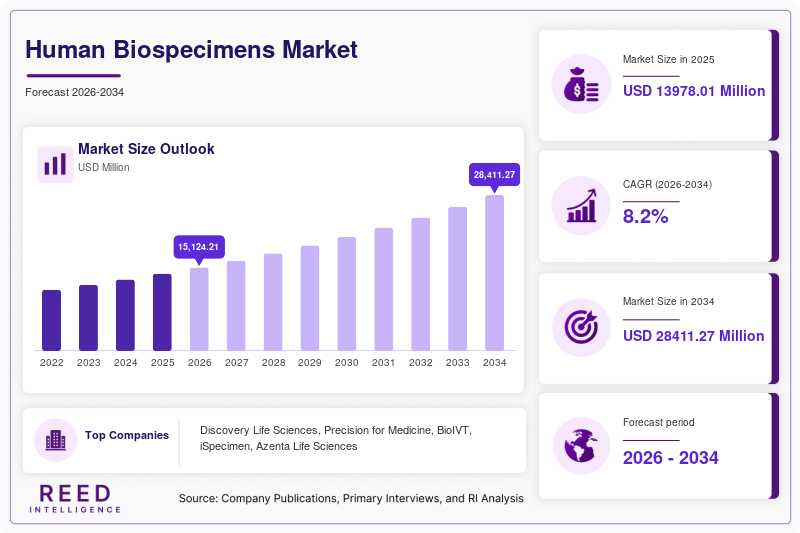
Human Biospecimens Market Size
Global Human Biospecimens Market size is projected at USD 15,124.21 million in 2026 and is expected to hit USD 28,366.90 million by 2034 with a CAGR of 8.2%. The industry is supported by expanding precision medicine, biomarker discovery, genomic research, oncology trials, and biobanking infrastructure. Detailed specimen-level segmentation and competitive assessment are increasingly necessary as pharmaceutical companies, CROs, diagnostic developers, hospitals, and academic institutes require clinically annotated, ethically sourced samples.
Key Takeaways
- Asia Pacific dominates geographically, accounting for approximately 32.96% of 2026 revenue, while LATAM records the fastest regional CAGR at 8.64% through 2034.
- Tissue specimens lead specimen categories with approximately 41.77% of 2026 revenue; biofluids are the fastest-growing major specimen category at 8.45% CAGR.
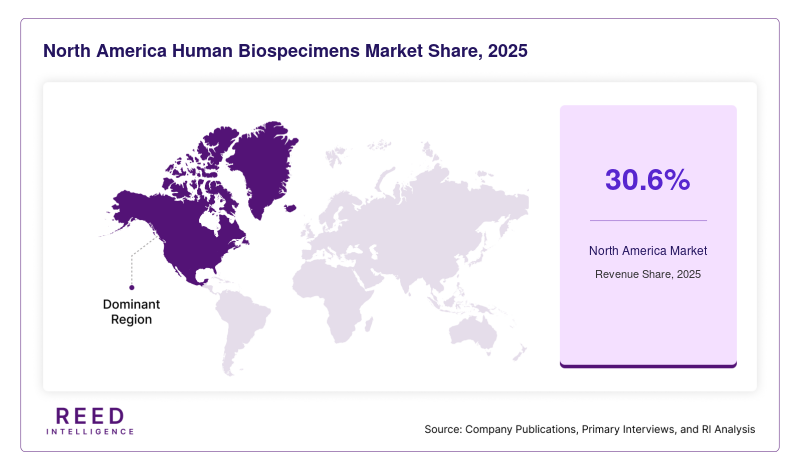
- North America represents approximately 30.63% of 2026 revenue and reaches USD 8,936.39 million by 2034, supported by biobanks, clinical trials, genomics, and pharmaceutical R&D.
- Asia Pacific rises from USD 4,984.75 million in 2026 to USD 9,097.36 million in 2034, maintaining the largest absolute regional contribution.
- Country-level 2034 values and CAGRs were not supplied in the mandatory dataset; consequently, no unsupported emerging-country forecast is presented.
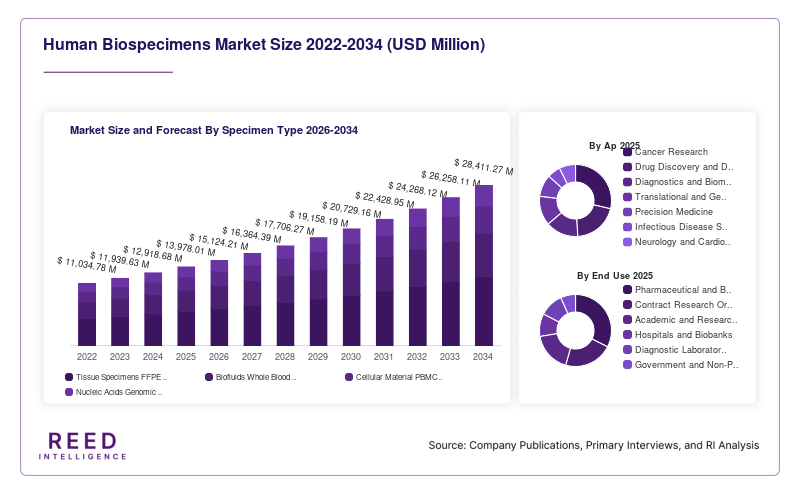
The human biospecimens industry encompasses ethically collected human tissue, blood, plasma, serum, urine, saliva, cells, DNA, RNA, and related biological material used in research, diagnostics, and therapeutic development. Tissue specimens contribute approximately 41.77% of 2026 revenue, biofluids 30.53%, cellular material 15.48%, and nucleic acids 12.23%. Asia Pacific contributes about 32.96%, North America 30.63%, Europe 20.25%, LATAM 8.17%, and Middle East and Africa 7.99%. Large-scale infrastructure illustrates the physical volume behind commercial demand: UK Biobank holds around 17 million containers from approximately 500,000 participants, including roughly 11 million samples at its main laboratory.
Human Biospecimens Market Trends
Digitization, Multi-Omics and Assay-Ready Sample Integration
Biobanking is shifting from basic physical inventory toward clinically annotated, molecularly characterized and digitally searchable collections. More than 800 million specimens are estimated to be stored in biobanks globally, while over 3 billion clinical specimens are estimated to be discarded annually. More than 80% of researchers report restricting studies because of insufficient specimen quantities, and over 80% report limitations associated with specimen quality, strengthening requirements for standardized collection and metadata.
Automation and multi-omics are further reshaping procurement. UK Biobank stores approximately 10 million samples at −80°C, keeps around 6 million backup samples at −196°C, and plans automated infrastructure with capacity for up to 20 million samples and retrieval capability approaching 1 million samples annually. Meanwhile, the U.S. All of Us Research Program made information on more than 370,000 available participant samples accessible through its controlled research environment in 2026.
Human Biospecimens Market Drivers
Expansion of Precision Medicine and Biomarker-Based Drug Development
The Global Human Biospecimens Market Growth is being accelerated by genomics, oncology, companion diagnostics, immunology, and patient-stratified clinical research. Precision for Medicine reports biorepositories containing more than 10 million specimens, including over 1 million biofluid specimens and 3 million tissue specimens, alongside prospective collection capabilities covering 90 medical conditions and approximately 150 clinical collection sites worldwide. These operating volumes demonstrate the scale required to support biomarker validation and increasingly data-rich therapeutic development.
Human Biospecimens Market Restraints
Quality Variability, Consent Requirements and Data-Security Exposure
Commercial expansion is constrained by specimen degradation, inconsistent pre-analytical procedures, donor-consent restrictions, cross-border rules, and cybersecurity requirements. The scale of governance exposure is substantial: UK Biobank includes approximately 500,000 participants and millions of biological containers, while a 2026 incident involved data relating to its participant population and triggered suspension and security scrutiny. Such events increase compliance costs for repositories handling genomic, phenotypic and clinical information across multiple jurisdictions.
Human Biospecimens Market Opportunities
Prospective Collection and Molecularly Characterized Specimens
Global Human Biospecimens Market Demand is creating opportunities for prospective collections, matched tissue-liquid sets, longitudinal sampling and NGS-characterized specimens. Discovery Life Sciences reports longitudinal information extending 2 years for samples associated with nearly 400 cancer patients, while Precision for Medicine maintains more than 10 million specimens and collection capabilities across 150 sites. These assets support increasingly narrow inclusion criteria in oncology, immunology, rare disease and translational studies.
Challenges in Global Human Biospecimens Market
Scaling Standardized Collections Without Compromising Sample Integrity
The principal challenge is maintaining reproducibility as repositories move from thousands to millions of samples. Temperature requirements can range from approximately −80°C frozen storage to −196°C liquid-nitrogen preservation, creating substantial infrastructure and logistics requirements. UK Biobank alone holds around 17 million sample containers, including 10 million in an automated −80°C freezer, demonstrating the equipment, traceability, energy and retrieval burden associated with population-scale repositories.
Human Biospecimens Market Segmentation
The market is segmented by specimen type, application, end use, storage type and procurement type. Tissue specimens dominate the supplied specimen dataset with USD 6,316.96 million in 2026, approximately 41.77% of specimen revenue, followed by biofluids at USD 4,617.06 million, or about 30.53%.
By Specimen Type
Tissue specimens, comprising FFPE tissue, fresh frozen tissue, tumor biopsies and normal tissue samples, increase from USD 5,851.20 million in 2025 to USD 6,316.96 million in 2026 and USD 11,657.64 million in 2034, representing a 7.96% CAGR.
Biofluids rise from USD 4,617.06 million in 2026 to USD 8,834.91 million by 2034 at 8.45% CAGR, the fastest major specimen-category rate. Plasma is identified as the fastest-growing biofluid subtype, while ctDNA/cfDNA leads growth within nucleic acids; separate subtype CAGRs were not supplied.
By Application
Applications include cancer research, drug discovery and development, diagnostics and biomarker discovery, translational and genomic research, precision medicine, infectious-disease studies, and neurology and cardiovascular research. Oncology remains particularly specimen-intensive because studies can require tumor tissue, matched normal tissue, plasma, serum and molecular derivatives from the same patient.
The application structure increasingly favors longitudinal and multi-modal datasets. Discovery reports 2-year longitudinal cancer information for nearly 400 patients, illustrating movement from single-time-point samples toward treatment-response, recurrence and survival-linked material. Application-level revenue and CAGR values were not supplied and are therefore not estimated.
By End Use
Pharmaceutical and biotechnology companies, CROs, academic institutes, hospitals and biobanks, diagnostic laboratories, and government/non-profit organizations constitute the principal customer groups. Commercial drug developers require scalable sample access across discovery, clinical development and companion-diagnostic validation.
Repository scale is consequently becoming an important procurement differentiator. Precision for Medicine reports more than 10 million specimens, 150 global collection sites, and prospective collection capabilities spanning 90 medical conditions. End-use-specific revenue and CAGR figures were not provided.
By Storage Type
Storage comprises −80°C/LN2 cold storage, ambient stabilized systems, −196°C cryogenic storage and formalin-fixed preservation. Selection depends on analyte stability, intended assay, tissue morphology, viable-cell requirements and duration of storage.
Large biobanks demonstrate the infrastructure intensity: UK Biobank maintains about 10 million samples at −80°C and approximately 6 million backup samples in liquid nitrogen at −196°C. Its planned automated freezers provide capacity for up to 20 million samples. Storage-specific revenue and CAGR figures were not supplied.
By Procurement Type
Prospective collection provides on-demand donor recruitment against predefined clinical criteria, whereas retrospective procurement draws from banked inventories. Prospective models are particularly relevant for rare biomarkers, treatment-stage requirements and longitudinal sampling.
Digital marketplaces increasingly connect both approaches. iSpecimen states that its marketplace provides access to millions of human biospecimens and patients, while broader industry estimates indicate more than 800 million specimens are held in biobanks worldwide. Procurement-specific revenue and CAGR data were not supplied.
Human Biospecimens Market Regional Outlook
North America
North America reaches USD 4,632.37 million in 2026, representing approximately 30.63% of global revenue, and advances to USD 8,936.39 million by 2034 at 8.56% CAGR. The United States contributes strongly through pharmaceutical R&D, CRO activity, precision diagnostics and population-scale research programs; All of Us reported information on more than 370,000 available participant samples in 2026.
Europe
Europe generates USD 3,062.63 million in 2026, approximately 20.25% of global revenue, reaching USD 5,719.30 million in 2034 at 8.12% CAGR. The UK is a major biobanking center, illustrated by UK Biobank's approximately 500,000 participants and 17 million sample containers, alongside extensive genomics and population-health research infrastructure.
APAC
Asia Pacific leads with USD 4,984.75 million in 2026, or approximately 32.96%, and reaches USD 9,097.36 million by 2034 at 7.81% CAGR. China, Japan, India, South Korea and Australia underpin research activity through genomics, clinical trials, oncology, diagnostics and expanding biopharmaceutical R&D.
Middle East and Africa
Middle East and Africa accounts for approximately 7.99% of 2026 revenue at USD 1,208.05 million and reaches USD 2,214.57 million by 2034, representing 7.87% CAGR. Gulf-state genomics programs, academic research and expanding hospital laboratory infrastructure support adoption, while biobanking capacity remains uneven across countries.
LATAM
LATAM records USD 1,236.41 million in 2026, approximately 8.17% of global revenue, and reaches USD 2,399.28 million by 2034. Its 8.64% CAGR is the fastest among the supplied regions, supported by Brazil, Mexico and regional clinical-research networks serving oncology, infectious disease and pharmaceutical studies.
Top players in Global Human Biospecimens Market
- Discovery Life Sciences
- Precision for Medicine
- BioIVT
- iSpecimen
- Azenta Life Sciences
- Charles River Laboratories
- Thermo Fisher Scientific
- QIAGEN
- ProteoGenex
- Cureline
- Boca Biolistics
- StemExpress
- AMSBIO
- Tissue Solutions
- Cerba Research
Top Two Companies
-
Discovery Life Sciences: The company holds a prominent competitive position through prospective collections, FFPE tissues, blood products, viable cells, matched sample sets and NGS-characterized materials. Its network supports both diseased and normal-control samples, while oncology offerings include longitudinal datasets covering nearly 400 patients over 2 years. A defensible company-specific global revenue percentage is not publicly disclosed; therefore, no unsupported percentage is assigned. Its positioning is strengthened by clinically annotated specimens, global collection capabilities and integration of AI-enabled pathology, including its 2025 PathAI collaboration and additional precision-oncology collaborations announced in 2026.
-
Precision for Medicine: Precision operates one of the larger disclosed commercial repositories, with 10+ million specimens, including 1+ million biofluid specimens and 3+ million tissue specimens, and access to approximately 150 collection sites. A verified percentage of worldwide industry revenue is not publicly available and is therefore not fabricated. Competitive positioning centers on oncology, autoimmune and infectious-disease collections, deeply annotated samples, custom procurement and integrated clinical-development services. Its April 2025 PathAI collaboration added AI-powered pathology and quality-control capabilities for clinical trials and biospecimen products.
Recent Developments in Global Human Biospecimens Market
- 2026: Discovery Life Sciences and Biocartis announced a strategic collaboration in July to advance precision-oncology diagnostics.
- 2026: Discovery launched an IVDR-compliant Luminos Comprehensive offering with a stated 7–10-day turnaround for European oncology trials.
- 2026: Discovery Life Sciences and Mindpeak partnered in March to introduce AI-supported precision into cancer biomarker testing for global clinical trials.
- 2025: Precision for Medicine and PathAI announced an AI-powered pathology collaboration integrating digital pathology into clinical-trial and biospecimen operations.
- 2025: iSpecimen announced suppliers for hMPV-related specimens in January, extending procurement readiness for infectious-disease research and potential vaccine-development requirements.
Human Biospecimens Market Segments
By Specimen Type
-
Tissue Specimens
- FFPE (Formalin-Fixed Paraffin-Embedded) Tissue
- Fresh Frozen Tissue
- Tumor Biopsies
- Normal Tissue Samples
-
Biofluids
- Whole Blood
- Plasma
- Serum
- Urine
- Saliva
- CSF (Cerebrospinal Fluid)
- Fastest Growing: Plasma
-
Cellular Material
- PBMCs (Peripheral Blood Mononuclear Cells)
- Buccal Cells
- Stem Cells
-
Nucleic Acids
- Genomic DNA
- RNA
- ctDNA/cfDNA (circulating tumor/DNA) – Fastest Growing
By Ap
- Cancer Research
- Drug Discovery and Development
- Diagnostics and Biomarker Discovery
- Translational and Genomic Research
- Precision Medicine
- Infectious Disease Studies (e.g., COVID-19, HIV, TB)
- Neurology and Cardiovascular Research
By End Use
- Pharmaceutical and Biotechnology Companies
- Contract Research Organizations (CROs)
- Academic and Research Institutes
- Hospitals and Biobanks
- Diagnostic Laboratories
- Government and Non-Profit Organizations
By Storage Type
- Cold Storage (−80°C or LN2)
- Ambient/Room Temperature Stabilized
- Cryogenic (Liquid Nitrogen, −196°C)
- Formalin-Fixed Storage
By Procurement Type
- Prospective Collection (On-Demand Collection)
- Retrospective/Banked Samples
By Region
- North America
- Europe
- APAC
- Middle East and Africa
- LATAM