Human Granulocytic Ehrlichiosis Market Size, Share Demand Report By Diagnosis Type (Serological Tests, Molecular Diagnostics, Blood Smear Tests), By Treatment Type (Antibiotic Therapy, Combination Therapy), By End-Use (Hospitals, Diagnostic Laboratories, Clinics), By Distribution Channel (Hospital Pharmacies, Retail Pharmacies, Online Pharmacies), By Region & Segment Forecasts, 2025–2034
USD 3950
Market Overview
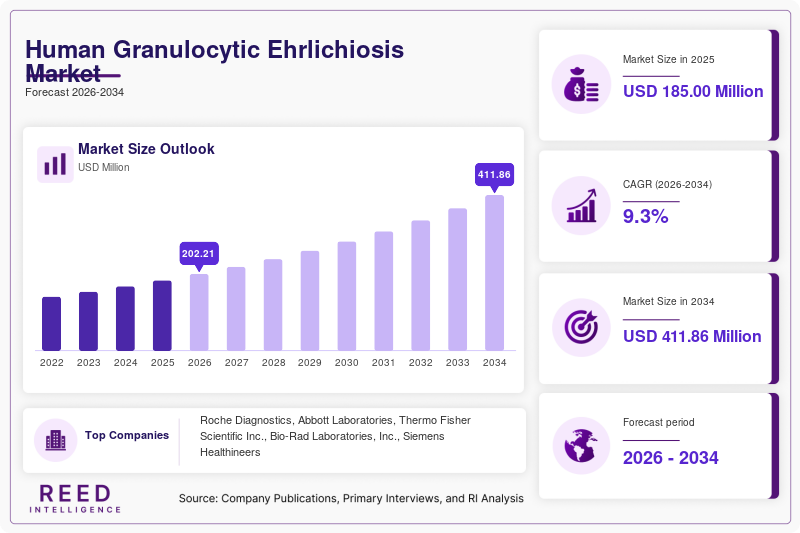
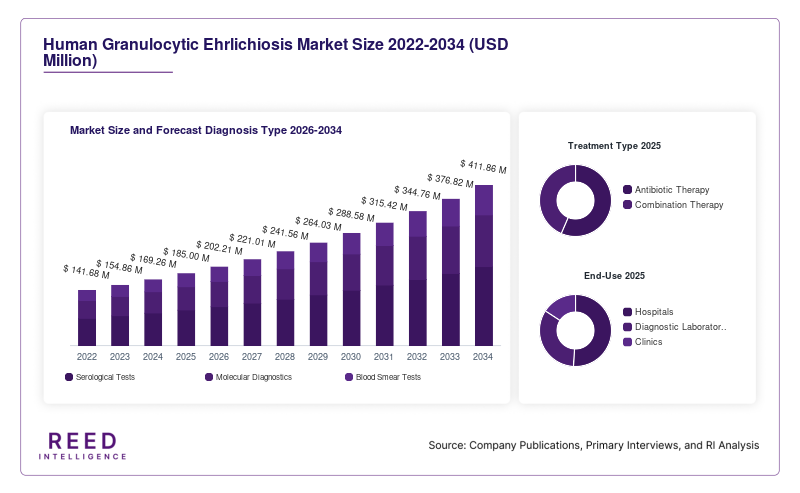
The global Human Granulocytic Ehrlichiosis Market size was valued at approximately USD 185 million in 2025 and is projected to reach USD 412 million by 2034, expanding at a CAGR of 9.3% during the forecast period (2025–2034). The market growth is primarily driven by the rising incidence of tick-borne infections worldwide, coupled with increased awareness and advancements in diagnostic technologies.
A key global factor supporting the growth of the Human Granulocytic Ehrlichiosis Market is the increasing prevalence of vector-borne diseases due to climate change and expanding tick habitats. Warmer temperatures and ecological shifts have contributed to the proliferation of ticks in previously unaffected regions, leading to higher infection rates and consequently boosting demand for early diagnosis and effective treatment options.
Key Highlights:
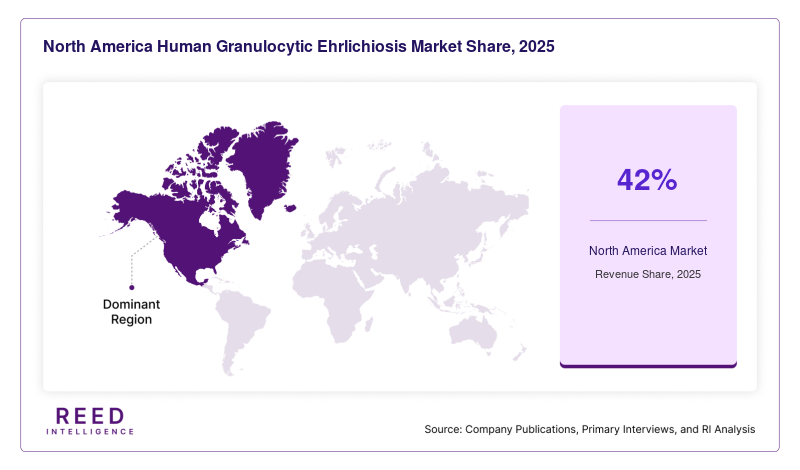
- North America dominated the market with a 42% share in 2025, while Asia Pacific is projected to register the fastest CAGR of 10.8% during the forecast period.
- Diagnostic testing was the leading segment in 2024, accounting for 55% share, while molecular diagnostics is expected to grow at the fastest CAGR of 11.2%.
- The United States remained the dominant country, with market values of USD 68 million in 2024 and USD 74 million in 2025.
Market Trends
Expansion of Molecular Diagnostic Techniques
The Human Granulocytic Ehrlichiosis Market is witnessing a shift toward advanced molecular diagnostics such as PCR-based testing. These technologies offer higher sensitivity and specificity compared to traditional serological methods. Laboratories are increasingly adopting automated diagnostic platforms to improve turnaround time and accuracy. This trend is particularly prominent in developed regions where healthcare infrastructure supports advanced testing capabilities.
Increasing Public Health Surveillance Programs
Governments and healthcare organizations are strengthening surveillance systems for tick-borne diseases. Enhanced reporting mechanisms and disease monitoring frameworks are helping in early detection and management of outbreaks. Digital health tools and data analytics are also being integrated into surveillance systems, enabling better tracking of infection patterns. This trend is expected to support sustained growth in the Human Granulocytic Ehrlichiosis Market by improving diagnosis rates and awareness.
Market Drivers
Rising Incidence of Tick-Borne Diseases
The increasing prevalence of tick-borne infections is a major driver for the Human Granulocytic Ehrlichiosis Market. Environmental changes, including deforestation and urban expansion, have increased human exposure to tick habitats. This has led to a higher number of reported cases globally, thereby driving demand for diagnostic and therapeutic solutions.
Advancements in Diagnostic Technologies
Technological advancements in diagnostics are significantly contributing to market growth. The development of rapid and highly accurate testing methods has improved disease detection rates. Innovations in molecular diagnostics and point-of-care testing are enabling quicker diagnosis, which is crucial for effective treatment. These advancements are encouraging healthcare providers to adopt modern diagnostic tools, thereby expanding the Human Granulocytic Ehrlichiosis Market.
Market Restraint
Limited Awareness in Emerging Economies
Despite growing awareness in developed regions, limited knowledge about Human Granulocytic Ehrlichiosis in emerging economies remains a significant restraint. Many healthcare providers and patients in these regions are not fully aware of the symptoms, diagnostic methods, or treatment options associated with the disease.
This lack of awareness often leads to underdiagnosis and misdiagnosis, which can delay treatment and reduce demand for diagnostic services. Additionally, inadequate healthcare infrastructure in certain regions further limits access to advanced diagnostic tools. The absence of widespread screening programs also contributes to lower detection rates.
These factors collectively hinder the growth of the Human Granulocytic Ehrlichiosis Market, particularly in low- and middle-income countries. Addressing this challenge requires increased investment in healthcare education, awareness campaigns, and infrastructure development.
Market Opportunities
Development of Point-of-Care Testing Solutions
The growing demand for rapid and accessible diagnostic tools presents a significant opportunity in the Human Granulocytic Ehrlichiosis Market. Point-of-care testing solutions enable diagnosis in remote and resource-limited settings, reducing the need for centralized laboratory infrastructure. These solutions are expected to gain traction as healthcare providers seek efficient ways to manage infectious diseases.
Expansion in Emerging Markets
Emerging economies present untapped growth potential for the Human Granulocytic Ehrlichiosis Market. Increasing healthcare investments and improving infrastructure are creating opportunities for market players to expand their presence. Governments in these regions are also focusing on strengthening disease surveillance systems, which is expected to boost demand for diagnostic and treatment solutions.
Segmental Analysis
By Diagnosis Type
Diagnostic testing dominated the Human Granulocytic Ehrlichiosis Market in 2024, accounting for a 55% share. This dominance was attributed to the critical role of accurate diagnosis in managing the disease. Serological tests were widely used due to their cost-effectiveness and accessibility.
Molecular diagnostics is expected to be the fastest-growing subsegment, with a projected CAGR of 11.2%. The increasing adoption of PCR-based techniques will drive this growth, as they offer higher accuracy and faster results.
By Treatment Type
Antibiotic therapy held the largest share of the Human Granulocytic Ehrlichiosis Market in 2024, accounting for approximately 62%. Doxycycline remained the primary treatment option due to its effectiveness in managing the infection.
Combination therapies are expected to grow at the fastest CAGR of 10.5% during the forecast period. These therapies will gain traction due to their potential to improve treatment outcomes in severe cases.
By End-Use
Hospitals dominated the market in 2024, accounting for a 48% share. The availability of advanced diagnostic facilities and skilled healthcare professionals contributed to this dominance.
Diagnostic laboratories are projected to be the fastest-growing segment, with a CAGR of 10.9%. The increasing demand for specialized testing services will drive this growth.
By Distribution Channel
Hospital pharmacies accounted for the largest share in 2024, holding around 46% of the Human Granulocytic Ehrlichiosis Market. This was due to the direct administration of treatment within hospital settings.
Online pharmacies are expected to witness the fastest growth, with a CAGR of 11.4%. The convenience of online platforms and increasing digital adoption will support this trend.
Regional Analysis
North America
North America accounted for approximately 42% of the Human Granulocytic Ehrlichiosis Market share in 2025 and is expected to grow at a CAGR of 8.7% during the forecast period. The region’s dominance was attributed to advanced healthcare infrastructure, high awareness levels, and strong surveillance systems for tick-borne diseases.
The United States dominated the regional market due to the high incidence of ehrlichiosis and well-established diagnostic facilities. The presence of leading healthcare institutions and continuous research activities contributed to sustained growth.
Europe
Europe held a market share of around 24% in 2025 and is projected to grow at a CAGR of 8.9% from 2025 to 2034. The region benefited from increasing awareness and government initiatives aimed at controlling vector-borne diseases.
Germany emerged as the dominant country, driven by its robust healthcare system and emphasis on early diagnosis. The country’s investment in research and development further supported market growth.
Asia Pacific
Asia Pacific captured approximately 18% of the Human Granulocytic Ehrlichiosis Market in 2025 and is expected to witness the fastest CAGR of 10.8% during the forecast period. Rapid urbanization and increasing healthcare investments are key factors driving growth in the region.
China led the regional market due to its large population base and improving healthcare infrastructure. Rising awareness and government initiatives to combat infectious diseases contributed to market expansion.
Middle East & Africa
The Middle East & Africa region accounted for about 9% of the market share in 2025 and is projected to grow at a CAGR of 9.1%. Growth in this region was supported by increasing healthcare spending and gradual improvements in diagnostic capabilities.
South Africa dominated the regional market, driven by its relatively advanced healthcare system and growing focus on infectious disease management.
Latin America
Latin America held a market share of approximately 7% in 2025 and is expected to grow at a CAGR of 9.4% during the forecast period. The region’s growth was driven by rising awareness and improving access to healthcare services.
Brazil emerged as the dominant country due to its large population and increasing investments in healthcare infrastructure. Government initiatives aimed at disease control further supported market growth.
Competitive Landscape
The Human Granulocytic Ehrlichiosis Market is moderately fragmented, with several global and regional players competing to enhance their market presence. Companies are focusing on product innovation, strategic partnerships, and geographic expansion to strengthen their position.
A leading player in the market is Roche Diagnostics, which has been actively investing in molecular diagnostic technologies. The company recently introduced an advanced PCR-based testing platform aimed at improving detection accuracy for infectious diseases.
Other key players are also emphasizing research and development to introduce innovative diagnostic solutions. Collaborations with healthcare institutions and government bodies are further supporting market growth.
Key Players List
- Roche Diagnostics
- Abbott Laboratories
- Thermo Fisher Scientific Inc.
- Bio-Rad Laboratories, Inc.
- Siemens Healthineers
- Quest Diagnostics Incorporated
- Hologic, Inc.
- Danaher Corporation
- Becton, Dickinson and Company
- Qiagen N.V.
- BioMérieux SA
- PerkinElmer Inc.
- Agilent Technologies, Inc.
- Ortho Clinical Diagnostics
- Sysmex Corporation
Recent Developments
- In 2024, several companies expanded their molecular diagnostic portfolios to include tick-borne disease detection panels.
- In 2025, new collaborations between diagnostic firms and research institutions were established to improve early detection methods.
- Increased investment in point-of-care testing technologies was observed, supporting rapid diagnosis in remote areas.
- Regulatory approvals for advanced diagnostic kits contributed to market expansion.
Human Granulocytic Ehrlichiosis Market Segments
Diagnosis Type
- Serological Tests
- Molecular Diagnostics
- Blood Smear Tests
Treatment Type
- Antibiotic Therapy
- Combination Therapy
End-Use
- Hospitals
- Diagnostic Laboratories
- Clinics
Distribution Channel
- Hospital Pharmacies
- Retail Pharmacies
- Online Pharmacies
By Region
- North America
- Europe
- APAC
- Middle East and Africa
- LATAM