Human Platelet Lysate Market Size, Share & Demand Report By Product Type (Pooled Human Platelet Lysate, Single-Donor Human Platelet Lysate, Pathogen-Reduced Human Platelet Lysate), By Application (Cell Therapy, Regenerative Medicine, Drug Development, Research Applications), By End-Use (Pharmaceutical & Biotechnology Companies, Academic & Research Institutes, Contract Research Organizations), By Form (Liquid, Lyophilized), By Region & Segment Forecasts, 2025–2034
USD 3950
Market Overview
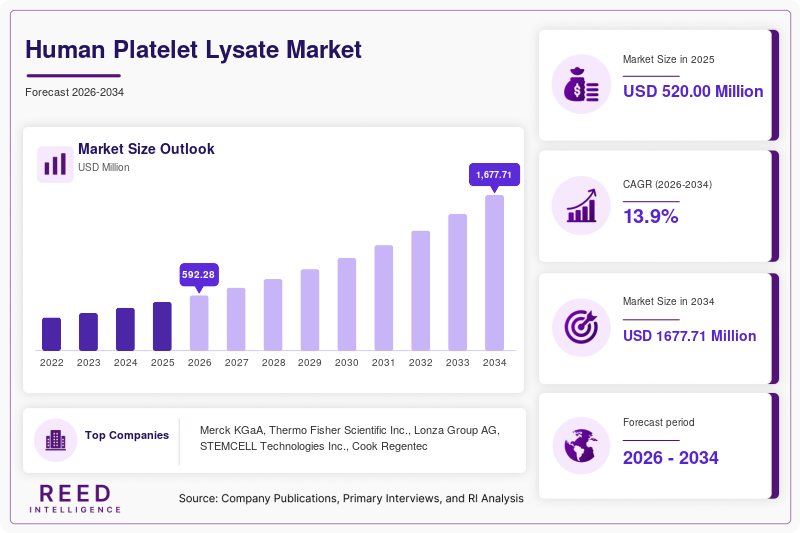
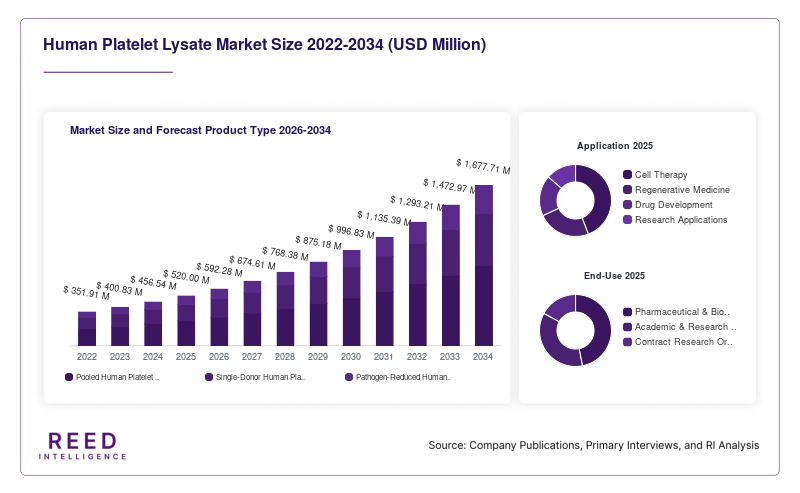
The global Human Platelet Lysate Market size was valued at approximately USD 520 million in 2025 and is projected to reach USD 1.68 billion by 2034, expanding at a CAGR of 13.9% during the forecast period (2025–2034). Human platelet lysate (HPL), derived from human platelets, is increasingly used as a xeno-free alternative to fetal bovine serum in cell culture applications, particularly in regenerative medicine and cell therapy.
One of the key global factors supporting market growth is the increasing demand for safe, ethical, and animal-free cell culture supplements. As regulatory bodies and research institutions emphasize the elimination of animal-derived components, HPL is gaining traction due to its compatibility with clinical-grade cell expansion and reduced immunogenic risks.
Key Highlights
- North America dominated the market with a 38.5% share in 2025, while Asia Pacific is expected to register the fastest CAGR of 15.8% during the forecast period.
- By product type, pooled HPL accounted for the largest share at 61.2%, while pathogen-reduced HPL is projected to grow at a CAGR of 16.4%.
- By application, cell therapy held the leading share at 42.7%, whereas regenerative medicine is anticipated to grow at a CAGR of 15.6%.
- The United States market was valued at USD 180 million in 2025 and is estimated to reach USD 205 million in 2026.
Market Trends
Shift Toward Xeno-Free and Serum-Free Cell Culture Systems
The Human Platelet Lysate Market is witnessing a notable shift toward xeno-free and serum-free culture systems. Traditional reliance on fetal bovine serum is declining due to concerns over variability, contamination risks, and ethical considerations. HPL provides a human-derived alternative that enhances reproducibility and safety in clinical applications. This trend is particularly strong in cell therapy manufacturing, where regulatory compliance and product consistency are essential.
Increasing Integration in Advanced Cell-Based Therapies
Another significant trend is the growing integration of HPL in advanced therapies such as CAR-T cell therapy, stem cell expansion, and tissue engineering. As personalized medicine gains traction, the demand for high-quality culture supplements is rising. HPL supports faster cell proliferation and improved viability, making it a preferred option for next-generation therapies. Moreover, collaborations between biotech firms and research institutes are accelerating innovation in HPL formulations, further expanding its role in cutting-edge biomedical applications.
Market Drivers
Rising Demand for Regenerative Medicine Applications
The increasing adoption of regenerative medicine is a major driver of the Human Platelet Lysate Market. Therapies involving stem cells and tissue repair require optimized culture environments to ensure cell viability and growth. HPL offers a rich source of growth factors, cytokines, and proteins that enhance cell proliferation and differentiation. As healthcare systems focus on advanced therapeutic solutions for chronic diseases and injuries, the demand for HPL-based culture systems continues to grow steadily.
Expansion of Biopharmaceutical and Cell Therapy Manufacturing
The rapid expansion of the biopharmaceutical sector and cell therapy manufacturing is significantly contributing to market growth. Pharmaceutical companies are increasingly investing in biologics and cell-based products, which require scalable and standardized culture media. HPL meets these requirements by offering consistent performance and compatibility with Good Manufacturing Practices (GMP). The growing number of clinical trials and product approvals in the cell therapy space is further driving the adoption of HPL across industrial applications.
Market Restraint
Variability and Standardization Challenges
A major restraint in the Human Platelet Lysate Market is the variability associated with raw material sourcing and processing methods. Since HPL is derived from human donors, differences in donor characteristics can lead to inconsistencies in product composition. This variability can impact reproducibility in research and clinical outcomes, posing challenges for large-scale adoption.
Additionally, the lack of standardized protocols for platelet collection, lysate preparation, and quality control creates barriers for manufacturers. Regulatory requirements for clinical-grade products further complicate the production process, increasing costs and limiting accessibility for smaller research institutions. While advancements in pooling techniques and pathogen reduction methods are addressing these challenges, achieving uniformity across batches remains a key concern for market participants.
Market Opportunities
Growth in Personalized Medicine and Cell-Based Therapies
The rise of personalized medicine presents a significant opportunity for the Human Platelet Lysate Market. As treatments become more tailored to individual patients, the need for customized cell culture solutions is increasing. HPL, with its human-derived composition, aligns well with personalized therapeutic approaches. Its ability to support autologous and allogeneic cell expansion makes it a valuable component in developing targeted therapies.
Emerging Markets and Healthcare Infrastructure Development
Emerging economies offer substantial growth opportunities due to improving healthcare infrastructure and increasing investments in biotechnology. Countries in Asia Pacific, Latin America, and the Middle East are expanding their research capabilities and establishing advanced laboratories. This expansion is expected to drive demand for high-quality cell culture supplements, including HPL. Government initiatives supporting life sciences research and the establishment of biopharma hubs are further contributing to market growth in these regions.
Segmental Analysis
By Product Type
Pooled human platelet lysate dominated the Human Platelet Lysate Market in 2025, accounting for 61.2% of the total share. This dominance was attributed to its ability to minimize donor variability and provide consistent performance across applications. Pooled HPL is widely used in large-scale research and clinical settings due to its reliability and standardized composition.
Pathogen-reduced HPL is expected to be the fastest-growing subsegment, with a projected CAGR of 16.4% during the forecast period. This growth will be driven by increasing safety requirements in clinical applications. The use of pathogen reduction technologies enhances product safety by eliminating potential contaminants, making it suitable for therapeutic use and compliant with regulatory standards.
By Application
Cell therapy represented the largest application segment in 2025, holding a 42.7% share of the Human Platelet Lysate Market. The segment’s growth was supported by the increasing number of clinical trials and the rising adoption of cell-based treatments for chronic diseases.
Regenerative medicine is anticipated to grow at the fastest CAGR of 15.6% during the forecast period. This growth will be driven by advancements in tissue engineering and the increasing demand for effective treatment solutions for degenerative conditions. HPL’s ability to enhance cell proliferation and differentiation makes it an essential component in regenerative applications.
By End-Use
Pharmaceutical and biotechnology companies dominated the market in 2025, accounting for 48.9% of the share. These organizations extensively use HPL in drug development and cell therapy production, benefiting from its scalability and compatibility with industrial processes.
Academic and research institutes are projected to grow at the fastest CAGR of 14.8%. This growth will be driven by increasing funding for life sciences research and the expansion of research activities in emerging economies. The growing focus on stem cell research and personalized medicine will further support this segment’s growth.
By Form
Liquid HPL held the largest share in 2025, accounting for 58.3% of the market. Its widespread use was attributed to ease of handling and direct application in cell culture processes, making it a preferred choice for laboratories and manufacturing facilities.
Lyophilized HPL is expected to grow at the fastest CAGR of 15.2% during the forecast period. This growth will be driven by its extended shelf life and ease of storage and transportation. The increasing need for stable and portable solutions in global supply chains will support the adoption of lyophilized products.
Regional Analysis
North America
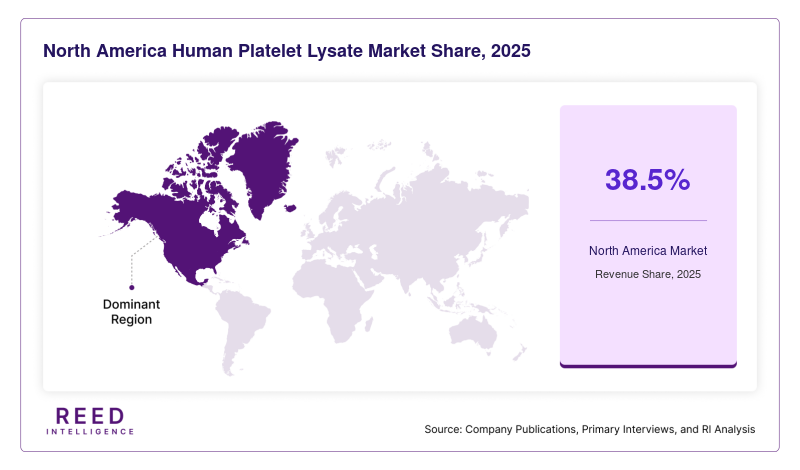
North America accounted for 38.5% of the Human Platelet Lysate Market share in 2025 and is expected to grow at a CAGR of 13.2% during the forecast period. The region’s established biotechnology ecosystem and strong presence of pharmaceutical companies have supported steady demand for HPL products.
The United States dominated the regional market due to its advanced research infrastructure and high investment in cell therapy development. The presence of leading research institutions and ongoing clinical trials in regenerative medicine have contributed to consistent market expansion. Additionally, favorable regulatory frameworks supporting biologics development have strengthened adoption rates.
Europe
Europe held a 27.8% share of the Human Platelet Lysate Market in 2025 and is projected to grow at a CAGR of 13.5%. The region has demonstrated strong adoption of ethical and animal-free research practices, which has supported the shift toward HPL-based solutions.
Germany emerged as the dominant country in this region due to its robust biopharmaceutical sector and emphasis on innovation in cell-based therapies. The country’s focus on quality standards and regulatory compliance has encouraged the use of HPL in both research and clinical applications, contributing to sustained growth.
Asia Pacific
Asia Pacific represented 21.6% of the Human Platelet Lysate Market in 2025 and is expected to register the fastest CAGR of 15.8% through 2034. The region’s rapid expansion in biotechnology research and increasing healthcare investments have fueled market growth.
China led the regional market, driven by large-scale investments in life sciences and government support for biopharmaceutical manufacturing. The country’s growing focus on stem cell research and regenerative medicine has significantly increased the demand for HPL products. Additionally, the expansion of contract research organizations has further supported market development.
Middle East & Africa
The Middle East & Africa accounted for 6.4% of the Human Platelet Lysate Market share in 2025 and is anticipated to grow at a CAGR of 12.6%. The region’s developing healthcare infrastructure and increasing focus on advanced medical research have contributed to gradual market growth.
The United Arab Emirates emerged as a key market within the region due to its investments in healthcare innovation and biotechnology. The establishment of research centers and collaborations with international institutions have supported the adoption of advanced cell culture technologies, including HPL.
Latin America
Latin America held a 5.7% share of the Human Platelet Lysate Market in 2025 and is projected to grow at a CAGR of 12.9%. The region’s improving healthcare systems and growing interest in regenerative medicine have driven market expansion.
Brazil dominated the regional market, supported by increasing research activities and government initiatives promoting biotechnology development. The country’s focus on expanding clinical research capabilities has created demand for high-quality culture supplements, including HPL, thereby supporting market growth.
Competitive Landscape
The Human Platelet Lysate Market is moderately consolidated, with key players focusing on product innovation, partnerships, and geographic expansion. Companies are investing in advanced processing technologies to improve product consistency and safety.
A leading player in the market is Merck KGaA, which has strengthened its position through continuous product development and strategic collaborations. The company recently introduced an enhanced HPL formulation designed for clinical-grade applications, supporting its expansion in the cell therapy segment.
Other prominent players are also focusing on expanding their product portfolios and strengthening distribution networks. The competitive environment is characterized by increasing emphasis on quality standards, regulatory compliance, and innovation to meet evolving customer requirements.
Key Players List
- Merck KGaA
- Thermo Fisher Scientific Inc.
- Lonza Group AG
- STEMCELL Technologies Inc.
- Cook Regentec
- Macopharma
- Compass Biomedical
- PL BioScience GmbH
- ZenBio Inc.
- Valley Biomedical Products & Services
- CellGenix GmbH
- Hematologic Technologies Inc.
- SeraCare Life Sciences
- Biowest SAS
- PromoCell GmbH
Recent Developments
- In 2024, Merck KGaA launched a new GMP-grade human platelet lysate product to support clinical applications in cell therapy.
- In 2024, PL BioScience expanded its production capacity to meet increasing global demand.
- In 2023, Lonza Group AG announced a strategic collaboration with a biotechnology firm to develop advanced cell culture solutions.
- In 2023, STEMCELL Technologies introduced a new line of pathogen-reduced HPL products.
- In 2023, Thermo Fisher Scientific Inc. enhanced its distribution network to strengthen its presence in emerging markets.
Human Platelet Lysate Market Segments
Product Type
- Pooled Human Platelet Lysate
- Single-Donor Human Platelet Lysate
- Pathogen-Reduced Human Platelet Lysate
Application
- Cell Therapy
- Regenerative Medicine
- Drug Development
- Research Applications
End-Use
- Pharmaceutical & Biotechnology Companies
- Academic & Research Institutes
- Contract Research Organizations
Form
- Liquid
- Lyophilized
By Region
- North America
- Europe
- APAC
- Middle East and Africa
- LATAM