Human Prion Disease Diagnostic Market Size, Share & Demand Report By Diagnostic Type (Diagnostic Tests, Molecular Diagnostics, Imaging Techniques), By Technology (Conventional Methods, Advanced Assays), By Sample Type (Cerebrospinal Fluid, Blood-Based Diagnostics, Tissue Samples), By End-Use (Hospitals, Diagnostic Laboratories, Research Institutes), By Distribution Channel (Direct Sales, Distributors, Online Channels), By Region & Segment Forecasts, 2026–2034
USD 3950
Market Overview
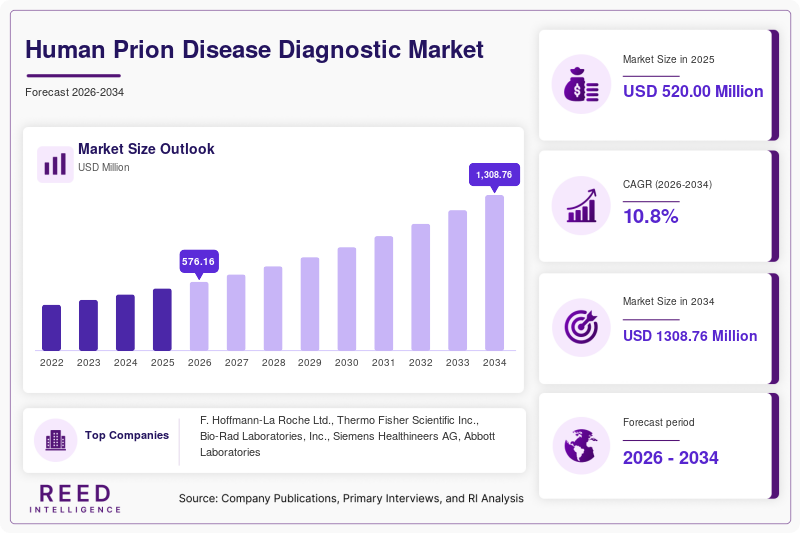
The global Human Prion Disease Diagnostic Market was valued at approximately USD 520 million in 2026 and is projected to reach USD 1.18 billion by 2034, expanding at a CAGR of 10.8% during the forecast period (2026–2034). The market growth is primarily supported by increasing awareness regarding rare neurodegenerative disorders and advancements in molecular diagnostic technologies that enable early and more accurate detection of prion-related diseases.
One of the key global factors contributing to market expansion is the growing integration of advanced biomarker-based diagnostic tools in clinical neurology. Techniques such as real-time quaking-induced conversion (RT-QuIC) assays and cerebrospinal fluid (CSF) protein analysis have improved diagnostic sensitivity and specificity, encouraging adoption across specialized healthcare settings. Additionally, the rise in surveillance programs for transmissible spongiform encephalopathies (TSEs) has enhanced early identification and monitoring capabilities, further driving demand.
Key Highlights:
- North America dominated the market with a 42.3% share in 2025, while Asia Pacific is expected to grow at the fastest CAGR of 12.6% (2026–2034).
- The diagnostic tests segment led with a 38.7% share, while molecular diagnostics is projected to grow at a CAGR of 13.2%.
- The hospital-based diagnostics segment accounted for 45.1% share, whereas specialized diagnostic laboratories are expected to grow at a CAGR of 11.9%.
- The United States remained the dominant country, with market values of USD 180 million in 2024 and USD 195 million in 2025.
Market Trends
Increasing Adoption of Biomarker-Based Diagnostics
The Human Prion Disease Diagnostic Market is witnessing a notable shift toward biomarker-based diagnostic approaches. Biomarkers such as 14-3-3 proteins, tau proteins, and prion protein aggregates are increasingly used to detect prion diseases at earlier stages. The adoption of RT-QuIC assays has gained traction due to its high diagnostic accuracy and ability to detect minute quantities of abnormal prion proteins. This trend reflects a broader industry movement toward precision diagnostics, where early detection is critical for disease management and epidemiological tracking. Healthcare providers are increasingly incorporating these advanced diagnostic tools into routine neurological assessments, improving clinical outcomes and supporting market growth.
Expansion of Specialized Diagnostic Laboratories
Another key trend shaping the market is the expansion of specialized diagnostic laboratories dedicated to rare neurological disorders. These laboratories are equipped with advanced technologies and trained personnel capable of handling complex prion disease diagnostics. The increasing demand for confirmatory testing and second opinions has encouraged healthcare systems to collaborate with specialized labs. Furthermore, centralized testing facilities are improving turnaround times and diagnostic accuracy. This trend is particularly evident in developed regions, where healthcare infrastructure supports high-end diagnostic services, and is gradually expanding into emerging economies through public-private partnerships.
Market Drivers
Rising Prevalence of Neurodegenerative Disorders
The growing prevalence of neurodegenerative disorders is a significant driver for the Human Prion Disease Diagnostic Market. Although prion diseases are rare, their fatal nature and similarity to other neurological conditions such as Alzheimer’s and Parkinson’s diseases necessitate accurate differential diagnosis. Increasing aging populations globally have led to a higher incidence of neurological conditions, thereby increasing the demand for precise diagnostic tools. Healthcare providers are focusing on early diagnosis to differentiate prion diseases from other neurodegenerative disorders, contributing to market expansion.
Technological Advancements in Diagnostic Methods
Technological advancements in diagnostic methodologies are playing a crucial role in market growth. Innovations such as RT-QuIC assays, next-generation sequencing, and advanced imaging techniques have significantly improved diagnostic capabilities. These technologies offer higher sensitivity, faster results, and improved reliability compared to traditional diagnostic methods. The integration of artificial intelligence in imaging and data analysis is further enhancing diagnostic accuracy. As these technologies become more accessible and cost-effective, their adoption is expected to increase across healthcare settings, driving the growth of the Human Prion Disease Diagnostic Market.
Market Restraint
Limited Awareness and Diagnostic Accessibility
A major restraint impacting the Human Prion Disease Diagnostic Market is the limited awareness and accessibility of diagnostic services, particularly in low- and middle-income countries. Prion diseases are rare and often underdiagnosed due to lack of clinical suspicion and insufficient diagnostic infrastructure. Many healthcare facilities lack the specialized equipment and expertise required for accurate diagnosis, leading to delayed or missed diagnoses.
Additionally, the high cost associated with advanced diagnostic tests such as RT-QuIC and molecular assays further restricts their adoption. Reimbursement challenges and limited insurance coverage also contribute to reduced accessibility. In rural and underserved areas, patients often face logistical challenges in accessing specialized diagnostic centers, further hindering market growth.
This restraint highlights the need for increased awareness campaigns, improved healthcare infrastructure, and cost-effective diagnostic solutions to ensure wider accessibility. Addressing these challenges will be critical for unlocking the full potential of the market, particularly in emerging economies where healthcare systems are still developing.
Market Opportunities
Development of Point-of-Care Diagnostic Solutions
The development of point-of-care diagnostic solutions presents a significant opportunity for the Human Prion Disease Diagnostic Market. Portable and rapid diagnostic tools can enable early detection in remote and resource-limited settings. These solutions have the potential to reduce diagnostic delays and improve patient outcomes by providing timely results. Advances in microfluidics and biosensor technologies are supporting the development of compact diagnostic devices, which can be used in decentralized healthcare settings.
Expansion in Emerging Markets
Emerging markets offer substantial growth opportunities due to improving healthcare infrastructure and increasing investments in diagnostic technologies. Countries in Asia Pacific, Latin America, and the Middle East are focusing on strengthening their healthcare systems and expanding access to advanced diagnostic services. Government initiatives aimed at improving disease surveillance and early detection are further supporting market growth. As awareness of prion diseases increases, demand for diagnostic services is expected to rise, creating opportunities for market players to expand their presence in these regions.
Segmental Analysis
By Diagnostic Type
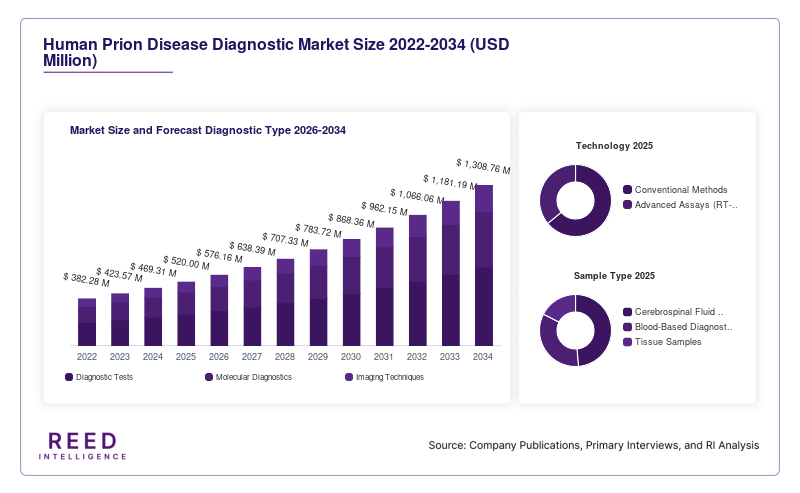
The diagnostic tests segment dominated the Human Prion Disease Diagnostic Market, accounting for 38.7% share in 2025. This dominance was driven by widespread use of CSF-based assays and RT-QuIC tests in clinical settings.
The molecular diagnostics segment is expected to grow at the fastest CAGR of 13.2%, driven by advancements in genetic testing and biomarker analysis. These technologies offer higher accuracy and enable early detection, supporting their adoption.
By Technology
Conventional diagnostic methods held the largest share of 41.5% in 2025, due to their established use in clinical practice.
Advanced technologies such as RT-QuIC are projected to grow at a CAGR of 14.1%, supported by their superior sensitivity and specificity.
By Sample Type
Cerebrospinal fluid (CSF) samples accounted for 46.8% share in 2025, as they are commonly used for prion disease diagnosis.
Blood-based diagnostics are expected to grow at a CAGR of 12.4%, driven by ongoing research aimed at developing less invasive diagnostic methods.
By End-Use
Hospitals dominated the market with a 45.1% share in 2025, due to availability of diagnostic facilities and patient inflow.
Specialized diagnostic laboratories are expected to grow at a CAGR of 11.9%, supported by increasing demand for advanced testing services.
By Distribution Channel
Direct sales accounted for the largest share of 52.6% in 2025, driven by strong relationships between manufacturers and healthcare providers.
Online distribution channels are projected to grow at a CAGR of 10.7%, supported by digitalization and increasing adoption of e-commerce platforms.
Regional Analysis
North America
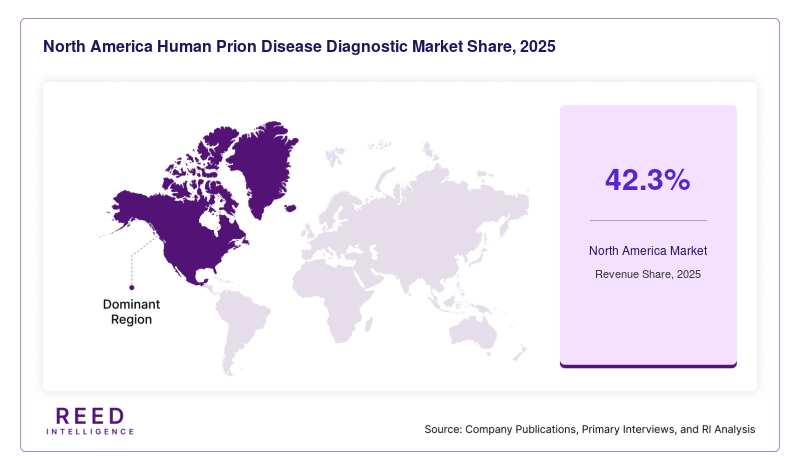
North America accounted for 42.3% of the Human Prion Disease Diagnostic Market share in 2025 and is expected to grow at a CAGR of 10.2% during the forecast period. The region’s dominance was attributed to well-established healthcare infrastructure, advanced diagnostic capabilities, and strong research initiatives in neurodegenerative diseases.
The United States dominated the regional market due to its robust healthcare system and extensive research activities. The presence of specialized diagnostic centers and ongoing clinical research programs contributed to market growth. Government support for disease surveillance and funding for neurological research further strengthened the country’s position.
Europe
Europe held a 28.7% share in 2025 and is projected to grow at a CAGR of 10.5%. The region benefited from strong regulatory frameworks and widespread adoption of advanced diagnostic technologies.
Germany emerged as the leading country in Europe, driven by its advanced healthcare infrastructure and focus on research and development. The country’s emphasis on early diagnosis and disease monitoring supported market expansion.
Asia Pacific
Asia Pacific captured 16.5% market share in 2025 and is anticipated to grow at the fastest CAGR of 12.6%. The region’s growth is driven by improving healthcare infrastructure and increasing awareness of rare diseases.
China dominated the region due to its large population base and growing investments in healthcare. Government initiatives to improve diagnostic capabilities and expand access to advanced technologies contributed to market growth.
Middle East & Africa
The Middle East & Africa region accounted for 6.2% share in 2025 and is expected to grow at a CAGR of 9.8%. Growth in this region is supported by increasing healthcare investments and improving diagnostic infrastructure.
Saudi Arabia led the regional market due to its focus on healthcare modernization and adoption of advanced diagnostic technologies. Government initiatives to enhance healthcare services played a key role.
Latin America
Latin America held a 6.3% share in 2025 and is projected to grow at a CAGR of 10.1%. The region’s growth is driven by expanding healthcare access and increasing awareness of neurological disorders.
Brazil dominated the market, supported by its large healthcare network and growing focus on advanced diagnostics. Investments in healthcare infrastructure contributed to market expansion.
Competitive Landscape
The Human Prion Disease Diagnostic Market is moderately consolidated, with key players focusing on technological innovation and strategic collaborations. Leading companies are investing in research and development to enhance diagnostic accuracy and expand their product portfolios. Hoffmann-La Roche Ltd.emergedas a market leader due to its strong presence in molecular diagnostics and continuous innovation. The company recently introduced advanced assay solutions aimed at improving early detection of prion diseases.
Other major players are actively expanding their geographic presence and forming partnerships with healthcare institutions to strengthen their market position. The competitive landscape is characterized by ongoing advancements in diagnostic technologies and increasing focus on precision medicine.
Key Players List
- F. Hoffmann-La Roche Ltd.
- Thermo Fisher Scientific Inc.
- Bio-Rad Laboratories, Inc.
- Siemens Healthineers AG
- Abbott Laboratories
- QuidelOrtho Corporation
- Danaher Corporation
- Sysmex Corporation
- Becton, Dickinson and Company
- PerkinElmer, Inc.
- Agilent Technologies, Inc.
- QIAGEN N.V.
- BioMérieux SA
- Fujirebio Diagnostics, Inc.
- Ortho Clinical Diagnostics
Recent Developments
- 2025: A leading diagnostics company launched an enhanced RT-QuIC assay with improved sensitivity.
- 2024: Strategic collaboration between diagnostic firms and research institutes to develop blood-based prion tests.
- 2025: Expansion of specialized diagnostic laboratories in Asia Pacific.
- 2026: Introduction of AI-integrated diagnostic platforms for neurological disease detection.
- 2024: Increased government funding for prion disease surveillance programs.
Human Prion Disease Diagnostic Market Segments
Diagnostic Type
- Diagnostic Tests
- Molecular Diagnostics
- Imaging Techniques
Technology
- Conventional Methods
- Advanced Assays (RT-QuIC, Biomarker-Based)
Sample Type
- Cerebrospinal Fluid (CSF)
- Blood-Based Diagnostics
- Tissue Samples
End-Use
- Hospitals
- Diagnostic Laboratories
- Research Institutes
Distribution Channel
- Direct Sales
- Distributors
- Online Channels
By Region
- North America
- Europe
- APAC
- Middle East and Africa
- LATAM