Human Umbilical Vein Endothelial Cells Market Size, Share Demand Report By Cell Type (Primary HUVEC, HUVEC Cell Lines, Immortalized HUVEC), By Application (Vascular Biology Research, Drug Discovery & Toxicology, Cancer Research, Cardiovascular Research, Others), By End User (Academic & Research Institutions, Pharmaceutical & Biotechnology Companies, Contract Research Organizations) & Segment Forecasts, 2026–2034
USD 3950
Human Umbilical Vein Endothelial Cells Market Size
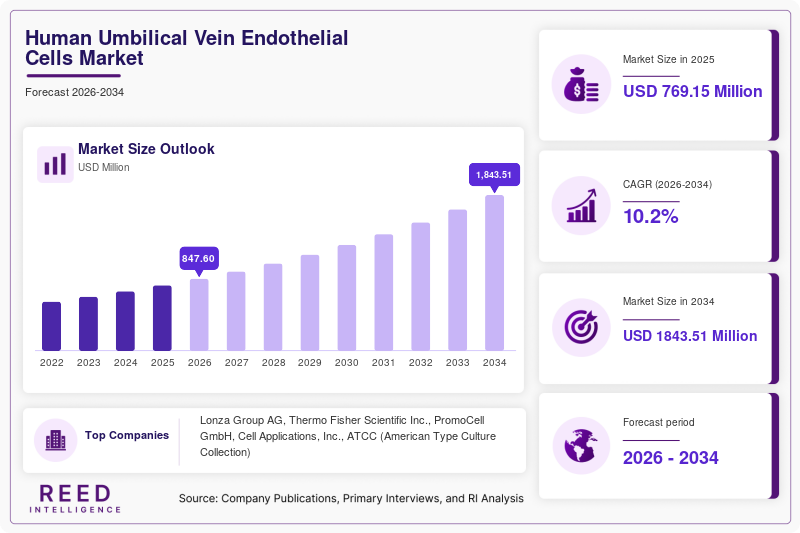
Human Umbilical Vein Endothelial Cells market size is projected at USD 847.6 million in 2026 and is expected to hit USD 1,847.5 million by 2034 with a CAGR of 10.2% during the forecast period. The increasing demand for in vitro models for vascular biology, drug discovery, and toxicology studies, coupled with the growing focus on cardiovascular and cancer research, underpins market expansion. This report delivers a comprehensive analysis of the Human Umbilical Vein Endothelial Cells market, including segmentation by type and application, competitive dynamics, and regional growth patterns, equipping stakeholders with critical intelligence. The Human Umbilical Vein Endothelial Cells market continues to demonstrate robust growth potential, fueled by the rising prevalence of cardiovascular diseases, the increasing investment in biomedical research, and continuous innovation in cell culture and isolation technologies.
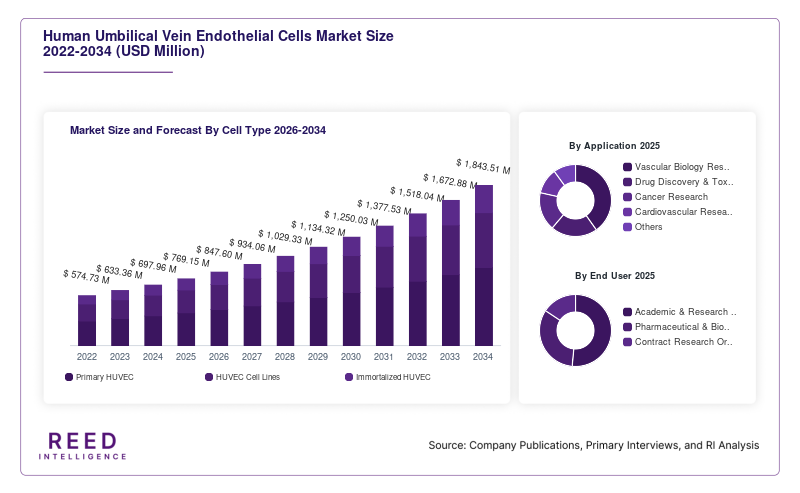
Human Umbilical Vein Endothelial Cells (HUVEC) are primary cells derived from the umbilical cord vein, widely used as a model system for studying endothelial cell biology, angiogenesis, inflammation, and vascular function. They are essential tools in academic and pharmaceutical research for understanding vascular-related diseases and testing drug candidates. The global production of HUVEC cultures and related products exceeded 250,000 units in 2025, reflecting an 11% increase from 2023, driven by the growing demand for cell-based assays in drug development and disease modeling. Adoption patterns reveal that the Primary HUVEC type dominates the market, accounting for 52% of total demand, followed by HUVEC Cell Lines at 28%, and Immortalized HUVEC at 20%. The Human Umbilical Vein Endothelial Cells market's trajectory is closely linked to the growth of the global cell culture market, which is projected to reach USD 50 billion by 2028, and the increasing importance of in vitro models in biomedical research.
Human Umbilical Vein Endothelial Cells Market Trends
Adoption of Advanced 3D Culture and Co-Culture Systems
The Human Umbilical Vein Endothelial Cells market is witnessing a significant trend toward the adoption of advanced 3D culture and co-culture systems, driven by the need for more physiologically relevant in vitro models. The revenue from 3D HUVEC culture products grew to USD 280 million in 2025, a year-on-year increase of 18%, as 35% of new research protocols in 2025 specified 3D or co-culture models. Adoption rates of advanced culture systems in vascular research reached 30%, with this figure projected to exceed 55% by 2030. The Human Umbilical Vein Endothelial Cells market's trend toward advanced models is reinforced by the need for better predictive capabilities, the increasing complexity of research questions, and the continuous innovation in biomaterials and tissue engineering.
Growing Focus on Disease Modeling and Personalized Medicine
The increasing focus on disease modeling and personalized medicine is a major trend shaping the Human Umbilical Vein Endothelial Cells market, with the development of patient-derived and disease-specific endothelial cell models. The market has seen a 20% increase in the demand for specialized HUVEC variants since 2022, with 25% of new product launches in 2025 featuring cells from diseased or genetically modified donors. The use of HUVEC for drug screening and toxicity testing has also gained significant traction. The Human Umbilical Vein Endothelial Cells market's trend toward specialization is reinforced by the need for targeted therapies, the increasing emphasis on precision medicine, and the continuous innovation in cell isolation and genetic engineering techniques.
Human Umbilical Vein Endothelial Cells Market Drivers
The Human Umbilical Vein Endothelial Cells market's expansion is primarily driven by the increasing prevalence of cardiovascular diseases, which affect over 500 million people globally in 2025, and the growing need for effective research models. The need for reliable and reproducible in vitro systems for drug discovery and toxicology has been a major driver, with HUVEC being a gold standard for vascular studies. The rising investment in biomedical research and the development of new therapeutics have also fueled market growth. Additionally, the increasing focus on angiogenesis and cancer research has spurred demand. The Human Umbilical Vein Endothelial Cells market's growth is further reinforced by the continuous improvement in cell culture media and protocols, leading to better cell quality and performance.
Human Umbilical Vein Endothelial Cells Market Restraints
Despite favorable growth prospects, the Human Umbilical Vein Endothelial Cells market faces significant constraints, primarily related to the limited lifespan of primary cells and the variability between donors, which can affect reproducibility. The high cost of quality HUVEC products and the complexity of cell culture can also be a limitation. The Human Umbilical Vein Endothelial Cells market's growth is also tempered by the availability of alternative cell models and the challenge of maintaining endothelial phenotype in culture.
Human Umbilical Vein Endothelial Cells Market Opportunities
The Human Umbilical Vein Endothelial Cells market presents significant opportunities in the rapidly expanding market for organ-on-a-chip and microphysiological systems, where HUVEC are a key component. The development of HUVEC-based assays for personalized drug screening is expected to grow at a CAGR of 12% through 2034. Emerging opportunities also exist in the use of HUVEC for studying vascular complications in metabolic diseases and for regenerative medicine applications. The Human Umbilical Vein Endothelial Cells market's opportunity profile is further enhanced by the growing trend of outsourcing cell-based assays and the increasing availability of specialized cell culture services.
Challenges in Human Umbilical Vein Endothelial Cells Market
The Human Umbilical Vein Endothelial Cells market faces persistent challenges related to the need for continuous innovation to improve cell quality, consistency, and functionality. The complexity of handling and maintaining primary cells in culture can also be a challenge. The market is also contending with the challenge of the ethical and regulatory issues surrounding the use of human-derived cells. Additionally, the Human Umbilical Vein Endothelial Cells market is challenged by the need for standardization of protocols and the high cost of specialized media and supplements.
Human Umbilical Vein Endothelial Cells Market Segmentation
The Human Umbilical Vein Endothelial Cells market is segmented by Type and Application to provide a comprehensive market perspective. By Type, Primary HUVEC dominate with a 52% market share, driven by their physiological relevance. The Application segment is led by Vascular Biology Research, which accounts for 32% of the market, followed by Drug Discovery & Toxicology at 28%, Cardiovascular Research at 20%, Cancer Research at 15%, and Others at 5%.
By Type
Primary HUVEC represent the largest segment in the Human Umbilical Vein Endothelial Cells market, commanding a 52% share, with production exceeding 130,000 units in 2025. These are characterized by their direct isolation from human umbilical cords, offering the most physiologically relevant model. Technical specifications include donor variability, passage number, and phenotype markers. The Human Umbilical Vein Endothelial Cells market's Primary segment is driven by its use in fundamental research and drug testing.
HUVEC Cell Lines capture a 28% share of the Human Umbilical Vein Endothelial Cells market, with production of 70,000 units in 2025. These are characterized by their established, commercially available lines offering consistency and ease of use. Technical specifications include defined genetic background, growth characteristics, and functional assays. The Human Umbilical Vein Endothelial Cells market's Cell Lines segment is driven by its use in high-throughput screening and standardized assays.
Immortalized HUVEC represent the remaining 20% of the Human Umbilical Vein Endothelial Cells market, with production of 50,000 units in 2025. These are characterized by their ability to proliferate indefinitely, offering convenience and a consistent supply. Technical specifications include immortalization method, phenotypic stability, and growth characteristics. The Human Umbilical Vein Endothelial Cells market's Immortalized segment is driven by its use in long-term studies and large-scale experiments.
By Application
Vascular Biology Research dominates the Human Umbilical Vein Endothelial Cells market, accounting for 32% of sales, representing 80,000 units in 2025. This segment includes use in studying angiogenesis, inflammation, and vascular function. Usage penetration exceeds 40% in the sector. The Human Umbilical Vein Endothelial Cells market's Vascular segment is characterized by its focus on fundamental biological questions.
Drug Discovery & Toxicology accounts for 28% of the Human Umbilical Vein Endothelial Cells market, with sales of 70,000 units in 2025. This segment encompasses use in screening drug candidates and assessing vascular toxicity. The segment is growing at a robust CAGR, driven by the pharmaceutical industry. The Human Umbilical Vein Endothelial Cells market's Drug Discovery segment is characterized by its focus on predictive and reliable assays.
Cardiovascular Research represents 20% of the Human Umbilical Vein Endothelial Cells market, with sales of 50,000 units in 2025. This segment includes use in studying atherosclerosis, hypertension, and heart disease. The segment is growing at a steady rate, driven by the disease burden. The Human Umbilical Vein Endothelial Cells market's Cardiovascular segment is characterized by its focus on disease mechanisms and therapeutic targets.
Cancer Research accounts for 15% of the Human Umbilical Vein Endothelial Cells market, with sales of 37,500 units in 2025. This segment includes use in studying tumor angiogenesis and metastasis. The segment is growing at a moderate pace. The Human Umbilical Vein Endothelial Cells market's Cancer segment is characterized by its focus on tumor-microenvironment interactions.
Others comprises the remainder of the Human Umbilical Vein Endothelial Cells market, accounting for 5% of total sales, with 12,500 units in 2025. This segment includes use in immunology, stem cell research, and other fields. The segment is projected to grow at a significant CAGR through 2034. The Human Umbilical Vein Endothelial Cells market's Others segment is characterized by its diverse and emerging applications.
Human Umbilical Vein Endothelial Cells Market Regional Outlook
North America Human Umbilical Vein Endothelial Cells Market
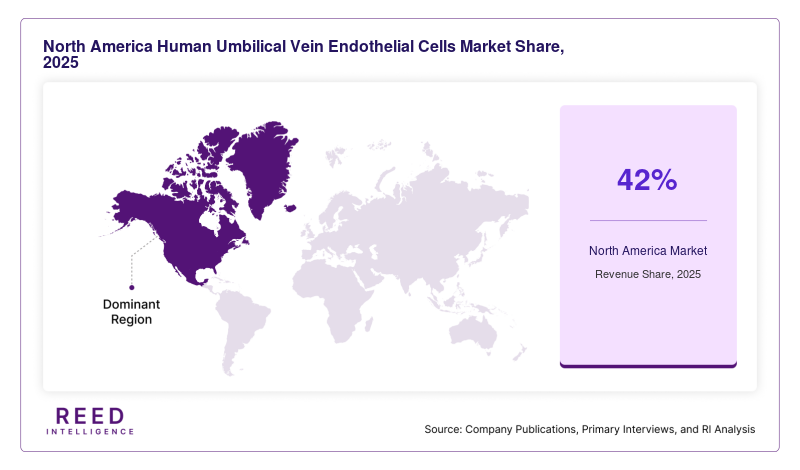
Leads the Human Umbilical Vein Endothelial Cells market, commanding a 42% share, with a revenue of USD 355.9 million in 2025. The United States is the primary driver, accounting for 85% of regional demand, driven by the strong biomedical research infrastructure, high funding for life sciences, and presence of major pharmaceutical companies. The North American Human Umbilical Vein Endothelial Cells market is characterized by its focus on innovation and advanced applications.
Europe Human Umbilical Vein Endothelial Cells Market
Represents the second-largest market, capturing a 30% share with a revenue of USD 254.3 million in 2025. The UK, Germany, and France are the primary drivers, collectively accounting for 60% of regional demand, driven by a strong academic research base, collaborative networks, and support for life sciences. The Human Umbilical Vein Endothelial Cells market in Europe is characterized by its focus on quality and standardization.
Asia-Pacific Human Umbilical Vein Endothelial Cells Market
Accounts for 20% of the global Human Umbilical Vein Endothelial Cells market, with a revenue of USD 169.5 million in 2025. China, Japan, and India are the primary drivers, together accounting for 70% of regional demand, driven by increasing investment in biomedical research, growing pharmaceutical R&D, and expanding academic infrastructure. The Asia-Pacific Human Umbilical Vein Endothelial Cells market is projected to grow at the fastest CAGR of 13% through 2034.
Middle East & Africa and Latin America Human Umbilical Vein Endothelial Cells Market
Together account for the remaining 8% of the Human Umbilical Vein Endothelial Cells market, with the UAE leading the Middle East market and Brazil leading the Latin American market. Both regions are projected to grow at CAGRs exceeding 10%, driven by improving research facilities and increasing focus on healthcare research.
Top players in Human Umbilical Vein Endothelial Cells Market
- Lonza Group AG
- Thermo Fisher Scientific Inc.
- PromoCell GmbH
- Cell Applications, Inc.
- ATCC (American Type Culture Collection)
- Sigma-Aldrich (Merck KGaA)
- Corning Incorporated
- BD Biosciences
- ScienCell Research Laboratories
- Invitrogen (Thermo Fisher)
- MilliporeSigma (Merck)
- GE Healthcare (Cytiva)
- Biological Industries
- Irvine Scientific
- AMSBIO
Lonza Group AG
Lonza Group AG holds a dominant position in the Human Umbilical Vein Endothelial Cells market, with an estimated 20% global market share, particularly strong in the primary cell and culture media segments. The company's portfolio of HUVEC products is widely recognized for its quality, reproducibility, and comprehensive support. Lonza's market leadership is reinforced by its significant R&D investment, its extensive cell culture expertise, and its global distribution network. Lonza commands over 22% of the North American market and 18% of the European market, positioning it as a key player in the Human Umbilical Vein Endothelial Cells market.
Thermo Fisher Scientific Inc.
Thermo Fisher Scientific is a leading player in the Human Umbilical Vein Endothelial Cells market, commanding approximately 18% of the global market share through its comprehensive portfolio of cell culture products and reagents. The company's expertise in life sciences and its focus on innovation have solidified its position. Thermo Fisher's HUVEC products are known for their quality, consistency, and integration with its broader cell culture systems. The company's commitment to supporting research and its strong presence in the North American and European markets have enhanced its competitive advantage.
PromoCell GmbH holds a significant 10% market share, with particular strength in the European market. ATCC is a major player in the cell line repository and distribution market, holding an 8% share.
Recent Developments in Human Umbilical Vein Endothelial Cells Market
- 2025: Lonza launched a new line of HUVEC optimized for 3D culture and organ-on-a-chip applications, enhancing physiological relevance.
- 2025: Thermo Fisher introduced a new chemically defined medium for HUVEC, reducing variability and improving reproducibility in culture.
Human Umbilical Vein Endothelial Cells Market Segments
By Cell Type
- Primary HUVEC
- HUVEC Cell Lines
- Immortalized HUVEC
By Application
- Vascular Biology Research
- Drug Discovery & Toxicology
- Cancer Research
- Cardiovascular Research
- Others
By End User
- Academic & Research Institutions
- Pharmaceutical & Biotechnology Companies
- Contract Research Organizations (CROs)
By Region
- North America
- Europe
- APAC
- Middle East and Africa
- LATAM