Hunting Apparel Market Size, Share & Trends Analysis Report By Product Type (Outerwear & Jackets, Hunting Pants & Bibs, Base Layers & Technical Midlayers, Hunting Shirts & Tops, Hunting Vests & Accessories), By Hunting Type (Big Game Hunting, Waterfowl Hunting, Upland Bird Hunting, Turkey Hunting, Small Game Hunting), By Distribution Channel (Offline, Online), By End User (Adult Hunters, Women Hunters, Youth Hunters, Professional Hunters & Guides) Forecasts, 2026–2034
USD 3950
Hunting Apparel Market Size
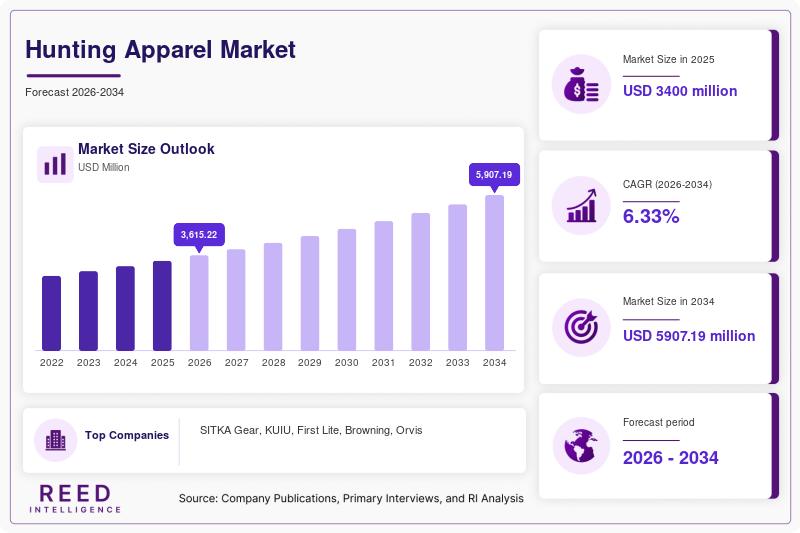
The global size was valued at USD 3,400 million in 2025 and is projected to grow from USD 3,570 million in 2026 to USD 5,907.19 million by 2034, registering a CAGR of 6.33% during the forecast period from 2026 to 2034.
The market is being shaped by the shift from basic camouflage clothing toward technical apparel designed around weather protection, layering, mobility, odor control, durability, and hunting-specific fit. In the United States, the latest federal hunting survey recorded 14.4 million hunters aged 16 years and older in 2022, while the U.S. outdoor recreation economy generated USD 16.5 billion in value added from hunting, shooting, and trapping in 2024.
Hunting apparel has moved from a largely functional clothing category toward a technical outdoor-apparel market where product performance increasingly determines purchasing decisions. Modern hunting systems commonly combine moisture-managing base layers, insulating midlayers, waterproof or windproof shells, quiet fabrics, stretch materials, odor-control treatments, and camouflage patterns matched to terrain and species.
The demand base remains concentrated in North America and Europe, where established hunting cultures, extensive public and private hunting areas, seasonal hunting licenses, specialist retailers, and mature hunting brands support recurring apparel purchases. The U.S. Fish and Wildlife Service reports 14.4 million hunters, while FACE represents more than 7 million hunters across Europe.
Product innovation is becoming an important commercial mechanism. Brands are introducing lighter insulation, breathable waterproof shells, technical merino layers, improved women's fits, modular layering systems, and specialized garments for individual hunting environments. Current collections from SITKA, KUIU, and First Lite demonstrate this movement toward application-specific technical apparel rather than one-piece general-purpose hunting clothing.
Hunting Apparel Market Drivers
Rising Demand for Technical, Weather-Adaptive Hunting Systems
Hunting apparel purchasing is increasingly linked to performance across changing weather and terrain rather than simple camouflage coverage. KUIU describes its apparel system around base layers, midlayers and outer layers that can be adjusted for changing temperature, elevation and activity levels. SITKA's current product range similarly combines GORE-TEX, WINDSTOPPER and other technical technologies across hunting garments.
This creates a replacement and upgrade mechanism because hunters can purchase several layers for one hunting season instead of relying on a single heavy jacket. Waterproof-breathable fabrics, lightweight insulation, stretch construction and moisture management also broaden the usable season for technical garments. GORE-TEX technologies specifically target waterproofing, wind protection and breathability for demanding outdoor conditions.
The commercial effect is particularly relevant for premium brands because technical differentiation supports higher-value garments. Product portfolios increasingly separate early-season, mid-season, cold-weather and extreme-weather systems, giving manufacturers more opportunities to increase revenue per active hunter.
Large and Established Hunting Participation Base
Hunting remains a material outdoor-recreation activity in major developed markets. The U.S. Fish and Wildlife Service recorded 14.4 million U.S. hunters in 2022 and continues to identify hunting participation, recruitment and retention as important areas for wildlife-management agencies.
Europe represents another substantial customer base. FACE represents more than 7 million hunters across 37 European countries, giving the region a large established population with diverse hunting traditions and requirements.
Participation creates direct apparel demand because hunting often involves repeated seasonal use, exposure to weather and terrain, and replacement of worn garments. Government hunting guidance also explicitly recommends layered clothing, waterproof footwear and protective garments for activities such as pheasant hunting, demonstrating the functional requirements surrounding the category.
Product Innovation and Expansion of Specialized Apparel
Manufacturers are expanding the number of products designed around specific species, environments and hunting methods. Current KUIU collections distinguish equipment for western big game, whitetail, waterfowl, turkey and other pursuits, while First Lite separates apparel by pursuit, temperature, weather condition and gender.
This specialization changes the purchasing mechanism from occasional replacement toward system building. A hunter may require separate garments for warm-weather scouting, cold-weather stand hunting, wet conditions, high-altitude hunts and waterfowl environments.
Women’s and youth collections are also receiving greater attention. First Lite's current women's range includes dedicated jackets, pants, bibs and base layers, while its fall 2026 assortment adds new women's products and fit options.
Hunting Apparel Market Restraints
Seasonal and Weather-Dependent Demand
Hunting apparel remains highly seasonal because purchasing and usage are tied to hunting seasons, migration periods, weather conditions and regional regulations. This creates inventory-management pressure for manufacturers and retailers. A mild season can also reduce demand for heavy insulation, while unusually wet or cold conditions can shift demand toward waterproof shells and insulated garments.
KUIU's review of the 2025 hunting season illustrates this sensitivity, noting unusually warm fall conditions and changes in animal movement.
The implication is that brands must maintain broad product ranges without carrying excessive seasonal inventory. Retailers also need to balance early-season lightweight products with late-season insulation and weatherproof products.
Regulatory and Market Differences Across Hunting Jurisdictions
Hunting regulations differ considerably by country, state and hunting method. Apparel manufacturers therefore need to accommodate requirements related to visibility, camouflage, safety and specific hunting environments.
For example, Minnesota requires blaze orange or blaze pink on specified visible portions of outer clothing during firearm and muzzleloader deer seasons, while Wisconsin requires at least 50% blaze orange or fluorescent pink on specified outer clothing during firearm deer seasons.
These requirements can increase product complexity because manufacturers must offer garments that combine mandatory visibility with camouflage or technical performance. International regulatory differences also make standardized product assortments more difficult.
Hunting Apparel Market Opportunities
Expansion of Women’s and Youth Hunting Apparel
Women and younger participants represent an important product-development opportunity because traditional hunting apparel ranges have historically been more concentrated around men's sizing and fit. Current industry collections show a broader approach. First Lite has dedicated women's base layers, jackets, pants and bibs, while KUIU explicitly offers women's and youth options across its technical hunting system.
The commercial mechanism is straightforward: better fit increases product suitability and expands the number of garments available to each customer. Women's-specific cuts, extended sizing, lighter construction and different layering proportions allow brands to move beyond simply adapting men's garments.
Premium Technical and Sustainable Materials
Technical materials create room for premium positioning through lightweight construction, insulation efficiency, breathability, water resistance, odor management and durability. KUIU uses technologies including Nuyarn merino, technical insulation and weather-resistant fabrics, while SITKA continues expanding GORE-TEX and WINDSTOPPER-based products.
Sustainability can add another differentiation layer. First Lite's Camo for Conservation program directs 1% of camo sales to conservation partners, linking apparel purchases with conservation activity.
Segmental Analysis
By Product Type
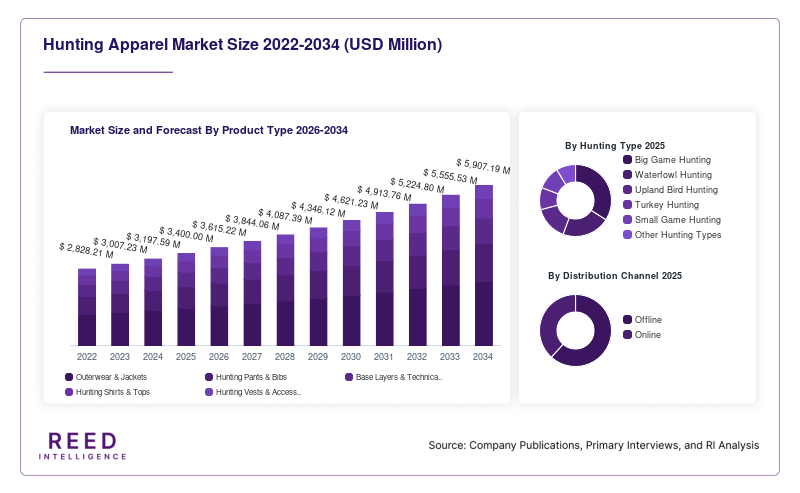
Outerwear & Jackets represent the dominant product category, accounting for approximately 34% of the global market in 2025. Jackets and shells have a high value per purchase and combine several technical functions, including weather protection, insulation, camouflage and storage. Current product ranges from SITKA, KUIU and First Lite show extensive segmentation of outerwear by temperature, terrain and hunting method.
Base Layers & Technical Midlayers are the fastest-growing product category, registering approximately 8.2% CAGR. Their growth is linked to layering systems that allow hunters to regulate temperature and moisture during changing activity levels. Merino wool, synthetic insulation and lightweight stretch fabrics are increasingly used as components of complete hunting systems rather than standalone garments.
By Hunting Type
Big Game Hunting accounts for approximately 44% of the market in 2025, supported by extensive participation in North America and specialized apparel requirements for long-duration, variable-terrain hunts. KUIU and First Lite both organize technical systems around western big game and whitetail pursuits.
Waterfowl Hunting is projected to register the fastest growth at approximately 7.4% CAGR. Waterfowl hunting requires waterproof protection, insulation, waders, layering and durable garments because users can face wet and cold environments for extended periods. Drake Waterfowl's portfolio illustrates this specialization, with dedicated jackets, bibs, waders, pants and accessories for waterfowl applications.
By Distribution Channel
Offline channels account for approximately 58% of the market in 2025 because hunting apparel is highly dependent on fit, fabric feel, garment construction and seasonal product availability. Specialist retailers also allow hunters to compare complete systems and obtain local guidance.
Online channels are the fastest-growing distribution route, with approximately 8.4% CAGR. Direct-to-consumer brands such as KUIU and specialist online manufacturers allow customers to access larger product ranges without depending on local hunting stores. KUIU's model combines direct product sales with detailed gear lists and technical product information, supporting online product selection.
By End User
Adult Hunters represent approximately 72% of the market in 2025, reflecting the established base of recreational hunters and their relatively high frequency of equipment purchases.
Women Hunters are the fastest-growing end-user group, with approximately 8.9% CAGR. Manufacturers are responding with dedicated fits and purpose-built women's collections rather than relying only on adapted men's products. First Lite's 2026 assortment includes women's jackets, pants, bibs and base layers designed around different temperatures and hunting pursuits.
Regional Analysis
North America Hunting Apparel Market
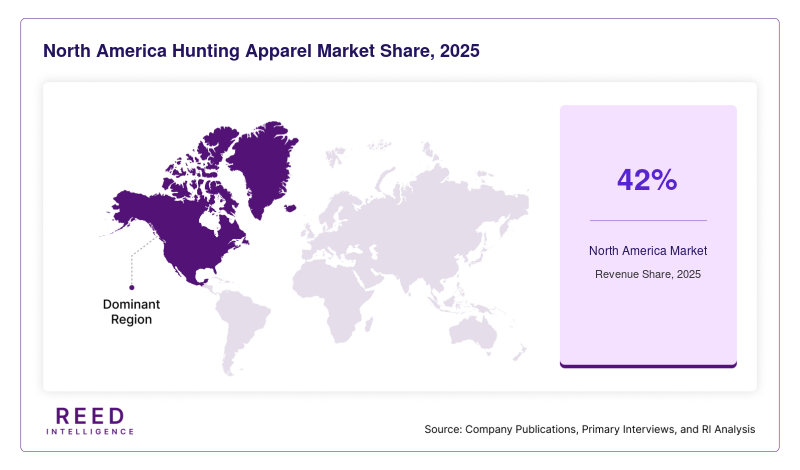
North America accounts for approximately 42% of the global hunting apparel market in 2025, making it the largest regional market. The region benefits from a large hunting population, extensive public hunting land, established specialist retailers and a strong ecosystem of hunting-apparel brands. The U.S. Fish and Wildlife Service recorded 14.4 million hunters in its latest national survey, while U.S. hunting, shooting and trapping generated USD 16.5 billion in value added in 2024.
The region also has a highly developed technical-apparel segment. SITKA, KUIU and First Lite compete through specialized layering systems, technical fabrics, species-specific garments and premium insulation.
Safety requirements create additional apparel demand. Minnesota and Wisconsin, for example, impose blaze-orange or fluorescent-pink requirements for specified firearm hunting seasons.
North America is projected to grow at approximately 5.8% CAGR, supported by replacement demand and premium technical apparel. The main constraint is participation: the U.S. Fish and Wildlife Service has identified long-term participation decline as an issue, increasing the importance of recruitment and retention programs.
Europe Hunting Apparel Market
Europe represents approximately 28% of the global market in 2025. The region has a large established hunting community, with FACE representing more than 7 million hunters across 37 European countries. Hunting traditions vary significantly by country, creating demand for different combinations of camouflage, high-visibility clothing, weather protection and field durability.
Regulation is an important market factor. European hunting policy includes ongoing discussions concerning ammunition, wildlife management, habitat protection and hunting methods. FACE's 2026 policy activity highlights continued regulatory attention across these areas.
Purchasing is also influenced by the region's varied climates, from Nordic cold-weather hunting to Mediterranean and Central European conditions. This supports demand for layered apparel rather than a single standardized garment.
Europe is projected to grow at approximately 5.6% CAGR. The market mechanism is mainly replacement of technical clothing, greater specialization by hunting method and demand for weather-adaptive garments. Regulatory variation across countries remains a constraint because apparel specifications and hunting practices are not uniform.
APAC Hunting Apparel Market
APAC accounts for approximately 17% of the global market in 2025 and is projected to register the fastest regional growth at approximately 8.2% CAGR. The region has a smaller aggregate hunting base than North America and Europe but includes established hunting markets such as Australia and New Zealand and specialized hunting activity in parts of Asia.
New Zealand provides an important signal for digital and recreational hunting infrastructure. In August 2026, the country's Department of Conservation reported more than 53,000 hunting permits issued through its new self-service online system, with active permits 10% higher than two years earlier.
Technical apparel is particularly relevant to APAC because hunting environments range from alpine terrain and cold climates to warm and humid environments. KUIU's product systems already span applications from North American mountains to Asian high-altitude conditions.
APAC's growth is therefore linked to expanding participation in selected markets, hunting tourism, specialized outdoor retail and technical apparel adoption. Market development remains uneven because hunting regulations and participation levels vary substantially between countries.
Middle East and Africa Hunting Apparel Market
Middle East and Africa represent approximately 7% of the global market in 2025 and are projected to grow at approximately 6.9% CAGR. South Africa is the most commercially important hunting market in the region, supported by wildlife ranching, domestic hunting and international hunting tourism.
South Africa's government biodiversity investment platform reports that trophy hunters spend about USD 250 million annually and support approximately 17,000 jobs, while hunting is integrated into a broader wildlife-ranching economy.
This market structure creates demand for durable hot-weather apparel, lightweight layers, sun protection and specialized garments for long periods in the field. International hunting tourism also supports premium apparel purchases before travel.
The main constraint is the uneven development of hunting markets across the region. Apparel demand is concentrated in specific countries and hunting destinations rather than being evenly distributed across the region.
LATAM Hunting Apparel Market
LATAM accounts for approximately 6% of the global market in 2025 and is projected to grow at approximately 7.2% CAGR. Hunting activity differs considerably by country and by species, while hunting tourism creates a specialized demand base in selected destinations.
Argentina is particularly relevant to international upland and big-game hunting, while other Latin American markets have more restrictive wildlife-hunting frameworks. Brazil, for example, maintains broad federal restrictions on hunting native wildlife, demonstrating how regulatory conditions can sharply affect the addressable market.
The opportunity therefore centers on countries and applications where regulated hunting, hunting tourism and outdoor recreation are established. Lightweight technical apparel, sun protection, durable pants and adaptable layering systems are particularly relevant to warmer environments.
Competitive Landscape
The hunting apparel market is fragmented between large outdoor brands, specialist hunting companies and direct-to-consumer technical brands. Competition increasingly occurs at the product-system level rather than only through camouflage patterns. Companies differentiate through fabric technology, insulation, weatherproofing, quiet construction, fit, species-specific design, women's ranges and direct digital sales.
SITKA Gear has built differentiation around technical fabrics and specialized hunting systems, with its current portfolio spanning GORE-TEX, WINDSTOPPER, insect protection, insulated garments and hunting-specific collections.
KUIU emphasizes direct-to-consumer technical apparel, layering systems, species-specific gear lists and material technologies such as merino and advanced insulation.
First Lite differentiates through merino-based apparel, species-specific systems, temperature-based products and expanding women's collections.
Key Market Players
Recent Market Developments
- August 2026 – SITKA scheduled a new fall product release for August 4, 2026, expanding its technical hunting assortment. Its current new-arrivals portfolio includes GORE-TEX and WINDSTOPPER-based products.
- 2026 – First Lite introduced new fall 2026 hunting apparel, including whitetail products, late-season pants and insulation. The women's range includes insulated jackets, soft-shell garments, and technical pants.
Hunting Apparel Market Segments
By Product Type
- Outerwear & Jackets
- Hunting Pants & Bibs
- Base Layers & Technical Midlayers
- Hunting Shirts & Tops
- Hunting Vests & Accessories
By Hunting Type
- Big Game Hunting
- Waterfowl Hunting
- Upland Bird Hunting
- Turkey Hunting
- Small Game Hunting
- Other Hunting Types
By Distribution Channel
- Offline
- Online
By End User
- Adult Hunters
- Women Hunters
- Youth Hunters
- Professional Hunters & Guides
By Region
- North America
- Europe
- APAC
- Middle East and Africa
- LATAM