Hybrid Propellants Market Size, Share & Demand Report By Fuel Type (Solid Fuel Hybrid Propellants, Liquid Fuel Hybrid Propellants, Paraffin-Based Hybrid Propellants), By Application (Space Launch Vehicles, Sounding Rockets, Missile Systems, Satellite Propulsion), By End-User (Commercial Space Companies, Defense Organizations, Government Space Agencies), By Region & Segment Forecasts, 2026–2034
USD 3950
Market Overview
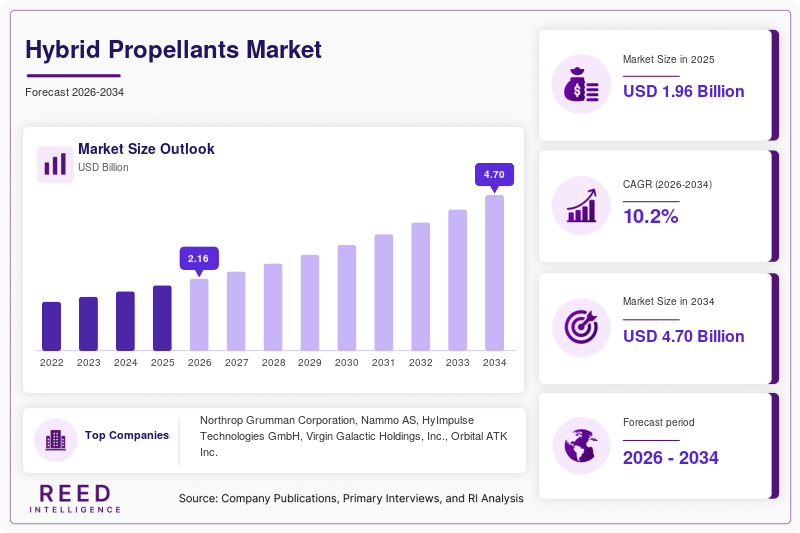
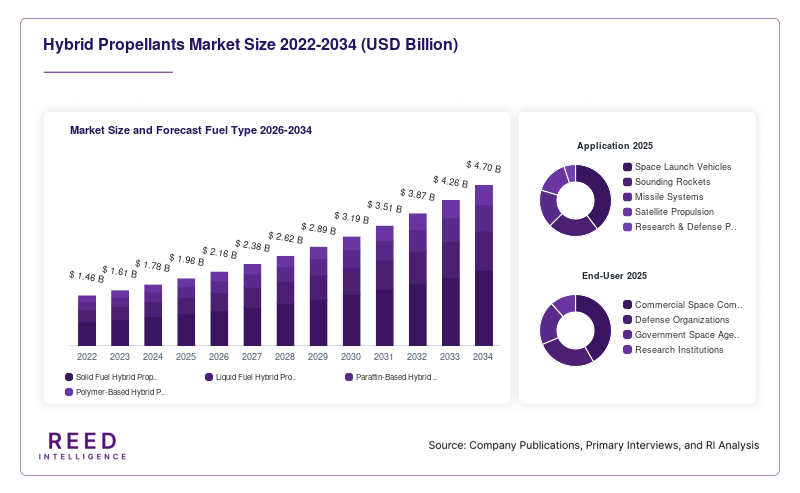
The Hybrid Propellants Market size was valued at USD 1.96 billion in 2026 and is projected to reach USD 4.28 billion by 2034, expanding at a CAGR of 10.2% during the forecast period (2026–2034). The global Hybrid Propellants Marketgrowth has been supported by increasing investments in commercial space exploration and rising demand for safer and environmentally sustainable propulsion technologies. Governments and private aerospace companies are increasingly focusing on advanced propulsion systems that provide operational flexibility, improved safety characteristics, and lower environmental impact compared to conventional solid and liquid propellant systems.
The Hybrid Propellants Market has gained momentum due to expanding satellite launch activities and the rapid growth of reusable launch vehicle programs. Hybrid propulsion systems combine solid fuel with liquid or gaseous oxidizers, offering improved throttle control and operational safety. These systems are increasingly being evaluated for space launch vehicles, sounding rockets, defense missiles, and suborbital tourism applications.
Key Highlights
- North America accounted for 38.4% of the global Hybrid Propellants Market share in 2025, while Asia Pacific is projected to register the fastest CAGR of 11.6% during 2026–2034.
- By propellant type, paraffin-based hybrid propellants held the dominant share of 34.9% in 2025, whereas hydroxyl-terminated polybutadiene (HTPB)-based propellants are expected to grow at the fastest CAGR of 11.1%.
- By oxidizer type, liquid oxygen (LOX) represented the leading segment with 41.7% market share in 2025, while nitrous oxide oxidizers are forecast to expand at a CAGR of 10.8%.
- By application, space launch vehicles accounted for 45.2% of the market share in 2025, while sounding rockets are anticipated to witness the fastest CAGR of 11.4%.
- By end use, commercial aerospace companies dominated the market with a 39.6% share in 2025, whereas defense organizations are projected to grow at a CAGR of 10.9%.
- The U.S. Hybrid Propellants Market was valued at USD 462 million in 2024 and reached USD 498 million in 2025.
Market Trends
Increasing Development of Reusable Launch Vehicles
The growing focus on reusable launch systems is emerging as a major trend in the Hybrid Propellants Market. Aerospace companies are developing propulsion technologies capable of supporting multiple launch cycles with improved operational efficiency. Hybrid propellant systems are gaining interest because they offer safer storage and handling compared to traditional propulsion technologies. The ability to throttle and restart hybrid rocket engines is supporting their adoption in reusable launch vehicle programs.
Rising Adoption of Green Propulsion Technologies
Another significant trend shaping the Hybrid Propellants Market is the rising adoption of environmentally sustainable propulsion systems. Aerospace agencies and commercial launch providers are increasingly investing in cleaner fuel technologies that reduce hazardous emissions and operational risks. Hybrid propellants are being evaluated as alternatives to toxic conventional propellants due to their lower environmental impact and simplified logistics. Manufacturers are also investing in advanced fuel formulations to improve combustion performance while reducing emissions.
Market Drivers
Expansion of Commercial Space Exploration Activities
The increasing number of commercial space missions is a major driver for the Hybrid Propellants Market. Satellite deployment programs, space tourism initiatives, and reusable rocket development projects are generating substantial demand for advanced propulsion technologies. Hybrid propulsion systems provide operational safety and cost advantages that make them suitable for emerging commercial aerospace applications. Rising participation from private aerospace companies is expected to continue supporting market growth.
Rising Investments in Defense Missile Programs
Growing defense modernization programs are also driving demand for hybrid propellant systems. Military organizations are investing in advanced missile propulsion technologies to improve operational performance and mission flexibility. Hybrid propulsion systems offer controlled thrust capabilities and improved safety characteristics, making them attractive for tactical missile and defense applications. Increasing geopolitical tensions and rising defense budgets are expected to contribute to long-term market expansion.
Market Restraint
Technical Challenges in Combustion Efficiency
One of the primary restraints in the Hybrid Propellants Market is the complexity associated with combustion efficiency and fuel regression rates. Hybrid propulsion systems often face technical limitations related to combustion stability and thrust optimization. These engineering challenges may increase development costs and delay commercialization for certain aerospace applications.
Market Opportunities
Growing Small Satellite Launch Programs
The rapid growth of small satellite launch programs presents a strong opportunity for the Hybrid Propellants Market. Increasing deployment of low-earth orbit satellites for communication, navigation, and earth observation applications is driving demand for cost-effective launch systems. Hybrid propulsion technologies are expected to benefit from the rising need for flexible and affordable launch solutions.
Expansion of Suborbital Tourism Projects
The development of commercial suborbital tourism services is creating new growth opportunities for hybrid propulsion manufacturers. Aerospace companies are investing in propulsion systems that provide enhanced safety and operational control for passenger flights. Hybrid rocket engines are expected to gain traction in suborbital tourism platforms because of their lower operational risks and simplified fuel handling processes.
Segmental Analysis
By Propellant Type
Paraffin-Based Hybrid Propellants Dominated the Market
Paraffin-based hybrid propellants accounted for 34.9% of the Hybrid Propellants Market share in 2025 due to their improved fuel regression rates and combustion performance. These propellants are increasingly used in experimental rockets and commercial launch applications because they provide higher thrust efficiency and operational reliability.
HTPB-Based Propellants to Register the Fastest Growth
Hydroxyl-terminated polybutadiene (HTPB)-based propellants are projected to grow at a CAGR of 11.1% during the forecast period. The segment growth will be supported by increasing adoption in defense missile systems and reusable launch vehicle applications. HTPB-based fuels are expected to gain traction because of their stable combustion properties and compatibility with advanced oxidizer systems.
By Oxidizer Type
Liquid Oxygen (LOX) Held the Largest Share
Liquid oxygen represented 41.7% of the Hybrid Propellants Market share in 2025 owing to its high oxidizing efficiency and widespread use in commercial rocket propulsion systems. LOX-based hybrid engines are extensively used in aerospace applications due to improved combustion efficiency and lower environmental impact.
Nitrous Oxide Oxidizers to Expand Rapidly
Nitrous oxide oxidizers are anticipated to grow at a CAGR of 10.8% through 2034. Growth will be driven by increasing use in suborbital tourism and experimental rocket programs. Nitrous oxide systems are expected to witness rising demand because they simplify storage requirements and improve operational safety.
By Application
Space Launch Vehicles Accounted for the Largest Share
Space launch vehicles held 45.2% of the Hybrid Propellants Market share in 2025 due to increasing global satellite launch activity and reusable rocket development projects. Hybrid propulsion systems are increasingly being integrated into launch vehicle designs to improve operational flexibility and reduce environmental impact.
Sounding Rockets to Witness the Fastest Growth
Sounding rockets are projected to grow at a CAGR of 11.4% during the forecast period. Increasing atmospheric research missions and educational aerospace programs will support segment expansion. Hybrid propulsion systems are expected to gain adoption in sounding rockets because of their cost efficiency and safety advantages.
By End Use
Commercial Aerospace Companies Dominated the Market
Commercial aerospace companies represented 39.6% of the Hybrid Propellants Market share in 2025 due to rising investments in private spaceflight and satellite deployment operations. Companies are increasingly developing advanced propulsion systems to support reusable launch technologies and cost-efficient space missions.
Defense Organizations to Record the Highest CAGR
Defense organizations are projected to expand at a CAGR of 10.9% during 2026–2034. Increasing investments in tactical missile systems and advanced propulsion research will support segment growth. Hybrid propulsion technologies are expected to gain traction in defense applications due to improved controllability and enhanced operational safety.
Regional Analysis
North America
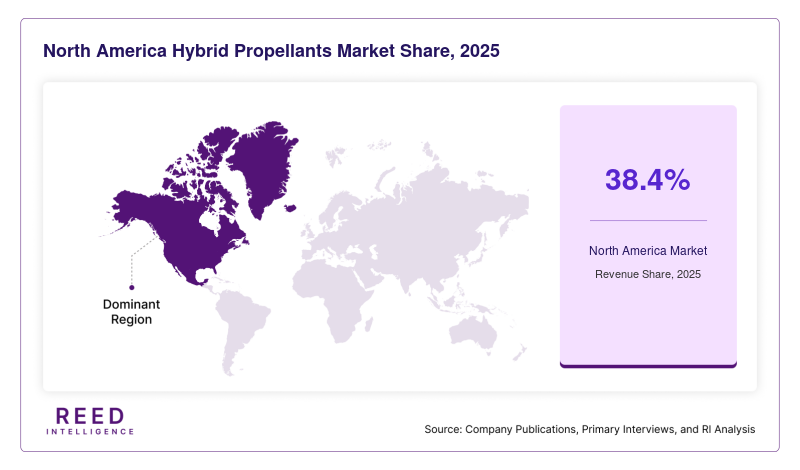
North America accounted for 38.4% of the Hybrid Propellants Market share in 2025 and is projected to grow at a CAGR of 9.8% during 2026–2034. The regional market growth has been associated with increasing investments in commercial space exploration and reusable launch vehicle programs. The United States dominated the regional market due to strong participation from private aerospace companies and rising defense research activities. Expansion of government-funded space initiatives has also strengthened market demand across the region.
Europe
Europe held 24.6% share of the Hybrid Propellants Market in 2025 and will expand at a CAGR of 9.6% during the forecast period. The market growth has been supported by increasing investments in satellite launch infrastructure and aerospace sustainability initiatives. France emerged as the dominant country because of the presence of advanced aerospace manufacturing capabilities and growing propulsion research programs. The focus on reducing environmental impact in aerospace operations has supported the adoption of hybrid propulsion technologies.
Asia Pacific
Asia Pacific represented 22.8% of the Hybrid Propellants Market share in 2025 and is expected to witness the fastest CAGR of 11.6% through 2034. Rising government investments in space exploration and defense modernization programs have accelerated regional market growth. China dominated the regional market due to increasing satellite deployment activities and rapid expansion of aerospace infrastructure. Growing investments in indigenous rocket development programs are expected to support future demand for hybrid propulsion systems.
Middle East & Africa
The Middle East & Africa accounted for 7.5% of the Hybrid Propellants Market share in 2025 and is anticipated to grow at a CAGR of 10.1% during the forecast period. Increasing investments in satellite communication infrastructure and aerospace research programs have contributed to regional market growth. The United Arab Emirates emerged as the dominant country owing to rising investments in national space exploration initiatives and advanced aerospace technologies.
Latin America
Latin America captured 6.7% of the Hybrid Propellants Market share in 2025 and is forecast to expand at a CAGR of 9.4% over the forecast period. The regional market growth has been supported by increasing research activities in aerospace engineering and satellite deployment initiatives. Brazil dominated the regional market because of investments in domestic launch capabilities and aerospace development programs. Expansion of scientific research missions is expected to support market demand in the region.
Competitive Landscape
The Hybrid Propellants Market remains competitive with the presence of aerospace manufacturers, propulsion technology developers, and defense contractors focusing on advanced propulsion innovation. Companies are investing in fuel formulation research, reusable launch systems, and environmentally sustainable propulsion technologies to strengthen their market positions.
Virgin Galactic Holdings remains a leading player in the Hybrid Propellants Market due to its extensive experience in hybrid rocket propulsion systems for suborbital spaceflight applications. The company recently expanded research activities focused on improving propulsion efficiency and operational reliability for commercial tourism platforms.
Nammo AS has strengthened its position through investments in advanced hybrid rocket technologies for defense and aerospace applications. SpaceDev continues to focus on propulsion systems for commercial launch vehicles. Sierra Space is investing in reusable propulsion technologies for next-generation space transportation systems. HyImpulse Technologies is developing paraffin-based hybrid rocket engines for satellite launch applications.
Key Players List
- Virgin Galactic Holdings Inc.
- Nammo AS
- Sierra Space Corporation
- SpaceDev
- HyImpulse Technologies GmbH
- Lockheed Martin Corporation
- Northrop Grumman Corporation
- ArianeGroup
- Safran S.A.
- Rocket Lab USA Inc.
- SpaceX
- Firehawk Aerospace Inc.
- Gilmour Space Technologies
- Orbital ATK Inc.
- Airbus Defence and Space
- Boeing Company
- Mitsubishi Heavy Industries Ltd.
Recent Developments
- January 2025 – Virgin Galactic Holdings expanded hybrid propulsion testing programs for commercial suborbital spacecraft.
- March 2025 – Nammo AS introduced advanced hybrid rocket motor technologies for defense applications.
- June 2024 – HyImpulse Technologies completed testing of paraffin-based hybrid rocket engines for satellite launch systems.
- August 2025 – Sierra Space expanded investments in reusable propulsion technologies for commercial space transportation.
- November 2024 – Firehawk Aerospace developed advanced oxidizer systems for tactical hybrid rocket applications.
- February 2025 – Rocket Lab USA initiated research partnerships for sustainable hybrid propulsion technologies.
- September 2024 – ArianeGroup expanded aerospace propulsion research activities focused on environmentally sustainable launch systems.
- April 2025 – Gilmour Space Technologies advanced development programs for hybrid rocket engines supporting small satellite launches.
Hybrid Propellants Market Segments
Fuel Type
- Solid Fuel Hybrid Propellants
- Liquid Fuel Hybrid Propellants
- Paraffin-Based Hybrid Propellants
- Polymer-Based Hybrid Propellants
Application
- Space Launch Vehicles
- Sounding Rockets
- Missile Systems
- Satellite Propulsion
- Research & Defense Programs
End-User
- Commercial Space Companies
- Defense Organizations
- Government Space Agencies
- Research Institutions
Region
- North America
- Europe
- Asia Pacific
- Middle East & Africa
- Latin America
By Region
- North America
- Europe
- APAC
- Middle East and Africa
- LATAM