Hydatidiform Mole Market Size, Share Demand Report By Type (Complete Hydatidiform Mole, Partial Hydatidiform Mole), By Diagnosis (Ultrasound Imaging, Blood Tests (hCG Monitoring), Molecular Diagnostics), By Treatment (Suction Curettage, Chemotherapy, Hysterectomy), By End-Use (Hospitals, Specialty Clinics, Diagnostic Centers) & Segment Forecasts, 2025–2034
USD 3950
Market Overview
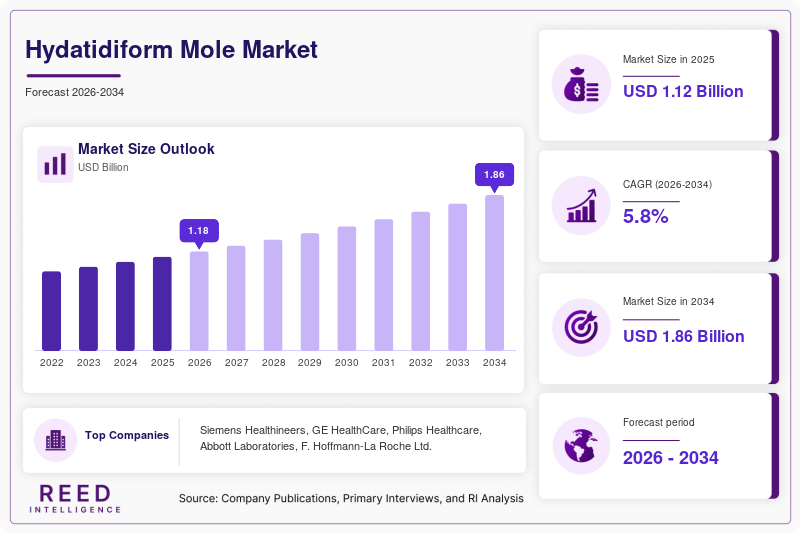
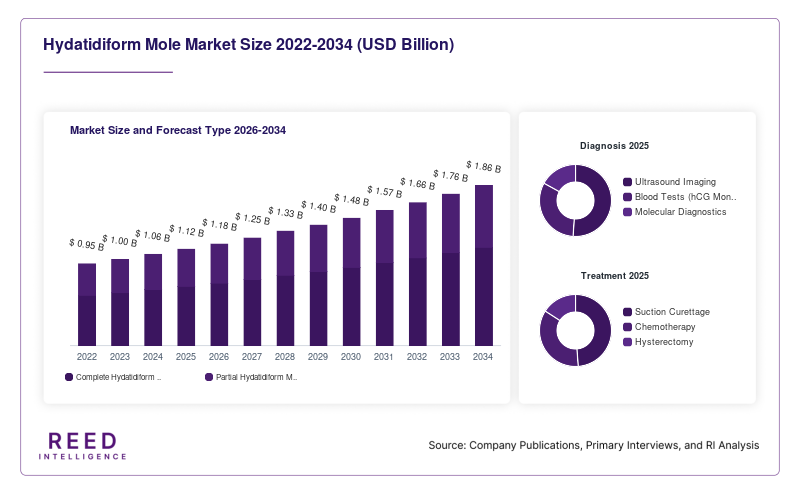
The global Hydatidiform Mole Market size was valued at approximately USD 1.12 billion in 2025 and is projected to reach USD 1.86 billion by 2034, expanding at a CAGR of 5.8% during the forecast period (2025–2034). The market growth is primarily supported by the rising incidence of gestational trophoblastic diseases and improved diagnostic capabilities in gynecological care. Increasing awareness regarding early pregnancy complications and advancements in ultrasound imaging and beta-hCG monitoring have further enhanced early detection rates, thereby strengthening market demand globally.
Healthcare systems across developed and emerging economies are increasingly prioritizing maternal health, which has contributed to better screening infrastructure and improved patient outcomes. Additionally, the growing adoption of minimally invasive treatment methods, including suction curettage and targeted chemotherapy protocols, is contributing to the overall market expansion.
Key Highlights
- North America dominated the market with a share of 38.6% in 2025, while Asia Pacific is expected to register the fastest CAGR of 6.7% during the forecast period.
- By type, Complete Hydatidiform Mole was the leading subsegment with 62.4% share in 2024, while Partial Hydatidiform Mole is anticipated to grow at a CAGR of 6.3%.
- By diagnosis, Ultrasound Imaging dominated with 44.8% share, whereas Molecular Diagnostics is projected to be the fastest-growing at 7.1% CAGR.
- The United States remained the dominant country, with a market value of USD 312 million in 2024, increasing to USD 328 million in 2025.
Market Trends
Integration of Advanced Diagnostic Technologies
The Hydatidiform Mole Market is witnessing a shift toward advanced diagnostic tools, including high-resolution ultrasound imaging and molecular testing. These technologies allow clinicians to distinguish between complete and partial molar pregnancies with higher precision. The incorporation of artificial intelligence in imaging analysis is also improving diagnostic accuracy, reducing misdiagnosis rates, and supporting timely intervention. This trend is particularly evident in tertiary care hospitals and specialized fertility centers.
Rising Adoption of Personalized Treatment Approaches
There is a growing emphasis on personalized treatment strategies based on patient-specific risk profiles. Clinicians are increasingly using individualized beta-hCG monitoring and risk stratification to determine the necessity of chemotherapy following molar evacuation. This trend minimizes overtreatment and improves patient safety. The adoption of tailored care pathways is expected to enhance treatment outcomes and optimize healthcare resource utilization, contributing to the long-term development of the Hydatidiform Mole Market.
Market Drivers
Increasing Prevalence of Gestational Trophoblastic Diseases
The rising global incidence of gestational trophoblastic diseases, including hydatidiform mole, is a key driver of market growth. Factors such as delayed pregnancies, nutritional deficiencies, and genetic predispositions contribute to higher occurrence rates. This has led to increased demand for diagnostic procedures and effective treatment solutions, supporting the expansion of the Hydatidiform Mole Market.
Expansion of Maternal Healthcare Infrastructure
Improvements in maternal healthcare services, especially in developing regions, are driving early diagnosis and treatment rates. Governments and healthcare organizations are investing in prenatal care programs, which include routine ultrasound screening and hormonal monitoring. Enhanced access to healthcare facilities has enabled timely intervention, reducing complications and increasing the demand for specialized treatments in this market.
Market Restraint
Limited Awareness in Low-Income Regions
Despite advancements in healthcare infrastructure, limited awareness about hydatidiform mole in low-income and rural regions remains a significant challenge. Many patients fail to recognize early symptoms, leading to delayed diagnosis and increased complications. Additionally, inadequate access to specialized diagnostic tools and trained healthcare professionals restricts timely treatment.
In several regions, cultural and socioeconomic barriers further hinder access to maternal healthcare services. These limitations reduce the overall adoption of advanced diagnostic and therapeutic options, thereby restraining the growth of the Hydatidiform Mole Market. Addressing these gaps through awareness campaigns and healthcare accessibility improvements remains essential for sustained market expansion.
Market Opportunities
Growth in Emerging Healthcare Markets
Emerging economies present significant growth opportunities for the Hydatidiform Mole Market due to improving healthcare infrastructure and increasing healthcare expenditure. Countries in Asia Pacific and Latin America are investing in maternal health programs, which is expected to enhance early diagnosis rates and expand treatment accessibility.
Development of Non-Invasive Diagnostic Techniques
The ongoing development of non-invasive diagnostic approaches, including advanced biomarker-based testing, offers promising opportunities for market growth. These methods reduce patient discomfort and improve early detection rates. As research progresses, the adoption of such technologies is expected to increase, creating new avenues for innovation and expansion in the Hydatidiform Mole Market.
Segmental Analysis
By Type
Complete Hydatidiform Mole dominated the market with a 62.4% share in 2024, owing to its higher incidence rate and greater clinical significance. This subtype often requires immediate medical intervention, driving demand for diagnostic and treatment services.
Partial Hydatidiform Mole is expected to grow at a CAGR of 6.3%, supported by advancements in diagnostic techniques that enable accurate differentiation from normal pregnancies. Increased awareness among healthcare providers will further drive growth.
By Diagnosis
Ultrasound Imaging held the largest share of 44.8% in 2024, as it remains the primary tool for detecting molar pregnancies. Its widespread availability and non-invasive nature contributed to its dominance.
Molecular Diagnostics is projected to grow at a CAGR of 7.1%, driven by its ability to provide precise genetic insights. The adoption of advanced diagnostic technologies will enhance early detection and treatment planning.
By Treatment
Suction Curettage accounted for 51.6% of the market share in 2024, as it is the standard treatment for molar pregnancy. Its effectiveness and relatively low complication rates supported its widespread use.
Chemotherapy is expected to grow at a CAGR of 6.5%, particularly for persistent gestational trophoblastic disease. Advances in drug formulations and targeted therapies will drive this segment.
By End-Use
Hospitals dominated the market with a 58.9% share in 2024, due to the availability of comprehensive diagnostic and treatment facilities. These institutions play a central role in managing complex cases.
Specialty Clinics are anticipated to grow at a CAGR of 6.8%, driven by increasing patient preference for specialized care and shorter treatment durations.
Regional Analysis
North America
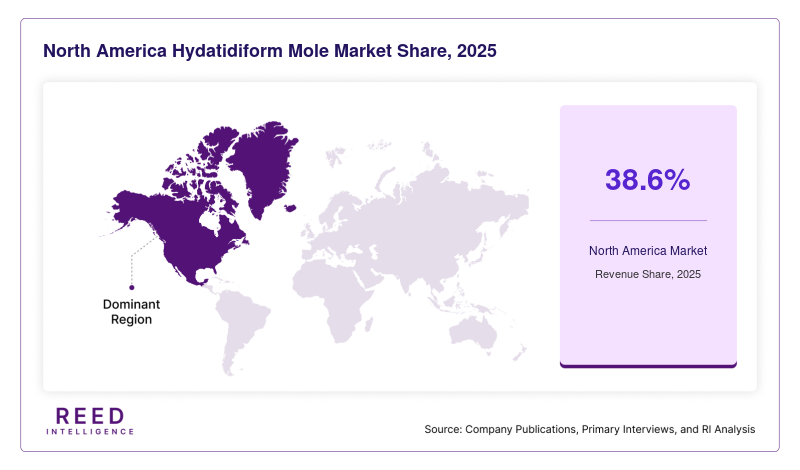
North America accounted for 38.6% of the Hydatidiform Mole Market share in 2025 and is expected to grow at a CAGR of 5.4% during the forecast period. The region benefited from well-established healthcare infrastructure, high awareness levels, and widespread access to advanced diagnostic technologies. The presence of specialized gynecological care centers supported early detection and treatment.
The United States dominated the regional market due to strong healthcare spending and advanced clinical research capabilities. A key growth factor was the widespread use of early prenatal screening programs, which enabled prompt diagnosis and management of molar pregnancies.
Europe
Europe held a 27.3% market share in 2025 and is projected to grow at a CAGR of 5.2%. The region experienced steady growth due to robust healthcare systems and increasing adoption of advanced diagnostic tools. Government initiatives aimed at improving maternal health further supported market expansion.
Germany emerged as the dominant country, driven by its strong healthcare infrastructure and emphasis on research and development. The availability of skilled healthcare professionals contributed to improved diagnosis and treatment outcomes.
Asia Pacific
Asia Pacific captured 19.8% of the market share in 2025 and is expected to register the fastest CAGR of 6.7%. Rapid urbanization, improving healthcare facilities, and rising awareness about maternal health contributed to market growth in the region.
China dominated the regional market due to its large population base and increasing healthcare investments. A significant growth factor was the expansion of public health programs focused on maternal and reproductive health.
Middle East & Africa
The Middle East & Africa accounted for 7.2% of the market share in 2025 and is anticipated to grow at a CAGR of 5.9%. The market growth was supported by gradual improvements in healthcare infrastructure and increasing government initiatives to enhance maternal care services.
Saudi Arabia led the region, driven by investments in healthcare modernization and the establishment of specialized medical centers. Improved access to diagnostic facilities played a key role in market expansion.
Latin America
Latin America held a 7.1% share of the Hydatidiform Mole Market in 2025 and is expected to grow at a CAGR of 6.1%. Increasing healthcare awareness and government efforts to improve maternal health services contributed to market growth.
Brazil dominated the regional market due to its expanding healthcare system and growing focus on prenatal care. Public health campaigns promoting early diagnosis significantly influenced market development.
Competitive Landscape
The Hydatidiform Mole Market is moderately fragmented, with several global and regional players focusing on diagnostic and treatment solutions. Companies are investing in research and development to enhance diagnostic accuracy and improve patient outcomes.
A leading player in the market is Siemens Healthineers, which has strengthened its position through advancements in imaging technologies. The company recently introduced enhanced ultrasound systems designed for improved prenatal diagnostics.
Other key players are focusing on expanding their product portfolios and geographical presence. Strategic collaborations, product innovations, and investments in emerging markets remain common growth strategies among industry participants.
Key Players List
- Siemens Healthineers
- GE HealthCare
- Philips Healthcare
- Abbott Laboratories
- F. Hoffmann-La Roche Ltd.
- Hologic, Inc.
- Canon Medical Systems Corporation
- Fujifilm Holdings Corporation
- Mindray Medical International Limited
- Becton, Dickinson and Company
- Danaher Corporation
- Thermo Fisher Scientific Inc.
- Quest Diagnostics Incorporated
- Bio-Rad Laboratories, Inc.
- Sysmex Corporation
Recent Developments
- 2024: Introduction of AI-assisted ultrasound systems for improved diagnostic accuracy.
- 2024: Expansion of molecular diagnostic testing capabilities by leading healthcare companies.
- 2025: Increased investment in maternal healthcare infrastructure across emerging markets.
- 2025: Launch of advanced chemotherapy protocols with improved safety profiles.
- 2025: Strategic partnerships between diagnostic firms and hospitals to enhance early detection rates.
Hydatidiform Mole Market Segments
Type
- Complete Hydatidiform Mole
- Partial Hydatidiform Mole
Diagnosis
- Ultrasound Imaging
- Blood Tests (hCG Monitoring)
- Molecular Diagnostics
Treatment
- Suction Curettage
- Chemotherapy
- Hysterectomy
End-Use
- Hospitals
- Specialty Clinics
- Diagnostic Centers
By Region
- North America
- Europe
- APAC
- Middle East and Africa
- LATAM