Hydraulic Ironworker Machine Market Size, Share & Demand Report By Machine Type (Dual-Cylinder Hydraulic Ironworker Machines, CNC Hydraulic Ironworker Machines, Portable Hydraulic Ironworker Machines), By Application (Shipbuilding and Marine Fabrication, Structural Steel Processing, Automotive Component Manufacturing), By End-Use Industry (Industrial Manufacturing, Construction and Infrastructure, Automotive Industry, Renewable Energy Infrastructure), By Region & Segment Forecasts, 2026–2034
USD 3950
Market Overview
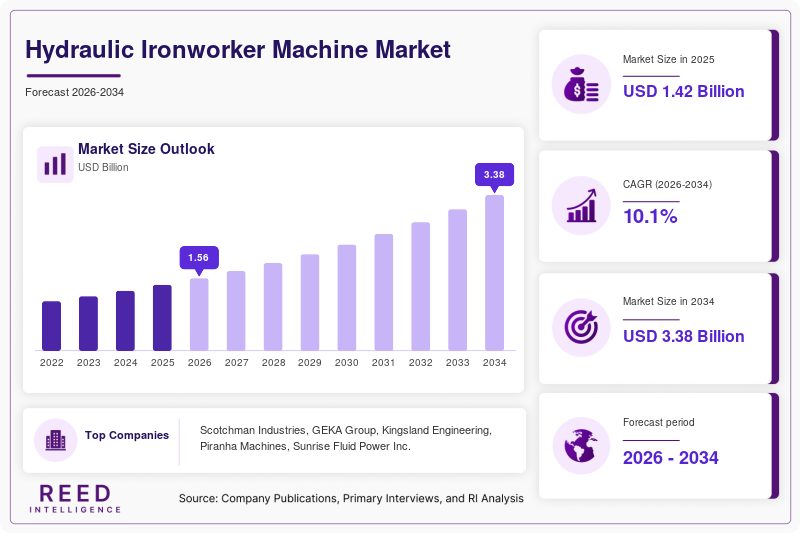
The global Hydraulic Ironworker Machine Market size was valued at approximately USD 1.42 billion in 2026 and is projected to reach nearly USD 3.07 billion by 2034, expanding at a CAGR of 10.1% during the forecast period from 2026 to 2034. Hydraulic ironworker machines are widely used in metal fabrication, construction, shipbuilding, heavy engineering, and industrial manufacturing processes because they combine punching, shearing, bending, and notching functions within a single system. Rising industrial automation and increasing demand for precision metalworking equipment are contributing significantly to market expansion across developed and emerging economies.
The market continues to benefit from the rapid modernization of manufacturing facilities worldwide. Industrial companies are replacing conventional fabrication tools with multifunctional hydraulic systems that improve operational efficiency, reduce labor costs, and support high-volume production. The growth of infrastructure projects, renewable energy installations, and transportation manufacturing has also increased the requirement for advanced metal processing equipment. In addition, manufacturers are integrating CNC controls, programmable automation, and energy-efficient hydraulic systems into modern ironworker machines to improve productivity and reduce downtime.
Key Highlights
- North America dominated the market with a 33.8% share in 2025.
- Asia Pacific is expected to grow at the fastest CAGR of 11.4% during 2026–2034.
- By machine type, single-cylinder hydraulic ironworker machines accounted for the largest share of 39.6%.
- while CNC hydraulic ironworker machines are projected to grow at a CAGR of 12.1%.
- By application, metal fabrication workshops led with a 42.4% share.
- whereas construction equipment manufacturing is expected to expand at a CAGR of 11.7%.
- By end-use industry, industrial manufacturing accounted for the largest share of 37.9%.
- while renewable energy infrastructure is projected to grow at a CAGR of 12.5%.
- The United States remained the dominant country, with market values of USD 462 million in 2024 and USD 515 million in 2025.
Market Trends
Integration of Smart Automation and CNC Technology
The Hydraulic Ironworker Machine Market is witnessing strong adoption of CNC-enabled and digitally integrated systems across industrial manufacturing environments. Manufacturers are increasingly introducing machines equipped with programmable interfaces, automated material feeding systems, touchscreen controls, and real-time monitoring capabilities. These technologies help reduce material waste, improve production precision, and minimize human intervention during repetitive fabrication processes. Industrial operators are using smart hydraulic ironworker machines to improve operational consistency while handling complex metal processing requirements in automotive, aerospace, and structural fabrication applications.
The trend toward Industry 4.0 integration is further supporting demand for connected hydraulic equipment capable of predictive maintenance and remote diagnostics. Companies are investing in software-driven machine tools to reduce downtime and increase output efficiency. Advanced machines with automated pressure control and intelligent hydraulic balancing systems are becoming popular among large manufacturing facilities seeking optimized production performance. The combination of automation and data-driven manufacturing is expected to reshape competitive dynamics in the hydraulic ironworker machine industry over the next decade.
Growing Preference for Compact and Energy-Efficient Machines
Industrial workshops and fabrication facilities are increasingly adopting compact hydraulic ironworker machines that offer multifunctional capabilities within limited operational space. Urban manufacturing units and small fabrication businesses are prioritizing space-saving equipment capable of punching, shearing, and notching in a single platform. This trend is particularly visible in emerging economies where small and medium-sized enterprises are investing in versatile machinery to improve productivity without increasing infrastructure costs.
Energy efficiency has also become an important purchasing factor among industrial buyers. Machine manufacturers are developing advanced hydraulic systems that consume less power while maintaining high operational performance. Variable-speed hydraulic pumps, efficient cooling systems, and reduced oil consumption technologies are helping companies lower operational expenses and comply with industrial sustainability goals. As electricity costs continue to rise globally, demand for low-energy hydraulic ironworker machines is expected to increase steadily, particularly among fabrication facilities focused on long-term operational savings and environmental compliance.
Market Drivers
Expansion of Global Infrastructure and Construction Activities
The rapid expansion of global infrastructure development projects is a major factor driving the Hydraulic Ironworker Machine Market. Governments and private investors are increasing spending on bridges, transportation systems, industrial buildings, renewable energy facilities, and urban development projects. These activities require extensive metal fabrication processes involving steel beams, plates, and structural components, creating strong demand for hydraulic ironworker machines capable of high-volume operations.
Construction equipment manufacturers and fabrication contractors are adopting multifunctional hydraulic machines to improve project timelines and reduce labor dependency. The ability of these systems to perform punching, shearing, and bending operations within a single unit improves productivity and minimizes equipment investment costs. Developing economies across Asia Pacific, Latin America, and the Middle East are experiencing rising urbanization and industrial expansion, which further supports market growth. Increasing demand for fabricated steel structures in commercial and residential projects is expected to sustain strong equipment demand during the forecast period.
Rising Demand for Precision Metal Fabrication Equipment
Industrial manufacturers are increasingly focusing on precision engineering and consistent product quality, creating substantial demand for advanced hydraulic ironworker machines. Industries such as automotive manufacturing, shipbuilding, heavy machinery, and energy infrastructure require highly accurate metal cutting and shaping operations to meet strict engineering standards. Hydraulic ironworker machines provide improved operational accuracy compared to traditional fabrication tools, making them suitable for high-performance industrial applications.
The growing adoption of automated manufacturing systems is further contributing to equipment demand. Companies are investing in advanced hydraulic machines that can process different metal thicknesses while maintaining consistent output quality. Modern ironworker systems also reduce production errors and improve worker safety through automated controls and integrated protection mechanisms. As industrial manufacturers continue modernizing their production lines, the demand for durable, high-capacity, and digitally integrated hydraulic ironworker machines is expected to expand steadily across global markets.
Market Restraint
High Initial Equipment and Maintenance Costs
The Hydraulic Ironworker Machine Market faces challenges related to the high capital investment associated with advanced hydraulic systems and automated fabrication equipment. Modern hydraulic ironworker machines equipped with CNC controls, automation features, and energy-efficient hydraulic systems require substantial upfront expenditure, making adoption difficult for small-scale workshops and budget-sensitive manufacturers. Many businesses in developing economies continue relying on conventional fabrication methods because of financial limitations and restricted access to industrial financing.
Maintenance requirements also create operational challenges for end users. Hydraulic systems require regular inspection, fluid replacement, seal maintenance, and technical servicing to maintain performance efficiency. Unexpected hydraulic failures can result in costly downtime and production delays, particularly in high-volume fabrication facilities. Companies operating in regions with limited technical support infrastructure often face difficulties sourcing replacement components and skilled maintenance personnel. For example, small fabrication workshops in developing industrial regions may postpone equipment upgrades because of concerns related to service costs and operational interruptions. These financial barriers may slow the adoption rate of technologically advanced hydraulic ironworker machines among smaller manufacturers during the forecast period.
Market Opportunities
Increasing Adoption in Renewable Energy Infrastructure Projects
The expansion of renewable energy infrastructure projects is creating strong growth opportunities for the Hydraulic Ironworker Machine Market. Solar farms, wind energy facilities, hydroelectric projects, and power transmission infrastructure require extensive fabrication of steel frames, mounting structures, and support systems. Hydraulic ironworker machines are widely used to process metal components required for renewable energy installations because they offer precision, operational efficiency, and multifunctional capabilities.
Governments across Europe, Asia Pacific, and North America are increasing investments in clean energy projects to reduce carbon emissions and strengthen energy security. This trend is encouraging metal fabrication companies to expand production capacities and adopt advanced machinery. Manufacturers supplying steel components for solar and wind installations are increasingly investing in high-performance hydraulic ironworker machines capable of handling large-scale production requirements. As renewable energy investments continue rising globally, demand for advanced fabrication equipment is expected to increase significantly during the forecast period.
Growth Potential Across Emerging Manufacturing Economies
Emerging manufacturing economies are creating substantial opportunities for hydraulic ironworker machine suppliers and industrial equipment manufacturers. Countries across Southeast Asia, Africa, and Latin America are expanding industrial production capabilities to strengthen domestic manufacturing and reduce dependence on imports. Governments are introducing industrial development policies, infrastructure investments, and manufacturing incentives that encourage the establishment of fabrication workshops and metal processing facilities.
The growing presence of automotive assembly plants, industrial machinery production facilities, and construction equipment manufacturers is increasing the requirement for efficient metalworking equipment. International machine manufacturers are also expanding distribution networks and regional partnerships to capture demand from developing industrial markets. Compact and cost-effective hydraulic ironworker machines are gaining popularity among small and medium-sized fabrication businesses seeking productivity improvements at manageable investment levels. These factors are expected to generate long-term expansion opportunities for market participants operating in emerging industrial regions.
Segmental Analysis
By Machine Type
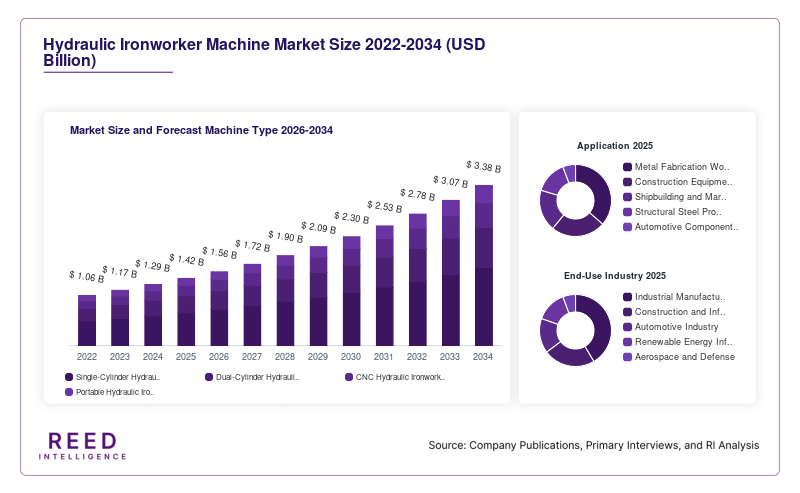
Single-cylinder hydraulic ironworker machines accounted for the largest share of approximately 39.6% in 2024 because of their cost efficiency, operational simplicity, and broad adoption among small and medium-sized fabrication workshops. These machines are widely preferred for punching, shearing, and notching operations in industrial manufacturing and construction applications. Their compact design and relatively lower maintenance requirements make them suitable for businesses operating with limited infrastructure space and moderate production volumes. Fabrication facilities across developing economies continue investing in single-cylinder machines because they offer a practical balance between affordability and productivity.
CNC hydraulic ironworker machines are projected to expand at the fastest CAGR of 12.1% during the forecast period due to rising demand for automation and precision manufacturing. Industrial operators are increasingly adopting CNC-enabled systems capable of programmable operations, reduced production errors, and higher operational consistency. These machines support advanced fabrication requirements across automotive, aerospace, heavy engineering, and industrial equipment manufacturing sectors. The growing integration of digital controls, automated material handling, and remote monitoring systems is encouraging large manufacturing companies to replace conventional equipment with technologically advanced CNC hydraulic ironworker machines.
By Application
Metal fabrication workshops held the largest market share of approximately 42.4% in 2024 because hydraulic ironworker machines are extensively used for routine punching, cutting, and bending operations within fabrication environments. Workshops processing steel structures, industrial frames, and construction materials rely heavily on multifunctional ironworker machines to improve productivity and reduce equipment costs. The ability to perform multiple operations within a single machine allows fabrication companies to optimize floor space and minimize labor dependency. Rising demand for fabricated steel products in infrastructure and industrial projects continues supporting segment growth.
Construction equipment manufacturing is expected to register the fastest CAGR of 11.7% during the forecast period owing to increasing infrastructure investments and demand for heavy construction machinery worldwide. Manufacturers producing cranes, excavators, loaders, and structural equipment require precise metal fabrication systems capable of handling thick steel materials and complex structural components. Hydraulic ironworker machines provide operational flexibility and high production efficiency required in construction equipment manufacturing processes. The growth of smart city projects, industrial construction activities, and transportation infrastructure modernization is expected to increase demand for advanced fabrication machinery within this application segment.
By End-Use Industry
Industrial manufacturing accounted for approximately 37.9% of the Hydraulic Ironworker Machine Market in 2024 due to extensive usage across machinery production, heavy engineering, automotive components, and industrial equipment fabrication. Manufacturing facilities require efficient metalworking solutions capable of supporting high-volume operations while maintaining consistent quality standards. Hydraulic ironworker machines help industrial companies improve fabrication efficiency through multifunctional processing capabilities and reduced production downtime. The increasing modernization of manufacturing plants and rising demand for precision metal components are sustaining strong adoption within this segment.
Renewable energy infrastructure is anticipated to witness the fastest CAGR of 12.5% during the forecast period because of growing investments in solar, wind, and power transmission projects worldwide. Renewable energy installations require fabricated steel structures, mounting systems, and support frames that depend heavily on advanced metalworking processes. Hydraulic ironworker machines are increasingly used to process structural components efficiently and accurately for large-scale energy projects. Government incentives supporting clean energy development and rising private investments in sustainable power infrastructure are expected to create significant long-term growth opportunities for hydraulic ironworker machine manufacturers serving this end-use industry.
Regional Analysis
North America
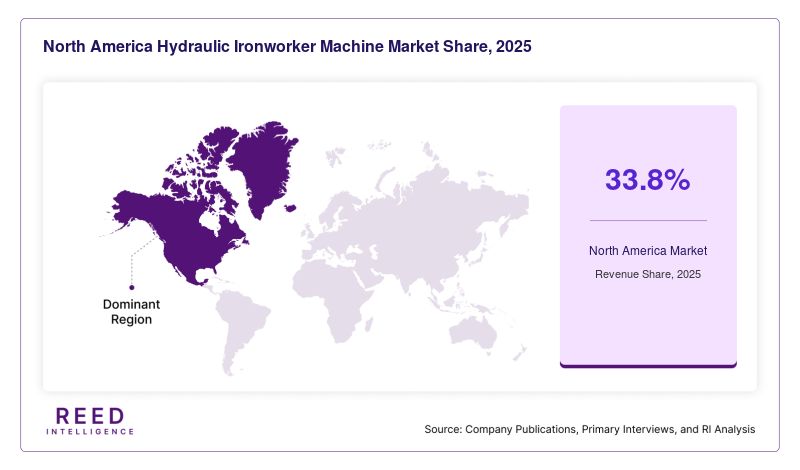
North America accounted for approximately 33.8% of the global Hydraulic Ironworker Machine Market in 2025 and continues to maintain a significant position due to strong industrial manufacturing activity and high adoption of automated fabrication equipment. The region is projected to expand at a CAGR of 8.9% during the forecast period. Growing investments in industrial automation, metal fabrication modernization, and transportation infrastructure projects are supporting demand for hydraulic ironworker machines across the United States and Canada.
The United States remains the dominant country within the North American market because of its extensive manufacturing ecosystem and strong presence of industrial machinery suppliers. The country benefits from high demand across aerospace, automotive, defense, and heavy engineering sectors. One major growth factor is the increasing replacement of aging fabrication equipment with digitally integrated hydraulic systems capable of supporting smart manufacturing operations. Industrial companies are also focusing on energy-efficient machines that reduce operational expenses and improve production consistency.
Europe
Europe represented nearly 27.4% of the global Hydraulic Ironworker Machine Market in 2025 and is expected to grow at a CAGR of 8.3% between 2026 and 2034. The region benefits from advanced industrial infrastructure, strong metalworking traditions, and increasing adoption of precision fabrication technologies. European manufacturers are prioritizing energy-efficient industrial machinery and automated production systems to maintain competitiveness within global manufacturing industries.
Germany continues to dominate the European market because of its strong engineering sector and advanced industrial manufacturing capabilities. The country has a well-established network of machine tool manufacturers and fabrication companies supporting automotive and industrial production. A key growth factor in Germany is the increasing integration of Industry 4.0 technologies within fabrication facilities. Companies are investing in intelligent hydraulic ironworker machines with automation and digital monitoring features to improve operational efficiency and production quality.
Asia Pacific
Asia Pacific held approximately 24.1% of the global Hydraulic Ironworker Machine Market in 2025 and is expected to register the fastest CAGR of 11.4% during the forecast period. Rapid industrialization, urban infrastructure development, and expanding manufacturing sectors are major contributors to regional market growth. Countries across the region are witnessing strong demand for fabricated metal components used in transportation, construction, energy, and industrial machinery applications.
China remains the leading country within the Asia Pacific market because of its large-scale industrial production capacity and extensive manufacturing infrastructure. The country continues investing heavily in transportation networks, industrial facilities, and renewable energy projects that require advanced metal fabrication equipment. One significant growth factor is the increasing adoption of automated manufacturing technologies among Chinese fabrication companies seeking higher productivity and international competitiveness. Rising exports of industrial machinery and fabricated steel products are also supporting equipment demand.
Middle East & Africa
The Middle East & Africa region accounted for nearly 8.2% of the global Hydraulic Ironworker Machine Market in 2025 and is projected to grow at a CAGR of 9.1% during the forecast period. Expanding infrastructure projects, industrial diversification strategies, and growing investments in construction activities are contributing to market development across the region. Demand for hydraulic ironworker machines is increasing within metal fabrication workshops serving energy, transportation, and industrial construction sectors.
Saudi Arabia is emerging as the dominant country within the regional market because of large-scale industrial and infrastructure initiatives associated with economic diversification programs. The country is investing significantly in industrial cities, renewable energy facilities, and transportation infrastructure that require fabricated steel structures. A major growth factor is the increasing establishment of domestic manufacturing and fabrication facilities aimed at reducing dependence on imported industrial products. These developments are generating sustained demand for advanced hydraulic metalworking equipment.
Latin America
Latin America represented approximately 6.5% of the global Hydraulic Ironworker Machine Market in 2025 and is expected to expand at a CAGR of 8.5% during the forecast period. The region is experiencing moderate industrial growth supported by infrastructure modernization and manufacturing sector expansion. Countries within the region are increasing investments in construction equipment manufacturing, metal fabrication, and industrial machinery production, creating opportunities for hydraulic ironworker machine suppliers.
Brazil continues to dominate the Latin American market because of its large industrial base and extensive construction sector. The country benefits from rising investments in transportation infrastructure, industrial facilities, and renewable energy projects requiring fabricated metal components. One important growth factor is the increasing modernization of local fabrication workshops seeking improved production efficiency and reduced operational costs. Brazilian manufacturers are gradually adopting multifunctional hydraulic systems to improve competitiveness and support expanding domestic industrial activities.
Competitive Landscape
The Hydraulic Ironworker Machine Market is characterized by moderate competition with the presence of established industrial machinery manufacturers and regional fabrication equipment suppliers. Companies are focusing on product innovation, automation integration, and energy-efficient hydraulic systems to strengthen market positioning. Strategic partnerships, regional distribution expansion, and investments in smart manufacturing technologies remain key competitive strategies among major participants.
Scotchman Industries is considered one of the leading companies within the market because of its strong portfolio of hydraulic ironworker machines designed for industrial fabrication and metalworking applications. The company continues investing in product modernization and operational efficiency improvements. A recent development involved the launch of upgraded CNC-compatible hydraulic systems aimed at improving precision fabrication capabilities for industrial manufacturers.
Manufacturers are also emphasizing compact machine designs, advanced safety systems, and customizable production capacities to address varying industrial requirements. European and Asian companies are increasingly expanding export operations to strengthen global market presence. Competitive differentiation is expected to depend largely on automation capabilities, machine durability, after-sales service quality, and energy-efficient hydraulic technologies.
Key Players
- Scotchman Industries
- GEKA Group
- Kingsland Engineering
- Piranha Machines
- Sunrise Fluid Power Inc.
- Edwards Manufacturing Company
- Durma Machinery
- Sahinler Metal Machinery
- JET Tools
- Baileigh Industrial
- Haco Group
- Nargesa
- Mubea Systems
- Fabmaster Machinery
- Ercolina Machinery
Recent Developments
- Scotchman Industries introduced an upgraded hydraulic ironworker series with improved CNC compatibility and automated operational controls for industrial fabrication facilities.
- GEKA Group expanded its production capabilities in Europe to support increasing demand for automated metal fabrication equipment across automotive and infrastructure sectors.
- Kingsland Engineering launched a new energy-efficient hydraulic ironworker machine featuring reduced hydraulic oil consumption and advanced operator safety systems.
- Durma Machinery announced strategic expansion of its distribution network across Southeast Asia to strengthen market penetration in emerging manufacturing economies.
Hydraulic Ironworker Machine Market Segments
Machine Type
- Single-Cylinder Hydraulic Ironworker Machines
- Dual-Cylinder Hydraulic Ironworker Machines
- CNC Hydraulic Ironworker Machines
- Portable Hydraulic Ironworker Machines
Application
- Metal Fabrication Workshops
- Construction Equipment Manufacturing
- Shipbuilding and Marine Fabrication
- Structural Steel Processing
- Automotive Component Manufacturing
End-Use Industry
- Industrial Manufacturing
- Construction and Infrastructure
- Automotive Industry
- Renewable Energy Infrastructure
- Aerospace and Defense
By Region
- North America
- Europe
- APAC
- Middle East and Africa
- LATAM