Hydrocarbon Ink Resin Market Size, Share & Demand Report By Product Type (C5 Hydrocarbon Resin, C9 Hydrocarbon Resin, Hydrogenated Hydrocarbon Resin), By Application (Printing Inks, Packaging Inks, Publication Inks, Industrial Printing), By Technology (Solvent-Based Inks, Water-Based Inks), By Printing Process (Flexographic Printing, Gravure Printing, Offset Printing), By End-Use Industry (Packaging, Publishing) By Region & Segment Forecasts, 2026–2034
USD 3950
Market Overview
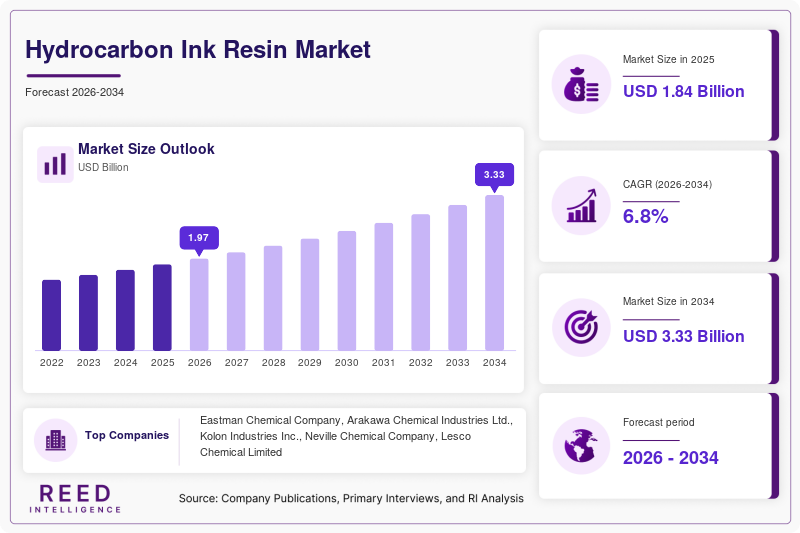
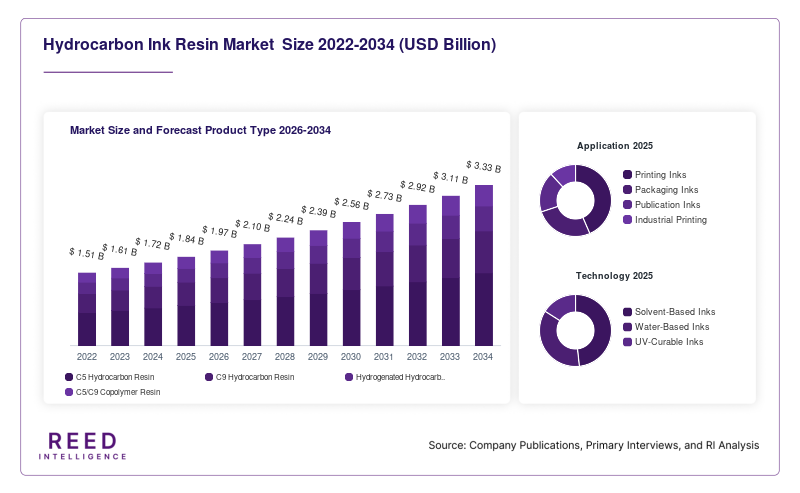
The global Hydrocarbon Ink Resin Market size was valued at USD 1.84 billion in 2026 and is projected to reach USD 3.12 billion by 2034, expanding at a CAGR of 6.8% during the forecast period from 2026 to 2034. The market growth was supported by rising global packaging consumption across food, pharmaceuticals, consumer goods, and e-commerce industries. Increasing demand for high-performance printing inks with improved adhesion, gloss, and drying efficiency also contributed to market expansion across developed and emerging economies.
Hydrocarbon ink resins are widely used in gravure, flexographic, offset, and screen printing applications because they provide strong pigment dispersion, color retention, and print consistency. The growing use of flexible packaging and commercial printing solutions has strengthened demand for hydrocarbon-based resins in both solvent-based and water-based ink formulations. Manufacturers are also focusing on advanced resin technologies that improve print durability while supporting low-VOC formulations.
Key Highlights
- Asia Pacific accounted for 41.8% of the global Hydrocarbon Ink Resin Market share in 2025, while Latin America is projected to register the fastest CAGR of 7.6% during the forecast period.
- By product type, C5 hydrocarbon resin held the dominant share of 46.2% in 2025, whereas hydrogenated hydrocarbon resin is expected to witness the fastest CAGR of 7.4% through 2034.
- By application, printing inks represented the leading segment with 58.7% market share in 2025, while packaging inks are projected to grow at a CAGR of 7.8% during the forecast period.
- By technology, solvent-based inks dominated the market with 49.5% share in 2025, whereas water-based inks are anticipated to expand at a CAGR of 8.1% between 2026 and 2034.
- China remained the dominant country in the Hydrocarbon Ink Resin Market, with market values reaching USD 312 million in 2024 and USD 333 million in 2025.
Market Trends
Digital Printing Expansion Supporting Resin Innovation
The rapid adoption of digital printing technologies is emerging as a major trend in the Hydrocarbon Ink Resin Market. Packaging manufacturers and commercial printers are increasingly shifting toward short-run printing and customized label production. This transition has created demand for hydrocarbon ink resins that provide enhanced print clarity, fast drying performance, and substrate compatibility. Resin manufacturers are developing specialized formulations suitable for digital flexographic and hybrid printing systems to improve operational efficiency.
Shift Toward Low-VOC and Sustainable Ink Formulations
Environmental regulations related to solvent emissions are influencing resin manufacturers to introduce low-VOC and environmentally compatible formulations. Water-based and hybrid ink systems are gaining traction across food packaging and consumer goods printing applications. Companies are integrating hydrogenated hydrocarbon resins into advanced ink formulations to improve environmental performance while maintaining color stability and adhesion properties. This trend is expected to reshape product development strategies across the global Hydrocarbon Ink Resin Market.
Market Drivers
Growing Flexible Packaging Industry
The rapid growth of flexible packaging across food, beverage, and personal care industries is driving demand for hydrocarbon ink resins. Flexible packaging requires high-quality printing performance, abrasion resistance, and strong substrate bonding. Hydrocarbon resins provide these properties while supporting high-speed production processes. Increasing packaged food consumption in urban economies continues to strengthen long-term demand for advanced printing ink solutions.
Rising Commercial Printing Activities in Emerging Economies
Expanding advertising, publishing, and industrial labeling activities in emerging economies are supporting market growth. Countries across Asia Pacific and Latin America are witnessing increased investments in commercial printing infrastructure. Hydrocarbon ink resins are extensively used in offset and gravure printing due to their cost efficiency and performance consistency. Rising demand for promotional packaging and branded labels further supports market expansion.
Market Restraint
Volatility in Raw Material Prices
Fluctuations in crude oil-derived feedstock prices remain a major restraint for the Hydrocarbon Ink Resin Market. Hydrocarbon resins are produced using petroleum-based raw materials, making manufacturers vulnerable to changes in energy prices and supply chain disruptions. Price instability affects production costs and profit margins, particularly for small and medium-scale resin producers.
Market Opportunities
Growth Potential in Bio-Modified Resin Development
The increasing focus on sustainable materials is creating opportunities for bio-modified hydrocarbon ink resins. Manufacturers are exploring renewable feedstock integration to reduce dependence on petroleum derivatives. The development of partially bio-based resin systems is expected to attract packaging and printing companies seeking environmentally aligned products.
Expansion of Industrial Labeling Applications
Industrial labeling applications across electronics, automotive, and logistics sectors are generating new growth opportunities. Durable labels with strong chemical resistance and print stability require high-performance ink resin systems. Hydrocarbon ink resins are increasingly used in specialty labeling applications because of their excellent adhesion and thermal resistance characteristics.
Segmental Analysis
By Product Type
C5 Hydrocarbon Resin Dominated the Market: C5 hydrocarbon resin accounted for 46.2% of the Hydrocarbon Ink Resin Market share in 2025. The segment maintained dominance because of its strong compatibility with solvent-based printing inks and excellent tackifying performance. These resins were extensively used in newspaper printing, packaging inks, and publication printing applications due to their cost effectiveness and rapid drying properties.
Hydrogenated Hydrocarbon Resin to Register Fastest Growth: Hydrogenated hydrocarbon resin is projected to grow at a CAGR of 7.4% during the forecast period. The segment will expand due to increasing demand for color-stable and low-odor resin systems in premium packaging applications. Enhanced thermal stability and environmental compatibility are expected to support adoption in advanced printing technologies.
By Application
Printing Inks Held the Largest Share: Printing inks represented 58.7% of the Hydrocarbon Ink Resin Market share in 2025. The segment remained dominant because hydrocarbon resins are critical components in gravure, flexographic, and offset inks. Growing demand for high-quality graphics and durable printed materials supported segment expansion across commercial and industrial printing sectors.
Packaging Inks to Witness Strong Growth: Packaging inks are expected to expand at a CAGR of 7.8% from 2026 to 2034. Rising consumption of flexible packaging and corrugated boxes will support growth in this segment. Increased demand for moisture-resistant and visually appealing packaging solutions is anticipated to strengthen resin usage in food and beverage applications.
By Technology
Solvent-Based Inks Dominated the Market: Solvent-based inks accounted for 49.5% of the market share in 2025. The segment maintained leadership due to strong adhesion characteristics and suitability for high-speed industrial printing applications. Hydrocarbon ink resins are commonly used in solvent-based systems because they provide improved gloss and print consistency across multiple substrates.
Water-Based Inks to Record the Fastest CAGR: Water-based inks are forecast to register a CAGR of 8.1% during the forecast period. The segment is expected to expand due to increasing adoption of environmentally aligned printing technologies. Improved resin compatibility with water-based formulations will drive demand across food packaging and consumer goods printing applications.
By End-Use Industry
Packaging Industry Led the Market: The packaging industry held 44.8% share of the Hydrocarbon Ink Resin Market in 2025. Growth in packaged food consumption, retail distribution, and logistics activities supported high resin demand in this segment. Hydrocarbon ink resins were widely used to enhance print durability and branding visibility in packaging applications.
Electronics Industry to Grow Rapidly: The electronics industry is anticipated to grow at a CAGR of 7.3% during the forecast period. Increasing use of specialty labels and printed electronic packaging will contribute to segment growth. Demand for precise printing and chemical-resistant labels is expected to accelerate adoption of high-performance hydrocarbon resin formulations.
By Printing Process
Flexographic Printing Accounted for Major Share: Flexographic printing captured 38.9% of the Hydrocarbon Ink Resin Market share in 2025. The segment dominated because of its extensive use in flexible packaging, labels, and corrugated printing. Hydrocarbon resins provide excellent adhesion and fast curing performance in flexographic applications.
Gravure Printing to Experience Significant Growth: Gravure printing is projected to witness a CAGR of 7.0% during the forecast period. The segment will benefit from increasing demand for high-volume packaging production and premium image quality. Growth in decorative packaging and publication printing is expected to strengthen gravure printing adoption globally.
Regional Analysis
North America
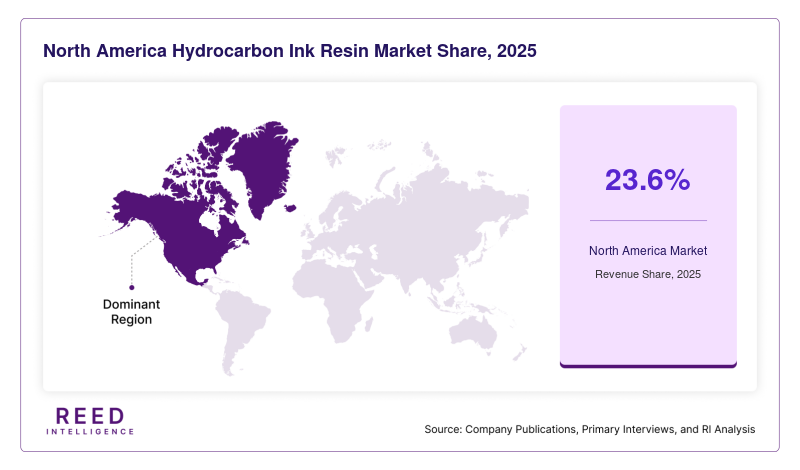
North America accounted for 23.6% of the global Hydrocarbon Ink Resin Market share in 2025 and is projected to expand at a CAGR of 5.9% during the forecast period. The region experienced stable demand from industrial packaging and pharmaceutical labeling sectors. The United States dominated the regional market due to increasing adoption of advanced flexographic printing systems. Growth in premium consumer packaging and specialty printing applications supported consistent resin consumption across commercial printing operations.
Europe
Europe held 21.4% of the Hydrocarbon Ink Resin Market share in 2025 and is expected to register a CAGR of 5.7% from 2026 to 2034. Germany emerged as the leading country in the region owing to its strong printing equipment manufacturing industry. The regional market benefited from technological modernization in packaging production facilities and increasing use of high-quality decorative printing solutions. Demand for premium publication printing also contributed to market growth.
Asia Pacific
Asia Pacific represented the largest regional market with 41.8% share in 2025 and is forecast to grow at a CAGR of 7.2% during the assessment period. China dominated the region due to large-scale packaging manufacturing capacity and strong export-oriented printing industries. Expanding e-commerce packaging requirements and rising industrial output strengthened regional demand for hydrocarbon ink resins. Increasing investments in high-speed printing technologies also accelerated market development.
Middle East & Africa
Middle East & Africa captured 7.1% of the Hydrocarbon Ink Resin Market share in 2025 and is anticipated to grow at a CAGR of 6.1% through 2034. Saudi Arabia led the regional market due to the expansion of food packaging and industrial labeling industries. The development of local manufacturing activities and increasing investments in retail packaging infrastructure supported market penetration across Gulf economies.
Latin America
Latin America accounted for 6.1% of the global market share in 2025 and is projected to witness the fastest CAGR of 7.6% during the forecast period. Brazil dominated the regional market owing to the growth of consumer packaged goods and commercial advertising industries. Increasing investments in domestic packaging production and rising demand for printed flexible films contributed to long-term market expansion across the region.
Competitive Landscape
The Hydrocarbon Ink Resin Market remains moderately fragmented, with manufacturers focusing on product innovation, capacity expansion, and strategic collaborations. Companies are investing in sustainable resin technologies and customized ink formulations to strengthen their competitive positions.
Eastman Chemical Company emerged as a leading participant in the Hydrocarbon Ink Resin Market due to its extensive product portfolio and strong distribution network. The company recently introduced advanced hydrogenated hydrocarbon resin grades designed for low-odor packaging ink applications.
Arakawa Chemical Industries Ltd. focused on specialty resin formulations for high-speed flexographic printing systems. Kolon Industries Inc. expanded production capabilities to support rising packaging industry demand across Asia Pacific. Neville Chemical Company emphasized durable resin technologies for industrial printing applications, while Lesco Chemical Limited increased investments in regional supply chain optimization.
Key Players List
- Eastman Chemical Company
- Arakawa Chemical Industries Ltd.
- Kolon Industries Inc.
- Neville Chemical Company
- Lesco Chemical Limited
- ExxonMobil Chemical
- Henan Anglxxon Chemical Co., Ltd.
- Puyang Tiancheng Chemical Co., Ltd.
- Shanghai Jinsen Hydrocarbon Resins Co., Ltd.
- Zibo Luhua Hongjin New Material Group Co., Ltd.
- Seacon Corporation
- Qingdao Bater Chemical Co., Ltd.
- TotalEnergies SE
- Resinall Corp.
- Arakawa Europe GmbH
Recent Developments
- In February 2025, Eastman Chemical Company introduced a new hydrogenated hydrocarbon resin series designed for low-migration food packaging inks.
- In June 2025, Kolon Industries Inc. expanded its petroleum resin manufacturing facility in South Korea to support rising export demand from packaging ink producers.
- In September 2024, Arakawa Chemical Industries Ltd. launched modified hydrocarbon resin grades compatible with advanced water-based ink systems.
- In January 2025, Neville Chemical Company announced a strategic partnership with packaging ink formulators to develop high-gloss industrial printing solutions.
- In August 2024, TotalEnergies SE increased investments in specialty hydrocarbon resin production to strengthen its presence in Asia Pacific printing markets.
Hydrocarbon Ink Resin Market Segments
Product Type
- C5 Hydrocarbon Resin
- C9 Hydrocarbon Resin
- Hydrogenated Hydrocarbon Resin
- C5/C9 Copolymer Resin
Application
- Printing Inks
- Packaging Inks
- Publication Inks
- Industrial Printing
Technology
- Solvent-Based Inks
- Water-Based Inks
- UV-Curable Inks
Printing Process
- Flexographic Printing
- Gravure Printing
- Offset Printing
- Screen Printing
End-Use Industry
- Packaging
- Publishing
- Consumer Goods
- Electronics
- Automotive
By Region
- North America
- Europe
- APAC
- Middle East and Africa
- LATAM