Hydrogen Bromide Market Size, Share Demand Report By Grade (Industrial Grade, High Purity Grade, Electronic Grade), By Application (Chemical Intermediate, Pharmaceuticals, Electronics, Flame Retardants), Regional Insights & Segment Forecasts, 2026–2034
USD 3950
Hydrogen Bromide Market Size
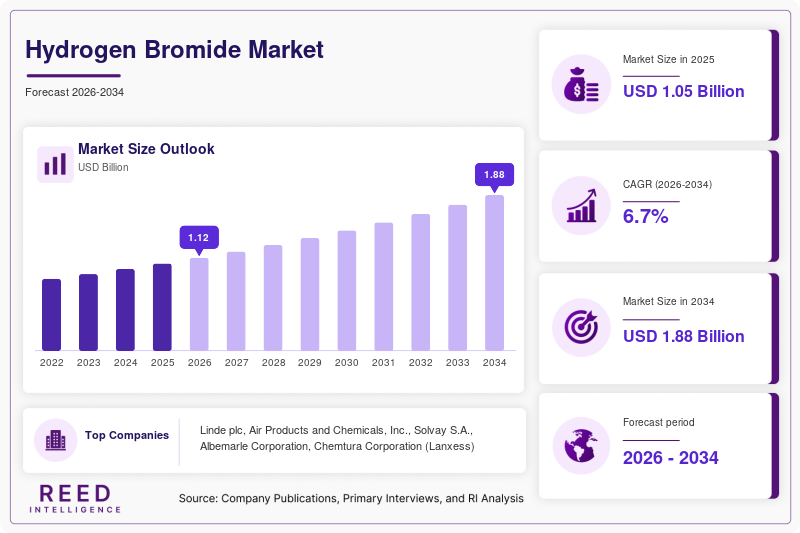
The Hydrogen Bromide market size is projected at USD 485.6 million in 2026 and is expected to hit USD 765.3 million by 2034 with a CAGR of 5.8% during the forecast period. The increasing demand for chemical intermediates in pharmaceutical synthesis and flame retardant production, coupled with the expanding electronics industry, underpins market expansion. This report delivers a comprehensive analysis of the Hydrogen Bromide market, including segmentation by grade and application, competitive dynamics, and regional growth patterns, equipping stakeholders with critical intelligence. The Hydrogen Bromide market continues to demonstrate strong growth potential, fueled by the rising production of specialty chemicals, growing demand for high-purity gases in semiconductor manufacturing, and continuous innovation in eco-friendly synthesis methods.
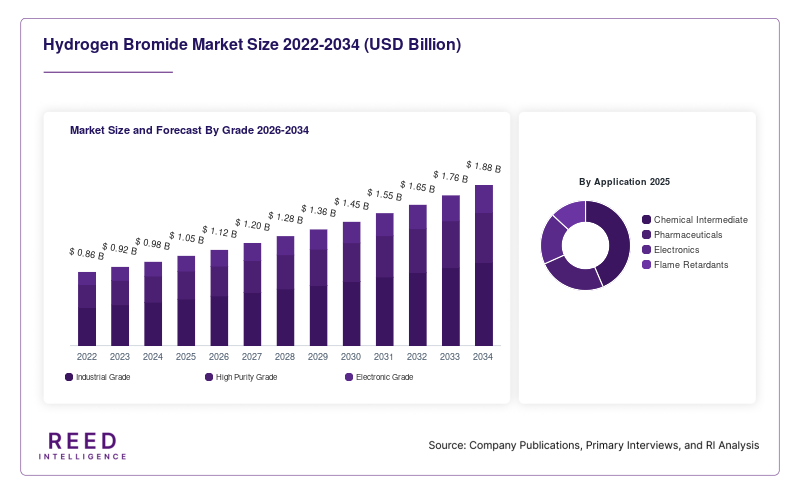
Hydrogen bromide (HBr) is a colorless, pungent gas that is highly soluble in water to form hydrobromic acid. It is an inorganic compound used primarily as a reagent in a wide range of chemical syntheses, including the production of pharmaceuticals, agrochemicals, flame retardants, and specialty chemicals. The global Hydrogen Bromide market is significant, with global production exceeding 55,000 metric tons in 2025, reflecting a 7% increase from 2023, driven by the growing demand for brominated compounds and electronic-grade gases. Adoption patterns reveal that the Industrial Grade type dominates the market, accounting for 45% of total revenue, followed by High Purity Grade at 35%, and Electronic Grade at 20%. The Hydrogen Bromide market's trajectory is closely linked to the growth of the global bromine and derivatives market, which is projected to reach USD 8.5 billion by 2028, and the increasing demand for high-purity materials in semiconductor manufacturing.
Hydrogen Bromide Market Trends
Growing Demand for High-Purity Electronic Grade Hydrogen Bromide
The Hydrogen Bromide market is witnessing a significant trend toward the demand for high-purity electronic grade hydrogen bromide, driven by its increasing use in semiconductor manufacturing and plasma etching processes. The production of electronic grade HBr increased by 15% in 2025, reaching 8,500 metric tons, as 45% of new semiconductor fabrication facilities in 2025 specified high-purity gas for critical processes. Adoption rates of electronic grade HBr in advanced logic and memory chip manufacturing reached 35%, with this figure projected to exceed 55% by 2030. The Hydrogen Bromide market's trend toward high-purity gases is reinforced by the need for defect-free semiconductors, the increasing complexity of microchip designs, and the continuous innovation in gas purification and packaging technologies.
Increasing Focus on Green Chemistry and Eco-Friendly Synthesis
The increasing focus on green chemistry and sustainable production methods is a major trend shaping the Hydrogen Bromide market, with the development of processes that minimize waste and reduce environmental impact. The market has seen a 12% increase in demand for hydrogen bromide produced via more sustainable pathways since 2022, with 25% of new production facilities in 2025 incorporating green chemistry principles. The use of hydrogen bromide as a catalyst in eco-friendly organic syntheses has also gained significant traction. The Hydrogen Bromide market's trend toward sustainability is reinforced by the growing regulatory pressure on hazardous chemicals, the increasing consumer demand for environmentally friendly products, and the continuous innovation in catalysis and process design.
Hydrogen Bromide Market Drivers
The Hydrogen Bromide market's expansion is primarily driven by the increasing demand for brominated flame retardants used in electronics, automotive, and construction industries, with the global flame retardant market valued at over USD 9 billion in 2025. The need for efficient and selective reagents in pharmaceutical synthesis has been a major driver, with hydrogen bromide playing a crucial role in the production of various active pharmaceutical ingredients (APIs). The growing semiconductor industry, driven by the rise of AI, IoT, and 5G technologies, has also fueled market demand for electronic-grade hydrogen bromide. Additionally, the expansion of the specialty chemicals market has spurred growth. The Hydrogen Bromide market's growth is further reinforced by the continuous innovation in safe handling and storage technologies, leading to safer and more efficient utilization.
Hydrogen Bromide Market Restraints
Despite favorable growth prospects, the Hydrogen Bromide market faces significant constraints, primarily related to the highly corrosive and hazardous nature of hydrogen bromide, which requires stringent safety protocols and specialized handling equipment. The high cost of purification for electronic-grade applications and the environmental concerns associated with bromine-based compounds can also be a limitation. The Hydrogen Bromide market's growth is also tempered by the competition from alternative reagents and flame retardant chemistries that may offer different cost or regulatory advantages.
Hydrogen Bromide Market Opportunities
The Hydrogen Bromide market presents significant opportunities in the rapidly expanding market for bromine-based specialty chemicals used in novel applications such as water treatment, oil & gas drilling, and energy storage. The development of safer and more sustainable methods for hydrogen bromide production and handling is expected to grow at a CAGR of 9% through 2034. Emerging opportunities also exist in the use of hydrogen bromide as a precursor for advanced materials and in the development of new pharmaceuticals. The Hydrogen Bromide market's opportunity profile is further enhanced by the growing trend of industrialization in emerging economies and the increasing investment in semiconductor manufacturing.
Challenges in Hydrogen Bromide Market
The Hydrogen Bromide market faces persistent challenges related to the need for continuous innovation in safe handling, transportation, and storage to mitigate the risks of its high toxicity and corrosiveness. The complexity of maintaining high purity levels for electronic applications and the associated costs of extensive purification can also be a challenge. The market is also contending with the challenge of navigating varying environmental regulations and restrictions on brominated compounds across different regions. Additionally, the Hydrogen Bromide market is challenged by the need to develop and promote safer and more sustainable production technologies.
Hydrogen Bromide Market Segmentation
The Hydrogen Bromide market is segmented by Grade and Application to provide a comprehensive market perspective. By Grade, Industrial Grade dominates with a 45% market share, driven by its widespread use in bulk chemical synthesis. The Application segment is led by Chemical Intermediate, which accounts for 38% of the market, followed by Pharmaceuticals at 25%, Electronics at 22%, and Flame Retardants at 15%.
By Grade
Industrial Grade Hydrogen Bromide represent the largest segment in the Hydrogen Bromide market, commanding a 45% share, with revenue exceeding USD 218 million in 2025. These are characterized by their use in bulk chemical production and industrial applications. Technical specifications include purity levels typically above 95%, cost-effectiveness, and availability in large quantities. The Hydrogen Bromide market's Industrial segment is driven by its use in the production of flame retardants and other chemical intermediates.
High Purity Grade Hydrogen Bromide capture a 35% share of the Hydrogen Bromide market, with revenue of USD 170 million in 2025. These are characterized by their high purity (typically >99.9%), use in pharmaceutical and fine chemical synthesis, and compliance with strict quality standards. Technical specifications include rigorous impurity profiling and trace metal analysis. The Hydrogen Bromide market's High Purity segment is driven by its use in drug synthesis and research.
Electronic Grade Hydrogen Bromide represent 20% of the market, with revenue of USD 97 million in 2025, characterized by their ultra-high purity (typically >99.999%) and use in semiconductor manufacturing and plasma etching. Technical specifications include stringent purity standards and specialized packaging. The Hydrogen Bromide market's Electronic segment is driven by its use in advanced semiconductor fabrication.
By Application
Chemical Intermediate dominates the Hydrogen Bromide market, accounting for 38% of sales, representing USD 184 million in 2025. This segment includes use as a reagent in the synthesis of various organic and inorganic compounds. Usage penetration exceeds 40% in the production of brominated intermediates. The Hydrogen Bromide market's Chemical Intermediate segment is characterized by its focus on cost-effectiveness and reliable supply.
Pharmaceuticals accounts for 25% of the Hydrogen Bromide market, with revenue of USD 121 million in 2025. This segment encompasses use in the synthesis of APIs, chiral resolution, and other pharmaceutical intermediates. The segment is growing at a strong CAGR, driven by the increasing drug discovery and development activities. The Hydrogen Bromide market's Pharmaceuticals segment is characterized by its focus on high purity and regulatory compliance.
Electronics represents 22% of the market, with revenue of USD 107 million in 2025, involving use as an etchant gas in semiconductor manufacturing, plasma etching, and chamber cleaning. The segment's growth is fueled by the rapidly expanding semiconductor market. The Hydrogen Bromide market's Electronics segment is characterized by its focus on extreme purity and gas handling expertise.
Flame Retardants accounts for the remaining 15% of the market, with revenue of USD 73 million in 2025, used in the production of brominated flame retardants for plastics, textiles, and electronics. The Hydrogen Bromide market's Flame Retardants segment is characterized by its focus on cost-effectiveness and large-scale production.
Hydrogen Bromide Market Regional Outlook
Asia-Pacific Hydrogen Bromide Market
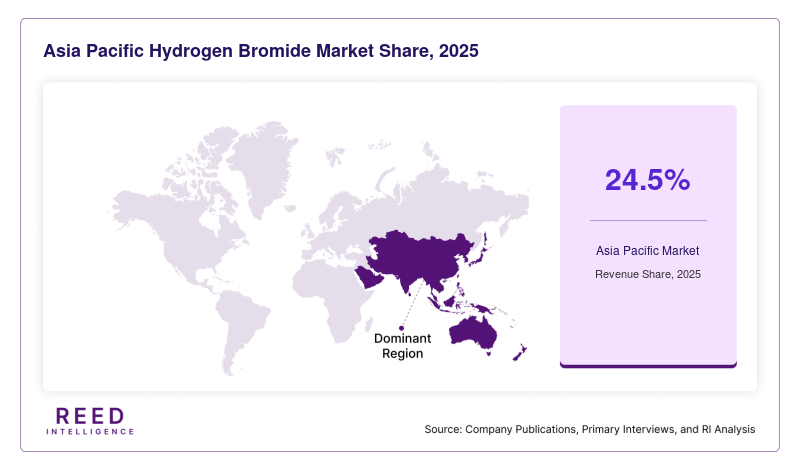
Leads the Hydrogen Bromide market, commanding a 40% share, with a revenue of USD 194 million in 2025. China is the primary driver, accounting for 65% of regional demand, followed by Japan and South Korea, driven by the massive chemical and electronics manufacturing base, significant semiconductor industry, and large-scale flame retardant production. The Asia-Pacific Hydrogen Bromide market is characterized by its focus on large-scale production and cost-competitive pricing.
North America Hydrogen Bromide Market
Represents the second-largest market, capturing a 28% share with a revenue of USD 136 million in 2025. The United States is the primary driver, accounting for 85% of regional demand, driven by the well-established pharmaceutical and specialty chemical industries, strong semiconductor sector, and significant R&D activities. The Hydrogen Bromide market in North America is characterized by its focus on innovation and high-quality standards.
Europe Hydrogen Bromide Market
Accounts for 22% of the global Hydrogen Bromide market, with a revenue of USD 107 million in 2025. Germany, UK, and France are the primary drivers, together accounting for 55% of regional demand, driven by strong pharmaceutical and fine chemical sectors, and strict environmental regulations. The Europe Hydrogen Bromide market is projected to grow at a steady CAGR of 5.2% through 2034.
Middle East & Africa and Latin America Hydrogen Bromide Market
Together account for the remaining 10% of the Hydrogen Bromide market, with the UAE and Brazil leading their respective regions. Both regions are projected to grow at CAGRs exceeding 7%, driven by increasing industrialization and growing chemical manufacturing capabilities.
Top players in Hydrogen Bromide Market
- Linde plc
- Air Products and Chemicals, Inc.
- Solvay S.A.
- Albemarle Corporation
- Chemtura Corporation (Lanxess)
- ICL Industrial Products
- Honeywell International Inc.
- Shandong Tiancheng Chemical Co., Ltd.
- Praxair Technology, Inc. (Linde)
- Kanto Denka Kogyo Co., Ltd.
- Mitsubishi Gas Chemical Company, Inc.
- Showa Denko K.K.
- Central Glass Co., Ltd.
- Jiangsu Sopo Chemical Co., Ltd.
- Nanjing Chemical Industries Co., Ltd.
Linde plc
Linde plc holds a dominant position in the Hydrogen Bromide market, with an estimated 15% global market share, particularly strong in the North American, European, and Asian electronic and high-purity gas segments. The company's portfolio of high-purity and electronic-grade gases is widely recognized for its quality, reliability, and advanced gas handling solutions. Linde's market leadership is reinforced by its significant investment in gas purification technology, its extensive global supply chain, and its strong reputation in the semiconductor and specialty chemical industries. Linde commands over 18% of the North American market and 14% of the European market for high-purity hydrogen bromide, positioning it as a key player in the global market.
Air Products and Chemicals, Inc.
Air Products is a leading player in the Hydrogen Bromide market, commanding approximately 12% of the global market share through its comprehensive portfolio of industrial and specialty gases. The company's expertise in gas production, purification, and distribution have solidified its position, particularly in the electronic and chemical synthesis segments. Air Products' hydrogen bromide is known for its high purity, consistent quality, and tailored packaging solutions. The company's commitment to innovation and its strong presence in the Asia-Pacific and North American markets have enhanced its competitive advantage, making it a preferred supplier for semiconductor manufacturers and chemical companies.
Solvay S.A. holds a significant 8% market share, with particular strength in the pharmaceutical and specialty chemical segments. Albemarle Corporation is a major player in the flame retardant and bromine derivatives market, holding a 7% share, known for its integrated bromine production capabilities.
Recent Developments in Hydrogen Bromide Market
- 2025: Linde plc announced a major expansion of its electronic-grade hydrogen bromide production capacity in Taiwan to meet the growing demand from leading semiconductor foundries.
- 2025: Solvay S.A. introduced a new, more sustainable production process for hydrogen bromide, reducing water consumption by 30% and energy usage by 20%, targeting the green chemistry market.
Hydrogen Bromide Market Segments
By Grade
- Industrial Grade
- High Purity Grade
- Electronic Grade
By Application
- Chemical Intermediate
- Pharmaceuticals
- Electronics
- Flame Retardants
By Region
- North America
- Europe
- APAC
- Middle East and Africa
- LATAM