Hydrogen Sulfide Scavenger Market Size, Share Demand Report By Type (Triazine-Based Scavengers, Non-Triazine-Based Scavengers), By Formulation (Liquid Scavengers, Solid Scavengers), By Application (Oil & Gas Production, Refining, Petrochemical Processing, Wastewater Treatment), By End Use Industry (Upstream Oilfield Operations, Midstream Transport, Downstream Refining), By Deployment Location (Onshore, Offshore), By Region & Segment Forecasts, 2026–2034
USD 3950
Market Overview
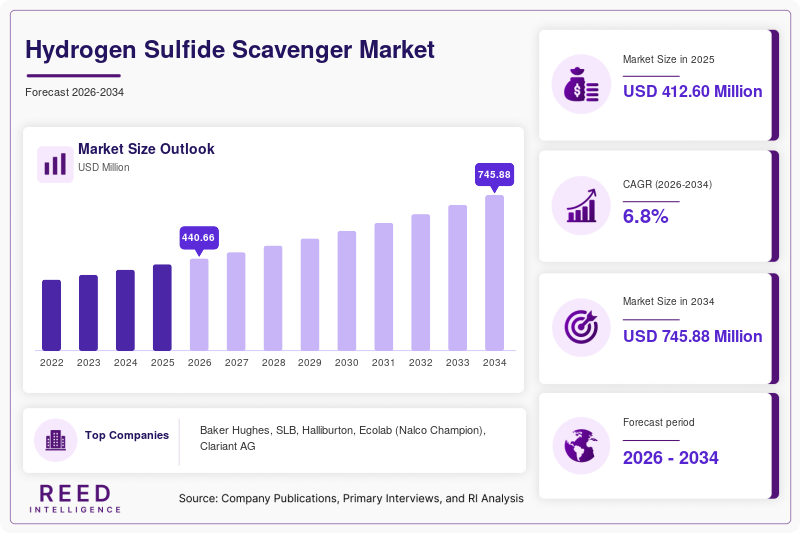
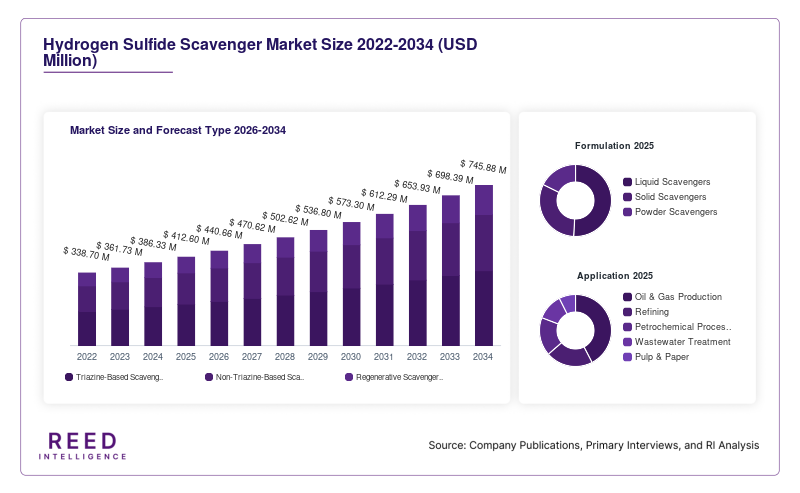
The global Hydrogen Sulfide Scavenger Market size was valued at USD 412.6 million in 2026 and is projected to reach USD 698.4 million by 2034, expanding at a CAGR of 6.8% during the forecast period from 2026 to 2034. The market is gaining momentum due to increasing crude oil and natural gas processing activities, where hydrogen sulfide removal remains essential for operational safety, corrosion prevention, and environmental compliance. Hydrogen sulfide scavengers are widely used across upstream, midstream, and downstream hydrocarbon operations to neutralize toxic H2S gas in liquid and gas streams.
A major global factor supporting market expansion has been the steady rise in sour gas exploration and production projects across mature oilfields. As oil and gas operators increasingly encounter high-sulfur reserves, the demand for effective scavenging chemistries has expanded across both onshore and offshore assets. In addition, tightening industrial emission standards have accelerated the adoption of hydrogen sulfide treatment chemicals in wastewater, petrochemical, and refining sectors.
Key Highlights:
- North America dominated the Hydrogen Sulfide Scavenger Market in 2025 with 34.8% share, while Asia Pacific is expected to register the fastest CAGR of 8.1% through 2034.
- By type, triazine-based scavengers led with 46.3% share; regenerative scavengers are projected to grow fastest at 8.5% CAGR.
- By application, oil & gas production remained dominant with 52.7% share; wastewater treatment is expected to expand fastest at 8.3% CAGR.
- The U.S. remained the dominant country market, valued at USD 118.4 million in 2024 and USD 124.9 million in 2025.
Market Trends
Rising Adoption of Triazine Alternatives
The Hydrogen Sulfide Scavenger Market is witnessing a shift away from conventional triazine chemistries toward low-solid and environmentally adaptive alternatives. Traditional triazine scavengers remain effective but generate byproducts that may clog pipelines and increase disposal burdens. Producers are increasingly investing in non-triazine liquid scavengers that offer lower deposition rates and improved compatibility with high-pressure production systems. This trend is especially visible in offshore production units where maintenance downtime carries significant operational costs.
Integration of Digital Chemical Monitoring Systems
Another emerging trend is the integration of digital dosing and chemical monitoring systems with hydrogen sulfide scavenger deployment. Oilfield operators are using automated sensing platforms to optimize injection rates based on real-time H2S concentration fluctuations. These systems reduce chemical waste, improve treatment precision, and lower operating costs. As digital oilfield infrastructure expands, intelligent scavenger management is becoming a core part of production chemistry programs, particularly in large-scale shale and deepwater projects.
Market Drivers
Expansion of Sour Gas Processing Infrastructure
Growing investment in sour gas processing plants is a primary driver of the Hydrogen Sulfide Scavenger Market. New gas reserves discovered in sulfur-rich basins require extensive H2S removal before commercialization. Hydrogen sulfide scavengers offer a flexible and scalable solution where permanent amine treatment systems are economically impractical. This is increasing their adoption in temporary production facilities and remote field operations.
Industrial Safety Compliance Requirements
Stringent occupational safety regulations regarding toxic gas exposure are driving wider deployment of scavenging solutions. Hydrogen sulfide is highly hazardous even at low concentrations, making removal mandatory in enclosed industrial environments. Refineries, petrochemical units, and wastewater plants are expanding preventive H2S treatment protocols, creating stable demand across industrial end users.
Market Restraint
High Operational Cost of Specialty Scavenger Formulations
One major restraint in the Hydrogen Sulfide Scavenger Market is the relatively high cost associated with specialty and customized scavenger chemistries. Advanced formulations designed for high-temperature wells, offshore rigs, or multi-phase flow systems often require premium raw materials and complex dosing controls. Small and mid-sized operators in cost-sensitive markets may delay adoption due to budget constraints, particularly when crude price volatility affects capital spending.
Market Opportunities
Growth in Offshore Deepwater Exploration
Deepwater oil and gas exploration is creating new opportunities for hydrogen sulfide scavenger suppliers. Offshore reservoirs increasingly contain sour hydrocarbons requiring efficient H2S neutralization before transport and storage. Compact liquid scavenger systems are becoming preferred solutions where platform space limitations restrict large treatment infrastructure.
Expansion in Municipal Wastewater Odor Control
Municipal wastewater treatment is emerging as a strong opportunity area. Rising urbanization has increased odor and corrosion issues linked to hydrogen sulfide generation in sewer networks. Scavenger suppliers are developing formulations specifically tailored for sewage lift stations and sludge processing plants, opening diversified non-oilfield revenue streams.
Segmental Analysis
By Type
Triazine-based scavengers dominated the Hydrogen Sulfide Scavenger Market in 2025 with 46.3% share due to their cost efficiency and broad oilfield compatibility. Their widespread use in upstream applications has maintained volume leadership.
Regenerative scavengers will grow fastest at 8.5% CAGR through 2034, driven by reduced waste generation and improved lifecycle economics in continuous industrial processing environments.
By Formulation
Liquid scavengers accounted for 68.5% share in 2025 because of easy injection handling and rapid reaction efficiency in pipelines and separators. Their operational flexibility supports dominance across hydrocarbon systems.
Solid scavengers are projected to expand at 7.4% CAGR as remote gas gathering systems increasingly adopt cartridge-based treatment formats requiring minimal infrastructure.
By Application
Oil & gas production led with 52.7% market share in 2025 due to widespread H2S removal requirements in extraction and separation operations. Sour crude treatment remains the largest demand center.
Wastewater treatment will grow fastest at 8.3% CAGR, supported by expanding municipal odor mitigation investments and sewer corrosion control programs.
By End Use Industry
Upstream oilfield operations dominated with 44.9% share in 2025, reflecting high scavenger consumption in wellhead and gathering systems. Continuous sulfur management needs supported segment leadership.
Petrochemical processing is expected to grow fastest at 7.8% CAGR as sulfur-sensitive feedstock purification requirements rise in integrated chemical complexes.
By Deployment Location
Onshore facilities accounted for 63.2% share in 2025 due to larger well counts and easier chemical logistics access. Land-based sour gas treatment networks supported strong volume demand.
Offshore deployment will register fastest growth at 8.0% CAGR as deepwater sour reservoirs require compact high-efficiency scavenging systems.
Regional Analysis
North America
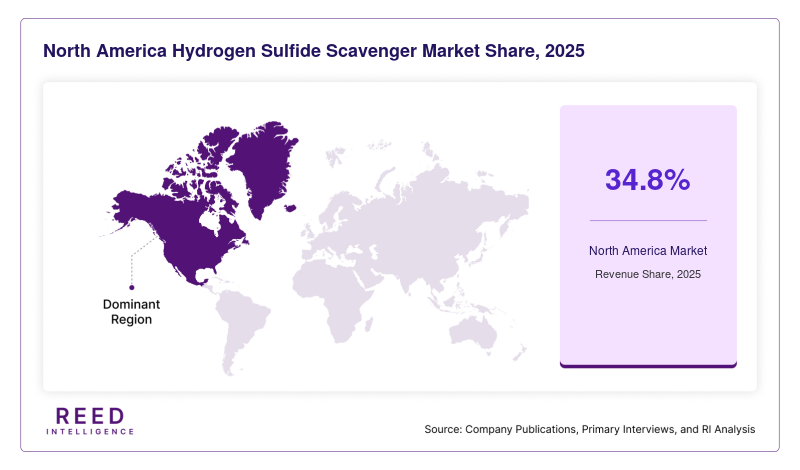
North America accounted for 34.8% of the Hydrogen Sulfide Scavenger Market in 2025 and will grow at a CAGR of 6.4% through 2034. The region maintained leadership due to extensive shale oil production, mature sour gas infrastructure, and established oilfield chemical supply chains. Strong adoption in U.S. onshore basins supported stable demand.
The United States dominated regional consumption due to high sour crude production in Texas and the Gulf Coast. Increased redevelopment of aging wells with elevated sulfur content has driven higher scavenger injection volumes across mature hydrocarbon assets.
Europe
Europe held 22.1% market share in 2025 and will expand at a CAGR of 5.9% during the forecast period. Regional growth is shaped by refinery modernization programs and stricter industrial emissions frameworks affecting sulfur handling operations.
Norway remained the dominant European country due to North Sea offshore production activity. Aging offshore reservoirs with sour gas accumulation are increasing demand for low-residue scavenger chemistries in subsea production systems.
Asia Pacific
Asia Pacific captured 19.4% share in 2025 and is projected to grow at the fastest CAGR of 8.1%. Industrialization, refinery expansion, and increasing LNG infrastructure investments are driving regional market acceleration.
China led the region due to rapid petrochemical capacity expansion and growing sour gas pipeline networks. New inland gas processing hubs are increasing procurement of scalable H2S scavenger systems.
Middle East & Africa
Middle East & Africa represented 15.8% of the Hydrogen Sulfide Scavenger Market in 2025 and will grow at 7.3% CAGR. The region’s sulfur-rich hydrocarbon reserves continue to create strong demand across upstream oil production.
Saudi Arabia dominated due to large sour crude extraction projects. Expansion of enhanced oil recovery operations in sulfur-bearing reservoirs is increasing continuous scavenger deployment.
Latin America
Latin America held 7.9% share in 2025 and is forecast to grow at CAGR 6.6%. Offshore oil redevelopment and refinery upgrades are contributing to steady regional expansion.
Brazil led the region owing to offshore pre-salt production complexity. Sour associated gas treatment in floating production units is supporting increased use of liquid scavenger systems.
Competitive Landscape
The Hydrogen Sulfide Scavenger Market remains moderately consolidated, with global chemical manufacturers and oilfield specialty suppliers competing through formulation innovation and regional distribution expansion. Leading participants focus on sulfur-selective chemistries, lower sludge residue generation, and offshore-grade performance enhancements.
Baker Hughes remains the market leader due to its extensive oilfield chemical portfolio and integrated production chemistry solutions. In 2025, the company introduced a next-generation low-deposit scavenger platform for offshore sour gas wells, strengthening its upstream market position.
Other prominent companies continue expanding through regional partnerships and custom formulation services tailored to field-specific sulfur concentrations.
Key Players List
- Baker Hughes
- SLB
- Halliburton
- Ecolab (Nalco Champion)
- Clariant AG
- BASF SE
- Dorf Ketal Chemicals
- Arkema Group
- Veolia Water Technologies
- Huntsman Corporation
- Innospec Inc.
- Stepan Company
- ChemTreat Inc.
- GEO Specialty Chemicals
- Merichem Technologies
Recent Developments
- Baker Hughes launched a low-residue offshore scavenger chemistry platform in 2025.
- SLB expanded sour gas chemical treatment services in Middle Eastern upstream fields in 2025.
- Clariant AG introduced sulfur-selective wastewater scavenger blends for municipal systems.
- Halliburton increased production capacity for liquid scavenger formulations in North America.
- Dorf Ketal Chemicals entered new distribution agreements across Southeast Asia for refinery-grade H2S scavengers.
Hydrogen Sulfide Scavenger Market Segments
Type
- Triazine-Based Scavengers
- Non-Triazine-Based Scavengers
- Regenerative Scavengers
Formulation
- Liquid Scavengers
- Solid Scavengers
- Powder Scavengers
Application
- Oil & Gas Production
- Refining
- Petrochemical Processing
- Wastewater Treatment
- Pulp & Paper
End Use Industry
- Upstream Oilfield Operations
- Midstream Transport
- Downstream Refining
- Municipal Utilities
- Industrial Manufacturing
Deployment Location
- Onshore
- Offshore
By Region
- North America
- Europe
- APAC
- Middle East and Africa
- LATAM