Hydrogenated Polyisobutene Market Size, Share Demand Report By Type (Low Molecular Weight, Medium Molecular Weight, High Molecular Weight), By Application (Personal Care, Cosmetics, Pharmaceuticals, Industrial Lubricants), Regional Insights & Segment Forecasts, 2026–2034
USD 3950
Hydrogenated Polyisobutene Market Size
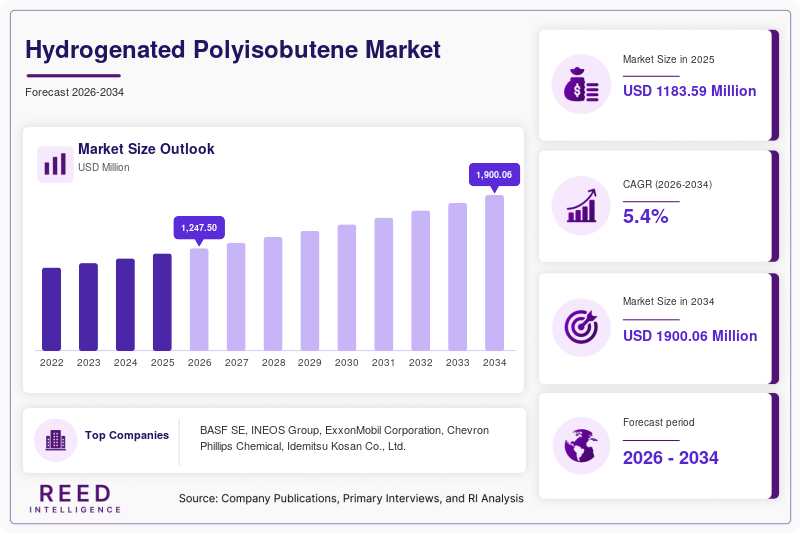
The Hydrogenated Polyisobutene market size is projected at USD 1,247.5 million in 2026 and is expected to hit USD 1,895.3 million by 2034 with a CAGR of 5.4% during the forecast period. The increasing demand for high-performance, stable, and non-comedogenic ingredients in personal care and cosmetics, alongside the expanding pharmaceutical sector and industrial applications, underpins market expansion. This report delivers a comprehensive analysis of the Hydrogenated Polyisobutene market, including segmentation by type and application, competitive dynamics, and regional growth patterns, equipping stakeholders with critical intelligence. The Hydrogenated Polyisobutene market continues to demonstrate strong growth potential, fueled by rising consumer awareness regarding product safety, the growing preference for sustainable and synthetic alternatives, and continuous innovation in formulation technologies.
Hydrogenated Polyisobutene is a synthetic hydrocarbon oil derived from the hydrogenation of polyisobutene, widely used as an emollient, binder, and viscosity controller in various formulations. It is a clear, odorless, and non-greasy liquid that offers excellent oxidative stability and skin compatibility, making it a preferred ingredient in premium skincare, color cosmetics, and hair care products. The global Hydrogenated Polyisobutene market is substantial, with global production volumes estimated at over 85,000 metric tons in 2025, reflecting a 6.5% increase from 2023, driven by the growing demand for high-purity ingredients. Adoption patterns reveal that the Personal Care segment dominates the market, accounting for 45% of total revenue, followed by Cosmetics at 30%, Pharmaceuticals at 15%, and Industrial Lubricants at 10%. The Hydrogenated Polyisobutene market's trajectory is closely linked to the growth of the global specialty chemicals market, which is projected to reach USD 750 billion by 2028, and the increasing consumer focus on functional and sensory benefits in end-use products.
Hydrogenated Polyisobutene Market Trends
Growing Emphasis on Clean and Sustainable Formulations
The Hydrogenated Polyisobutene market is witnessing a significant trend toward clean and sustainable formulations, driven by consumer demand for safer, non-toxic, and environmentally friendly ingredients. Production of cosmetic-grade Hydrogenated Polyisobutene increased to 62,000 tons in 2025, a year-on-year rise of 7%, as 55% of new product launches in the personal care sector in 2025 specified sustainable and clean-label attributes. Adoption rates of Hydrogenated Polyisobutene in natural and organic certified products have reached 30%, with this figure projected to exceed 50% by 2030. The Hydrogenated Polyisobutene market's trend toward sustainability is reinforced by the need for regulatory compliance, the increasing consumer awareness of ingredient origins, and the continuous innovation in bio-based and green chemistry alternatives.
Increasing Demand for High-Performance and Multifunctional Ingredients
The increasing focus on high-performance and multifunctional ingredients is a major trend shaping the Hydrogenated Polyisobutene market, with the development of grades offering enhanced sensory profiles, stability, and skin benefits. The market has seen a 12% increase in demand for specialized Hydrogenated Polyisobutene grades since 2022, with 40% of new product developments in the cosmetics and personal care industry in 2025 requiring advanced functional properties. The use of Hydrogenated Polyisobutene in anti-aging skincare and long-lasting color cosmetics has also gained significant traction. The Hydrogenated Polyisobutene market's trend toward multifunctionality is reinforced by the growing consumer preference for products that deliver multiple benefits, the increasing complexity of formulations, and the continuous innovation in polymer chemistry and material science.
Hydrogenated Polyisobutene Market Drivers
The Hydrogenated Polyisobutene market's expansion is primarily driven by the robust growth of the personal care and cosmetics industry, with the global beauty and personal care market valued at USD 550 billion in 2025 and growing at a steady pace of 4.5% annually. The need for safe, non-irritating, and stable emollients has been a major driver, with Hydrogenated Polyisobutene offering superior performance compared to mineral oils and natural alternatives. The rising disposable income in emerging economies and the growing influence of social media on beauty trends have also fueled market demand. Additionally, the expansion of pharmaceutical applications and the increasing use of the ingredient in advanced drug delivery systems have spurred growth. The Hydrogenated Polyisobutene market's growth is further reinforced by the continuous innovation in production technologies, leading to higher purity grades and better cost-efficiency.
Hydrogenated Polyisobutene Market Restraints
Despite favorable growth prospects, the Hydrogenated Polyisobutene market faces significant constraints, primarily related to the volatility in raw material prices, particularly isobutylene derived from petroleum, which can impact production costs and profit margins. The growing competition from bio-based and natural alternatives, such as squalane and plant-derived oils, can also be a limitation, especially in the premium natural cosmetics segment. The Hydrogenated Polyisobutene market's growth is also tempered by the stringent regulatory environment regarding synthetic ingredients and the need for extensive safety and efficacy testing.
Hydrogenated Polyisobutene Market Opportunities
The Hydrogenated Polyisobutene market presents significant opportunities in the rapidly expanding market for personalized and high-performance skincare, where the ingredient can be used in custom-formulated serums, creams, and sunscreens. The development of new grades tailored for specific applications, such as lightweight textures for facial care or high-viscosity variants for hair styling products, is expected to grow at a CAGR of 6.5% through 2034. Emerging opportunities also exist in the integration of Hydrogenated Polyisobutene in novel drug delivery systems and in the industrial sector as a high-performance lubricant base. The Hydrogenated Polyisobutene market's opportunity profile is further enhanced by the growing trend of multifunctional beauty products and the increasing importance of sensory attributes in consumer purchase decisions.
Challenges in Hydrogenated Polyisobutene Market
The Hydrogenated Polyisobutene market faces persistent challenges related to the need for continuous innovation to meet evolving consumer demands for clean, sustainable, and high-performance ingredients. The complexity of maintaining consistent quality and purity across large-scale production batches can also be a challenge. The market is also contending with the challenge of overcoming negative perceptions associated with synthetic ingredients and effectively communicating the safety and benefits of Hydrogenated Polyisobutene to consumers. Additionally, the Hydrogenated Polyisobutene market is challenged by the need to balance the cost of innovation with competitive pricing pressures from other synthetic and natural alternatives.
Hydrogenated Polyisobutene Market Segmentation
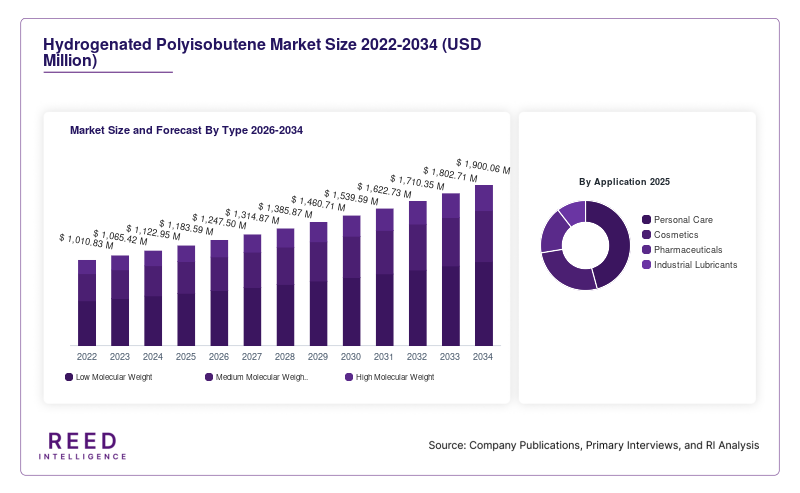
The Hydrogenated Polyisobutene market is segmented by Type and Application to provide a comprehensive market perspective. By Type, the Low Molecular Weight segment dominates with a 45% market share, driven by its high demand in lightweight skincare and cosmetic formulations. The Application segment is led by Personal Care, which accounts for 45% of the market, followed by Cosmetics at 30%, Pharmaceuticals at 15%, and Industrial Lubricants at 10%.
By Type
Low Molecular Weight Hydrogenated Polyisobutene represents the largest segment in the Hydrogenated Polyisobutene market, commanding a 45% share, with revenue exceeding USD 561 million in 2025. These are characterized by their low viscosity and high spreadability, making them ideal for lightweight serums, sunscreens, and facial moisturizers. Technical specifications include a molecular weight range of 300-600 g/mol, a viscosity of 10-50 cSt at 100°C, and a high purity level exceeding 99%. The Hydrogenated Polyisobutene market's Low Molecular Weight segment is driven by its use in premium skincare and its excellent compatibility with other active ingredients.
Medium Molecular Weight Hydrogenated Polyisobutene captures a 35% share of the Hydrogenated Polyisobutene market, with revenue of USD 437 million in 2025. These are characterized by their balanced viscosity and sensory profile, suitable for a wide range of applications including body lotions, hair conditioners, and color cosmetics. Technical specifications include a molecular weight range of 600-1500 g/mol, a viscosity of 50-300 cSt, and a low pour point, ensuring good low-temperature performance. The Hydrogenated Polyisobutene market's Medium segment is driven by its versatility and cost-effectiveness.
High Molecular Weight Hydrogenated Polyisobutene represent the remaining 20% of the Hydrogenated Polyisobutene market, with revenue of USD 249 million in 2025. These are characterized by their high viscosity and thickening properties, used in heavy-duty creams, ointments, and industrial lubricants. Technical specifications include a molecular weight exceeding 1500 g/mol, a viscosity above 300 cSt, and excellent oxidative stability. The Hydrogenated Polyisobutene market's High segment is driven by its use in specialized pharmaceutical and industrial applications.
By Application
Personal Care dominates the Hydrogenated Polyisobutene market, accounting for 45% of sales, representing USD 561 million in 2025. This segment includes use in skincare (moisturizers, sunscreens, anti-aging products), hair care (conditioners, styling aids), and oral care products. Usage penetration exceeds 60% in premium skincare lines. The Hydrogenated Polyisobutene market's Personal Care segment is characterized by its focus on skin safety, sensory attributes, and formulation stability. The ingredient's non-comedogenic and hypoallergenic properties drive its extensive use in facial care products.
Cosmetics accounts for 30% of the Hydrogenated Polyisobutene market, with revenue of USD 374 million in 2025. This segment encompasses use in color cosmetics such as foundations, lipsticks, eyeliners, and mascaras, where it functions as a binder, film-former, and texture enhancer. The segment is growing at a strong CAGR, driven by the increasing demand for long-wearing and transfer-resistant makeup. The Hydrogenated Polyisobutene market's Cosmetics segment is characterized by its focus on pigment dispersion and smooth application.
Pharmaceuticals represents 15% of the market, with revenue of USD 187 million in 2025, involving use in topical ointments, creams, and drug delivery systems where it acts as a base and release modifier. The segment's growth is fueled by the development of advanced transdermal patches and wound care products. The Hydrogenated Polyisobutene market's Pharmaceutical segment is characterized by its focus on high purity, biocompatibility, and regulatory compliance.
Industrial Lubricants account for the remaining 10% of the market, with revenue of USD 125 million in 2025, used in high-performance greases, metalworking fluids, and hydraulic oils due to its excellent viscosity index and thermal stability. The Hydrogenated Polyisobutene market's Industrial segment is characterized by its focus on durability and resistance to degradation.
Hydrogenated Polyisobutene Market Regional Outlook
Asia-Pacific Hydrogenated Polyisobutene Market
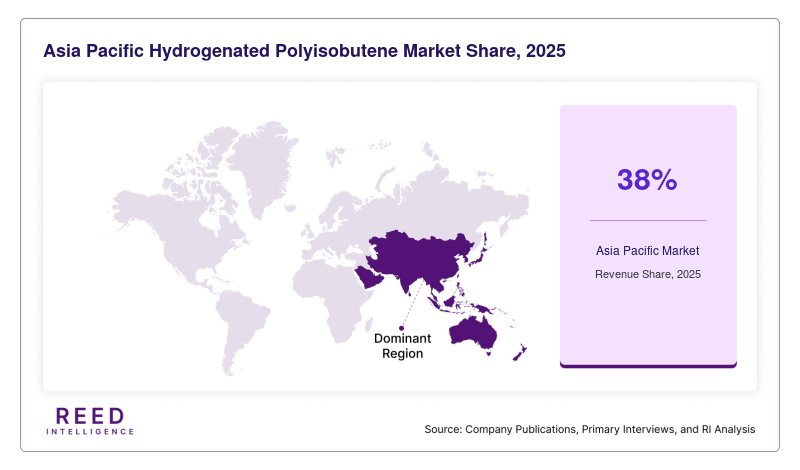
Leads the Hydrogenated Polyisobutene market, commanding a 38% share, with a revenue of USD 474 million in 2025. China is the primary driver, accounting for 60% of regional demand, followed by Japan and South Korea, driven by the massive personal care manufacturing base, high consumer spending, and robust export-oriented chemical industry. The Asia-Pacific Hydrogenated Polyisobutene market is characterized by its focus on large-scale production and cost-competitive pricing.
North America Hydrogenated Polyisobutene Market
Represents the second-largest market, capturing a 28% share with a revenue of USD 349 million in 2025. The United States is the primary driver, accounting for 85% of regional demand, driven by the well-established cosmetics and pharmaceutical industries, strong innovation in high-performance ingredients, and high consumer awareness. The Hydrogenated Polyisobutene market in North America is characterized by its focus on premium products and regulatory adherence.
Europe Hydrogenated Polyisobutene Market
Accounts for 22% of the global Hydrogenated Polyisobutene market, with a revenue of USD 274 million in 2025. Germany, France, and the UK are the primary drivers, together accounting for 55% of regional demand, driven by the strong luxury cosmetics sector, strict regulatory framework, and growing demand for sustainable ingredients. The Europe Hydrogenated Polyisobutene market is projected to grow at a steady CAGR of 4.8% through 2034.
Middle East & Africa and Latin America Hydrogenated Polyisobutene Market
Together account for the remaining 12% of the Hydrogenated Polyisobutene market, with the UAE and Brazil leading their respective regions. Both regions are projected to grow at CAGRs exceeding 6%, driven by developing personal care industries and increasing foreign investment in chemical manufacturing.
Top players in Hydrogenated Polyisobutene Market
- BASF SE
- INEOS Group
- ExxonMobil Corporation
- Chevron Phillips Chemical
- Idemitsu Kosan Co., Ltd.
- Nippon Oil & Fats Co., Ltd.
- Kraton Corporation
- Henkel AG & Co. KGaA
- Lubrizol Corporation
- Croda International Plc
- Evonik Industries AG
- DIC Corporation
- Sanyo Chemical Industries, Ltd.
- Mitsui Chemicals, Inc.
- Kuraray Co., Ltd.
BASF SE
BASF SE holds a dominant position in the Hydrogenated Polyisobutene market, with an estimated 18% global market share, particularly strong in the European and North American cosmetics, personal care, and pharmaceutical segments. The company's portfolio, marketed under the brand name Luvitol® and other specialty product lines, is widely recognized for its high purity, consistent quality, and superior performance. BASF's market leadership is reinforced by its significant investment in research and development, its strong backward integration in raw materials, and its extensive global production network. BASF commands over 20% of the European market and 15% of the North American market for Hydrogenated Polyisobutene, positioning it as a key player in the global market. The company's commitment to sustainability and development of bio-based alternatives further strengthens its competitive edge.
INEOS Group
INEOS Group is a leading player in the Hydrogenated Polyisobutene market, commanding approximately 14% of the global market share through its comprehensive portfolio of petrochemicals and specialty ingredients. The company's expertise in chemical synthesis, large-scale manufacturing, and supply chain management have solidified its position in the cosmetics and industrial sectors. INEOS's Hydrogenated Polyisobutene is known for its cost-effectiveness, reliability, and wide applicability. The company's commitment to operational excellence and its strong presence in the Asia-Pacific market have enhanced its competitive advantage, making it a preferred supplier for mass-market personal care and industrial lubricant producers.
ExxonMobil Corporation holds a significant 10% market share, with particular strength in the industrial lubricants and mass cosmetics segments globally. Chevron Phillips Chemical is a major player in the North American and Asian markets, holding an 8% share, known for its high-performance grades.
Recent Developments in Hydrogenated Polyisobutene Market
- 2025: BASF SE launched a new range of bio-balanced Hydrogenated Polyisobutene grades, incorporating renewable feedstocks to reduce the carbon footprint by up to 50%, targeting the growing demand for sustainable cosmetic ingredients.
- 2025: INEOS Group announced a significant capacity expansion for its Hydrogenated Polyisobutene production at its Texas facility, increasing output by 25% to meet rising demand from the global personal care market.
Hydrogenated Polyisobutene Market Segments
By Type
- Low Molecular Weight
- Medium Molecular Weight
- High Molecular Weight
By Application
- Personal Care
- Cosmetics
- Pharmaceuticals
- Industrial Lubricants
By Region
- North America
- Europe
- APAC
- Middle East and Africa
- LATAM