Hydroiodic Acid Market Size, Share & Demand Report By Grade (Industrial Grade, Pharmaceutical Grade, Laboratory Grade), By Application (Pharmaceuticals, Electronics, Chemical Synthesis, Others), By End-Use Industry (Chemical Manufacturing, Pharmaceuticals, Electronics & Semiconductor, Others), By Region & Segment Forecasts, 2026–2034
USD 3950
Market Overview
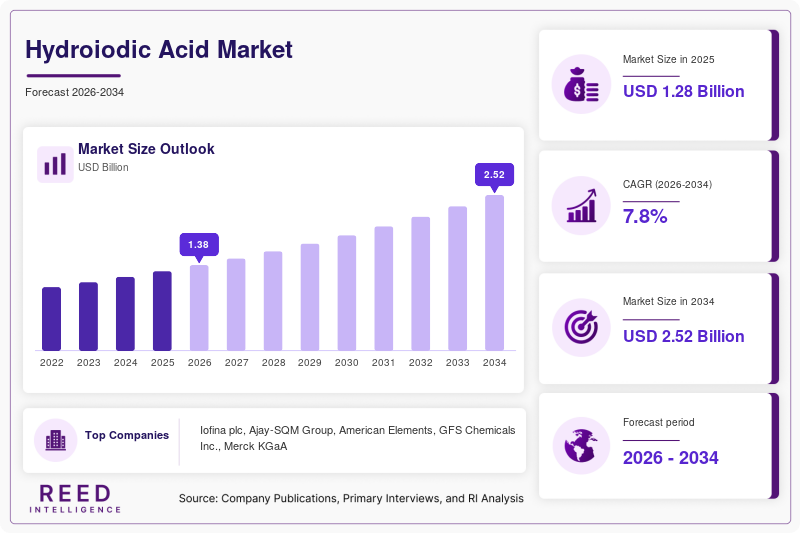
The Hydroiodic Acid Market size was valued at approximately USD 1.28 billion in 2026 and is projected to reach USD 2.34 billion by 2034, expanding at a CAGR of 7.8% during the forecast period. The market reflects steady growth driven by its critical role in organic synthesis, pharmaceuticals, and chemical manufacturing processes. Hydroiodic acid is widely used as a reducing agent and catalyst, particularly in the production of iodine-based compounds and active pharmaceutical ingredients. Its importance in industrial chemistry continues to sustain demand across both developed and emerging economies.
A key global factor supporting market growth is the increasing demand for specialty chemicals in pharmaceutical manufacturing. As drug development pipelines expand globally, hydroiodic acid finds consistent application in synthesis reactions, especially in the production of iodinated intermediates. Additionally, growth in agrochemicals and electronics manufacturing has strengthened the demand outlook, as hydroiodic acid is used in etching processes and chemical formulations.
Key Highlights
- North America dominated the market with a 35.1% share in 2025.
- Asia Pacific is expected to grow at the fastest CAGR of 9.2% during 2026–2034.
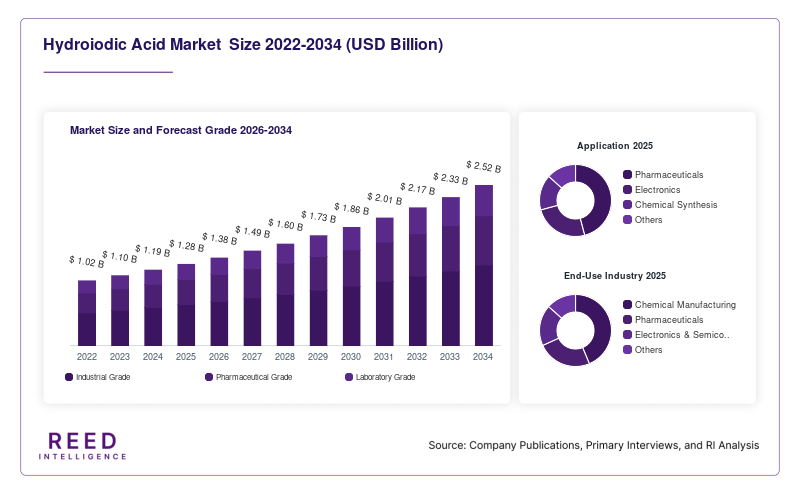
- By grade, industrial grade accounted for the largest share of 42.6%, while pharmaceutical grade is projected to grow at a CAGR of 9.8%.
- By application, pharmaceuticals led with a 39.8% share, whereas electronics is expected to expand at a CAGR of 8.9%.
- The United States remained the dominant country, with market values of USD 420 million in 2024 and USD 455 million in 2025.
Market Trends
Increasing utilization in pharmaceutical synthesis
The growing demand for hydroiodic acid in pharmaceutical synthesis represents a prominent trend shaping the market. The compound is widely used in the preparation of active pharmaceutical ingredients, particularly in reactions requiring strong reducing agents. With the expansion of global healthcare infrastructure and increased investment in drug discovery, pharmaceutical manufacturers are intensifying their use of hydroiodic acid in various chemical processes. This trend is further supported by the rise in generic drug production, which requires cost-effective and efficient chemical reagents. Additionally, stringent regulatory standards for purity have encouraged manufacturers to develop high-grade hydroiodic acid formulations, thereby contributing to market growth.
Expansion of electronics and semiconductor manufacturing
Another significant trend influencing the Hydroiodic Acid Market is the expansion of the electronics and semiconductor industries. Hydroiodic acid is used in etching and cleaning processes during semiconductor fabrication, making it essential in the production of integrated circuits and advanced electronic components. As global demand for consumer electronics, electric vehicles, and smart devices increases, semiconductor production is witnessing steady growth. This has directly increased the consumption of specialty chemicals, including hydroiodic acid. Furthermore, the shift toward miniaturization and high-performance electronics requires precision-grade chemicals, thereby boosting demand for high-purity hydroiodic acid products.
Market Drivers
Growth of the pharmaceutical industry
The expanding pharmaceutical sector is a primary driver for the Hydroiodic Acid Market. Hydroiodic acid is widely used in organic synthesis for drug development, particularly in the creation of iodine-containing compounds. With increasing global healthcare needs, aging populations, and rising prevalence of chronic diseases, pharmaceutical companies are scaling up production capacities. This has led to higher consumption of essential chemical intermediates, including hydroiodic acid. Moreover, the growth of contract manufacturing organizations and the rise in research and development activities are further strengthening the demand for chemical reagents. As pharmaceutical production becomes more complex, the reliance on efficient and high-quality chemicals continues to grow.
Rising demand for specialty chemicals
The increasing demand for specialty chemicals across multiple industries is another key driver. Hydroiodic acid plays a crucial role in chemical synthesis, catalysis, and reduction reactions. Industries such as agrochemicals, polymers, and electronics rely heavily on specialty chemicals to enhance product performance and efficiency. As industrial processes become more sophisticated, the need for high-performance chemical inputs is rising. This has led to increased adoption of hydroiodic acid in niche applications. Additionally, advancements in chemical engineering and production technologies have made it easier to produce and utilize hydroiodic acid in large-scale industrial settings, further driving market growth.
Market Restraint
Regulatory and safety concerns associated with handling
One of the major restraints in the Hydroiodic Acid Market is the stringent regulatory framework and safety concerns associated with its handling and storage. Hydroiodic acid is highly corrosive and requires specialized equipment and safety protocols for transportation and usage. Regulatory authorities across regions have imposed strict guidelines regarding its production, distribution, and disposal, which can increase operational costs for manufacturers. Additionally, improper handling can pose health risks to workers and environmental hazards, leading to compliance challenges. For example, chemical manufacturing plants must invest heavily in safety infrastructure and employee training to mitigate risks. These additional requirements can limit market expansion, particularly for small and medium-sized enterprises with limited resources.
Market Opportunities
Increasing demand in emerging economies
Emerging economies present substantial opportunities for the Hydroiodic Acid Market due to rapid industrialization and expanding manufacturing sectors. Countries in Asia Pacific and Latin America are witnessing growth in pharmaceuticals, agrochemicals, and electronics industries. As these regions continue to develop their industrial infrastructure, the demand for chemical intermediates such as hydroiodic acid is expected to rise. Additionally, favorable government policies supporting domestic manufacturing and foreign investment are encouraging market players to expand their presence. The availability of cost-effective labor and raw materials further enhances production capabilities, making emerging markets attractive for growth.
Development of high-purity chemical applications
The development of high-purity applications in industries such as electronics and biotechnology offers another growth avenue. Hydroiodic acid with high purity levels is increasingly required for precision manufacturing processes, particularly in semiconductor fabrication and advanced research applications. As technology evolves, industries are demanding chemicals with minimal impurities to ensure product quality and performance. This has led to increased investment in research and development for producing ultra-pure hydroiodic acid. Manufacturers focusing on innovation and quality enhancement are likely to gain a competitive advantage, thereby unlocking new revenue streams in specialized applications.
Segmental Analysis
By Grade
Industrial grade hydroiodic acid dominated the market, accounting for approximately 42.6% of the share in 2024. This segment is widely used in chemical manufacturing, including synthesis reactions and industrial processes. Its cost-effectiveness and availability make it suitable for large-scale applications. Industries such as agrochemicals and polymers rely heavily on industrial-grade hydroiodic acid for various chemical formulations. The segment's dominance is further supported by the growing demand for bulk chemicals in developing regions, where industrial expansion continues at a steady pace.
Pharmaceutical grade hydroiodic acid is expected to be the fastest-growing segment, with a CAGR of 9.8%. This growth is driven by increasing demand for high-purity chemicals in drug manufacturing. Strict regulatory standards for pharmaceutical products have necessitated the use of high-quality reagents, boosting the demand for pharmaceutical-grade hydroiodic acid. Additionally, advancements in drug development and biotechnology are contributing to the segment's rapid growth.
By Application
The pharmaceuticals segment held the largest share of 39.8% in 2024, driven by extensive use of hydroiodic acid in drug synthesis. The compound plays a critical role in producing iodine-based intermediates and active pharmaceutical ingredients. Increasing global healthcare needs and rising investment in pharmaceutical research have significantly contributed to the segment's dominance.
The electronics segment is projected to grow at the fastest CAGR of 8.9%. This growth is attributed to increasing demand for semiconductors and electronic components. Hydroiodic acid is used in etching and cleaning processes, which are essential for manufacturing integrated circuits. The rapid expansion of the electronics industry is expected to drive demand in this segment.
By End-Use Industry
The chemical manufacturing industry accounted for the largest share of 44.2% in 2024. Hydroiodic acid is widely used as a reducing agent and catalyst in various chemical processes. The industry's growth is driven by increasing demand for specialty chemicals and expanding industrial applications.
The electronics and semiconductor industry is expected to grow at the fastest CAGR of 9.1%. The increasing demand for advanced electronic devices and miniaturized components is driving the need for high-purity chemicals. Hydroiodic acid plays a crucial role in semiconductor fabrication, making it essential for this rapidly growing industry.
Regional Analysis
North America
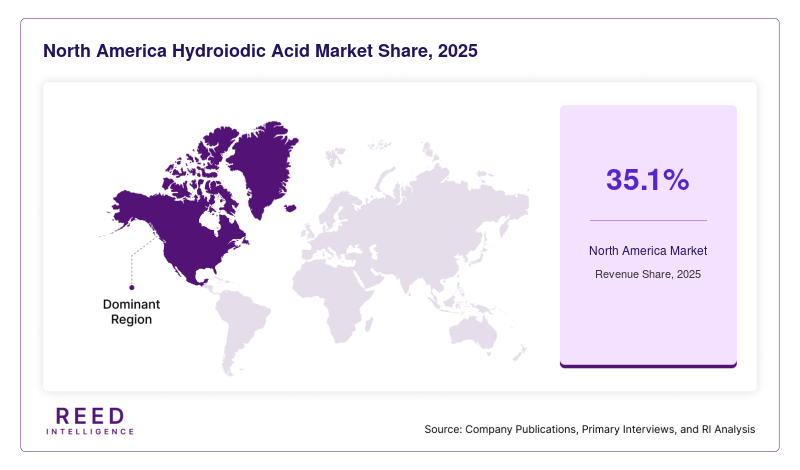
North America held a significant share of the Hydroiodic Acid Market, accounting for approximately 35.1% in 2025, and is expected to grow at a CAGR of 6.9% during the forecast period. The region benefits from a well-established chemical manufacturing sector and strong demand from pharmaceutical and electronics industries. Continuous advancements in research and development activities further support market growth.
The United States dominates the regional market, driven by its robust pharmaceutical industry and advanced manufacturing capabilities. A key growth factor is the increasing investment in drug development and biotechnology research, which has led to higher demand for hydroiodic acid as a chemical reagent.
Europe
Europe accounted for around 27.4% of the market share in 2025 and is projected to grow at a CAGR of 6.5%. The region's focus on sustainable chemical production and stringent quality standards has influenced the adoption of high-purity hydroiodic acid. Strong regulatory frameworks ensure consistent demand across industries.
Germany leads the European market due to its advanced chemical industry and strong industrial base. A unique growth factor is the emphasis on green chemistry practices, which has encouraged the use of efficient and recyclable chemical processes involving hydroiodic acid.
Asia Pacific
Asia Pacific is expected to witness the fastest growth, with a CAGR of 9.2% during the forecast period, and held a 24.6% share in 2025. Rapid industrialization and expanding manufacturing sectors are key contributors to regional growth. Increasing demand for electronics and pharmaceuticals is driving consumption.
China dominates the Asia Pacific market due to its large-scale chemical production and export capabilities. A key growth factor is the rapid expansion of the semiconductor industry, which requires hydroiodic acid for etching and cleaning processes.
Middle East & Africa
The Middle East & Africa region accounted for approximately 6.3% of the market share in 2025 and is projected to grow at a CAGR of 5.8%. Growth is supported by increasing investments in chemical manufacturing and industrial diversification initiatives.
Saudi Arabia leads the regional market, driven by its expanding petrochemical sector. A unique growth factor is the government's focus on reducing dependency on oil by promoting chemical and manufacturing industries, thereby boosting demand for hydroiodic acid.
Latin America
Latin America held around 6.6% of the market share in 2025 and is expected to grow at a CAGR of 6.2%. The region is experiencing growth in pharmaceuticals and agrochemicals, which is driving demand for chemical intermediates.
Brazil is the dominant country in the region, supported by its growing agricultural sector. A key growth factor is the increasing use of agrochemicals, where hydroiodic acid is utilized in the synthesis of crop protection products.
Competitive Landscape
The Hydroiodic Acid Market is moderately fragmented, with several key players competing based on product quality, pricing, and technological capabilities. Leading companies are focusing on expanding production capacities and improving product purity to meet industry requirements. Strategic partnerships and investments in research and development are common approaches to gaining a competitive edge.
Iofina plc is recognized as a leading player in the market, known for its strong iodine production capabilities. The company has recently expanded its production facilities to increase hydroiodic acid output. Other major players are also investing in advanced manufacturing technologies to enhance efficiency and reduce costs. The competitive environment is characterized by continuous innovation and a focus on meeting the evolving needs of end-use industries.
Key Players
- Iofina plc
- Ajay-SQM Group
- American Elements
- GFS Chemicals Inc.
- Merck KGaA
- Thermo Fisher Scientific Inc.
- Tokyo Chemical Industry Co., Ltd.
- Alfa Aesar
- Deepwater Chemicals Inc.
- Noah Technologies Corporation
- Spectrum Chemical Manufacturing Corp.
- Central Drug House
- Loba Chemie Pvt. Ltd.
- Parchem Fine & Specialty Chemicals
- Finetech Industry Limited
Recent Developments
- Iofina plc expanded its iodine extraction facility to enhance hydroiodic acid production capacity in 2025.
- Merck KGaA introduced a high-purity hydroiodic acid product line aimed at semiconductor applications in 2024.
- Thermo Fisher Scientific announced an investment in specialty chemical production to support pharmaceutical-grade hydroiodic acid demand in 2025.
Hydroiodic Acid Market Segments
Grade
- Industrial Grade
- Pharmaceutical Grade
- Laboratory Grade
Application
- Pharmaceuticals
- Electronics
- Chemical Synthesis
- Others
End-Use Industry
- Chemical Manufacturing
- Pharmaceuticals
- Electronics & Semiconductor
- Others
By Region
- North America
- Europe
- APAC
- Middle East and Africa
- LATAM